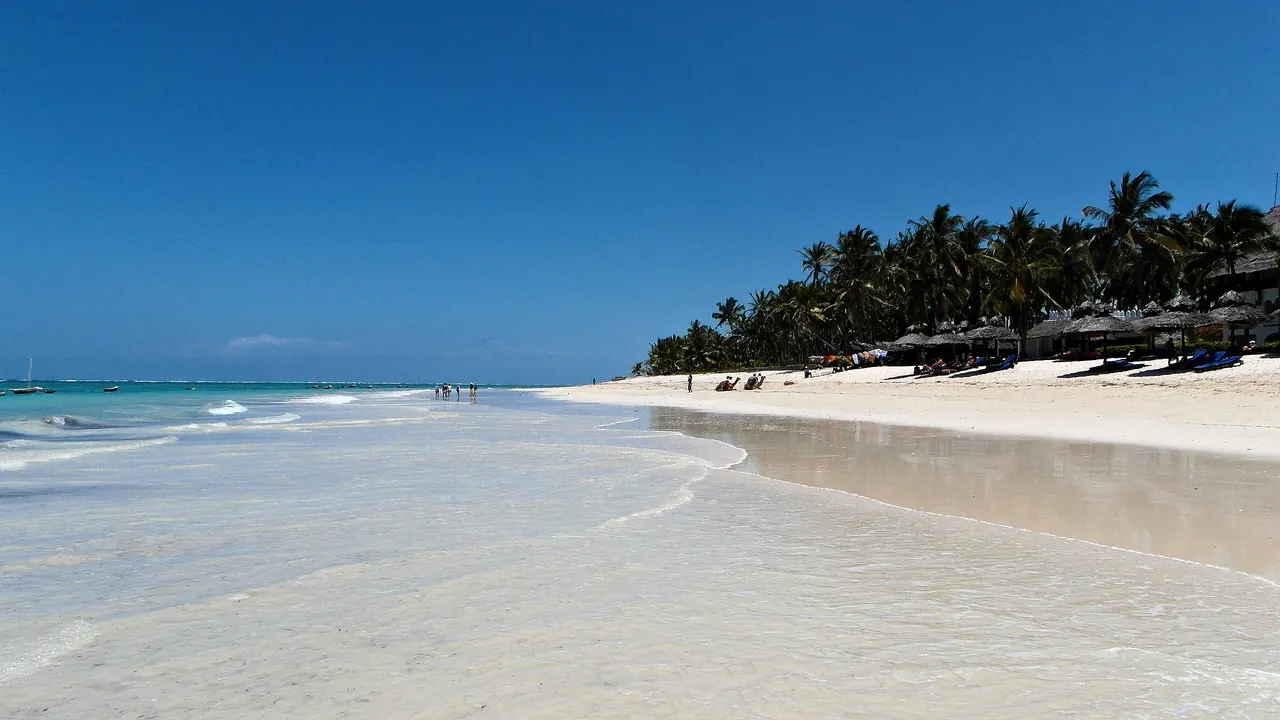
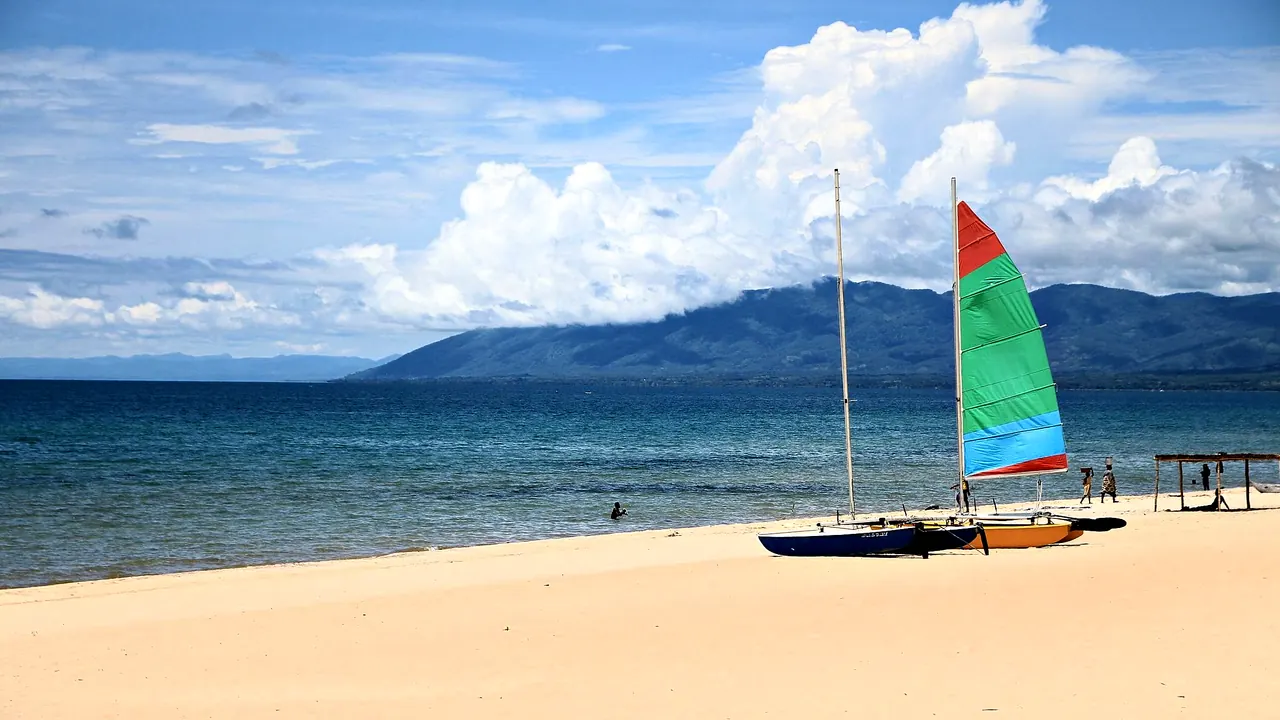
Photos: Diani by Roma Neus, CC BY 3.0, cropped; Lake Malawi by Ros NL, Pexels License.
Diani or Lake Malawi?
Our verdict in twelve categories, each scored against the same fixed benchmark cities, and the climate month by month, so you can choose for your trip.
Choose Diani for
- families
- beaches
- nightlife
Diani suits a beach vacation in the full sense: one long strand of white coral sand, a warm reef lagoon, resort hotels with pools and enough beach bars to fill the evenings. It is the easier trip of the two, with a short hop from Nairobi to the Ukunda airstrip, tuk-tuks for every errand and Mombasa's old town within a day's reach. Families, couples who want comfort, and anyone who wants some company after dark will be happier here.
Choose Lake Malawi for
- nature and the outdoors
- prices
- culture and sights
Lake Malawi asks more of the traveller and gives back something rarer. It is fresh water instead of sea, with fish in colours found nowhere else to snorkel among straight off the rocks, kayaks to the islands and the escarpment trails above the north shore. The distances are long and the comforts simple, so it rewards independent travellers with time to spare, people on a modest budget and anyone happy to end the day by a bonfire soon after dinner.
Scoreboard
Twelve categories on one fixed scale from 0 to 100. The shaded stretch is the gap between the two.
Your match
Pick a travel style or drag the sliders, and both match scores follow your weighting.
Wins on families and beaches with your weighting.
Wins on nature and the outdoors and prices with your weighting.
What matters to you?
Category by category
What the scores mean for a trip.
Beaches & swimming
Diani has the stronger beach: one continuous stretch of white coral sand running about 17km from Tiwi to Galu and Kinondo, with a reef that keeps the salt-water lagoon calm. The catch is the tide, which pulls far out across seagrass and rock pools, so you swim at high tide and walk the reef flats at low. Seaweed in the southern monsoon and the vendors on the central stretch are the other irritations.
Lake Malawi gives fresh, clear water with no tides or salt, and lodges set right on golden sand at Cape Maclear, Nkhata Bay, Chintheche and Likoma. It is lovely for a swim, but it carries risks the sea does not: bilharzia in reedy shallows near villages, and hippos and crocodiles near river mouths in the south.
Food & drink
Neither is a food destination, but Diani eats better. Its seafood comes cooked with coconut, tamarind and Swahili coast spices, small local places serve pilau and biryani, and mishkaki skewers are grilled at roadside stalls in the evening. A long-settled European community has added plenty of Italian cooking, and Mombasa's old town is close enough for a serious Swahili meal.
On Lake Malawi nearly every meal comes from the lodge kitchen. The local plate is chambo or tiny dried usipa with nsima, and beyond that there is roasted maize, mandazi and cold lager. It is honest food, but there is very little choice.
Culture & sights
Both are thin on sights, and both are places people visit for the water. What differs is the kind of heritage. Diani's is Swahili and Mijikenda: the old coral-stone Kongo Mosque among baobabs at Tiwi, and the sacred forest of Kaya Kinondo, walked with local guides.
The lake's heritage is missionary and colonial. There is the outsized brick and granite St Peter's Cathedral on Likoma, the stone church and small museum at Livingstonia, and the clock tower and lake museum at Mangochi.
Nightlife
Diani is the place for a night out, modest as it is. Beach bars and open-air clubs on the central strip play reggae, Afrobeats and house past midnight, and they fill up at weekends and over Christmas and New Year, when Kenyans come down from Nairobi and Mombasa.
Lake Malawi's evenings are a lodge bar and a fire on the sand. Nkhata Bay and Cape Maclear have backpacker bars with pool tables and the odd beach party, and almost everywhere else is quiet soon after dinner.
Nature & outdoors
Lake Malawi has the wider outdoors. Underwater it has hundreds of endemic cichlid species, and the national park around Cape Maclear lets you snorkel off the rocks or learn to dive in calm fresh water. On land and water there is kayaking to the islands, the trails and falls below Livingstonia with views over the north basin, and boat safaris on the Shire River at Liwonde.
Diani's nature is the sea and its larger animals: dolphins at Kisite-Mpunguti, humpback whales offshore from about July to October, and steady winds for kitesurfing. Colobus monkeys live in the roadside forest and the Shimba Hills give a short taste of elephants, but the coast is flat and there is little walking.
Day trips
Diani has the better day out, and it is one the lake cannot match: Mombasa, an hour or more north depending on traffic and the Likoni ferry, with Fort Jesus, the carved doors of the old town and the spice market. To the south, the dhow run from Shimoni to Wasini island and the slave-trade caves make a second good day away from the beach.
At the lake, what you can reach depends on where you are staying. From the southern lakeshore, Zomba and its colonial buildings are about two hours away. Senga Bay is the base for a day in Lilongwe's markets. In the north there is the trading town of Mzuzu, or the half-day climb up the escarpment to the Livingstonia mission. Likoma is out of reach for a day, because the ferries and flights make it a trip of several days.
Good for families
Diani is the easier place to take children. Large hotels with pools, the lagoon at high tide and rock pools at low tide keep young ones busy, while dolphin trips and the Shimba Hills interest older ones. Malaria, strong sun and sea urchins on the reef flats need planning.
Lake Malawi suits only families used to independent travel in Africa. Calm water and friendly lodges help, but bilharzia, long bumpy transfers and basic medical care weigh heavily, and there is nothing for children beyond the water and the sand.
Getting around
Diani is compact by comparison. Everything sits along one beach road served by tuk-tuks, motorbike taxis and matatus, the sand makes a fine walkway at low tide, and the Ukunda airstrip links straight to Nairobi. The slow part is reaching Mombasa via the Likoni ferry.
Lake Malawi is spread over hundreds of kilometres of slow shore road, with rough tracks down to places like Cape Maclear. Moving between bases means lodge transfers, a car with a driver, packed minibuses or the infrequent steamer and Likoma flights, so most visitors pick one or two bases and stay put.
Shopping & style
Neither is for serious shopping, though Diani has a little more. There are small shopping centres on the beach road and a good range of Kenyan crafts, including kikoi and kanga cloths, kiondo baskets and Kisii soapstone, with Mombasa's market a day away.
At the lake it comes down to roadside carvers selling bao boards and chief's chairs, and village markets where chitenje cloth is the best buy.
Affordability
Lake Malawi is the cheaper trip, and the budget route there takes little effort: campsites, simple lodges, local meals and minibuses cost very little. Costs climb with private transfers, diving, park entry and the luxury island lodges.
Diani can be economical if you stay in a cottage or guesthouse back from the sand and eat locally. The beachfront resorts, though, are priced for international guests, especially over Christmas, and marine park fees and boat trips add up.
Live music & performing arts
There is no theatre or concert life at either, so this is not a reason to choose one over the other. Diani's version is hotel shows with acrobats and Mijikenda or Maasai dance, plus the occasional band at a beach bar.
At the lake it is drumming evenings arranged with nearby villages and Sunday choirs in church. The Chewa masked dances belong to ceremonies, not to visitors.
Wellness & relaxation
Neither has a bathing tradition, and both are good for slowing down, in slightly different ways. Diani has more treatments on offer, with resort spas, massage huts on the beach and yoga lodges in the coastal forest. Galu, at the southern end, is the restful place to stay.
Lake Malawi is quieter still, with hammocks, early swims in still water and sunsets with nothing planned afterwards. Proper treatments are scarce beyond a few massage and yoga decks on Likoma and the Cape Maclear islands.
When should you go?
Pick your month. The climate figures are measured averages, not a forecast.
Diani in July
Lake Malawi in July
Daytime high, °C
Rainfall in the month, mm
Where the figures come from
Diani's temperatures are measured 32 km from the centre, at Mombasa.
Diani has no rain gauge within 25 km of the centre, so its rainfall comes from a gridded climate dataset read at the destination rather than from a gauge further away.
Lake Malawi has no weather station within reach, so its figures come from a gridded climate model rather than a measured record, and read a broad area rather than one spot.
Temperature and rainfall are climate normals, averaged over the years shown. Diani: 1991-2020 normals, Mombasa (31.7 km from centre). Lake Malawi: 2001-2020 normals, NASA POWER reanalysis grid, no weather station within 90 km.
Diani is hot all year, with daytime highs from about 28°C in July and August up to 33°C from January to March, and the sea is warm enough to swim in every month. The best stretch is December to March, which is dry and sunny. The long rains arrive in April and peak in May at about 310mm, and a shorter wet spell returns in October and November. The mid-year months are the coolest and most comfortable for walking about, although showers still come and go.
Lake Malawi runs on almost the opposite calendar. The rains fall from December to March, with January the wettest, and from April to October the shore is nearly dry. May to August is the mild season, with highs around 25°C and the lake at its coolest. September to November gets steadily hotter, reaching 33°C, and the water is at its warmest then. In short, Diani is at its best in the northern winter and Lake Malawi in the northern summer and early autumn.
Which traveller are you?
For a beach and sun trip, Diani is the clear pick. It has a single long beach of fine coral sand, a reef-calmed lagoon at sea temperature all year and beachfront hotels from end to end, while the lake's shore has bilharzia and hippos to think about.
On a family trip with children, Diani is the safer and simpler choice. Resort pools, rock pools at low tide, dolphin trips and the Shimba Hills fill the days, whereas the lake means long bumpy transfers, basic medical care and watching where children paddle.
On an outdoors trip, Lake Malawi has more to offer. You can snorkel and learn to dive among endemic cichlids, kayak to Thumbi and Mumbo islands, walk to the Manchewe Falls below Livingstonia and take boat safaris at Liwonde. Diani's outdoors is mostly the reef and the wind.
Before you go
| Measure | Diani | Lake Malawi |
|---|---|---|
| Official language | English, Swahili | English, Chewa, Tumbuka |
| Currency | Kenyan Shilling (KES) | Malawi Kwacha (MWK) |
| Sockets | G240 V, 50 Hz | G230 V, 50 Hz |
| Driving side | Left | Left |
| Time zone | UTC+3 | UTC+2 |
| Emergency number | Police 112/999, ambulance 112/999, fire 112/999 | Police 990/997, ambulance 998, fire 999 |
| Main airport | Moi International Airport (MBA)22 non-stop destinations | Kamuzu International Airport (LLW)9 non-stop destinations |
| Public holidays this year | 10 days | 11 days |
By the numbers
| Measure | Diani | Lake Malawi |
|---|---|---|
| Swim season, months above 21 °C | 12 months | - |
Where else could you go?
Every comparison below shares a destination with this one, so you can follow Diani or Lake Malawi somewhere new.
- Mombasavs Diani
- Lilongwevs Lake Malawi
- Zanzibarvs Diani
- Ngorongorovs Diani
- Masai Maravs Diani
- Zanzibarvs Lake Malawi