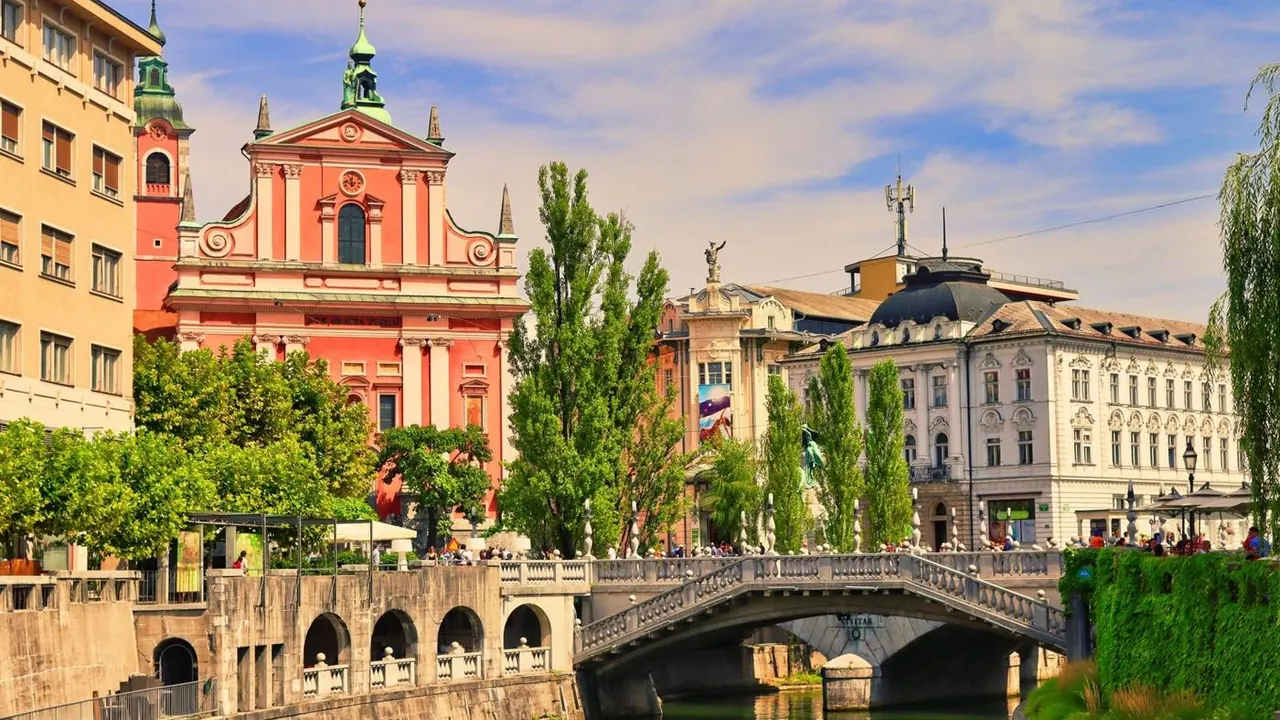
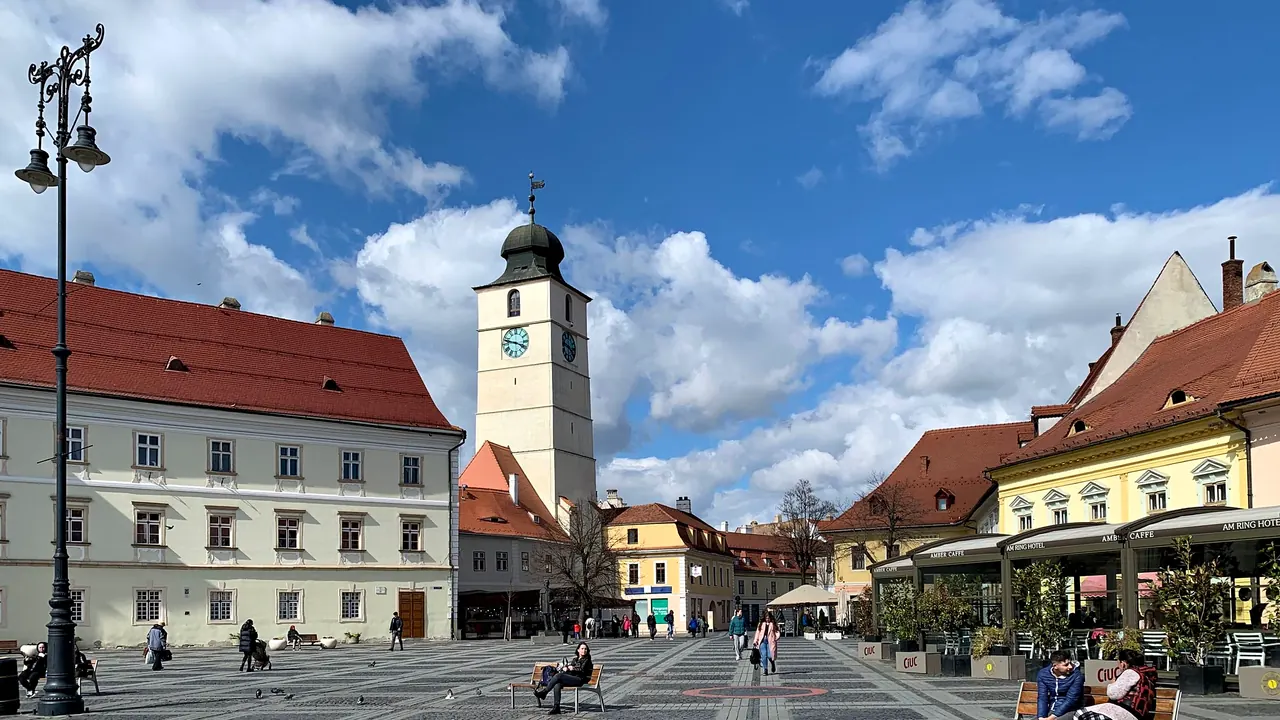
Photos: Ljubljana by detait, Pexels License; Sibiu by Chainwit., CC BY 4.0, cropped.
Ljubljana or Sibiu?
Our verdict in twelve categories, each scored against the same fixed benchmark cities, and the climate month by month, so you can choose for your trip.
Choose Ljubljana for
- getting around
- food and drink
- families
Ljubljana suits travellers who want a small, walkable capital with good wine, an evening scene along the river and much of Slovenia within easy reach, from the Julian Alps to the coast. It is the easier choice with young children or without a car, and eating and drinking go further here, though rooms cost noticeably more.
Choose Sibiu for
- prices
- culture and sights
Pick Sibiu if old streets and history matter more to you than dining or going out. Its Saxon squares, medieval walls and the ASTRA open-air museum give it the stronger sightseeing, the Carpathians are just as close as Ljubljana's Alps, and a stay costs a good deal less. Plan on a car or organised tours for the fortified churches and the mountains.
Scoreboard
Twelve categories on one fixed scale from 0 to 100. The shaded stretch is the gap between the two.
Your match
Pick a travel style or drag the sliders, and both match scores follow your weighting.
Wins on getting around and food and drink with your weighting.
Wins on prices and culture and sights with your weighting.
What matters to you?
Category by category
What the scores mean for a trip.
Beaches & swimming
Neither city is a beach destination, but Ljubljana has more water within reach. Lake Bled, about an hour away, is warm enough to swim in high summer, and the Adriatic at Piran and Izola makes a day trip, even if the shore there is concrete and pebble rather than sand.
Sibiu is far from any sea. Its one real swim is in the salt lakes at Ocna Sibiului, about 20km out, where the dense water lets you float. Otherwise it is outdoor pools or a mountain reservoir.
Food & drink
Ljubljana eats and drinks better, largely thanks to wine. Bottles from Vipava, Brda and the Styrian hills are poured by the glass along the river, the orange wines of the west are a speciality, and a few ambitious kitchens and the summer street-food gathering at the Central Market add range. Sibiu's strength is hearty Transylvanian cooking: sarmale with polenta, bean soup in bread, and sheep's cheese and smoked meat from the Marginimea villages, served in vaulted cellars around the squares.
Both run thin within a week, Sibiu sooner, since it has almost no street food and little beyond the traditional menu.
Culture & sights
Sibiu has the fuller sightseeing. The three linked squares of the Upper Town, the Gothic Lutheran Cathedral and Council Tower, long stretches of medieval wall with guild towers, the Brukenthal's European paintings and the ASTRA open-air museum in the Dumbrava forest add up to more worth seeing.
Ljubljana's appeal lies in the whole townscape rather than its sights: Plečnik's UNESCO-listed bridges, colonnades and library, a baroque and Secession old town and the castle on its hill. Its museums are sound rather than memorable, though the murals of Metelkova give it an alternative edge that Sibiu lacks.
Nightlife
Neither is a party city, but Ljubljana gives more to an evening. Bars and terraces line both banks of the Ljubljanica, and Metelkova's scruffy clubs in the old barracks run late at weekends, a scene known well beyond the city.
Sibiu's going out means cellar bars, pubs and craft beer around the squares and down into the Lower Town, busiest in term time. It suits a drink after dinner rather than a late night.
Nature & outdoors
Both have serious mountains on the doorstep, so the difference is in the kind of trip. From Ljubljana you reach the Julian Alps and Triglav National Park, the Vintgar gorge, rafting on the Soča and the Postojna and Škocjan caves, with Šmarna Gora and Tivoli's wooded hills right in town.
Sibiu looks onto the wilder Southern Carpathians: easy walks in the Cindrel range from Paltinis, the high Fagaras ridges with glacial lakes and multi-day traverses, the Transfagarasan climb to Balea Lake, and forests where brown bears live. Ljubljana's landscapes are more varied and easier to reach, while Sibiu's feel bigger and emptier and almost always need a car or a tour.
Day trips
Ljubljana's place at the centre of a small country gives it a little more range: Bled, Škofja Loka, Predjama Castle, the mining town of Idrija, the coast at Piran and the Brda wine villages, plus Trieste and Zagreb across the borders. Buses and trains reach the main ones.
Sibiu's excursions stick to one theme and cover it well: walled Sighisoara, the fortified Saxon churches at Biertan and Valea Viilor, Alba Iulia's star-shaped citadel, Corvin Castle and the painted gates of the shepherd villages. Trains in Transylvania are slow, so that list depends on a car or a tour.
Good for families
Ljubljana is the easier family base. Its flat, car-free centre is good for pushchairs, and the castle funicular, the Dragon Bridge, Tivoli's playgrounds, a hands-on science centre and the puppet theatre fill a couple of days.
Sibiu has one excellent outing in the ASTRA museum, with the zoo and playgrounds next door, and the Natural History Museum for a wet day, but less beyond that. The stairways down to the Lower Town are hard going with small children in tow.
Getting around
Both are walking cities, but Ljubljana is the smoother one. Everything sits within about 20 minutes on foot on level ground, with bike-share and electric shuttles in the centre, and intercity buses make car-free trips into the country realistic.
Sibiu's centre is compact too, but the steep lanes between the Upper and Lower Town take effort. Its airport is close in, yet beyond the city slow, infrequent trains leave you relying on a car or a tour.
Shopping & style
Neither is a shopping destination, and in both the best buys are local. Ljubljana's lean towards food and fine craft: pumpkin-seed oil, coastal salt and honey from the Central Market, Idrija lace, the Sunday antiques market on the embankment and a few design boutiques around Trubarjeva.
Sibiu's are folk crafts, with painted ceramics, embroidered blouses and icons on glass along Nicolae Balcescu Street, and its summer pottery fair and Christmas market are when it is at its best.
Affordability
Sibiu is clearly the cheaper stay. Guesthouses near the old town are affordable for most of the year, a meal with local wine costs little and taxis are cheap, with prices climbing only during the June theatre festival and the Christmas market.
Ljubljana sits in the European middle. Lunchtime set menus at the inns are good value and walking costs nothing, but central rooms in summer are priced like Western Europe's, and that is where a budget gets stretched.
Live music & performing arts
Ljubljana leans towards music: the Slovenian Philharmonic with roots going back to 1701, opera and ballet in the neo-Renaissance house, Cankarjev dom's year-round programme and summer concerts in Plečnik's Križanke courtyard. Sibiu leans towards theatre, with the well-regarded Radu Stanca National Theatre and, every June, one of the largest theatre festivals anywhere, which spills into churches and squares.
Outside those high points both offer a solid but limited choice. Most spoken theatre is in Slovene or Romanian, so a concert is the easier night out for visitors.
Wellness & relaxation
Neither city has much spa culture of its own. Both rely on quiet streets and long hours in cafés as their way of slowing down, Ljubljana along the river and Sibiu on its squares.
The bathing lies outside town. Ljubljana has several Slovenian thermal spa towns with mineral pools and saunas within about an hour's drive, plus a large water park with a sauna complex on its eastern edge. Sibiu has Ocna Sibiului, a spa resort since the 19th century, for floating in salt lakes and mud cures, and the clean mountain air of Paltinis.
When should you go?
Pick your month. The climate figures are measured averages, not a forecast.
Ljubljana in July
Sibiu in July
Daytime high, °C
Rainfall in the month, mm
Temperature and rainfall are climate normals, averaged over the years shown. Ljubljana: 1991-2020 (sunshine 1981-2010, rainfall 1981-2010) normals, Ljubljana / Bezigrad (1.9 km from centre). Sibiu: 1991-2020 normals, Sibiu (0 km from centre).
Through the year the two run almost in step: cold winters, and summers that peak at around 28°C in July and August, warm but rarely too hot for a day on foot. Rain is what sets them apart. Ljubljana is much the wetter, with a heavy June and then a long wet stretch from August to October that tops out at around 176mm in October. July is its driest and sunniest summer month. Sibiu gets well under half that through late summer and autumn, and its wettest spell falls in June and July.
That changes when each is at its best. May is pleasant in both, mild and fairly sunny. In Sibiu, September and early October are dry and comfortable for walking the old town or the hills. In Ljubljana, September is about as wet as August, so late spring is the safer bet for walking and hiking there. Winter is only a degree or two colder in Sibiu, with January highs near 2°C, and Sibiu sees a little more winter sun. For a swim at Bled or in the salt lakes at Ocna Sibiului, July and August are the months to go.
Which traveller are you?
On a trip on a tight budget, Sibiu goes noticeably further. Guesthouses near the old town, hearty meals with local wine, taxis and museum entry all cost little, while central Ljubljana in summer charges room rates closer to Western Europe's.
For a culture and arts trip, Sibiu has more to see: the three Saxon squares and their medieval walls, the Brukenthal's paintings and the large ASTRA open-air museum, with the June theatre festival as the high point. Ljubljana's Plečnik cityscape is charming but takes less time to see.
On a food and nightlife trip, Ljubljana is the better pick. Riverside wine bars pour Slovenian and orange wines, the market square holds a summer street-food gathering, and Metelkova's clubs run late at weekends. Sibiu's cellar bars make a pleasant evening, but its food choice is narrower.
Before you go
| Measure | Ljubljana | Sibiu |
|---|---|---|
| Official language | Slovene | Romanian |
| Currency | Euro (EUR) | Romanian Leu (RON) |
| Sockets | CF230 V, 50 Hz | CF230 V, 50 Hz |
| Driving side | Right | Right |
| Time zone | UTC+1, UTC+2 in summer | UTC+2, UTC+3 in summer |
| Emergency number | 112 | 112 |
| Elevation | 309 m | 415 m |
| Main airport | Ljubljana Jože Pučnik Airport (LJU)20 km from centre32 non-stop destinations | Sibiu International Airport (SBZ)5 km from centre11 non-stop destinations |
| Public holidays this year | 21 days | 17 days |
By the numbers
| Measure | Ljubljana | Sibiu |
|---|---|---|
| City population | 284,293 | 134,308 |
| People per km² | 1,736 | 1,110 |
| Museums within 10 km | 14 | 12 |
| UNESCO World Heritage sites within 50 km | 3 | 2 |
Where else could you go?
Every comparison below shares a destination with this one, so you can follow Ljubljana or Sibiu somewhere new.
- Bledvs Ljubljana
- Triestevs Ljubljana
- Brasovvs Sibiu
- Cluj-Napocavs Sibiu
- Zagrebvs Ljubljana
- Rovinjvs Ljubljana