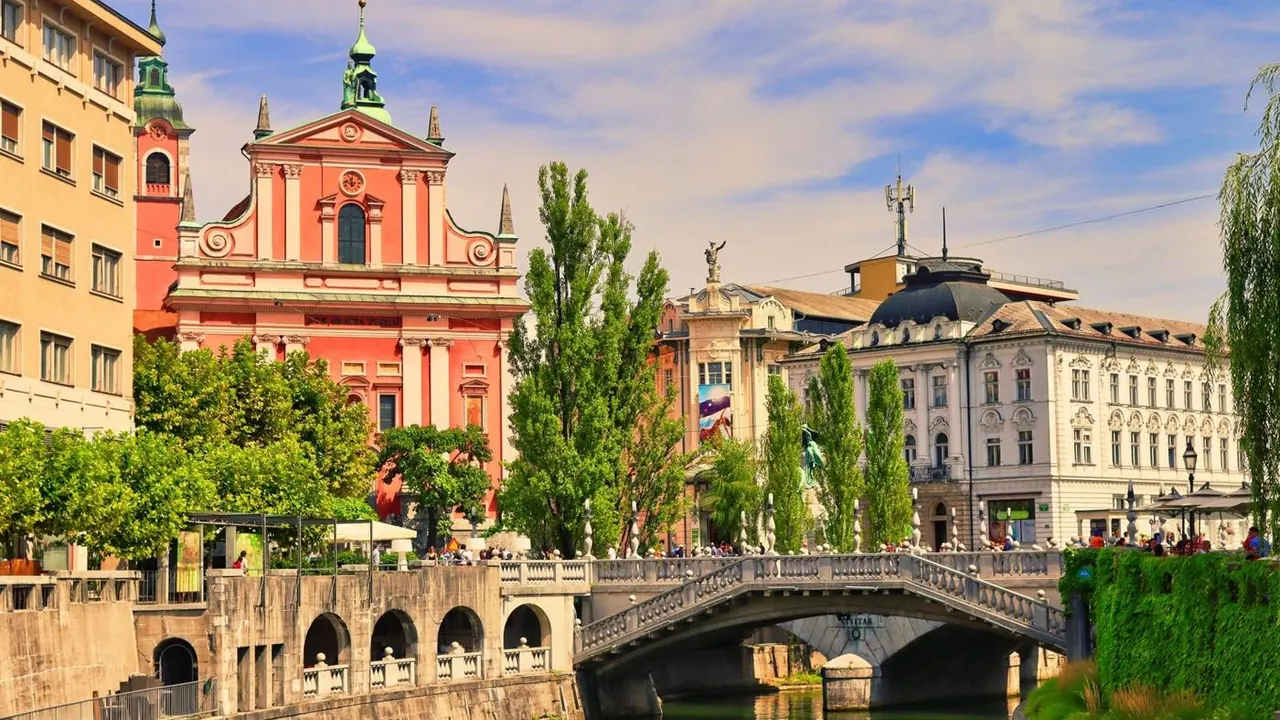
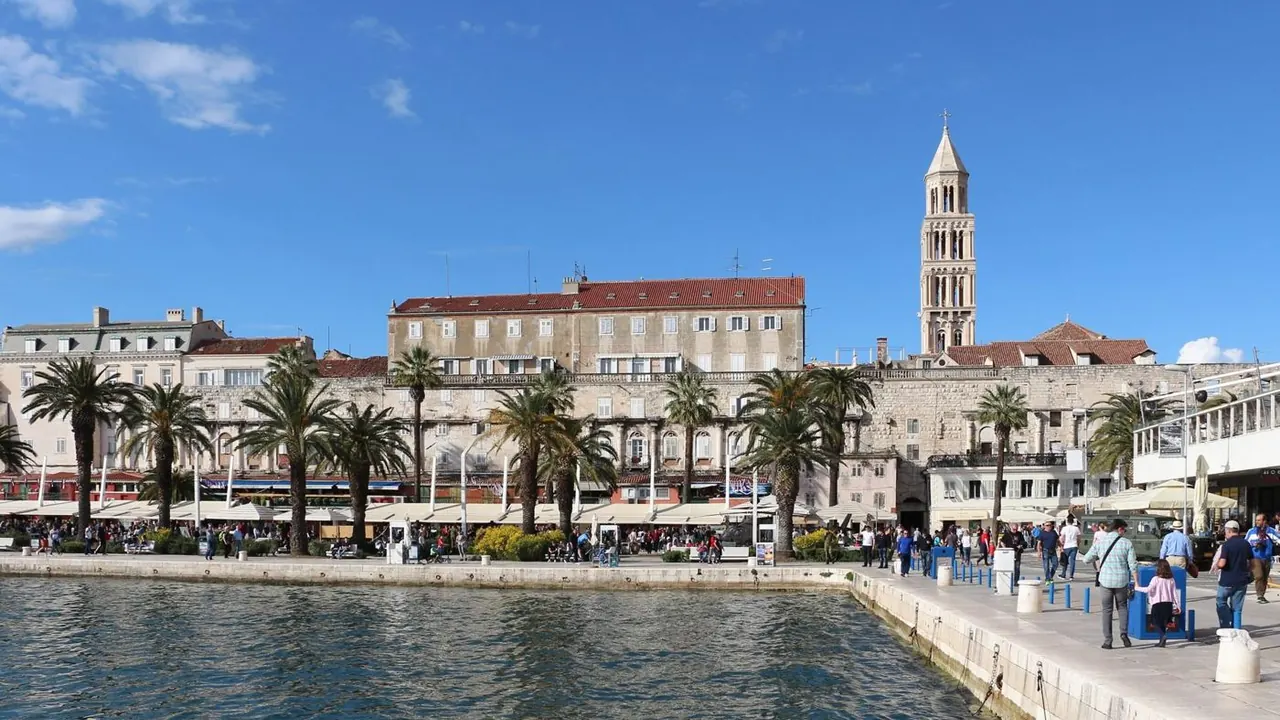
Photos: Ljubljana by detait, Pexels License; Split by Bernard Gagnon, CC BY-SA 4.0, cropped.
Ljubljana or Split?
Our verdict in twelve categories, each scored against the same fixed benchmark cities, and the climate month by month, so you can choose for your trip.
Choose Ljubljana for
- live music and the arts
- prices
- getting around
Ljubljana suits a calm, green city stay with the mountains close at hand. Its car-free centre is easy to walk, the concert and opera calendar runs all year, and costs are gentler. The Julian Alps, Bled and the caves of the karst are all an easy day out. Choose it for a spring or autumn trip built around walking, wine and scenery, when a beach doesn't matter.
Choose Split for
- beaches
- nightlife
- culture and sights
Split is the pick when the sea is the point. You can swim within a short walk of a Roman palace that people still live in, and ferries take you out to Hvar and Brač. In summer the evenings run late and the Dalmatian coast is right there. It suits a warm-weather trip that mixes swimming, island days and old stone streets, as long as you can take the heat and the summer crowds.
Scoreboard
Twelve categories on one fixed scale from 0 to 100. The shaded stretch is the gap between the two.
Your match
Pick a travel style or drag the sliders, and both match scores follow your weighting.
Wins on live music and the arts and prices with your weighting.
Wins on beaches and nightlife with your weighting.
What matters to you?
Category by category
What the scores mean for a trip.
Beaches & swimming
This is the clearest difference between the two. Ljubljana has no beach of its own, so swimming means the Sava on the northern edge of the city, a drive out to Lake Bled or the colder, clearer water of Bohinj. Slovenia's short coast at Piran is a day trip of about an hour and a half.
In Split you can walk from the palace to a swim. Bačvice is a shallow sandy bay, while Kašjuni and the coves around Marjan offer pine shade and deeper water. Brač, Šolta and Hvar are a ferry ride away. Most of the shore is pebble or concrete, and the city beaches fill up in high summer.
Food & drink
The two are about level for food, but they eat from different landscapes. Ljubljana's cooking is inland and Alpine: Carniolan sausage, štruklji and jota bean stew in gostilna inns, with cheeses and pumpkin-seed oil at the Central Market. Its real strength is wine, especially the orange wines of the west, poured by the glass along the river.
Split's cooking comes from the sea: grilled fish and squid, black risotto, pašticada and peka baked under an iron bell, with Plavac Mali or Pošip to drink. The best meals are in Varoš rather than inside the palace walls, and the scene gets much quieter in winter.
Culture & sights
Split has the stronger single sight. Diocletian's Palace is a Roman emperor's residence that people still live in, with the cathedral set in his mausoleum and the vaulted substructures still beneath. The Meštrović Gallery on Marjan adds a fine museum.
Ljubljana's appeal is the whole townscape rather than one monument. Plečnik's bridges, colonnades and library, the baroque old town and the castle on its hill make a pleasant whole, and Metelkova adds an alternative edge. Both can be seen in two or three days.
Nightlife
In summer, Split is livelier. Evenings start on the Riva, move into bars squeezed into the palace's stone alleys and stairways, and end at the clubs around Bačvice in the early hours. From October to May, though, it shrinks to a handful of bars.
Ljubljana is quieter and less tied to the seasons. Students keep it busy in term time, and the riverside terraces are made for an unhurried drink. Metelkova's scruffy clubs are the one place for a late weekend night.
Nature & outdoors
Both have superb outdoors on the doorstep, of very different kinds. From Ljubljana the draw is Alpine: Triglav National Park and the Vintgar gorge, rafting on the emerald Soča, the high pasture of Velika Planina, the Postojna and Škocjan caves, and skiing in winter.
Split pairs bare limestone ridges with sea and islands. Marjan's trails start at the edge of the old town, and Mosor and Biokovo offer longer hikes. There is rafting and canyoning on the Cetina at Omiš, the Krka waterfalls, and sea kayaking or sailing among the islands. Midsummer is too hot for serious hiking here.
Day trips
The two are equally good bases, but you travel differently from each. From Ljubljana, the middle of a small country, the trips are overland: Bled, Škofja Loka, Predjama Castle in its cliff, Idrija and the Brda wine villages, with Trieste or Zagreb about two hours away.
From Split, many of the best trips are by sea. Hvar, Brač and Vis are reached by ferry, and Trogir, Šibenik, Salona and Klis lie along the coast. Ferry timetables make island trips harder to plan in winter.
Good for families
Both are easy rather than thrilling with children, and neither has an aquarium or theme park. Ljubljana's centre is flat and closed to cars, which suits pushchairs. Children remember the castle funicular, the Dragon Bridge and the puppet theatre, where the shows need no language.
Split's highlights are outdoors: paddling in shallow Bačvice, running around Marjan and a ferry ride to an island. Its stepped palace streets and the July heat are harder going with small children.
Getting around
Ljubljana is the easier city to get around on foot. The centre is flat and largely pedestrianised, with electric shuttles and a bike-share scheme, and the market, the museums and Tivoli Park are all within about 20 minutes' walk.
Split's centre is just as compact, but the palace lanes are polished stone with many steps, local buses are basic and the coast road clogs in summer. In its favour, the ferry port and the bus and train stations sit together at the harbour.
Shopping & style
Neither is a shopping destination, and the best buys in both are edible. Ljubljana adds Idrija lace, a Sunday flea market on the embankment and small design boutiques along Trubarjeva. In Split, the shops inside the palace lean towards souvenirs. The Pazar market is the place for figs, honey, brandy and olive oil.
Affordability
Ljubljana is the cheaper and the more predictable of the two, because its costs change little from season to season. Food and drink stay moderate all year, so a room is the one real expense. With only a handful of central hotels, a summer stay in the old town is the costly choice, and a base a little out of the centre is the easy saving.
In Split, when you go decides what you spend. In July and August a room near the palace and fish sold by weight on the waterfront make it the more expensive stay, and island ferries mount up for a family. Come in late spring or early autumn and eat in the konobas away from the Riva, and the gap narrows a good deal.
Live music & performing arts
Ljubljana offers more for an evening of music. The Slovenian Philharmonic, the National Opera and Ballet and Cankarjev dom keep a programme going all year, and the summer festival brings visiting orchestras to Plečnik's Križanke courtyard.
Split's highlights are seasonal. Opera under the stars on the Peristyle during the summer festival is memorable, and klapa singing echoes in the palace vestibule, but outside summer the calendar is thin.
Wellness & relaxation
Neither city has a bathing tradition, and both offer calm rather than spas. In Ljubljana the calm comes from the green, car-free centre. Slovenia's thermal spa towns, with their mineral pools, are about an hour's drive away.
Split's version is fjaka, long coffees on the Riva and quiet pine woods on Marjan. But the old town is loud on midsummer nights, so the islands are the better place for real rest.
When should you go?
Pick your month. The climate figures are measured averages, not a forecast.
Ljubljana in July
Split in July
Daytime high, °C
Rainfall in the month, mm
Temperature and rainfall are climate normals, averaged over the years shown. Ljubljana: 1991-2020 normals, Ljubljana / Bezigrad (1.9 km from centre). Split: 1991-2020 normals, Split / Marjan (0.9 km from centre).
Ljubljana has a proper inland climate. Winter highs hover around 4°C, so December to February is a season for cafés and short walks. Late spring and early summer are the most pleasant time for the streets and the nearby mountains. July and August are warm but not oppressive, and a good time for swimming in the Alpine lakes. Autumn is the wettest stretch, with September bringing about 159mm of rain, though the hills are at their best for walking then.
Split stays mild all winter and gets properly hot in summer, with highs near 31°C in July and August. Those two months are also the driest, at around 25mm in July. The sea is warm enough for swimming from June to September and peaks around 25°C in August. For walking and hiking, May, June and late September are more comfortable than midsummer. In winter Split is clearly the sunnier and milder of the two, and in summer Ljubljana is the cooler one.
Which traveller are you?
On a beach and sun trip, choose Split without hesitation. Bačvice and the Marjan coves are a walk from the old town, the summer sea is warm and clear, and the ferries reach longer beaches on Brač and Hvar. Ljubljana's nearest swims are lakes and rivers.
For a food and nightlife trip in summer, Split has the edge. You can eat grilled fish and peka in the konobas of Varoš, then move from the Riva into bars packed into the palace alleys. Ljubljana's evenings are gentler, a glass of Vipava wine by the river.
On a tight budget, Ljubljana stretches money further. Inns serve set lunch menus, the walkable centre saves on transport and sights cost little to enter. In Split, high-summer rooms, fish sold by weight and island ferries quickly push costs up.
Before you go
| Measure | Ljubljana | Split |
|---|---|---|
| Official language | Slovene | Croatian |
| Currency | Euro (EUR) | Euro (EUR) |
| Sockets | CF230 V, 50 Hz | CF230 V, 50 Hz |
| Driving side | Right | Right |
| Time zone | UTC+1, UTC+2 in summer | UTC+1, UTC+2 in summer |
| Emergency number | 112 | 112 |
| Elevation | 309 m | 0 m |
| Main airport | Ljubljana Jože Pučnik Airport (LJU)20 km from centre32 non-stop destinations | Split Saint Jerome Airport (SPU)12 km from centre69 non-stop destinations |
| Public holidays this year | 21 days | 14 days |
By the numbers
| Measure | Ljubljana | Split |
|---|---|---|
| City population | 284,293 | 160,577 |
| People per km² | 1,736 | - |
| Museums within 10 km | 14 | 11 |
| UNESCO World Heritage sites within 50 km | 3 | 4 |
| Swim season, months above 21 °C | - | 4 months |
Where else could you go?
Every comparison below shares a destination with this one, so you can follow Ljubljana or Split somewhere new.