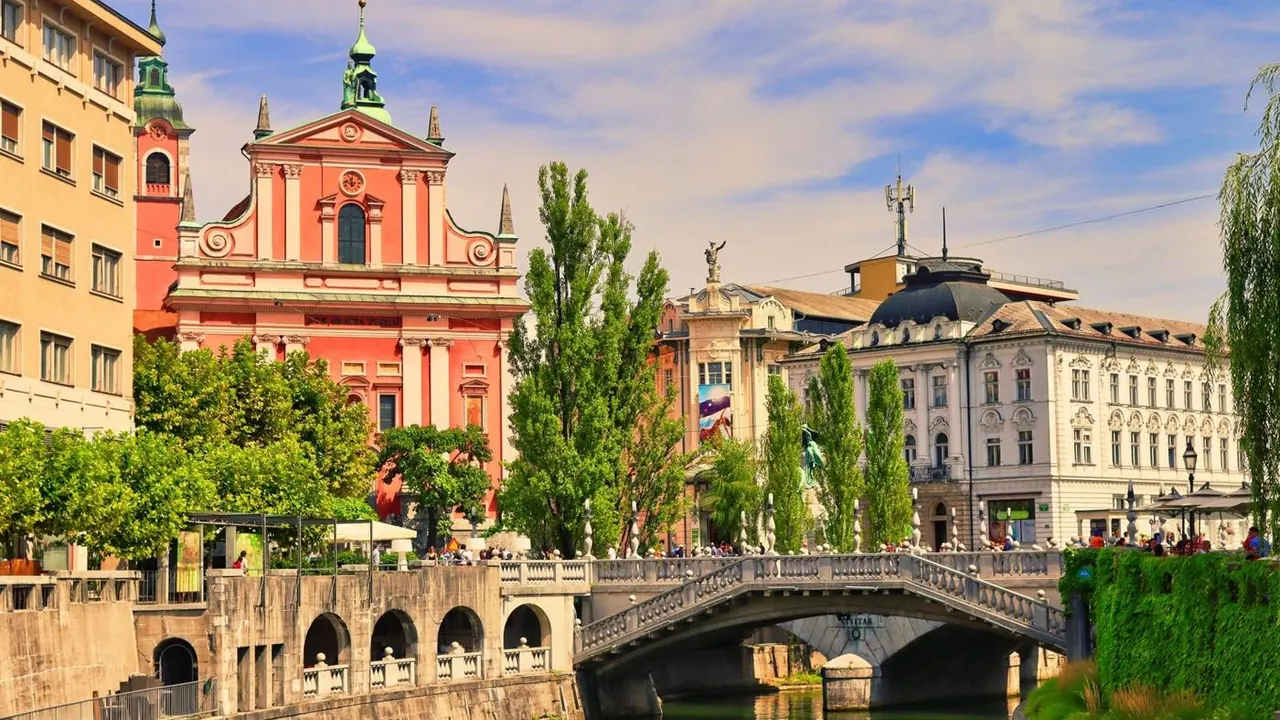
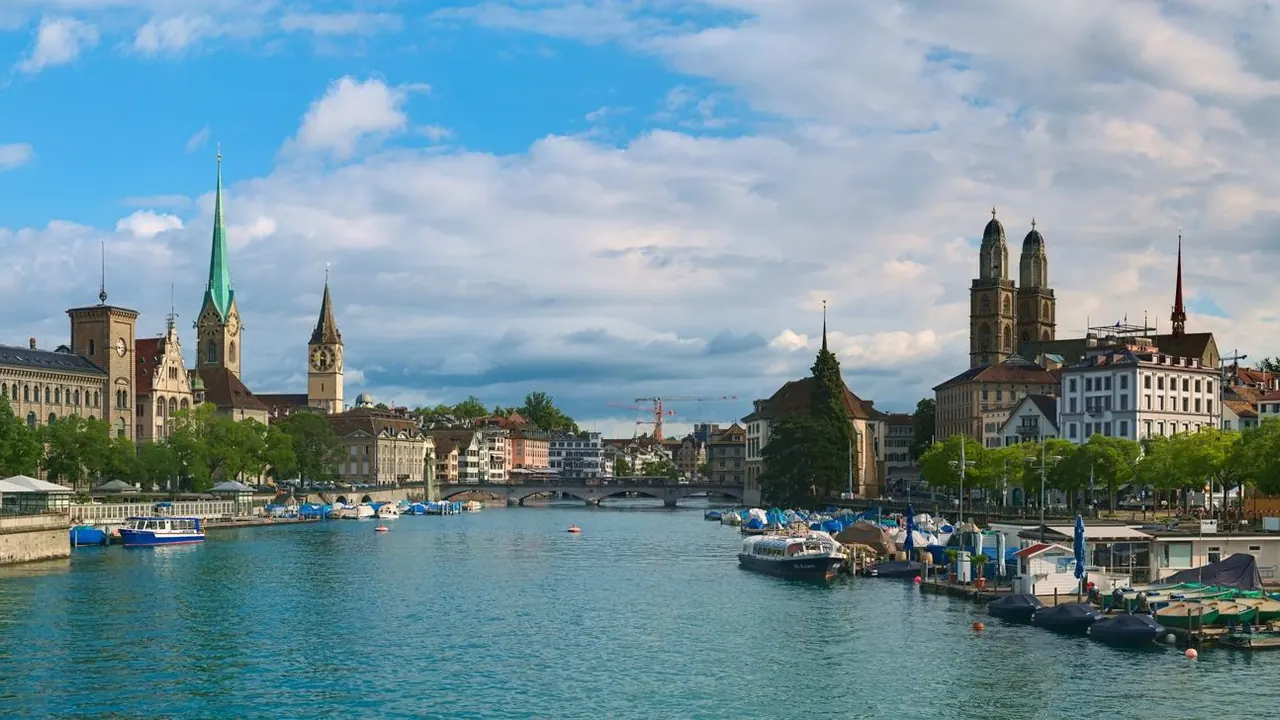
Photos: Ljubljana by detait, Pexels License; Zurich by Daniel Kraft, CC BY-SA 3.0, cropped.
Ljubljana or Zurich?
Our verdict in twelve categories, each scored against the same fixed benchmark cities, and the climate month by month, so you can choose for your trip.
Choose Ljubljana for
- prices
- food and drink
Ljubljana suits travellers who want a small, slow capital with the mountains at its back and money left over at the end. You walk everywhere, drink Slovenian wine by the river and spend your days in the Julian Alps, the karst caves or Bled. It is the better pick for a couple or a solo traveller on a moderate budget who would rather stroll than tick off sights, and who doesn't mind a quiet night.
Choose Zurich for
- shopping
- beaches
- nightlife
Choose Zurich if you want everything to run smoothly and can live with a steep bill. Trams and trains take you anywhere without effort, the zoo and lake lidos keep children busy, and the opera house, concert hall and techno clubs give your evenings more weight. It also makes the stronger base for crossing Switzerland by rail, and it is the one place of the two for serious shopping.
Scoreboard
Twelve categories on one fixed scale from 0 to 100. The shaded stretch is the gap between the two.
Your match
Pick a travel style or drag the sliders, and both match scores follow your weighting.
Wins on prices and food and drink with your weighting.
Wins on shopping and beaches with your weighting.
What matters to you?
Category by category
What the scores mean for a trip.
Beaches & swimming
Neither city has a beach, but Zurich builds summer around water in a way Ljubljana cannot. In Zurich, clean lake lidos and wooden bathing houses sit along both shores, and you can drift down the Limmat at the Letten river baths, all a short walk or tram ride from the old town.
In Ljubljana, swimming means the Sava on the city's edge or a trip out: Bled is about an hour away, and the pebble and concrete shore of the Adriatic at Piran about an hour and a half. If you want to swim every day, Zurich is the easier place to do it.
Food & drink
The two are much alike on food, but in different ways. Ljubljana is earthy and regional, with its open-air Central Market, gostilna inns serving štruklji and jota, and a real strength in wine, especially the orange wines of the west, poured in bars along the river.
Zurich is more polished and much more expensive: veal Geschnetzeltes with rösti in guild-house dining rooms, fondue in winter and a chocolate and confectionery tradition that Ljubljana can't match. Zurich has no markets or street food to speak of, so if you like to graze, Ljubljana is the better fit.
Culture & sights
These are two compact old towns that you can cover in a couple of days, but they reward different kinds of visitor. In Ljubljana, the city itself is the sight: Plečnik's bridges, colonnades and library, UNESCO-listed, give it a single designer's character, and the museums play a supporting role.
Zurich puts more into its collections. The Kunsthaus has Monet, Munch and Giacometti, there is the Swiss National Museum, and the Rietberg holds non-European art. In the old town you also have the Grossmünster, where the Swiss Reformation began, and Chagall's windows in the Fraumünster.
Nightlife
Zurich is the place for a proper night out. Its electronic music scene runs deep, clubs in Kreis 4 and 5 and Zurich West stay open until morning at weekends, and the August Street Parade fills the lake shore. The catch is the price of every round.
Ljubljana's evenings are gentler and mostly happen on the terraces along the Ljubljanica, livelier during university term. Metelkova's scruffy clubs are the one late-night draw, and the riverside goes quiet after midnight on weekdays.
Nature & outdoors
Both cities have outstanding countryside close by, but the landscapes differ. Near Ljubljana you get rivers and rock: the emerald Soča for rafting, the Vintgar gorge, Triglav National Park about an hour away and the karst caves of Postojna and Škocjan, plus Šmarna Gora right on the edge of town.
Zurich's scenery centres on its lake, with the Glarus Alps on the horizon, shoreline promenades and the Uetliberg a short train ride up. The big peaks, Rigi and Pilatus, are about an hour away. Fog can sit over the lake in late autumn and winter, while Ljubljana's autumn is good walking weather.
Day trips
Zurich has the edge, mainly because of its trains. Lucerne, Bern, Basel, St Gallen and the Rhine Falls are each about an hour or less by train, and you never need a car.
Ljubljana sits in the middle of a small country with plenty to see, including Bled, Predjama Castle, Lipica, Idrija and Piran, and Trieste and Zagreb are within reach across the borders. The difference is that buses and a hired car do more of the work, especially for the smaller places.
Good for families
Zurich gives families much more to do. The zoo's indoor rainforest hall and elephant park, the lidos with their shallow areas, the lake boats and the Technorama in Winterthur can fill a week. Getting about with a buggy is easy too.
Ljubljana is pleasant for children rather than thrilling. Its flat, car-free centre, the castle funicular, the Dragon Bridge and a puppet theatre that needs no Slovene will keep young children happy, but the small zoo and science centre won't take more than a few days.
Getting around
Both centres are easy to walk, but Zurich adds a transport system that reaches everywhere: blue trams, S-Bahn trains, funiculars and even lake boats, all on one ticket, with the airport a short train ride away.
Ljubljana has no tram or metro, and as a visitor you will rarely need its buses, since the main sights are within about 20 minutes of each other on foot or by shared bike. Outside the city, the slow rail network means intercity buses or a hired car.
Shopping & style
This is one of the widest gaps between the two. Zurich's Bahnhofstrasse is a luxury street of world standing, with Swiss watches as the speciality. The Niederdorf adds antiques and small boutiques, and the viaduct arches in Zurich West hold design shops.
Ljubljana's best buys come from its market and the country around it: honey, coastal salt, Idrija lace and gingerbread hearts. There is also a Sunday flea market on the embankment, but no luxury quarter at all.
Affordability
Ljubljana costs about what most of Europe does, and the only real expense is a central hotel room in July or August. Lunch menus at the inns, cheap entry to sights and walking instead of taking transport keep daily costs down.
Zurich is a different matter. Simple rooms, casual lunches, drinks and museums are all expensive, and even budget travellers living on supermarket food and free lidos will spend far more than they would in Ljubljana.
Live music & performing arts
Zurich has the stronger stage. The Opernhaus is one of Europe's most respected opera houses, the Tonhalle Orchestra plays in a restored nineteenth-century hall, and Rote Fabrik and the Kreis 4 and 5 venues regularly host touring bands and jazz.
Ljubljana is good for one evening rather than a whole trip. You could see the Slovenian Philharmonic, an opera at the national house, or a summer concert in Plečnik's Križanke courtyard during the Ljubljana Festival. Most drama in both cities is in the local language.
Wellness & relaxation
For proper bathing, Zurich does better within the city. It has the thermal pools and rooftop pool in the vaults of the old Hürlimann brewery, and in winter the lake bathing houses open as saunas with cold-water dips. Roman Baden is twenty minutes away by train.
Ljubljana offers calm more than bathing. The car-free centre and long afternoons at riverside cafés slow you down, and the city's own wellness is a water park on the eastern edge. For thermal pools you would drive to one of Slovenia's spa towns, about an hour away.
When should you go?
Pick your month. The climate figures are measured averages, not a forecast.
Ljubljana in July
Zurich in July
Daytime high, °C
Rainfall in the month, mm
Temperature and rainfall are climate normals, averaged over the years shown. Ljubljana: 1991-2020 normals, Ljubljana / Bezigrad (1.9 km from centre). Zurich: 1991-2020 normals, Zurich Town / Ville. (2.2 km from centre).
Both cities are cold and grey from December to February, with daytime highs around 4°C, so winter is for museums, saunas and the odd ski day rather than long walks. In summer Ljubljana runs warmer, reaching about 28°C in July and August, which is good for lake swims but can be sticky for sightseeing. It also gets clearly more sun. Rain is steady from May to August, but September is the turning point, with about 159mm, and autumn stays wet. That makes late May to August the best time to go.
Zurich peaks around 24°C, which is comfortable for walking and warm enough for the lake lidos from June to August. Those are also its wettest months, so expect showers between swims. September is clearly drier, at about 87mm, and still mild. If you want to walk the old town and take trains into the mountains rather than swim, that makes September the better choice.
Which traveller are you?
On a trip on a tight budget, Ljubljana is the sensible choice. The same money lasts far longer, with enough left over for a bus to Bled or the caves. In Zurich, a tight budget means cutting corners all day, which makes the city hard to enjoy.
On a family trip with children, Zurich keeps a full week varied. On rainy days there is plenty to do indoors, and the train makes Lucerne's Swiss Museum of Transport an easy outing. Ljubljana is better for a shorter, quieter stay with small children, ideally combined with time at the Alpine lakes.
For a shopping trip, Zurich is the only real option, especially if a Swiss watch or international fashion is on your list and you are ready for Swiss prices. In Ljubljana you shop in passing, picking up a few food and craft gifts rather than spending a day on it.
Before you go
| Measure | Ljubljana | Zurich |
|---|---|---|
| Official language | Slovene | French, German, Italian, Romansh |
| Currency | Euro (EUR) | Swiss Franc (CHF) |
| Sockets | CF230 V, 50 Hz | CJ230 V, 50 Hz |
| Driving side | Right | Right |
| Time zone | UTC+1, UTC+2 in summer | UTC+1, UTC+2 in summer |
| Emergency number | 112 | 112 |
| Elevation | 309 m | 408 m |
| Main airport | Ljubljana Jože Pučnik Airport (LJU)20 km from centre32 non-stop destinations | Zürich Airport (ZRH)9 km from centre226 non-stop destinations |
| Public holidays this year | 21 days | 10 days |
By the numbers
| Measure | Ljubljana | Zurich |
|---|---|---|
| City population | 284,293 | 440,935 |
| People per km² | 1,736 | 5,016 |
| Museums within 10 km | 14 | 63 |
| UNESCO World Heritage sites within 50 km | 3 | 1 |
Where else could you go?
Every comparison below shares a destination with this one, so you can follow Ljubljana or Zurich somewhere new.