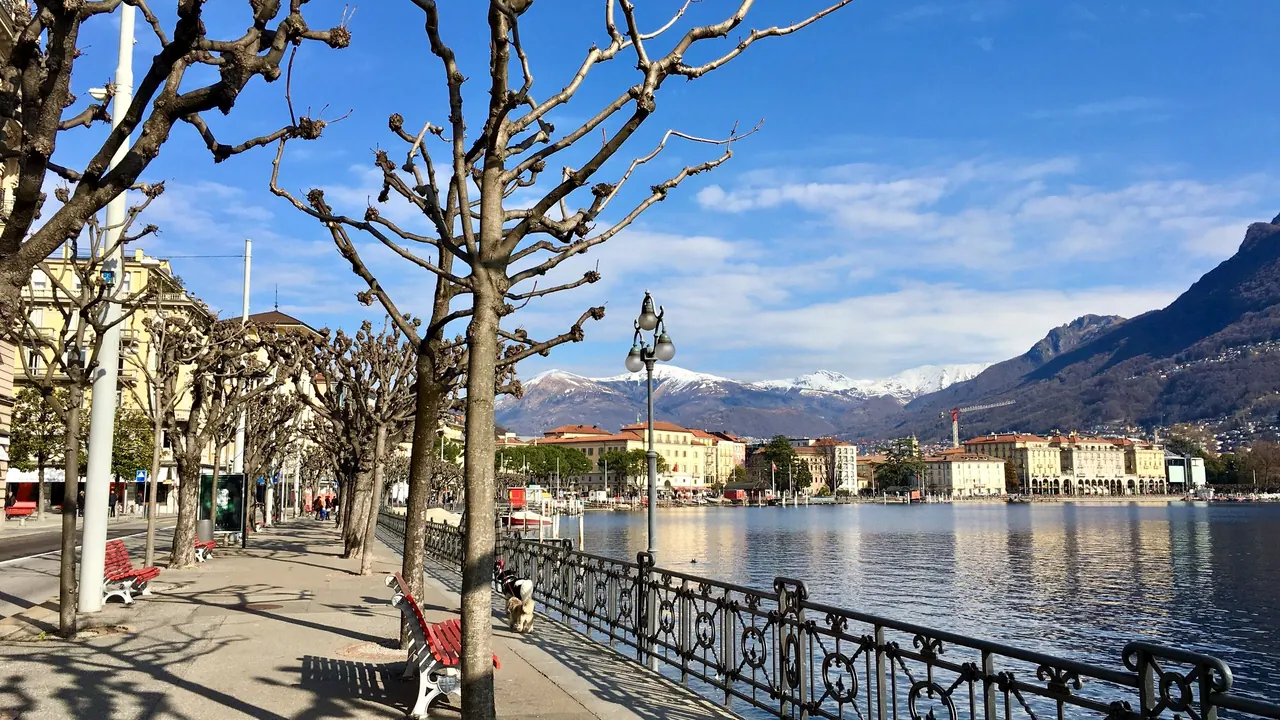
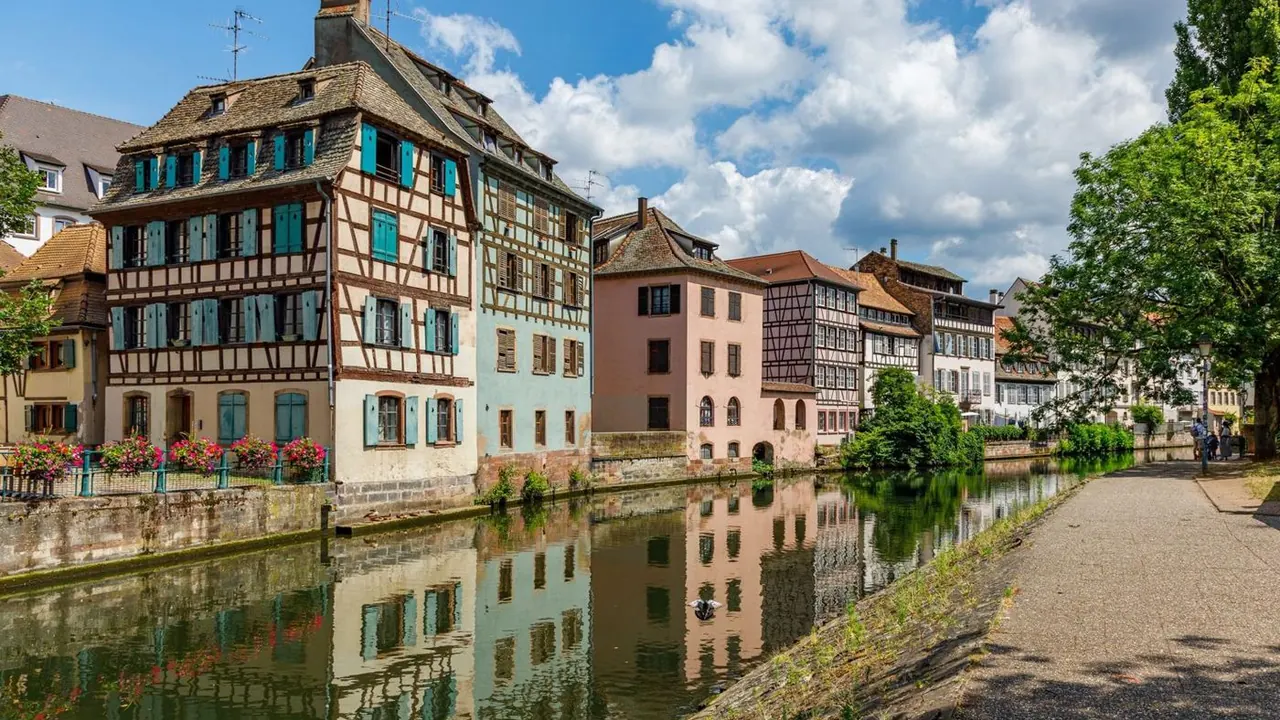
Photos: Lugano by Thomas Woodtli from Zürich, Switzerland, CC BY-SA 2.0, cropped; Strasbourg by Edoardo Colombo, Pexels License.
Lugano or Strasbourg?
Our verdict in twelve categories, each scored against the same fixed benchmark cities, and the climate month by month, so you can choose for your trip.
Choose Lugano for
- beaches
- nature and the outdoors
- day trips
Lugano is for travellers who want scenery more than sights. Mountains rise straight out of the lake, funiculars and boats do most of the work, and in summer you can swim from a lido after a morning on a summit path. It suits a slow, comfortable stay with walks, lake villages and easy trips into Italy, as long as you are ready for Swiss prices and quiet evenings.
Choose Strasbourg for
- prices
- culture and sights
- food and drink
Strasbourg gives you more to do inside the city itself. Its cathedral, timber-framed old town and museums fill two or three days, winstub cooking is richer and more varied than anything in Lugano, and there is a real season of opera, theatre and concerts. Prices are a good deal easier too. It is the better pick for culture, food and a city break on a sensible budget, while its countryside of vineyards and low hills is gentler than Lugano's.
Scoreboard
Twelve categories on one fixed scale from 0 to 100. The shaded stretch is the gap between the two.
Your match
Pick a travel style or drag the sliders, and both match scores follow your weighting.
Wins on beaches and nature and the outdoors with your weighting.
Wins on prices and culture and sights with your weighting.
What matters to you?
Category by category
What the scores mean for a trip.
Beaches & swimming
Neither city has a sea, but Lugano has a proper swimming lake on its doorstep. Its lidos at the mouth of the Cassarate and along the shore towards Paradiso and Castagnola have lawns, decks and ladders into the water, and boats take you to small lake baths in the villages. In summer you can plan whole afternoons around them.
Strasbourg's swimming is in old gravel pits on the edge of town, such as the Baggersee at the end of a tram line. They have grassy banks and lifeguards in July and August. They are good for cooling off on a hot day, but locals go there after work and nobody plans a trip around them.
Food & drink
Strasbourg eats better, and with more range. Its winstubs serve choucroute, baeckeoffe and tarte flambée with Riesling from the vineyards to the south, foie gras is a local speciality, and there is serious fine dining in the city and the villages around it. The covered market, local beer and the December mulled wine add more.
Lugano's best meals are in grotti, rustic taverns in the hills serving polenta, braised meats and Merlot under chestnut trees. Beyond them there is little street food, little international cooking and almost nothing cheap, so many visitors eat their more adventurous meals across the border in Italy.
Culture & sights
Strasbourg is far ahead. Its pink sandstone cathedral with the astronomical clock, the Grande Ile, Petite France and the German-built Neustadt make up a whole UNESCO-listed townscape, and the Palais Rohan, the Oeuvre Notre-Dame and the modern art museum need two or three days.
Lugano's arcaded old town, the Luini fresco in Santa Maria degli Angioli and the LAC arts centre can be seen in a day. The Hermann Hesse museum in Montagnola is a good reason to head up into the hills.
Nightlife
Neither is a place for a big night out. Lugano's evenings are an aperitivo by the lake or under the arcades, then a long dinner among a well-dressed local crowd. Most nights the town is quiet before midnight, and young locals who want to dance take the train to Milan.
Strasbourg has more going on. Its large student population keeps the bars and beer cellars of the Krutenau and around Place Saint-Étienne busy, and in summer the riverside terraces stay full well into the evening. Nights still rarely run late, but there is more choice and a younger crowd.
Nature & outdoors
Lugano has the more dramatic setting. Wooded mountains rise straight from the lake, funiculars climb Monte Brè and San Salvatore from the edge of town, and the path to Gandria, the rack railway up Monte Generoso and the Lema to Tamaro ridge are all within easy reach. The clear green rivers of the Verzasca and Maggia valleys are about an hour away.
Strasbourg itself is flat, and its outdoors is greener and gentler: the Orangerie, Rhine forests with storks and beavers, and long, level cycle routes into Germany. The Vosges and the Black Forest offer good hiking about an hour away, though a car makes them much easier to reach.
Day trips
Both make excellent bases, and the difference is in where you go. From Lugano you travel by train and boat to lakes and Italian cities: Milan with The Last Supper, Como, the castles of Bellinzona, Lake Maggiore and the Borromean Islands, and Morcote by water.
From Strasbourg the trips are into wine country and across the Rhine: Colmar and the Isenheim Altarpiece, Riquewihr and Eguisheim on the wine route, then Baden-Baden, Freiburg and Heidelberg on the German side. The cities are easy by train, but the wine villages are best done by car or bike.
Good for families
Strasbourg is the easier place with children. The centre is flat and mostly car-free, Le Vaisseau science centre is built for them, the Orangerie has storks, playgrounds and rowing boats, and Europa-Park is about an hour away for older children.
Lugano works best for younger children who like being outdoors: boat trips, lido slides, funicular rides and the long-loved miniature Switzerland park at Melide. Steep streets are hard work with a pushchair, and there is little for teenagers who want big attractions.
Getting around
Both are easy without a car, but they feel very different on foot. Lugano is a slope: the station sits high above the old town, a short funicular links the two, and buses, lake boats and mountain railways take you further.
Strasbourg is flat. Its island centre is mostly pedestrianised, trams run out to the European quarter and across the Rhine to Kehl, and bikes are often the quickest way to get about. In both cities a car only helps for the countryside, whether that means Lugano's valleys or Strasbourg's wine villages.
Shopping & style
Strasbourg has the broader shopping, with chain stores and a large department store around Place Kléber, independent bookshops and delicatessens near the cathedral, and regional things to take home such as Soufflenheim pottery, printed linens and kougelhopf moulds. It has little luxury, though.
Luxury is where Lugano is strong. Via Nassa is lined with Swiss watchmakers, jewellers and Italian fashion houses, and there is a designer outlet near Mendrisio. Outside that, there is little depth, and keen shoppers go to Milan.
Affordability
Strasbourg costs much less. It is priced like a French regional city, with affordable winstub meals, good wine by the pichet, cheap trams and bike hire, and a free cathedral and old town. Hotels are the main cost, and they get much dearer during the Christmas market and the weeks when the European Parliament sits.
Lugano charges Swiss prices for everything from lakeside rooms to boat trips and mountain railways. Grotti, set lunches and the regional transport pass that comes with most hotel stays soften the bill, but there is no cheap way to stay in the town.
Live music & performing arts
Strasbourg has the fuller programme. Opera at the house on Place Broglie, a philharmonic season and the Théâtre National de Strasbourg make it a real stage city, and the autumn Musica festival, a jazz festival and smaller rock venues add more.
In Lugano, almost everything happens at LAC, where the Orchestra della Svizzera italiana plays a mainly classical programme. In summer, the free Estival Jazz concerts in Piazza della Riforma are the highlight. For opera you have to go to La Scala in Milan.
Wellness & relaxation
Strasbourg has a real bathing culture nearby. The tiled Bains municipaux, an early twentieth-century public bathhouse with a hammam and saunas, is in the city, and Baden-Baden's Friedrichsbad and Caracalla baths are under an hour away.
Lugano has no springs or public baths. Its spas are mostly in the big hotels, plus an indoor pool complex near Rivera. What it offers is calm: a lido on a hot afternoon, palm-lined promenades and a slow lunch in a grotto.
When should you go?
Pick your month. The climate figures are measured averages, not a forecast.
Lugano in July
Strasbourg in July
Daytime high, °C
Rainfall in the month, mm
Temperature and rainfall are climate normals, averaged over the years shown. Lugano: 1991-2020 normals, Lugano (1.2 km from centre). Strasbourg: 1991-2020 normals, Strasbourg (9.1 km from centre).
The two cities have almost the same temperatures. Both reach about 27°C in July and August and turn cold in winter, so the real differences are rain and light. Lugano's lido season runs from late June to early September, and high summer brings its sunniest weather, though it can feel humid. From April to November it is a wet place, often above 150mm a month, so a walking trip in spring or autumn needs some flexibility. Its winters are wetter than Strasbourg's, but much brighter.
Strasbourg is the drier city all year. Even May, its wettest month, stays under 80mm. May to September is the best stretch for walking the old town and cycling along the Rhine, with long, light evenings. From November to January the skies are dull, with less than half of Lugano's winter sunshine, and the cold makes long days outdoors hard going.
Which traveller are you?
On a culture and arts trip, choose Strasbourg. Lugano's old town and frescoes fill a day, while Strasbourg's cathedral, museums and UNESCO-listed old town need several, and its opera, orchestra and national theatre give the evenings a full programme too.
For an outdoors trip, Lugano is the better base. A mountain path or a hired kayak on the lake is minutes from your hotel, with no car needed, and spring and autumn suit hiking best. Strasbourg is mostly level cycling until you drive to the hills.
On a tight budget, choose Strasbourg. In Lugano, Swiss prices reach every part of a stay, from your room to your dinner. Strasbourg costs what a French regional city does, and its best pleasures, wandering the old town and cycling by the river, cost next to nothing.
Before you go
| Measure | Lugano | Strasbourg |
|---|---|---|
| Official language | French, German, Italian, Romansh | French |
| Currency | Swiss Franc (CHF) | Euro (EUR) |
| Sockets | CJ230 V, 50 Hz | CE230 V, 50 Hz |
| Driving side | Right | Right |
| Time zone | UTC+1, UTC+2 in summer | UTC+1, UTC+2 in summer |
| Emergency number | 112 | 112 |
| Elevation | 283 m | 132 m |
| Main airport | Milan Malpensa International Airport (MXP)46 km from centre208 non-stop destinations | Strasbourg Airport (SXB)10 km from centre43 non-stop destinations |
| Public holidays this year | 15 days | 11 days |
By the numbers
| Measure | Lugano | Strasbourg |
|---|---|---|
| City population | 63,495 | 293,771 |
| People per km² | 837 | 3,752 |
| Museums within 10 km | 17 | 21 |
| UNESCO World Heritage sites within 50 km | 5 | 3 |
Where else could you go?
Every comparison below shares a destination with this one, so you can follow Lugano or Strasbourg somewhere new.
- Comovs Lugano
- Baden-Badenvs Strasbourg
- Colmarvs Strasbourg
- Milanvs Lugano
- Freiburgvs Strasbourg
- Bergamovs Lugano