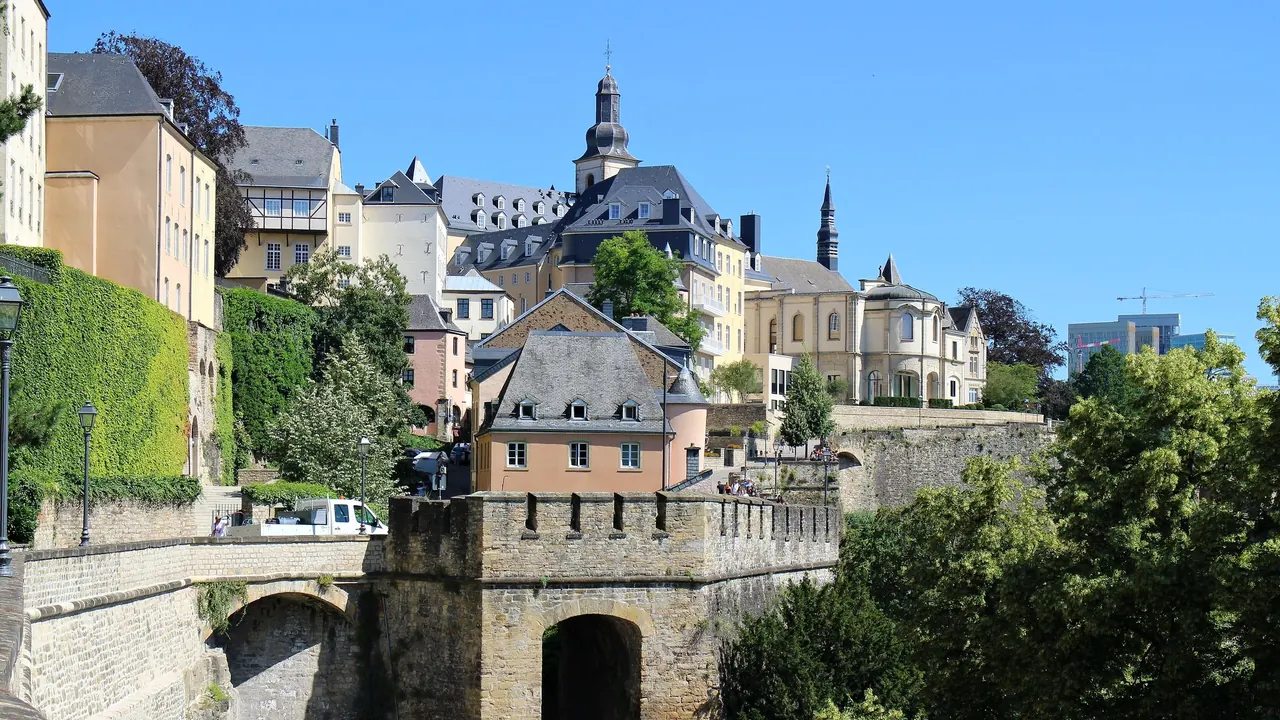
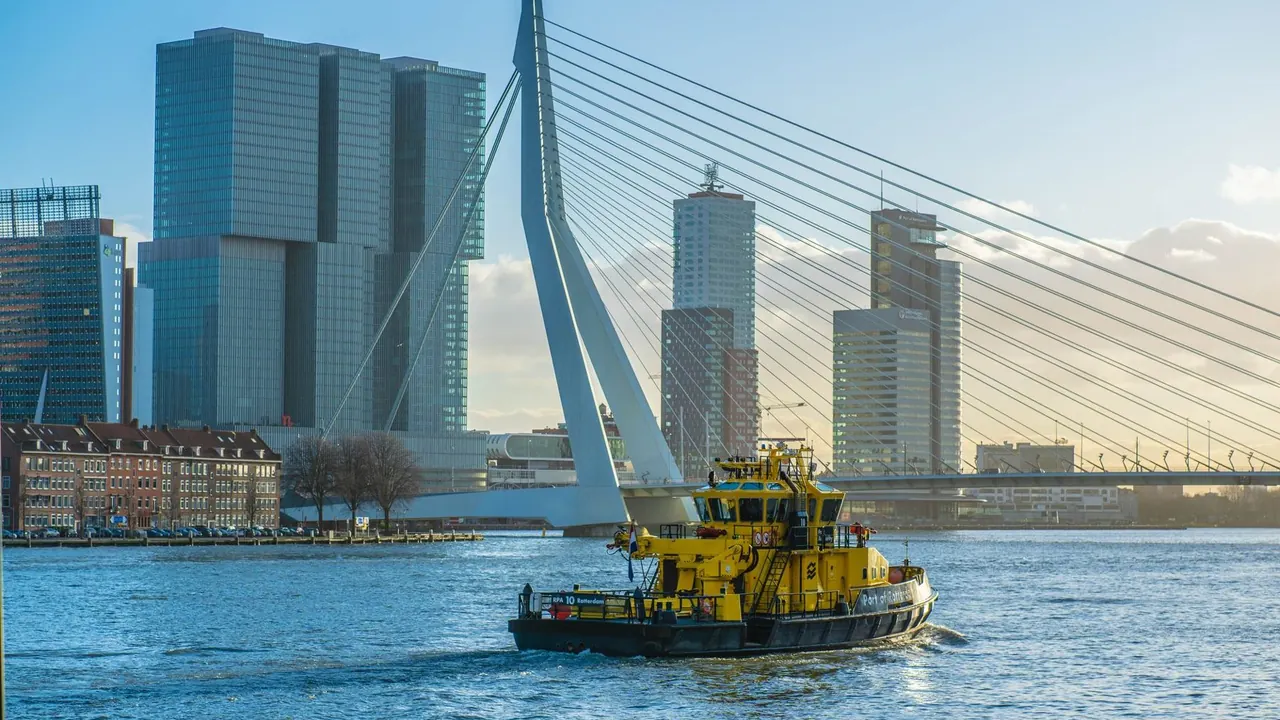
Photos: Luxembourg by Suicasmo, CC BY-SA 4.0, cropped; Rotterdam by Bas Geerlings, Pexels License.
Luxembourg or Rotterdam?
Our verdict in twelve categories, each scored against the same fixed benchmark cities, and the climate month by month, so you can choose for your trip.
Choose Luxembourg for
- nature and the outdoors
- wellness
- getting around
Luxembourg suits a calm, compact trip where the setting does most of the work. The fortress old town stands above wooded gorges, the sandstone ravines of the Müllerthal are close by, Moselle Riesling comes by the glass and free trains run to castles and wine villages. It rewards walkers, wine drinkers and anyone who wants a quiet few days with a spa day included, as long as the budget can take the hotel bills.
Choose Rotterdam for
- prices
- nightlife
- families
For a livelier and more varied stay at a gentler cost, Rotterdam is the better pick. People come for its modern architecture rather than old stones, and the food reflects a port city, with Surinamese, Turkish and Indonesian kitchens. The clubs are a real draw, and children get a first-rate zoo. Rotterdam is also the stronger base for seeing a whole region, with Delft, The Hague, Amsterdam and Antwerp all easy by train.
Scoreboard
Twelve categories on one fixed scale from 0 to 100. The shaded stretch is the gap between the two.
Your match
Pick a travel style or drag the sliders, and both match scores follow your weighting.
Wins on nature and the outdoors and wellness with your weighting.
Wins on prices and nightlife with your weighting.
What matters to you?
Category by category
What the scores mean for a trip.
Beaches & swimming
Neither city is a beach destination, but only Rotterdam has a coast. Hoek van Holland's broad sand and dunes, with ships passing at the harbour mouth, are a metro ride away. The cold, windy North Sea means most people walk there rather than swim.
Luxembourg has only lakes: the Upper Sûre reservoir about an hour north and the flooded gravel pits at Remerschen. In high summer the lakes are warmer for swimming than Rotterdam's sea, but they make an afternoon by a lake, not a day at the seaside.
Food & drink
The two eat equally well but in different ways. Luxembourg's strength is French-led cooking, with more fine dining than a city its size would suggest, and Moselle Riesling and crémant are served everywhere. Local dishes are hearty but few, and cheap eating is hard to find.
Rotterdam's best food comes from its port communities: Surinamese roti, Turkish bakeries and Indonesian, Moroccan and Cape Verdean kitchens. The Markthal and the Binnenrotte market are easy places to start. Local craft beer takes the place of wine, and the top end is thin.
Culture & sights
Both fill two or three days well, but they show opposite things. Luxembourg is about the past: a UNESCO-listed fortress on a plateau, the Bock casemate tunnels and the Corniche looking down on the Grund. The palace and cathedral stand at the top of the town, and MUDAM's contemporary art is across the bridge on Kirchberg.
Rotterdam lost its centre in 1940 and is about the modern city that replaced it: the Erasmus Bridge, the Cube Houses, the Markthal and the mirrored Depot Boijmans. Its history survives in pockets such as Delfshaven, and its museums, including the Kunsthal and the Maritime Museum, are solid rather than grand.
Nightlife
Rotterdam has far more to offer after dark. The bar streets around the Witte de Withstraat and the Oude Haven fill on summer evenings. The clubs are the real draw, with techno and house in warehouse and harbour venues in the city where gabber began.
Luxembourg's evenings are smaller and quieter. They centre on the Rives de Clausen, the Grund's riverside pubs and a few later venues in Hollerich, and are busiest on Thursdays and Fridays. Expect a glass of crémant and an early night rather than a club.
Nature & outdoors
Luxembourg has much the better outdoors. Wooded gorges run through the centre and the Müllerthal's sandstone ravines and beech forest are half an hour away. The Ardennes hills and the cycle paths through the Moselle vineyards are within easy reach, and autumn is the best season for all of them.
Rotterdam's landscape is flat and man-made. It offers the Kralingse Bos lake, cycling through the polders along the dykes, canoeing and birdwatching in the creeks of the Biesbosch, and dune walks at Hoek van Holland. It is pleasant, but there are no hills.
Day trips
Both are good bases, but Rotterdam has more within a short train ride. Delft is a quarter of an hour away and The Hague only a little further. Amsterdam, Utrecht, Leiden, Haarlem and Antwerp are all about an hour or less by train, and a water bus reaches the Kinderdijk windmills.
Luxembourg's advantage is its borders: Roman Trier and Gothic Metz are each under an hour by train. Within the country, free trains reach Vianden castle, Echternach and the Moselle wine villages for slower outings.
Good for families
Rotterdam gives children more to do. Blijdorp zoo with its ocean section, the hands-on harbour area at the Maritime Museum, boat tours, water taxis and the Euromast can fill several days. Madurodam is a short train ride away.
Luxembourg is calm and safe, and the casemate tunnels and ramparts feel like an adventure. Beyond those there is only the small Parc Merveilleux at Bettembourg, plus castle and gorge outings for older children. With no zoo or aquarium, it suits two or three days rather than a week of school vacation.
Getting around
Both are easy without a car, in different ways. Luxembourg's public transport is free across the whole country, and public lifts and a funicular link the compact old town to the river quarters below. That matters in a city built on several levels.
Rotterdam is more spread out, with long, windy walks between its postwar sights, so the metro, trams and above all the bike paths do most of the work. Water taxis across the Maas make the river itself part of the route.
Shopping & style
Rotterdam is the better place to shop for most visitors. The Lijnbaan, one of Europe's first pedestrian streets, keeps the chains close together, and the Meent and Nieuwe Binnenweg add vintage, record and independent design shops. The Binnenrotte market is large and lively.
Luxembourg's Grand-Rue leans towards luxury and premium labels for a wealthy local clientele, with little independent or bargain shopping. The best things to take home are the locally made porcelain and a bottle of Moselle crémant.
Affordability
Neither city is cheap, but Rotterdam is noticeably easier on the budget. It has plenty of hotels and they cost less than in the best-known Dutch cities. Market stalls and Surinamese and Turkish snack shops keep simple meals reasonable, even though restaurants and beer are expensive.
Luxembourg is expensive almost across the board, with hotels and restaurants priced for business travellers. Free public transport, free museums and lunch menus help, and some visitors stay in Trier or Metz and come in by train for the day.
Live music & performing arts
Both have a fine orchestra and concert hall, with Rotterdam slightly ahead. Its Philharmonic plays a full season at De Doelen, and small jazz and pop venues benefit from the music conservatory. The North Sea Jazz Festival makes July a major draw, though much of the theatre needs Dutch.
Luxembourg's Philharmonie on Kirchberg has excellent acoustics and attracts touring orchestras. The Grand Théâtre often stages opera and drama in French or English, which helps visitors. Most of it, though, is brought in from elsewhere.
Wellness & relaxation
Luxembourg is the easier place to unwind. Mondorf-les-Bains, half an hour away, has a thermal spa fed by a mineral spring, set in a landscaped park. Back in the city, the quiet evenings and the river walks through the Grund and the Pétrusse valley keep the pace slow.
Rotterdam moves at a brisker pace, but it has the Dutch sauna tradition in large wellness complexes on the edge of the city. The sauna areas are usually textile-free. In the centre, calm means the Kralingse Bos or a terrace by the water.
When should you go?
Pick your month. The climate figures are measured averages, not a forecast.
Luxembourg in July
Rotterdam in July
Daytime high, °C
Rainfall in the month, mm
Where the figures come from
Rotterdam has no rain gauge within 25 km of the centre, so its rainfall comes from a gridded climate dataset read at the city rather than from a gauge further away.
Rotterdam's sunshine is measured 52 km from the centre, at De Bilt.
Temperature and rainfall are climate normals, averaged over the years shown. Luxembourg: 1991-2020 normals, Luxembourg / Luxembourg (6.3 km from centre). Rotterdam: 1993-2020 (sunshine 1991-2020, rainfall 1991-2020) normals, Rotterdam Airport Zestienhoven (3.9 km from centre).
Both cities are at their best from May to September, but they differ either side of that. Luxembourg has the warmer and sunnier summer, reaching about 24°C in July and August. Its rain is spread fairly evenly through the year, and April is the only clearly drier month. Winters are colder, and from November to February the short, grey days suit museums and wine bars more than long walks. Autumn is a good time for the forests and the grape harvest.
Rotterdam is slightly milder and a little brighter in winter, but its summer peaks lower, at around 22°C. April and May are its driest months and a good time to go. The rain sets in from July, and October is the wettest month at about 99mm. The North Sea warms to only about 19°C in August, so the beach is better for walking than for swimming.
Which traveller are you?
On an outdoors trip, choose Luxembourg. Good walking country starts at the edge of town and is easy to reach without a car. Rotterdam's outdoors is flat and gentle, better for an afternoon on a bike than a full day on foot.
For a food and nightlife trip, Luxembourg offers a fine dinner with Moselle wine but little after it. Rotterdam is the better bet. Its restaurant streets double as bar streets, and at weekends the clubs are the real draw.
On a trip on a tight budget, Luxembourg's free transport and free museums only take the edge off costs that stay high, so a short stay is the wiser plan. Rotterdam makes the money go further, mainly on the room and on simple meals.
Before you go
| Measure | Luxembourg | Rotterdam |
|---|---|---|
| Official language | French, German, Luxembourgish | Dutch |
| Currency | Euro (EUR) | Euro (EUR) |
| Sockets | CF230 V, 50 Hz | CF230 V, 50 Hz |
| Driving side | Right | Right |
| Time zone | UTC+1, UTC+2 in summer | UTC+1, UTC+2 in summer |
| Emergency number | 112 | 112 |
| Elevation | 300 m | 10 m |
| Main airport | Luxembourg-Findel International Airport (LUX)6 km from centre115 non-stop destinations | Rotterdam The Hague Airport (RTM)5 km from centre53 non-stop destinations |
| Public holidays this year | 12 days | 11 days |
By the numbers
| Measure | Luxembourg | Rotterdam |
|---|---|---|
| City population | 137,678 | 664,311 |
| People per km² | 2,663 | 2,080 |
| Museums within 10 km | 19 | 41 |
| UNESCO World Heritage sites within 50 km | 4 | 5 |
| Swim season, months above 21 °C | - | None |
Where else could you go?
Every comparison below shares a destination with this one, so you can follow Luxembourg or Rotterdam somewhere new.
- The Haguevs Rotterdam
- Utrechtvs Rotterdam
- Haarlemvs Rotterdam
- Amsterdamvs Rotterdam
- Antwerpvs Rotterdam
- Ghentvs Rotterdam