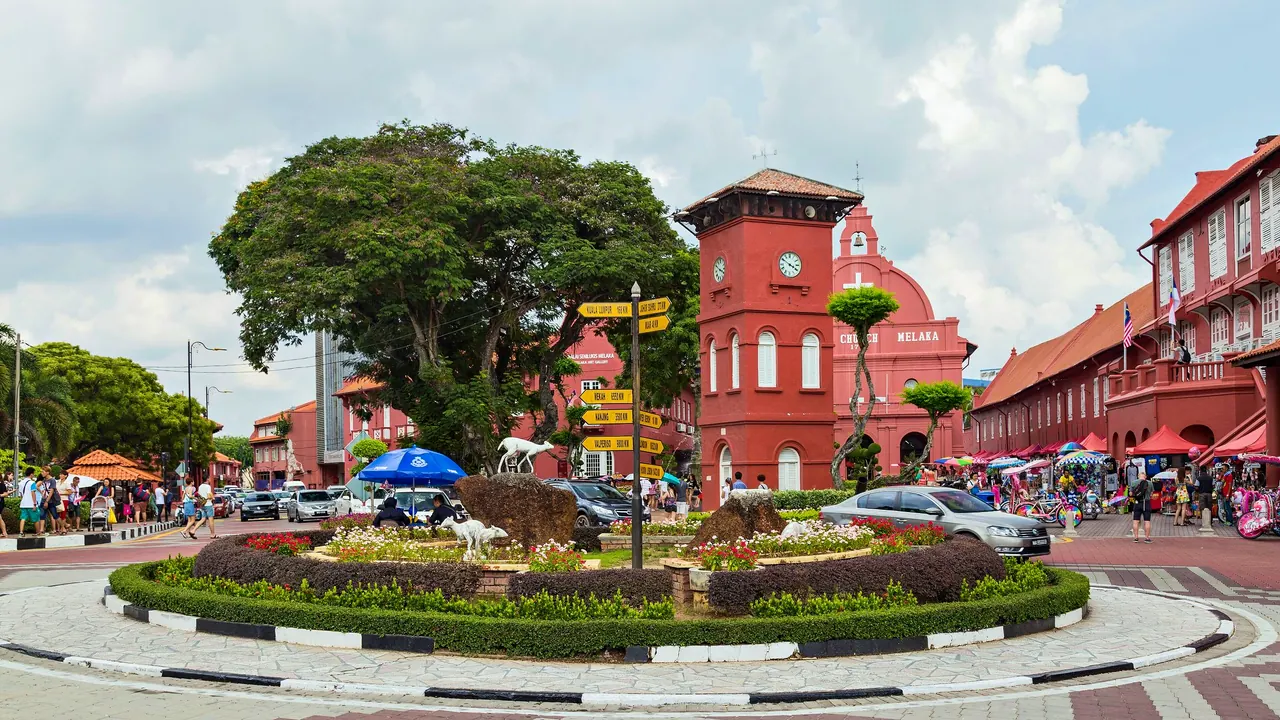
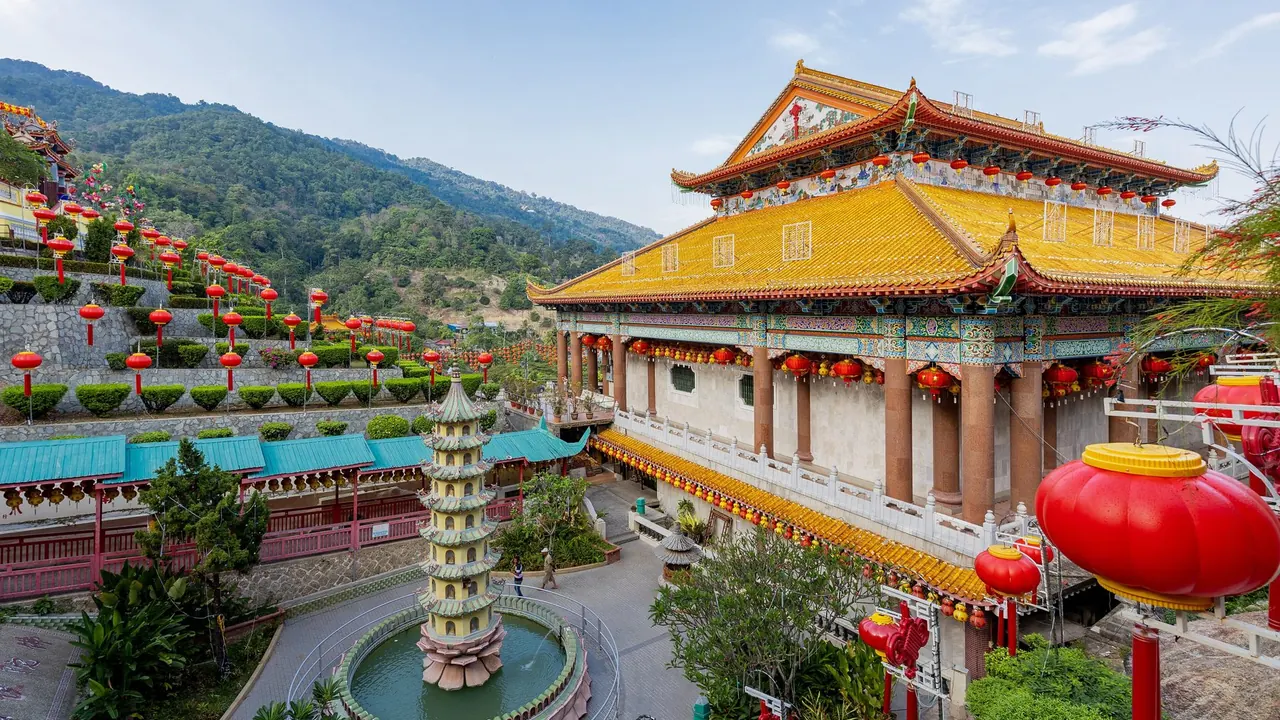
Photos: Malacca by Marcin Konsek, CC BY-SA 4.0, cropped; Penang by Supanut Arunoprayote, CC BY 4.0, cropped.
Malacca or Penang?
Our verdict in twelve categories, each scored against the same fixed benchmark cities, and the climate month by month, so you can choose for your trip.
Choose Malacca for
- getting around
- prices
Malacca suits a short, unhurried heritage trip. Its old centre is small enough that the Dutch square, the Portuguese ruins on St Paul's Hill and the Peranakan shophouse lanes all sit within a few minutes' walk of each other, and its Nyonya and Kristang cooking gives you plenty to eat for a few days. Come midweek, eat well, walk the river in the early morning and expect quiet evenings.
Choose Penang for
- nature and the outdoors
- beaches
- food and drink
Penang is the better choice for a longer stay with more variety. Its hawker food has more range, George Town has more going on after dark, and the island adds forested hills, a national park and a resort beach to a heritage town every bit as rich as Malacca's. The price is more travelling time between the sights, but there is enough here to fill a week.
Scoreboard
Twelve categories on one fixed scale from 0 to 100. The shaded stretch is the gap between the two.
Your match
Pick a travel style or drag the sliders, and both match scores follow your weighting.
Wins on getting around and prices with your weighting.
Wins on nature and the outdoors and beaches with your weighting.
What matters to you?
Category by category
What the scores mean for a trip.
Beaches & swimming
Neither city is a beach destination, but Penang at least has a beach worth an afternoon. Malacca's waterfront is reclaimed land and mudflat facing a brown strait busy with shipping, and Klebang is for a sunset stroll rather than a swim. The nearest real sand, at Tanjung Bidara about 30km up the coast, still lacks clear water.
Penang has Batu Ferringhi, a long sandy bay with resort hotels and water sports, and the quieter coves of the national park, Monkey Beach and Kerachut, which you reach on foot or by boat. The water can be cloudy there too, but a few resort days by the sea fit easily into a Penang trip, and Malacca cannot offer that.
Food & drink
Both cities share Nyonya cooking, but Malacca is where it is most at home. Its own specialities are chicken rice rolled into balls, satay celup dipped in a shared pot of peanut sauce, and Kristang devil's curry from the Portuguese Settlement. It is a focused, local table, eaten in kopitiams around Jonker Street and Heeren Street.
Penang eats more widely. Hokkien, Malay and Tamil Muslim traditions sit alongside the Peranakan one, and single-dish stalls have perfected char kway teow, assam laksa and prawn mee over decades. Hawker centres on Gurney Drive and the banana-leaf meals of Little India give you more variety than you can get through in a week.
Culture & sights
These two share a single UNESCO listing and are closely matched, but they show different chapters of history. Malacca's layers are older and more European on the surface: the Dutch Stadthuys, the roofless Portuguese church on St Paul's Hill and the surviving gate of A Famosa, with Peranakan townhouses and the temples and mosque of Harmony Street across the river.
George Town is larger and more Chinese and Indian in character. It has the carved Khoo Kongsi clan house, the indigo Cheong Fatt Tze Mansion and the clan jetties on stilts, and the huge Kek Lok Si temple sits on the edge of town. Neither has major museum collections. You go to both for the streets themselves.
Nightlife
Penang has the livelier evenings, though it is still no party city. Backpackers drink on the pavements of Chulia Street and Love Lane, Upper Penang Road has louder bars and a couple of clubs, and Batu Ferringhi adds beach bars.
In Malacca, evenings mean the weekend night market on Jonker Street and a quiet beer by the lit-up river, with flashing trishaws making most of the noise. On weeknights the old town is asleep early, and there are no clubs at all.
Nature & outdoors
Penang wins clearly here. The island is hilly and forested. A funicular climbs Penang Hill to about 800m, where the air is cooler and canopy walks run through old rainforest, and macaques and leaf monkeys live along the paths up from the Botanic Gardens. The national park adds coastal jungle trails, a turtle hatchery beach and a lighthouse.
Malacca's surroundings are flat towns and plantations. A river walk, the mangrove paths and a boat to Pulau Besar fill a morning, and the only real climb, Gunung Ledang, is a long drive away across the Johor border.
Day trips
Penang has slightly better outings, and they suit a day trip better. Ipoh offers its own colonial old town, cave temples in limestone cliffs and a strong food culture. Royal Kuala Kangsar and the lake gardens of Taiping round out the list.
Malacca's headline excursion is Kuala Lumpur, which is reachable in a long day but really deserves its own stay, with Putrajaya on the way. Closer options are quieter: riverside Muar and the buffalo-horn roofs of Negeri Sembilan.
Good for families
Both are warm towards children and equally hard on them in the midday heat, but they keep children busy in different ways. Malacca has the bigger set-piece attractions: Zoo Melaka, the water parks at Ayer Keroh, and the light-covered trishaws and revolving tower in town.
Penang has no zoo, but it has a beach. Splitting the stay with a Batu Ferringhi resort gives easy afternoons in the sea and the pool, and the Penang Hill funicular, the butterfly park and hunting for street murals fill the rest. In both, plan around a hotel pool after lunch.
Getting around
Malacca is the easier of the two. Almost everything a visitor wants is in one compact core tied together by the riverside path, so beyond a ride to the zoo or the Portuguese Settlement you rarely need transport at all.
Penang's sights are spread around an island. George Town itself is walkable and has a free shuttle loop, though motorbikes and steps break up the five-foot ways. Getting to Batu Ferringhi, Penang Hill or the national park means slow buses or ride-hailing on roads that often jam.
Shopping & style
Malacca's shopping is a narrow niche, but a distinctive one. The antique dealers of Jonker Street sell old porcelain, clocks and furniture, and the Peranakan craft shops beside them have hand-beaded slippers, embroidered kebaya and painted tiles. Its waterfront malls cover everyday needs and little more.
Penang has more range in what it sells. Chowrasta Market has nutmeg products and local snacks, Little India has saris, spices and gold, and the lanes around Campbell Street still hold joss-stick makers and rattan weavers. The big Gurney Drive malls handle anything practical. In both cities, the things worth taking home are small and local, not designer labels.
Affordability
Both are among the cheapest trips you can take, with hawker meals, temples and ride-hailing costing very little in either, and alcohol heavily taxed in both. The difference lies in what pushes the cost up. In Malacca it is timing, because visitors from the capital and Singapore fill the old-town hotels at weekends. In Penang it is choice, because a heritage boutique hotel or a beachfront resort costs noticeably more than a George Town guesthouse.
Live music & performing arts
Penang has a little more to see, mostly because of the George Town Festival, which fills warehouses and shophouses with theatre and dance for several weeks each year. The Straits Quay arts centre adds local productions, and Chinese opera and getai stages appear during the Hungry Ghost month.
Malacca's one reliable evening is the staged history spectacle on the waterfront, where the audience rotates through the city's eras. Beyond that you depend on luck, such as Kristang branyo dancing at the Festa San Pedro or lion dances at Chinese festivals.
Wellness & relaxation
Neither has a bathing tradition, and in both you can get cheap foot reflexology in the old town, but Penang offers more ways to properly switch off. Full-service spas at the Batu Ferringhi resorts, quiet heritage courtyard pools and cool evenings up Penang Hill make a split stay restful.
Malacca relies on its own pace. A weekday kopitiam breakfast and a slow river walk are calming, but weekend crowds and the noise of the night market take that away, so timing matters more than facilities.
When should you go?
Pick your month. The climate figures are measured averages, not a forecast.
Malacca in July
Penang in July
Daytime high, °C
Rainfall in the month, mm
Temperature and rainfall are climate normals, averaged over the years shown. Malacca: 1991-2020 (sunshine 1981-2010) normals, Malacca (8.7 km from centre). Penang: 1991-2020 (sunshine 1981-2010) normals, Penang / Bayan Lepas (14.5 km from centre).
Neither city has a cool season. Daytime highs stay at around 32°C all year in both, so street walking is always best early in the morning or after dark, and the sea is warm enough to swim in every month. What changes is the rain. Both are driest in January and February. In Malacca the rain builds steadily from March and peaks in November at about 234mm, but there is no single month that stands out as a washout.
Penang's pattern is sharper. January to March is clearly sunnier than anywhere in Malacca's year, with longer bright days, but September and October are very wet, at up to 335mm in October. For Penang, aim for December to March. Malacca is more even, so outside its rainiest late-year months the timing matters less.
Which traveller are you?
On a food and nightlife trip, Penang is the stronger pick. The hawker range runs from charcoal-fried char kway teow to nasi kandar and banana-leaf meals in Little India, and afterwards Love Lane and Upper Penang Road have bars, while Malacca goes quiet early.
For an outdoors trip, choose Penang. You can ride the funicular or hike up Penang Hill, walk the coastal jungle trails of the national park and cycle the orchard roads around Balik Pulau. Flat, plantation-covered Malacca has one serious hike, and it is well outside town.
For a short city break, Malacca works better. Its whole heritage core, from the Stadthuys to Harmony Street, can be covered on foot in a day or two without buses or long rides. In Penang, the highlights are spread across an island where traffic slows every trip.
Before you go
| Measure | Malacca | Penang |
|---|---|---|
| Official language | Malay | Malay |
| Currency | Malaysian Ringgit (MYR) | Malaysian Ringgit (MYR) |
| Sockets | G240 V, 50 Hz | G240 V, 50 Hz |
| Driving side | Left | Left |
| Time zone | UTC+8 | UTC+8 |
| Emergency number | 999 | 999 |
| Elevation | 14 m | 4 m |
| Main airport | Kuala Lumpur International Airport (KUL)86 km from centre146 non-stop destinations | Penang International Airport (PEN)14 km from centre32 non-stop destinations |
By the numbers
| Measure | Malacca | Penang |
|---|---|---|
| City population | 455,300 | 794,313 |
| Museums within 10 km | 22 | 9 |
| UNESCO World Heritage sites within 50 km | 1 | 1 |
| Swim season, months above 21 °C | 12 months | 12 months |
Where else could you go?
Every comparison below shares a destination with this one, so you can follow Malacca or Penang somewhere new.
- Kuala Lumpurvs Malacca
- Singaporevs Malacca
- Kuala Lumpurvs Penang
- Krabivs Penang
- Phuketvs Penang
- Singaporevs Penang