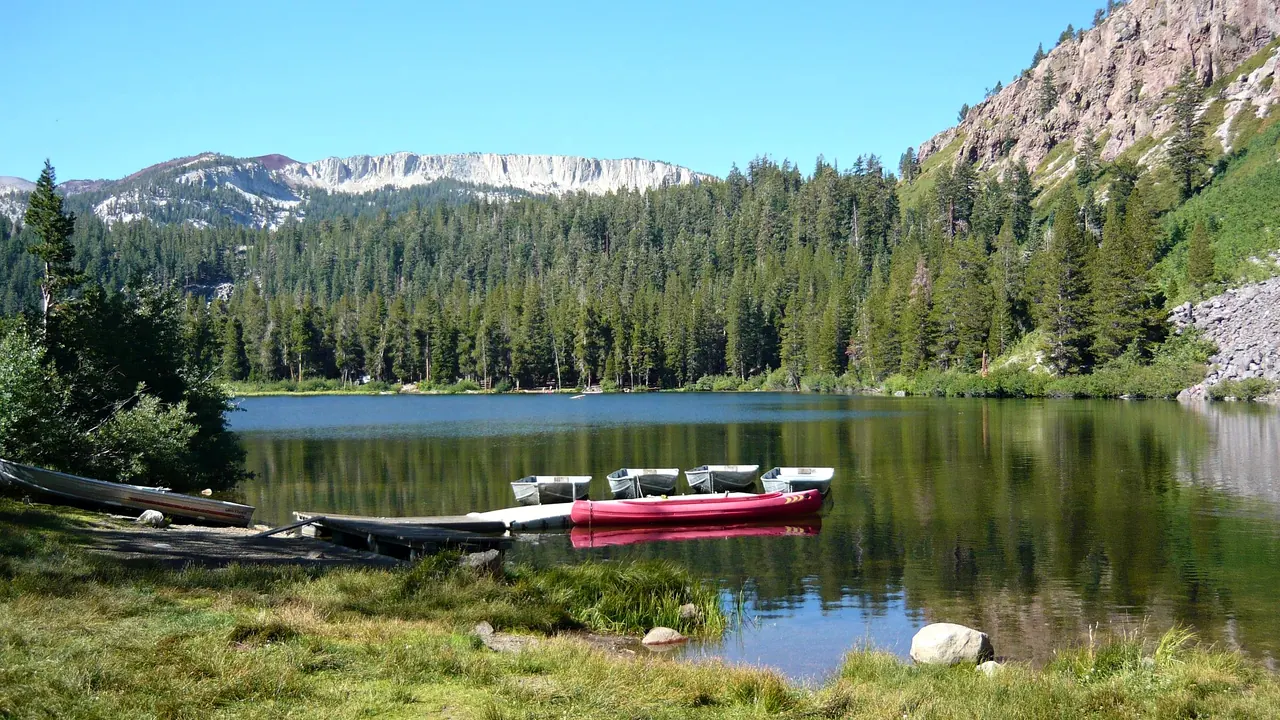
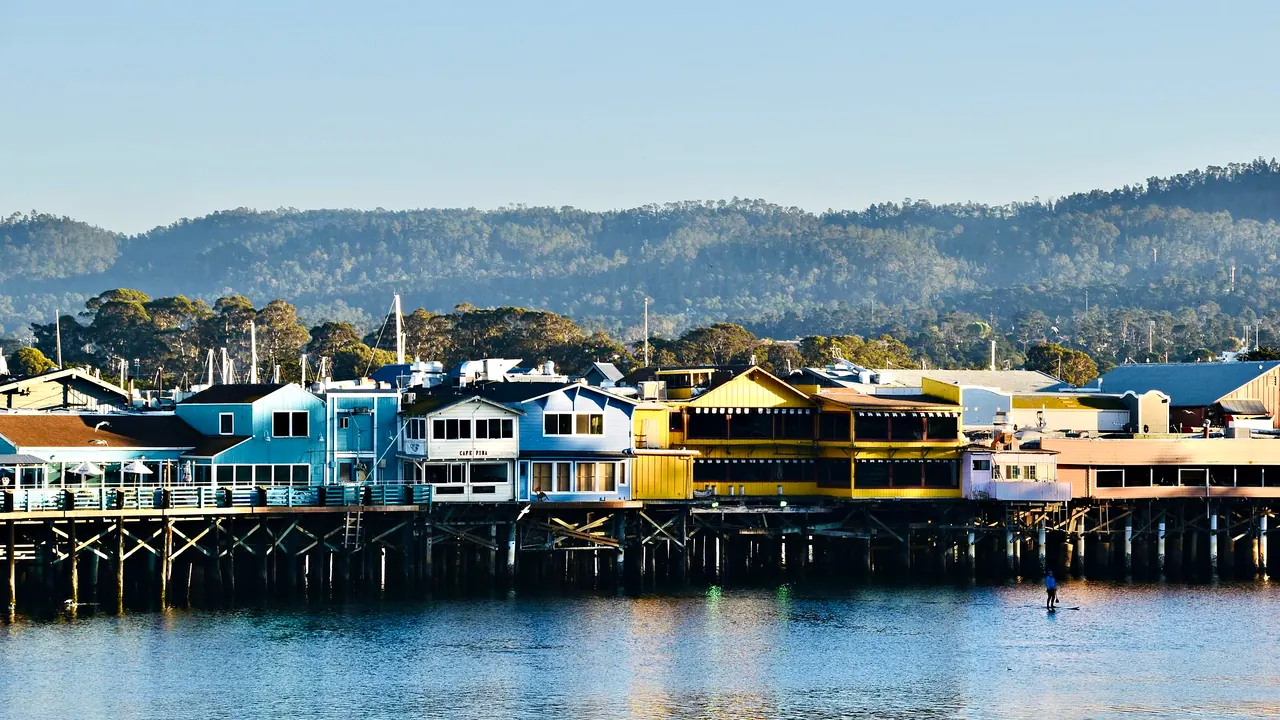
Photos: Mammoth Lakes by Dr. Al. K. Lisch, CC BY-SA 3.0, cropped; Monterey by Lesli Whitecotton, Pexels License.
Mammoth Lakes or Monterey?
Our verdict in twelve categories, each scored against the same fixed benchmark cities, and the climate month by month, so you can choose for your trip.
Choose Mammoth Lakes for
- nature and the outdoors
- wellness
- getting around
Mammoth Lakes suits travellers who want to spend every day in the mountains. Winter means one of North America's largest ski areas right above town. Once the snow melts there are granite lakes, wilderness trails, a bike park and primitive hot springs out in the sagebrush. The town itself offers little beyond lodges and après-ski, so come for the landscape and plan on driving.
Choose Monterey for
- culture and sights
- day trips
- shopping
Monterey is the better choice if you want the coast's wildlife and a town worth walking around. Sea otters float in the kelp, whales pass offshore, the aquarium is outstanding and the adobes of California's old capital are on foot from the waterfront. It suits families and couples who like an easy pace, good seafood and wine, and short outings to Carmel, Point Lobos and Big Sur.
Scoreboard
Twelve categories on one fixed scale from 0 to 100. The shaded stretch is the gap between the two.
Your match
Pick a travel style or drag the sliders, and both match scores follow your weighting.
Wins on nature and the outdoors and wellness with your weighting.
Wins on culture and sights and day trips with your weighting.
What matters to you?
Category by category
What the scores mean for a trip.
Beaches & swimming
Neither is a beach destination, but Monterey at least has a real shoreline. Del Monte Beach, the white sand at Carmel and the Asilomar dunes are lovely for walking and picnics. The bay stays chilly and rip currents are common, so swimming is mostly for wetsuited kayakers and divers.
Mammoth Lakes is far from any sea. Its swimming is a brief, cold dip in Horseshoe Lake or the slightly warmer Crowley Lake in July and August, and most people sit on the shore instead.
Food & drink
Monterey eats better because it has local ingredients to cook with. There is squid, Dungeness crab and sand dabs from the bay, vegetables from the Salinas Valley, and Pinot Noir and Chardonnay from Carmel Valley and the Santa Lucia Highlands. Skip the bread-bowl chowder on the wharf and eat in Old Monterey or Carmel instead.
Mammoth Lakes serves filling ski-town food: big breakfasts, burgers, steaks and a few more ambitious kitchens in the Village, washed down with beer brewed in town. It is a good meal after a day outside, not a reason to go.
Culture & sights
Monterey wins this easily. Its State Historic Park keeps the Custom House, Colton Hall and a walkable group of adobes from the Spanish and Mexican capital. The Royal Presidio Chapel and the Carmel Mission are close by, and Cannery Row ties the town to Steinbeck.
Mammoth Lakes grew from a mining camp into a ski resort, and its modern lodges and condominiums have little history to show. A small museum in a log cabin is close to the whole list.
Nightlife
Both towns are quiet after dark and neither has clubs, but the evenings feel different. In Mammoth Lakes, going out follows the snow. The Village and the bars near the lifts fill with après-ski crowds, and long ski weekends can run late, but the town falls silent the rest of the year. In Monterey the evening is dinner and then perhaps a glass in the wine bars and brewpubs of Alvarado Street, a steadier, low-key routine through the year.
Nature & outdoors
Both are superb, but Mammoth Lakes goes further. A huge ski mountain stands over town and becomes a bike park in summer. The Lakes Basin, the Ansel Adams and John Muir wildernesses, Devils Postpile, the tufa towers of Mono Lake and Tuolumne Meadows are all within reach. Living at about 2,400m means thin air and strong sun.
Monterey's nature is coastal and full of animals: otters in the kelp, sea lions on the wharf, and whales over the deep submarine canyon. Point Lobos and the Big Sur cliffs are just south. It is gentler and easier to reach from town, but less varied than Mammoth's high country.
Day trips
Monterey has far more within easy reach. Pacific Grove is next door and Carmel is fifteen minutes away. Steinbeck's Salinas, the mission at San Juan Bautista and Santa Cruz's boardwalk make easy half-days or full days.
From Mammoth Lakes, places are spread thinly along the highway. Bodie's ghost town and the Manzanar internment camp are each well over an hour's drive, and Mono Lake and June Lake are closer. Most outings head into the mountains rather than to other towns.
Good for families
Monterey has the edge, mostly because of its aquarium, with its kelp forest, otters and hands-on galleries. Tide pools, whale-watching boats and Dennis the Menace Park fill other days, and there is always something to do in bad weather.
Mammoth Lakes is excellent for outdoorsy families, with a big ski school, a tubing hill, rowing boats and trout fishing in the Lakes Basin. But there is nothing indoors for children, and the altitude can tire small children for the first day or two.
Getting around
In both, a car does most of the work beyond town, but they differ in how you get around within it. Mammoth Lakes is spread along a few roads. Its free winter shuttles and the Village gondola make a ski trip possible without driving, and a summer trolley and the Reds Meadow shuttle cover the lakes. Monterey has a flat, walkable waterfront, and the coastal trail joins the wharf, Cannery Row, the aquarium and Pacific Grove on foot or by bike.
Shopping & style
Monterey offers the better browsing, though mostly next door rather than in town. Carmel's small streets of galleries and independent boutiques and Pacific Grove's antique shops make a pleasant afternoon, while Cannery Row is mostly taffy and otter souvenirs. Mammoth Lakes is for buying gear: good ski, climbing and fly-fishing shops, landscape photography galleries and little else.
Affordability
Both are expensive, though they are dearest at opposite times of year. Mammoth Lakes is costliest in the peak ski weeks, when lift tickets, rentals and lodging all climb. Summer and the shoulder months are kinder, and condominium kitchens help. Monterey peaks on summer weekends and during the Pebble Beach car week in August. Budget travellers stay in the motels of Seaside or Marina, come midweek or in winter, and spend their days on the free coastal trail and tide pools.
Live music & performing arts
Monterey has the deeper musical history. Its jazz festival has run every September since 1958 on the fairgrounds that hosted the 1967 Pop Festival, and summer brings the Carmel Bach Festival and plays in the open-air Forest Theater. Outside the festivals there is the symphony and the restored Golden State Theatre.
Mammoth Lakes has a summer jazz festival too, plus chamber music in mountain meadows and a community theatre on the college campus. These are pleasant local evenings, not a reason to plan a trip.
Wellness & relaxation
Mammoth Lakes has something Monterey lacks: natural hot springs. You soak in simple pools out in the sagebrush with the Sierra across the valley, and lodge spas and hot tubs ease skiers' legs. Monterey's calm comes from its pace instead: fog lifting off the bay, shore walks in Pacific Grove, and vineyard resort spas in sunnier Carmel Valley, with no bathing culture to speak of.
When should you go?
Pick your month. The climate figures are measured averages, not a forecast.
Mammoth Lakes in July
Monterey in July
Daytime high, °C
Rainfall in the month, mm
Where the figures come from
Mammoth Lakes's station stands 227 m below the city centre, so the centre is likely a little cooler than the figures say.
Mammoth Lakes has no rain gauge within 25 km of the centre, so its rainfall comes from a gridded climate dataset read at the city rather than from a gauge further away.
Temperature and rainfall are climate normals, averaged over the years shown. Mammoth Lakes: 2008-2020 (rainfall 1991-2020) normals, Mammoth / Whitmore Hot Springs (12 km from centre). Monterey: 1991-2020 normals, Monterey / Pacific Grove Acres (5 km from centre).
The two climates run on opposite rhythms. Mammoth Lakes has real seasons. Winter highs sit around 6°C, and the wet months from November to March bring the snow that feeds the ski mountain, which is the reason for a winter visit. From June to September the days turn warm and almost dry, peaking near 28°C, so this is the time for hiking, the lakes and the high passes. Spring and late autumn fall in between, cool and quieter.
Monterey barely changes through the year, with mild daytime highs in the high teens and low twenties in every month. It is warmest from August to October, at about 23°C, and July and August are the driest months, with almost no rain at all. The rain comes from December to March, up to about 86mm in January. The sea stays cold all year and only reaches about 15°C at best, so it is for wetsuits rather than swimming. That makes Monterey the easier choice in winter, while Mammoth is at its best in high summer.
Which traveller are you?
For an outdoors trip, Mammoth Lakes has the edge. It has a huge ski mountain, the Lakes Basin trails, Devils Postpile and the Yosemite high country over Tioga Pass. Monterey's coastal walks and whale watching are superb, but Mammoth's mountains are wilder and more varied.
On a culture and arts trip, choose Monterey without hesitation. It has the adobes of the old Spanish and Mexican capital, the Carmel Mission, Steinbeck's Cannery Row and a jazz festival with a long history. Mammoth Lakes has little more than a small log-cabin museum.
On a family trip with children, Monterey is the easier choice. The aquarium alone fills a day, and the tide pools, the otters along the waterfront and whale-watching boats fill the rest. Mammoth suits outdoorsy families, but there is nothing to do there on a stormy day.
Before you go
| Measure | Mammoth Lakes | Monterey |
|---|---|---|
| Currency | US Dollar (USD) | US Dollar (USD) |
| Sockets | AB120 V, 60 Hz | AB120 V, 60 Hz |
| Driving side | Right | Right |
| Time zone | UTC-8, UTC-7 in summer | UTC-8, UTC-7 in summer |
| Emergency number | 911 | 911 |
| Elevation | 2,402 m | 8 m |
| Main airport | Reno Tahoe International Airport (RNO)217 km from centre25 non-stop destinations | Mineta San Jose International Airport (SJC)85 km from centre39 non-stop destinations |
| Public holidays this year | 13 days | 13 days |
By the numbers
| Measure | Mammoth Lakes | Monterey |
|---|---|---|
| City population | 7,191 | 30,218 |
| People per km² | 110 | 991 |
| Museums within 10 km | 0 | 5 |
| UNESCO World Heritage sites within 50 km | 0 | 0 |
| Swim season, months above 21 °C | - | None |
Where else could you go?
Every comparison below shares a destination with this one, so you can follow Mammoth Lakes or Monterey somewhere new.
- Carmel-by-the-Seavs Monterey
- San Josevs Monterey
- San Franciscovs Monterey
- South Lake Tahoevs Mammoth Lakes
- Napavs Monterey
- Sonomavs Monterey