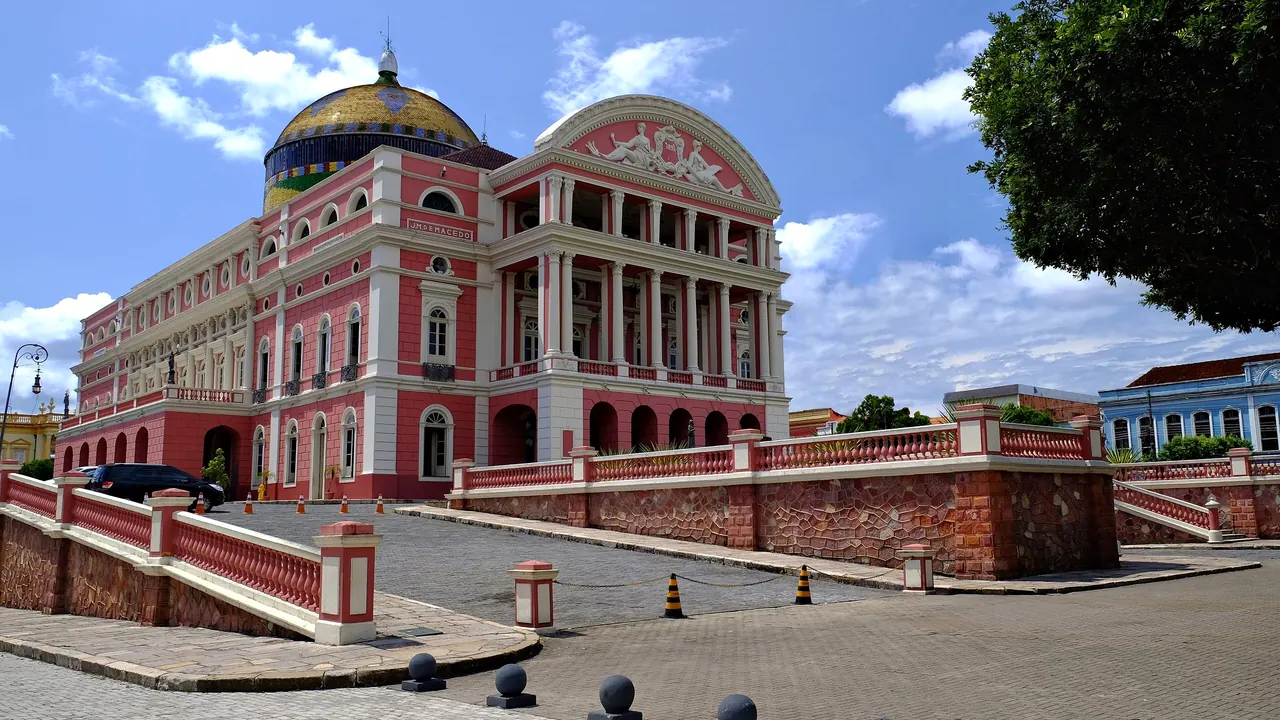
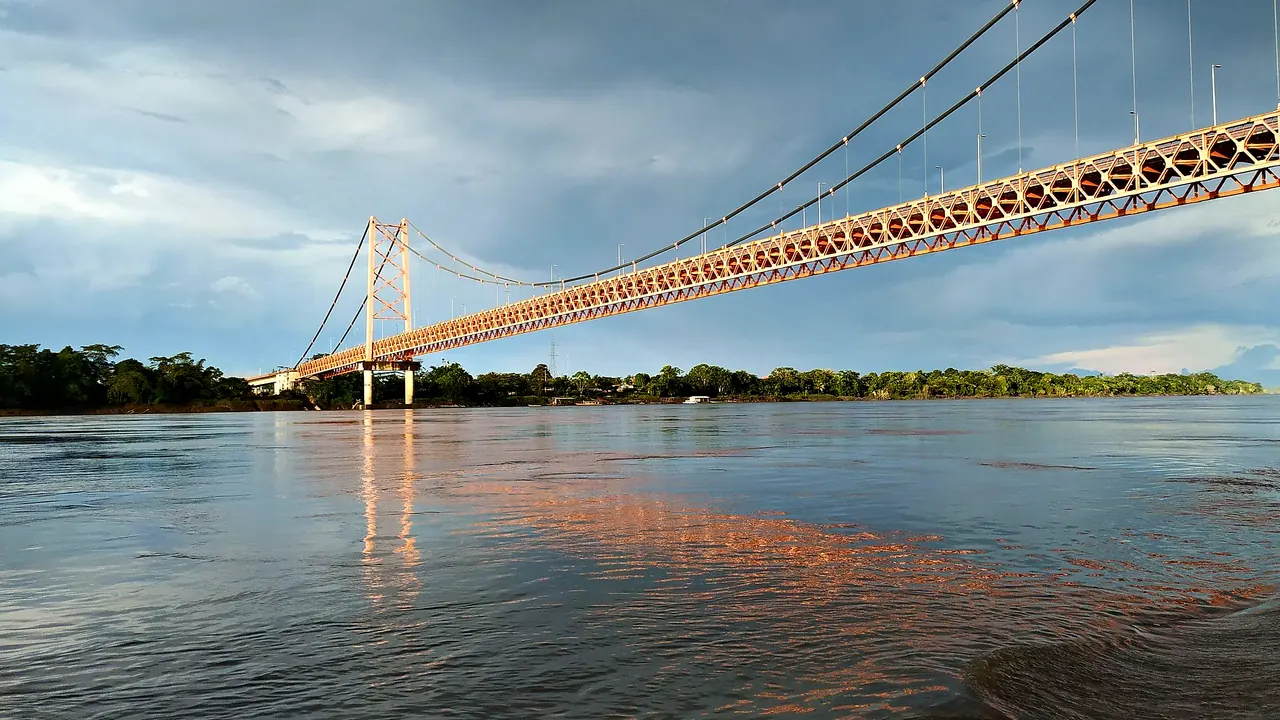
Photos: Manaus by Jardelsliumba, CC BY-SA 4.0, cropped; Puerto Maldonado by FERNANDO HUAMANI, Pexels License.
Manaus or Puerto Maldonado?
Our verdict in twelve categories, each scored against the same fixed benchmark cities, and the climate month by month, so you can choose for your trip.
Choose Manaus for
- live music and the arts
- culture and sights
- beaches
Manaus suits travellers who want the Amazon and a proper city in the same trip. Between boat outings you can tour the rubber-boom opera house, eat river fish and tacacá at the markets, and spend an evening at Ponta Negra or in the bars of Vieiralves. If the jungle is one part of a broader Brazilian journey, or you want a few comfortable days in town either side of a lodge stay, this is the better base.
Choose Puerto Maldonado for
- wellness
- nature and the outdoors
Puerto Maldonado is for people who have come for the rainforest and very little else. The town is a functional stop with few sights, and almost everything worth doing happens upriver: giant otters on Lake Sandoval, macaws at the clay licks, night walks in the Tambopata reserve. Some lodges are less than an hour away by canoe, so you are in the forest almost as soon as you land. Choose it for a focused wildlife trip where evenings mean an early bed rather than a night out.
Scoreboard
Twelve categories on one fixed scale from 0 to 100. The shaded stretch is the gap between the two.
Your match
Pick a travel style or drag the sliders, and both match scores follow your weighting.
Wins on live music and the arts and culture and sights with your weighting.
Wins on wellness and nature and the outdoors with your weighting.
What matters to you?
Category by category
What the scores mean for a trip.
Beaches & swimming
Manaus at least gives you somewhere to swim. Ponta Negra lies on the warm, dark Rio Negro, with a promenade and sunsets over the water, though the water quality is not always good. In the low-water months boats run out to white sandbanks such as those around Tupé.
Puerto Maldonado's Tambopata and Madre de Dios are brown and fast, and nobody swims from the town. A lodge may offer a guided dip in a calm oxbow lake when caimans and stingrays allow, but in practice the hotel pool is where you cool off.
Food & drink
The two cities share a lot of produce, since the giant fish Brazilians call pirarucu is the paiche of Peruvian menus, but Manaus has far more places to eat it. Here you can try grilled tambaqui ribs, tacacá from street stalls in the late afternoon and tucumã rolls for breakfast, and the Adolpho Lisboa and Panair markets are worth a morning.
Puerto Maldonado's dishes are good and distinctive: juane steamed in leaves, tacacho with smoked pork, and Brazil nuts in every form. But the restaurants around the Plaza de Armas are few and simple, and most of your meals will be the plain set menus at a jungle lodge.
Culture & sights
Both towns grew rich on rubber, but only Manaus spent the money on monuments. The pink-domed Teatro Amazonas, the Palácio da Justiça, the Customs House and the iron market hall give it a real rubber-boom centre, and there is a boat trip to the rebuilt estate at the Museu do Seringal. Allow two days.
Puerto Maldonado is a frontier town of timber, gold and Brazil nuts. The Obelisco viewing tower, the modern cathedral and the bridge over the Madre de Dios take an hour or two at most.
Nightlife
Manaus has a real night out, even though it is informal and spread across the city. The Ponta Negra waterfront fills on warm evenings, Adrianópolis and Vieiralves have bars visitors feel at ease in, and the dance halls play forró and boi-bumbá late into Friday and Saturday nights. There are no proper clubs, though, and getting between places takes taxis.
Puerto Maldonado's cumbia and reggaeton discotecas and karaoke bars are for local weekends and hold little for a visitor. Most guests are at a lodge by dark, out on a caiman walk.
Nature & outdoors
This is why people go to either city, and both deliver superbly in different ways. Manaus is about the scale of the great rivers: the Meeting of the Waters, the island maze of the Anavilhanas, pink dolphins and boats gliding through flooded treetops in high water. Even within the city, the INPA grounds and the canopy tower at the Museu da Amazônia let you see the forest up close.
Puerto Maldonado puts you closer to protected forest. The Tambopata reserve and Bahuaja-Sonene park begin upriver, Lake Sandoval's giant otters are near town, and the dawn clay licks draw hundreds of macaws. For serious wildlife watching in Manaus you need a few nights at a lodge. Here, that is simply how everyone stays.
Day trips
Neither city is a base for touring, but Manaus has slightly more beyond the riverbank. The road north reaches the waterfalls and caves of Presidente Figueiredo, and boat outings call at riverside communities.
From Puerto Maldonado the roads lead only into cattle ranches and gold-mining land, so every excursion is a trip into the forest itself.
Good for families
Both are hard going with small children, but Manaus is the easier of the two. The Bosque da Ciência has manatees, otters and squirrel monkeys, the army jungle centre keeps a small zoo, and Ponta Negra gives children room to run in the evening. Brazilian warmth towards children helps too, although heat, mosquitoes and the crowded centre take their toll.
Puerto Maldonado really suits older children who love animals: tarantulas on night walks, macaws and a butterfly farm near town. Yellow fever vaccination is advised, medical care is basic, the days start at dawn and the boat rides to the better lodges are long.
Getting around
Neither place is easy to get around, but the difficulty takes a different shape in each. Manaus spreads far beyond its compact rubber-boom core, so once you leave the streets by the theatre and the market you will call a car for almost every journey, whether to the riverfront at Ponta Negra or to an evening in Vieiralves, and after dark even the centre is better crossed by car than on foot. What you gain is independence on the water: you can take a public ferry from the port or choose your own boat excursion, and plan each day as you like.
Puerto Maldonado is small enough that a mototaxi covers any trip in town. Beyond it, though, the river belongs to your lodge, which meets you at the airport and carries you upstream by boat. Nothing needs organising, but there is also little you can do on your own.
Shopping & style
Manaus is the place to buy something to take home. Indigenous basketry, feather work, seed jewellery and natural oils are sold around the market and near the theatre, along with guaraná powder. As a free-trade zone it also has streets full of electronics and large malls.
Puerto Maldonado offers Brazil nuts, nut sweets and a few craft stalls, and the forest gear you need should be bought before you arrive.
Affordability
The two work out much the same: cheap in town, expensive once you go into the forest, with the remote lodges and private boats costing most. The difference lies in how the trip is built. Manaus rewards a few days in town, with reasonably priced business hotels, cheap taxis and modest tickets to the Teatro Amazonas.
In Puerto Maldonado almost everyone buys an all-inclusive lodge package, which makes it the main cost of the trip. The ways to save are a lodge closer to town or a day trip to Lake Sandoval.
Live music & performing arts
Here the two are far apart. In Manaus the Teatro Amazonas is a working opera house. The Amazonas Philharmonic and the state ballet and choir perform there, and the annual opera festival stages full productions, so a night inside is among the highlights of the city. Boi-bumbá shows and dance halls add the drums and costumes of the Amazon festival tradition.
In Puerto Maldonado the performing arts amount to the odd festival folk dance on the plaza and a little music at some lodges.
Wellness & relaxation
Neither has a spa or bathing tradition, and in both the restful part is time on the river. In Manaus you have to leave a hot, noisy, congested city to find that calm, and in town relaxing means the hotel pool or the occasional hotel spa.
Puerto Maldonado's visitors are mostly at a lodge from the start, with hammocks and forest sounds at night, and a few lodges offer massages. Dawn walks and insects keep it from being a lazy stay, though.
When should you go?
Pick your month. The climate figures are measured averages, not a forecast.
Manaus in July
Puerto Maldonado in July
Daytime high, °C
Rainfall in the month, mm
Temperature and rainfall are climate normals, averaged over the years shown. Manaus: 1991-2020 normals, Manaus (1.7 km from centre). Puerto Maldonado: 1963-2025, 28 years observed (rainfall 1981-2010) normals, Puerto Maldonado (4.1 km from centre).
Both cities are hot in every month, with daytime highs around 30°C or above all year, so the choice is really between wet and dry. In Manaus the heavy rain runs from about December to May, with more than 300mm a month in March and April. The drier, sunnier stretch lasts from June to October. August and September are the clearest months but also the hottest, reaching 35°C, which makes walking the old centre at midday hard work. The river keeps its own calendar: flooded forest roughly from May to July, then sandbanks and river beaches from about September.
Puerto Maldonado's dry season is shorter and sharper. From June to August rainfall drops to around 45mm a month and the forest trails are at their firmest, and May and June are slightly less hot than the rest of the year. The rain comes back sooner than in Manaus, building from September and October, and December to March are the wettest, muddiest months. July and August suit either city well.
Which traveller are you?
For a culture and arts trip, Manaus is the clear choice. The Teatro Amazonas can be toured by day and heard at night, with opera, ballet and the Philharmonic, and the rubber-boom palaces and market hall fill two days. Puerto Maldonado has almost none of this.
On a food and nightlife trip, Manaus again comes out ahead. Its markets and street stalls serve tambaqui, pirarucu and tacacá, and on weekends forró and boi-bumbá keep going late. In Puerto Maldonado most meals are set lodge menus and evenings end early.
For an outdoors trip built around wildlife, Puerto Maldonado is the sharper choice. Lodges inside the Tambopata area are quick to reach, and Lake Sandoval's otters and the dawn macaw clay licks are its signatures. Manaus is better for vast river scenery and flooded forest.
Before you go
| Measure | Manaus | Puerto Maldonado |
|---|---|---|
| Official language | Portuguese | Spanish, Aymara, Quechua |
| Currency | Brazilian Real (BRL) | Sol (PEN) |
| Sockets | CN60 Hz | ABC220 V, 60 Hz |
| Driving side | Right | Right |
| Time zone | UTC-4 | UTC-5 |
| Emergency number | Police 190, ambulance 192, fire 193 | 111 or 911 |
| Elevation | 92 m | 183 m |
| Main airport | Eduardo Gomes International Airport (MAO)9 km from centre21 non-stop destinations | Padre Aldamiz International Airport (PEM)5 km from centre2 non-stop destinations |
| Public holidays this year | 14 days | 17 days |
By the numbers
| Measure | Manaus | Puerto Maldonado |
|---|---|---|
| Population | 2,303,732 | 85,024 |
| People per km² | 202 | - |
| Museums within 10 km | 13 | 0 |
| UNESCO World Heritage sites within 50 km | 1 | 0 |
Where else could you go?
Every comparison below shares a destination with this one, so you can follow Manaus or Puerto Maldonado somewhere new.
- Cuscovs Puerto Maldonado
- Punovs Puerto Maldonado
- La Pazvs Puerto Maldonado
- Arequipavs Puerto Maldonado
- Limavs Puerto Maldonado
- Paramaribovs Manaus