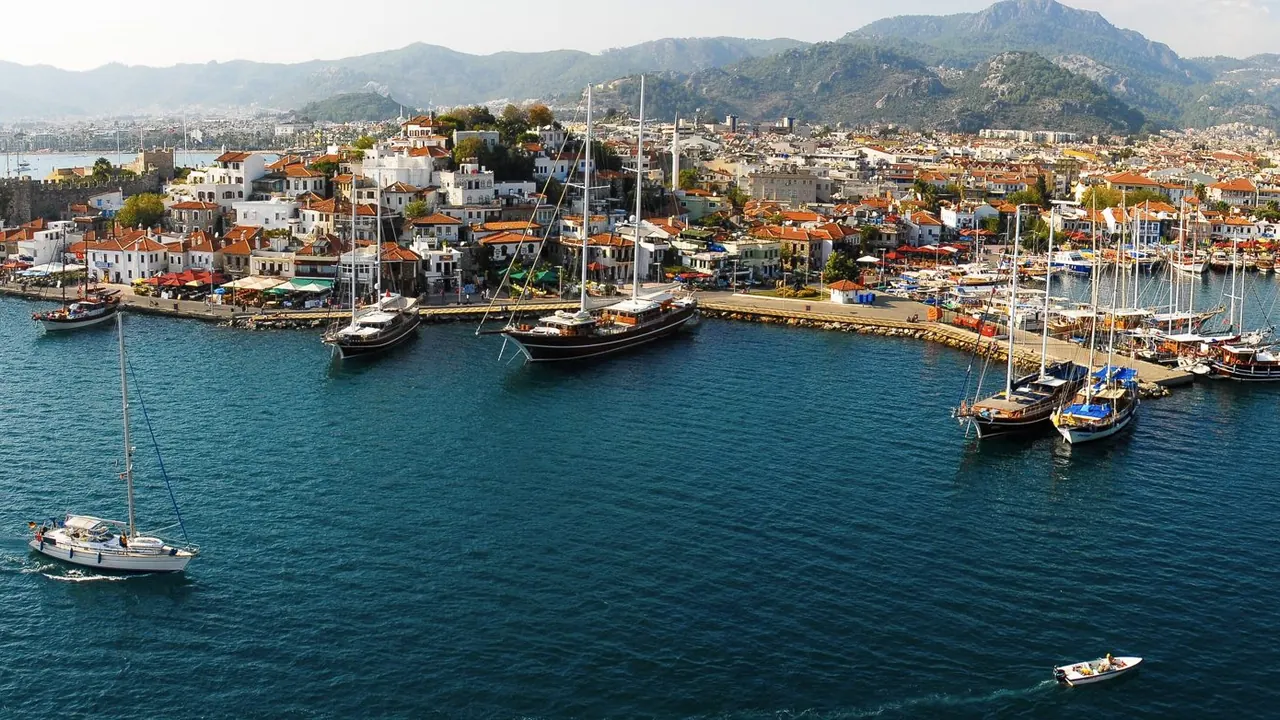
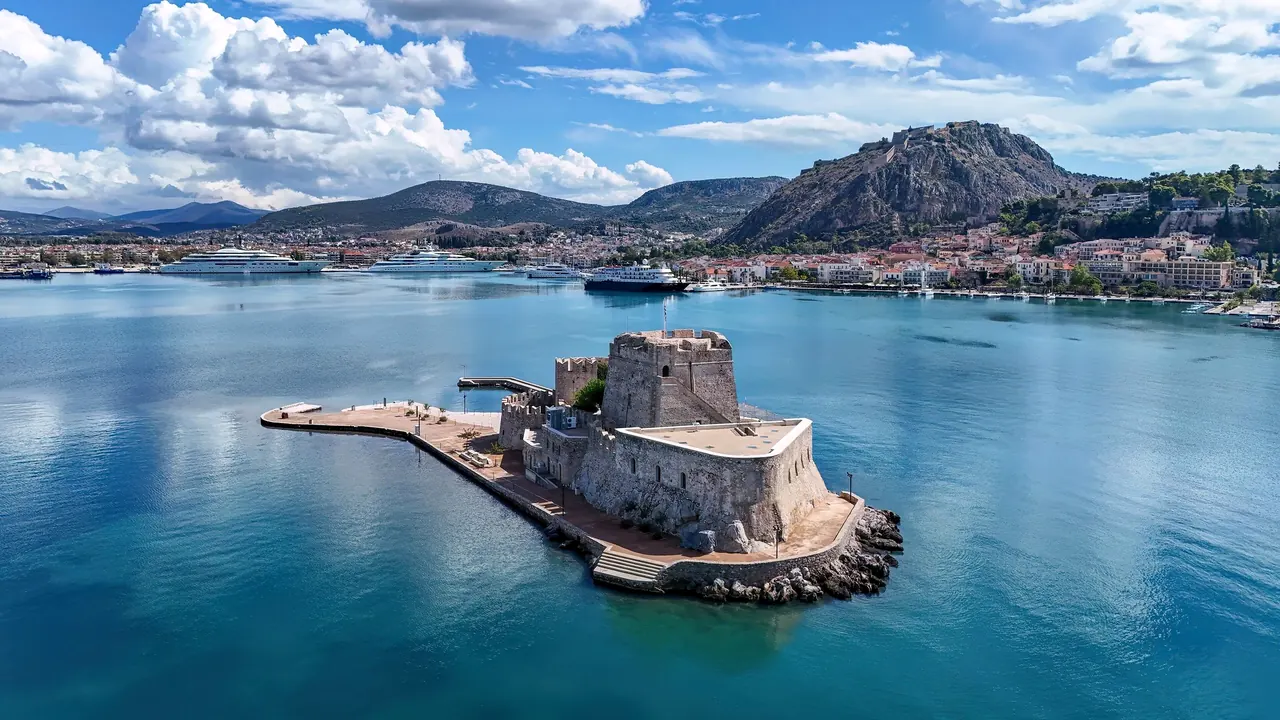
Photos: Marmaris by Mstyslav Chernov, CC BY-SA 3.0, cropped; Nafplio by Giles Laurent, CC BY-SA 4.0, cropped.
Marmaris or Nafplio?
Our verdict in twelve categories, each scored against the same fixed benchmark cities, and the climate month by month, so you can choose for your trip.
Choose Marmaris for
- nightlife
- wellness
- beaches
Marmaris suits a trip built around the water. The enclosed bay, the boat trips to clear coves and the sailing grounds of the Bozburun and Datca peninsulas make it the better choice for swimming, sailing and lazy resort days. Bar Street gives it a loud summer night out that Nafplio does not try to match. Families who want pools, calm water and a water park will find it easier too, and it costs a little less.
Choose Nafplio for
- culture and sights
- day trips
- live music and the arts
Travellers who want history around them should pick Nafplio. Its Venetian and neoclassical old town and the Palamidi fortress are far more rewarding to explore than the castle quarter of Marmaris, and Mycenae, Tiryns and Epidaurus are a short drive away. It is the quieter of the two after dark, made for long dinners by the harbour rather than clubs, and it suits couples and history lovers who want their swimming to fit around the sightseeing.
Scoreboard
Twelve categories on one fixed scale from 0 to 100. The shaded stretch is the gap between the two.
Your match
Pick a travel style or drag the sliders, and both match scores follow your weighting.
Wins on nightlife and wellness with your weighting.
Wins on culture and sights and day trips with your weighting.
What matters to you?
Category by category
What the scores mean for a trip.
Beaches & swimming
Marmaris has the better swimming. A long strip of sand and shingle runs the length of the promenade towards Icmeler, but the real reward is out on the water: boat trips to clear coves, the pebble bays of the Bozburun peninsula and the fine sand of Sedir Island. The catch is the summer crowds on the main beach.
Nafplio's beaches are smaller and play a supporting role. Arvanitia is a pebbly spot for a quick swim below the cliffs, a short walk from the old town. Karathona has sand in a bay backed by pines, and Tolo has the sunbeds and tavernas. The swimming is pleasant, but few people would choose Nafplio for its beaches alone.
Food & drink
Neither town is a food destination, and in both you eat better away from the busiest streets. In Marmaris that means skipping the resort menus on the seafront for lokanta stews, pide houses and meze by the harbour, with the weekly market and pine honey as the highlights.
Nafplio's cooking is Peloponnesian rather than Turkish: grilled octopus, slow-cooked lamb, Argolid citrus and Nemea red wine, eaten at tables in the lanes of the old town. The best meals tend to be out at Tolo or in the villages of the plain, and there is little on offer beyond Greek food.
Culture & sights
Here Nafplio is far ahead. It was the first capital of modern Greece, and its old town of Venetian, Ottoman and neoclassical houses is worth exploring for its own sake. The Palamidi fortress stands above it, and the Venetian arsenal on Syntagma Square holds the Archaeological Museum and its Mycenaean bronze armour.
Marmaris has its small Ottoman castle, a modest museum and enough whitewashed lanes in the old quarter for about an hour. Visitors interested in history spend their time there on excursions, while in Nafplio the town itself is the sight.
Nightlife
Marmaris is the place for a big night out. Bar Street, behind the harbour, packs open-fronted clubs, laser shows and foam parties into one lane, and it runs until near dawn all summer, mostly for a young British crowd. There are calmer cocktail bars around the marina. It offers one style of night, and it mostly shuts down from November to April.
Nafplio has no real clubs. An evening there means a late dinner and then drinks on the harbour front or in the lanes off Syntagma Square. It gets livelier on summer weekends, when visitors arrive from Athens.
Nature & outdoors
Pine-covered hills almost enclose the bay at Marmaris, and beyond them the largely undeveloped Bozburun and Datca peninsulas make it one of the great sailing bases of the Turkish coast. Gulet cruises, diving, kayaking and the Carian Trail are all on offer.
Nafplio's outdoors is gentler and closer to hand: the paved path around the Akronafplia headland, the coastal trail to Karathona, limestone crags for climbers and kayaking off Tolo. For serious hiking you drive about an hour and a half to the fir forests and gorges of the Mainalo range.
Day trips
Nafplio has far richer surroundings. Tiryns is about ten minutes away, Mycenae under half an hour and Epidaurus about forty minutes. With a car, Ancient Corinth, the Nemea wine villages and even the islands of Hydra and Spetses each make a day out.
Marmaris has one outstanding outing, the hour's ferry to the walled medieval town of Rhodes. The boat trip up the river at Dalyan, past rock tombs to the ruins of Kaunos, is also good. The peninsula villages, Datca and Knidos are rewarding but mean long drives on winding roads.
Good for families
Marmaris is the easier base for families. Large hotels with children's pools and clubs, a water park, calm shallow water and boat trips with swimming stops keep children busy. The best places to stay are Icmeler or Armutalan, away from the noise of Bar Street.
Nafplio suits families who want a slower pace, with an old town largely free of traffic, ice cream along the harbour, shallow water at Karathona and the boat out to the Bourtzi. Nothing there is built for children, though, and the Palamidi steps and the exposed ancient sites are tough going in summer.
Getting around
Getting around the bay is easier in Marmaris. The flat promenade runs for several kilometres to Icmeler, dolmus minibuses come and go constantly, and water taxis cross to Icmeler and Turunc.
Nafplio's old town is small and flat enough to cover on foot, but beyond it buses are infrequent and a car is close to essential for the ancient sites. In both towns, exploring further afield means hiring a car or joining tours.
Shopping & style
Marmaris gives shoppers more to do. Most of it happens in the covered bazaar behind the harbour, where you haggle over leather, carpets, spices and copy designer goods, and there is also a lively weekly market. Pine honey, natural sponges and peshtemal towels are the things worth taking home.
Shopping in Nafplio takes an hour or two of browsing along Vasileos Konstantinou and around Syntagma Square, among sandals, souvenirs and a few jewellers and galleries. Komboloi worry beads, olive oil and Nemea wine are the local buys.
Affordability
Marmaris is a little easier on the wallet. Package and all-inclusive hotels are plentiful and keenly priced, the dolmus is cheap and so is the food in the lokanta, which keeps a stay affordable. The costs that add up are seafront restaurants, Bar Street and organised trips.
In Nafplio, meals, wine and entry to the ancient sites are fair value, and your room is the main expense. Guesthouses in old-town mansions cost more at weekends and in high summer, so staying on weekdays or in Tolo makes a budget go further.
Live music & performing arts
Nafplio has the one great event. Each summer the Athens and Epidaurus Festival stages ancient Greek drama in the theatre of Epidaurus, about forty minutes away, and a classical music festival uses historic buildings in town. Outside summer there is little on.
Marmaris offers hotel shows, Turkish nights put on for tourists and the occasional concert in its open-air amphitheatre, but nothing to plan an evening around.
Wellness & relaxation
Steam, scrub and foam massage in a hammam are easy to find in Marmaris, both in town and in most large hotels, and the bigger resorts add full spas. The mud baths near Dalyan make a good half-day, and for real quiet you can stay in Turunc, Selimiye or Bozburun rather than the centre.
Nafplio has no baths of its own, so relaxing there comes down to its slow pace: long lunches, an evening walk around the headland and coffee by the harbour. The nearest thermal spa is at Loutraki, about an hour's drive away.
When should you go?
Pick your month. The climate figures are measured averages, not a forecast.
Marmaris in July
Nafplio in July
Daytime high, °C
Rainfall in the month, mm
Where the figures come from
Marmaris's temperatures are measured 49 km from the centre, at Dalaman.
Marmaris has no rain gauge within 25 km of the centre, so its rainfall comes from a gridded climate dataset read at the city rather than from a gauge further away.
Nafplio's temperatures are measured 89 km from the centre, at Kalamata Airport.
Nafplio has no rain gauge within 25 km of the centre, so its rainfall comes from a gridded climate dataset read at the city rather than from a gauge further away.
Temperature and rainfall are climate normals, averaged over the years shown. Marmaris: 2000-2020 (rainfall 1991-2020) normals, Dalaman (48.8 km from centre). Nafplio: 1991-2020 normals, Kalamata Airport (88.8 km from centre).
Summer is almost the same in both towns. June to August is dry, with afternoons around 32°C that make sightseeing in the middle of the day hard work and push any walking into the early morning. The sea is warm enough for swimming from June into October in both, and Marmaris keeps its water slightly warmer, reaching 27°C in August and holding more of that warmth into autumn. May and late September are the best months to do more than swim, with warm days, little rain and a sea that is still inviting. October is still warm, but the rain comes back, especially in Marmaris, where October is as wet as March.
Winter is where they differ. Marmaris turns very wet from November to February, with about 232mm of rain in January. Nafplio gets only a fraction of that, about 66mm, and from March its days turn sunny again. Neither town is cold in winter, but out of season you are far more likely to stay dry walking Nafplio's lanes and ruins.
Which traveller are you?
For a beach and sun trip, Marmaris is the better pick. The long bay beach, the quieter sand at Icmeler and Turunc and the daily boat trips to clear coves offer more choice than Nafplio's small pebble beach and its modest bays at Karathona and Tolo.
On a culture and arts trip, Nafplio wins easily. The preserved old town of Greece's first capital, Palamidi and the Archaeological Museum are close to Mycenae, Tiryns and Epidaurus, and Epidaurus stages summer drama in its ancient theatre. Marmaris has nothing to match this.
For a food and nightlife trip, Marmaris comes out ahead because of its nights. The food is of a similar standard in both, Turkish meze and grilled fish in one and Greek taverna cooking in the other. But the clubs on Bar Street run until near dawn, while Nafplio winds down over a glass of wine by the harbour.
Before you go
| Measure | Marmaris | Nafplio |
|---|---|---|
| Official language | Turkish | Greek |
| Currency | Turkish Lira (TRY) | Euro (EUR) |
| Sockets | CF230 V, 50 Hz | CF230 V, 50 Hz |
| Driving side | Right | Right |
| Time zone | UTC+3 | UTC+2, UTC+3 in summer |
| Emergency number | 112 | 112 |
| Elevation | 7 m | 6 m |
| Main airport | Dalaman International Airport (DLM)49 km from centre61 non-stop destinations | Athens Eleftherios Venizelos International Airport (ATH)109 km from centre173 non-stop destinations |
| Public holidays this year | 14 days | 15 days |
By the numbers
| Measure | Marmaris | Nafplio |
|---|---|---|
| City population | 97,818 | 14,532 |
| People per km² | 111 | 433 |
| Museums within 10 km | 1 | 5 |
| UNESCO World Heritage sites within 50 km | 1 | 2 |
| Swim season, months above 21 °C | 6 months | 5 months |
Where else could you go?
Every comparison below shares a destination with this one, so you can follow Marmaris or Nafplio somewhere new.
- Bodrumvs Marmaris
- Fethiyevs Marmaris
- Athensvs Nafplio
- Kasvs Marmaris
- Kusadasivs Marmaris
- Izmirvs Marmaris