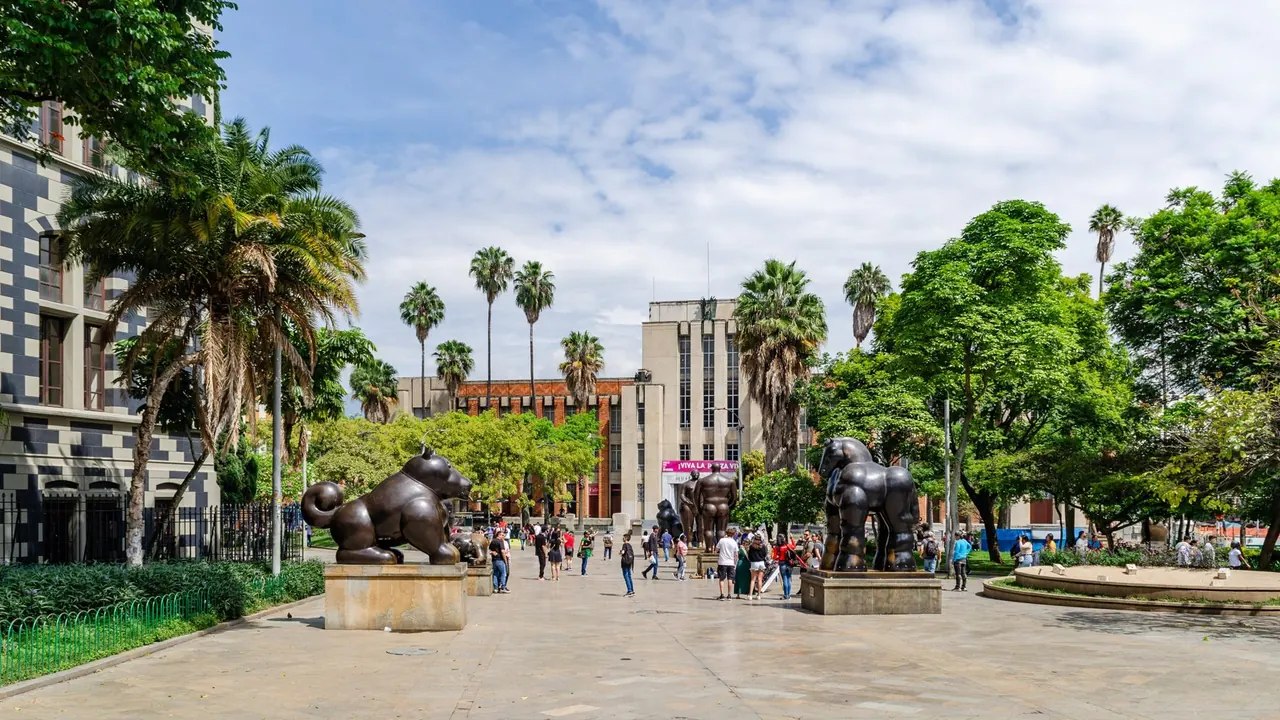
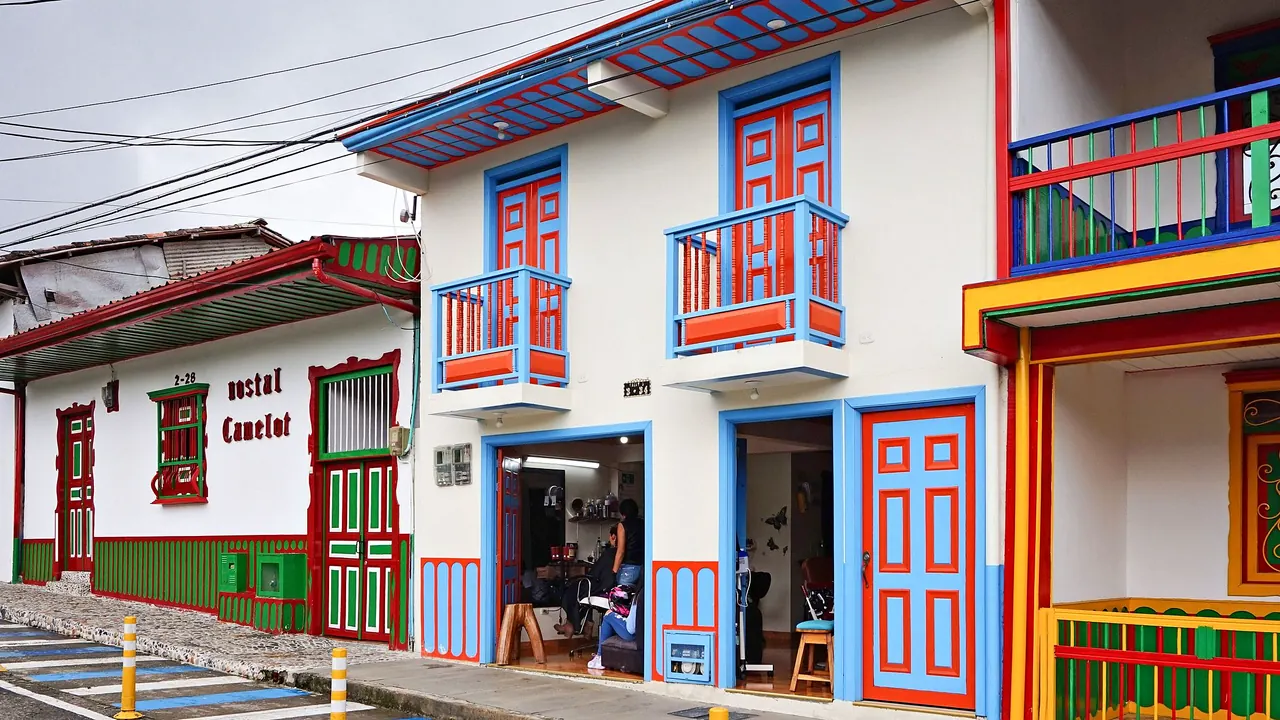
Photos: Medellin by Steffen Schmitz, CC BY-SA 4.0, cropped; Salento by Bernard Gagnon, CC BY-SA 4.0, cropped.
Medellin or Salento?
Our verdict in twelve categories, each scored against the same fixed benchmark cities, and the climate month by month, so you can choose for your trip.
Choose Medellin for
- nightlife
- live music and the arts
- food and drink
Medellín suits travellers who want a city with some energy behind it. You get reggaeton clubs and salsa bars, a far wider choice of restaurants and cafés, the Botero collection, and a modern history told honestly at the Casa de la Memoria and in Comuna 13. The metro and gondolas make it easy to get around, and both Guatapé and the colonial streets of Santa Fe de Antioquia are within a day's reach.
Choose Salento for
- nature and the outdoors
- wellness
- families
Pick Salento for the landscape rather than the town. The wax palms of the Cocora Valley, cloud forest trails, coffee farms within walking distance and treks towards the volcanoes of Los Nevados make it the better base for days outdoors. A finca on its edge also gives a quieter rest than anything in Medellín's loud valley. Evenings end early and the menus are simple, so it rewards walkers more than night owls.
Scoreboard
Twelve categories on one fixed scale from 0 to 100. The shaded stretch is the gap between the two.
Your match
Pick a travel style or drag the sliders, and both match scores follow your weighting.
Wins on nightlife and live music and the arts with your weighting.
Wins on nature and the outdoors and wellness with your weighting.
What matters to you?
Category by category
What the scores mean for a trip.
Beaches & swimming
Neither city is anywhere near the sea, and in both of them swimming means a pool. In Medellín the warmer air makes an afternoon at a hotel pool or a hill finca more tempting, and the Guatapé reservoir adds boating on open water. In Salento the mountain rivers are cold and rocky, so a dip means a finca pool or the water rides at the theme parks near Armenia. Either way, sand means flying to the Caribbean coast as a separate leg of the trip.
Food & drink
Medellín offers far more to eat. Beyond the hearty paisa staples of bandeja paisa, sancocho and arepas, El Poblado and Provenza have creative Colombian and international kitchens, Laureles is good for long local lunches, and the Minorista market shows off the region's fruit and produce.
Salento's cooking comes down to one good dish, local trout on a crisp patacón, plus set lunches around the plaza. Coffee is what the two share. Medellín serves it in a strong café scene, while in Salento you can walk out to a finca and drink it where it was grown.
Culture & sights
Medellín has the larger cultural programme, and most of it is about the city's recent past rather than old buildings. You have the Botero collection and plaza in the old centre, the Casa de la Memoria on the years of violence, the murals and escalators of Comuna 13 and the Metrocable over the barrios. Together they fill two or three days.
Salento turns that round. It has almost no museums, but its Calle Real of painted timber-and-earth houses with carved balconies, set within the UNESCO coffee landscape, has the traditional character that Medellín largely lost. An hour or two and the climb to Alto de la Cruz cover it.
Nightlife
This is where the two differ most. Medellín is a city people visit partly to go out. Reggaeton clubs and rooftop bars pack Parque Lleras and Provenza, Laureles and La 70 have cheaper salsa bars full of locals, and nights run until morning at weekends.
Salento's evenings are a few bars on the plaza and a game of tejo, throwing metal discs at exploding targets over beers, which is fun and unlike anything in the city. Most visitors are up early for hikes, so the town is asleep well before Medellín has got going.
Nature & outdoors
Salento wins here, because the landscape is the reason to go. The Cocora Valley's wax palms, up to 60m tall, the cloud forest loop with its plank bridges and hummingbirds, and multi-day treks across the páramo of Los Nevados towards glaciated volcanoes are all on its doorstep.
Medellín's green is easier to reach but gentler. A cable car from the metro climbs to the forest trails of Parque Arví, paragliders take off from San Félix, and the drowned valleys and granite rock of El Peñol are two hours away. It is good for a city, but no match for Salento's high mountains.
Day trips
Medellín's day trips cover more ground. Guatapé's painted zócalo houses and El Peñol's rock are a lake landscape, Santa Fe de Antioquia is a whitewashed colonial capital in hot lowland, and Carmen de Viboral adds its hand-painted ceramics.
From Salento the outings are pleasant but similar to each other. Filandia's lookout tower, ridge-top Buenavista and Circasia repeat the same balconies and coffee hills. The real change of scene is Armenia's museum of Quimbaya goldwork, or the busier city of Pereira.
Good for families
Both work for families, but in different ways. Medellín's draw is its cluster of museums: Parque Explora with its aquarium, the planetarium and botanical garden beside it, and gondola rides up to Parque Arví. The costs are heavy traffic, uneven pavements and sticking to El Poblado or Laureles.
Salento is a small town where children can ride in open jeeps, go on horseback, watch hummingbirds and see coffee picked. The Parque del Café and Panaca's farm animals are about an hour away, though rain and the muddy Cocora loop can test small legs.
Getting around
Medellín has a real network. The tidy metro along the valley links up with Metrocable gondolas and a tram, and cheap taxis and ride-hailing apps fill the gaps between neighbourhoods. Peak-hour traffic is the main drawback.
Salento takes a few minutes to cross on foot, but beyond the town you depend on old Willys jeeps that leave for Cocora when they are full, and on regional buses that usually mean a change in Armenia or Pereira. It works without a car, but expect waits and winding roads, or hire a driver.
Shopping & style
Medellín is Colombia's textile centre. You can browse local clothing labels, swimwear and leather in the El Poblado malls and the Provenza boutiques, or brave the crowded wholesale maze of El Hueco downtown. Salento's shopping is the craft shops of Calle Real, selling woven bags, ponchos and carved wood, and bags of beans from the farms around town make the best souvenir.
Affordability
Both are cheap for most visitors, and the costs fall in different places. In Medellín the metro, taxis, fruit and set lunches cost little, and most sights are free. Prices rise in El Poblado and Provenza, so staying in Laureles keeps the bill down. In Salento hostels, set lunches and jeep rides are cheap, but the town costs more than the farming towns around it, and boutique fincas and guided high-mountain treks are what push a budget up.
Live music & performing arts
Medellín has a genuine stage life. Salsa bars have live bands, tango has held on since Carlos Gardel died here in 1935, the Teatro Metropolitano is home to the philharmonic, and the Feria de las Flores fills the streets with music each August.
Salento has nothing comparable. Music there means a guitar in a café, a weekend band in a bar or the town's annual festivities, and the nearest theatres are in Armenia and Pereira.
Wellness & relaxation
Salento is the better place to slow down. Neither has a spa tradition, but a coffee finca outside town gives you misty mornings, birdsong and coffee from the slope, a few places offer yoga and massage, and the waterfall-fed hot springs above Santa Rosa de Cabal are about two hours away.
Medellín's motorbikes, music and traffic make it a city for energy rather than rest. Its answer is cheap massage, hotel spas and yoga in El Poblado and Laureles, or escaping to a finca in the cool hills of Santa Elena.
When should you go?
Pick your month. The climate figures are measured averages, not a forecast.
Medellin in July
Salento in July
Daytime high, °C
Rainfall in the month, mm
Where the figures come from
Salento has no weather station within reach, so its figures come from a gridded climate model rather than a measured record, and read a broad area rather than the city itself.
Temperature and rainfall are climate normals, averaged over the years shown. Medellin: 1958-2025, 20 years observed (rainfall 1971-2000) normals, Medellin / Olaya Herrera (5.2 km from centre). Salento: 2001-2020 normals, NASA POWER reanalysis grid, no weather station within 90 km.
Neither place changes much in temperature through the year, so rain decides the timing. Medellín's afternoons stay around 28°C in every month. That is warm enough for a hotel pool and still comfortable for walking the streets. Salento lies much higher and holds at about 19°C, so you need a layer for misty mornings and evenings, and no month is warm enough for an outdoor swim.
Medellín is driest from December to February, with only 49mm in January. Rain builds through March into a first wet season in April and May, eases a little in June and July, then returns from August to November and peaks at 213mm in October. Over a whole year the two get much the same rain, but their timing differs. Salento is the wetter of the two from November to April. From June to October it is clearly drier than Medellín, with about 90mm in July and August. In Salento, March to May and October to December bring the heavy rain that turns the Cocora trails to mud. January suits both, since it is dry in Medellín and one of Salento's drier months. July and August favour Salento over the city.
Which traveller are you?
For a food and nightlife trip, Medellín is the clear choice. Provenza and Parque Lleras run past dawn at weekends, La 70 has salsa bars for serious dancing, and the restaurants range far beyond Salento's trout and set lunches, in a town that goes quiet before midnight.
On a culture and arts trip, Medellín again fills more days: the Botero rooms at the Museo de Antioquia, the Casa de la Memoria, Comuna 13 and evenings at the Teatro Metropolitano or a tango bar. Salento's painted bahareque streets take a morning.
For an outdoors trip, Salento is the stronger base. The Cocora Valley's wax palms and cloud forest loop are half an hour away by jeep, coffee farms are a walk from town, and guided treks climb into Los Nevados. Medellín's Parque Arví and El Peñol are good, but tamer.
Before you go
| Measure | Medellin | Salento |
|---|---|---|
| Official language | Spanish | Spanish |
| Currency | Colombian Peso (COP) | Colombian Peso (COP) |
| Sockets | AB110 V, 60 Hz | AB110 V, 60 Hz |
| Driving side | Right | Right |
| Time zone | UTC-5 | UTC-5 |
| Emergency number | 123 | 123 |
| Elevation | 1,405 m | 1,895 m |
| Main airport | Jose Maria Córdova International Airport (MDE)19 km from centre42 non-stop destinations | El Eden Airport (AXM)30 km from centre2 non-stop destinations |
| Public holidays this year | 19 days | 19 days |
By the numbers
| Measure | Medellin | Salento |
|---|---|---|
| City population | 2,529,403 | 7,578 |
| People per km² | 6,644 | 20 |
| Museums within 10 km | 14 | 0 |
| UNESCO World Heritage sites within 50 km | 0 | 1 |
Where else could you go?
Every comparison below shares a destination with this one, so you can follow Medellin or Salento somewhere new.
- Bogotavs Salento
- Calivs Salento
- Bogotavs Medellin
- Calivs Medellin
- Cartagenavs Medellin
- Santa Martavs Medellin