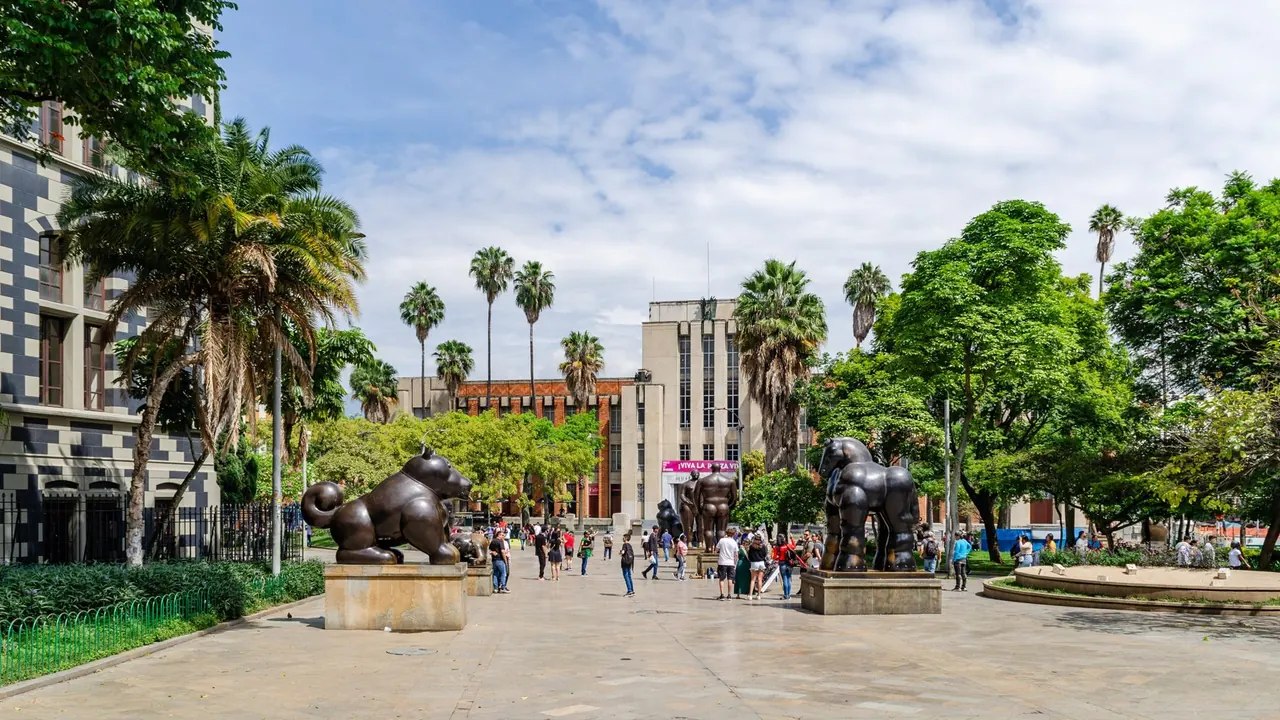
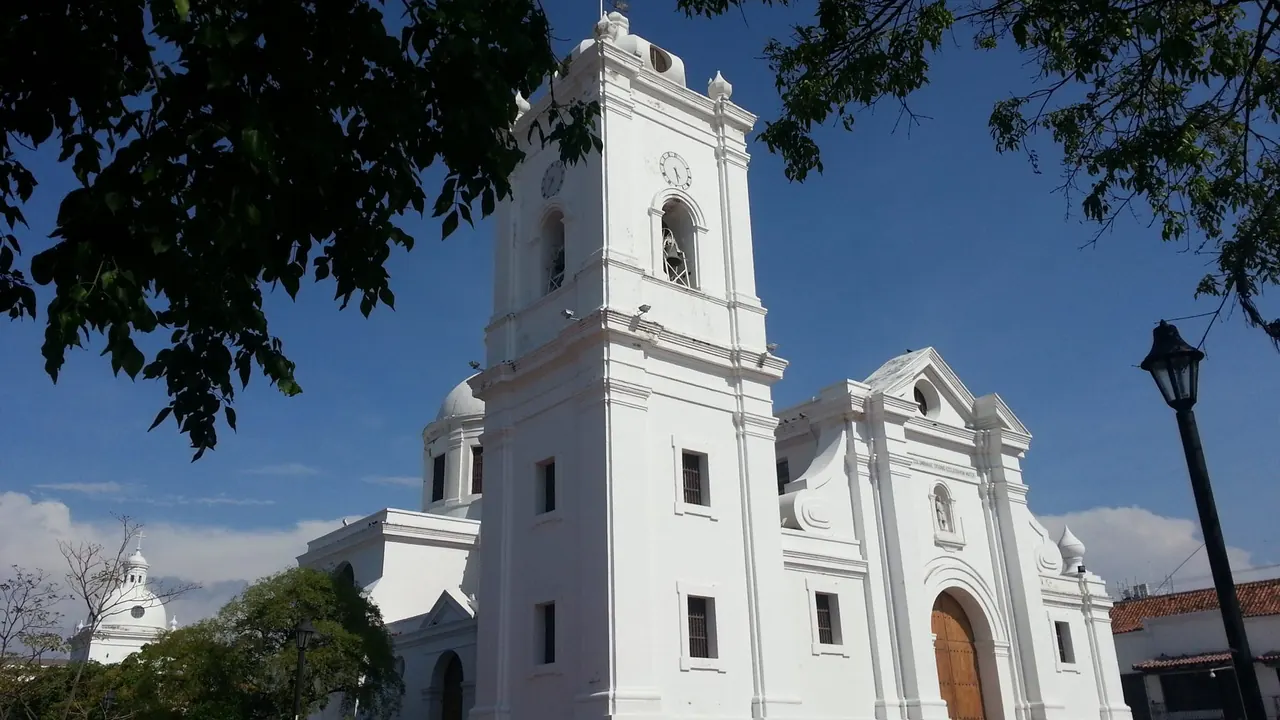
Photos: Medellin by Steffen Schmitz, CC BY-SA 4.0, cropped; Santa Marta by Oliver H, CC BY-SA 3.0, cropped.
Medellin or Santa Marta?
Our verdict in twelve categories, each scored against the same fixed benchmark cities, and the climate month by month, so you can choose for your trip.
Choose Medellin for
- nightlife
- live music and the arts
- day trips
Medellín suits travellers who want a proper city to settle into for a week. Nights out in Provenza or along La 70, coffee and long lunches in Laureles, a metro and cable cars that make the hillsides easy, and day trips to Guatapé and Santa Fe de Antioquia give it more to fill the days. The mild mountain climate makes walking comfortable all year. There is no sea, though, so anyone who wants beaches has to add a separate leg.
Choose Santa Marta for
- beaches
- nature and the outdoors
Sand, warm water and wild landscape are what draw people to Santa Marta. Tayrona's jungle coves, the cloud forest at Minca and the trek to the Lost City in the Sierra Nevada give it an outdoor reach that Medellín cannot match. The town itself is small, hot and quickly seen, with simpler food and a modest night scene. It works best as a base for the coast and mountains, not as a city break.
Scoreboard
Twelve categories on one fixed scale from 0 to 100. The shaded stretch is the gap between the two.
Your match
Pick a travel style or drag the sliders, and both match scores follow your weighting.
Wins on nightlife and live music and the arts with your weighting.
Wins on beaches and nature and the outdoors with your weighting.
What matters to you?
Category by category
What the scores mean for a trip.
Beaches & swimming
On beaches the two could hardly differ more. Medellín has none at all. Swimming there means a hotel pool, a finca pool in the hills or the reservoir at Guatapé, and the coast is a flight away.
Santa Marta has the Caribbean on its doorstep, and the sea stays warm all year. El Rodadero and coves such as Bahía Concha are easy for a swim. Tayrona's golden beaches take a walk to reach, and only sheltered spots like La Piscina and Cabo San Juan are safe for swimming.
Food & drink
Neither city is a great food destination, but Medellín offers more choice. Beyond the hearty bandeja paisa and arepas, El Poblado and Provenza have creative Colombian kitchens and international restaurants. Laureles is good for unhurried local lunches, and the Minorista market and the coffee from Antioquia add to the appeal.
Santa Marta's strength is simple Caribbean cooking: fried fish with coconut rice and patacones, seafood soups and arepas de huevo from street fryers. In the evening there is a modest choice around Parque de los Novios, but fine dining is scarce and the range runs out quickly.
Culture & sights
Medellín has more to see, though its interest is modern rather than old. Botero's work in the Museo de Antioquia and on Plaza Botero, the Museo Casa de la Memoria and the outdoor escalators of Comuna 13 tell the story of a city that rebuilt itself after decades of violence. Together they fill two or three days.
Santa Marta has the older buildings. It is Colombia's oldest surviving Spanish city, with a colonial grid, a whitewashed cathedral, the Tairona gold collection in the Casa de la Aduana and the hacienda where Bolívar died. You can see it all in a day, and the great Tairona site, the Lost City, needs a trek of several days.
Nightlife
Medellín is by far the bigger night out. Parque Lleras and Provenza fill their rooftop bars and reggaeton clubs at weekends. Along La 70 in Laureles, cheaper salsa bars draw people who come to dance properly, and Friday and Saturday nights run past dawn.
Santa Marta's evenings are smaller and spent outdoors: terraces and pavement tables around Parque de los Novios, beach dance bars playing vallenato and champeta at El Rodadero, and backpacker parties in Taganga. It livens up at Christmas and Easter and is quiet on weeknights in low season.
Nature & outdoors
Both cities have mountains close by, but Santa Marta's setting is far grander. The Sierra Nevada climbs from the coast to snow peaks above 5,700m. Tayrona brings rainforest down to the sea, Minca's cloud forest has some of the richest birdwatching in the Americas, and Taganga adds snorkelling and diving.
Medellín's outdoors is gentler and easier to reach. A cable car from the metro takes you straight up to the forest trails of Parque Arví, paragliders launch from San Félix, and the lakes around El Peñol are about two hours away.
Day trips
Medellín has the better choice of towns to visit. Guatapé, with its painted zócalos beside El Peñol's rock, the colonial streets of Santa Fe de Antioquia and the ceramics town of Carmen de Viboral each make a different day out, and there are coffee farm tours close by.
From Santa Marta, most outings head into the landscape rather than to other towns. The main town visits are Aracataca, the birthplace of García Márquez, and Barranquilla, with Palomino for a beach day. Cartagena is too far to visit there and back in a day.
Good for families
Medellín has more for children to do. Parque Explora's science museum and aquarium, the planetarium and the botanical garden sit together in the north of the city, and the cable car ride to Parque Arví is a treat. The streets are steep and the traffic heavy, so families tend to stay in El Poblado or Laureles.
Santa Marta has the beach, which many children will prefer, with El Rodadero's calm, shallow bay and a small aquarium reached by boat. Beyond that, the heat, the long hot walks to Tayrona's beaches and the strong currents there make it better suited to older children who like walking.
Getting around
Medellín is much easier to get around. Its clean metro runs the length of the valley and links to the Metrocable gondolas and a tram, reaching the centre, Comuna 13 and Parque Arví. Cheap ride-hailing covers the steep trips between neighbourhoods.
Santa Marta has no metro or trains. The flat historic centre can be walked, though it is tiring in the heat. Getting to El Rodadero, Taganga or Tayrona means crowded small buses or taxis, and Minca is reached by shared jeep up a winding road.
Shopping & style
Medellín is Colombia's textile and fashion centre and the place to buy clothes. There is local swimwear and leather, boutiques in Provenza, large malls in El Poblado and the crowded wholesale maze of El Hueco.
Santa Marta has no shopping streets worth a day, but its crafts are distinctive: Arhuaco mochilas, Wayuu bags and hammocks, and coffee from the Sierra Nevada, sold in the old centre and along the waterfront.
Affordability
Both are cheap for visitors from Europe or North America, and everyday spending is low in each. The difference is where the money goes. In Medellín, prices rise mainly in El Poblado and Provenza, and staying in Laureles keeps costs down, with most sights free or cheap.
In Santa Marta the daily basics stay cheap, but the excursions add up. Tayrona charges foreign visitors a separate entry rate, a guided trek to the Lost City is a significant expense, and beach hotels cost noticeably more around Christmas, New Year and Easter.
Live music & performing arts
Medellín has a real, if mostly local, scene. There are live salsa bands, tango bars kept going since Carlos Gardel died here in 1935, the philharmonic at the Teatro Metropolitano and theatre at the Teatro Pablo Tobón Uribe, as well as music in the streets during the Feria de las Flores each August.
Santa Marta has almost no formal programme. Its music is informal: vallenato and champeta in bars, and drumming and dance groups in the squares of the old centre, best around carnival time.
Wellness & relaxation
Neither city is restful in itself, and in both the way to unwind is to leave town for a few nights. From Medellín that means a finca or eco-lodge in the cool hills of Santa Elena or near the eastern lakes, with inexpensive massage and yoga in El Poblado and Laureles.
Santa Marta offers two kinds of escape: the cloud forest lodges of Minca, with hammocks and river pools, and the yoga retreats and beach cabins towards Palomino, where rest can come with the sea.
When should you go?
Pick your month. The climate figures are measured averages, not a forecast.
Medellin in July
Santa Marta in July
Daytime high, °C
Rainfall in the month, mm
Where the figures come from
Medellin has no rain gauge within 25 km of the centre, so its rainfall comes from a gridded climate dataset read at the city rather than from a gauge further away.
Temperature and rainfall are climate normals, averaged over the years shown. Medellin: 1958-2025 (rainfall 1991-2020) normals, Medellin / Olaya Herrera (5.2 km from centre). Santa Marta: 1991-2020 normals, Santa Marta / Simon Bolivar (11.9 km from centre).
Medellín stays at around 28°C in the daytime all year, so the streets are comfortable to walk in any month. The real difference is the rain. December to March is the driest stretch. April and May, and then October and November, are the two wet seasons, and October brings around 356mm. Even then, mornings are often clear.
Santa Marta is hotter, with highs of 32°C through much of the year, so midday walking in the old centre is tiring in every month. From December to March it hardly rains, and these are also the sunniest months, though the trade winds make the sea rougher. The wet months run from September to November and peak at about 122mm in October, still far drier than Medellín. The sea is warm enough to swim in all year and reaches 29°C in September and October. December to March is the period when both cities are at their best.
Which traveller are you?
For a beach and sun trip, Santa Marta is the only real choice of the two. The sea is warm all year, El Rodadero and Bahía Concha are easy places to swim, and Tayrona has its jungle beaches. Medellín has no coast, only pools and a reservoir.
On a food and nightlife trip, Medellín is the stronger pick. Provenza and El Poblado have the widest choice of restaurants and a serious coffee culture. At night you can move from rooftop bars to reggaeton clubs and the salsa bars of La 70, and stay out until dawn.
For an outdoors trip, Santa Marta wins on scale. Its rainforest coast at Tayrona, the birdwatching around Minca, diving from Taganga and the trek through the Sierra Nevada to the Lost City go well beyond Medellín's trails at Parque Arví and paragliding at San Félix.
Before you go
| Measure | Medellin | Santa Marta |
|---|---|---|
| Official language | Spanish | Spanish |
| Currency | Colombian Peso (COP) | Colombian Peso (COP) |
| Sockets | AB110 V, 60 Hz | AB110 V, 60 Hz |
| Driving side | Right | Right |
| Time zone | UTC-5 | UTC-5 |
| Emergency number | 123 | 123 |
| Elevation | 1,405 m | 8 m |
| Main airport | Jose Maria Córdova International Airport (MDE)19 km from centre35 non-stop destinations | Simón Bolívar International Airport (SMR)13 km from centre6 non-stop destinations |
| Public holidays this year | 19 days | 19 days |
By the numbers
| Measure | Medellin | Santa Marta |
|---|---|---|
| City population | 2,529,403 | 505,915 |
| People per km² | 6,644 | 1,723 |
| Museums within 10 km | 14 | 3 |
| UNESCO World Heritage sites within 50 km | 0 | 0 |
| Swim season, months above 21 °C | - | 12 months |
Where else could you go?
Every comparison below shares a destination with this one, so you can follow Medellin or Santa Marta somewhere new.