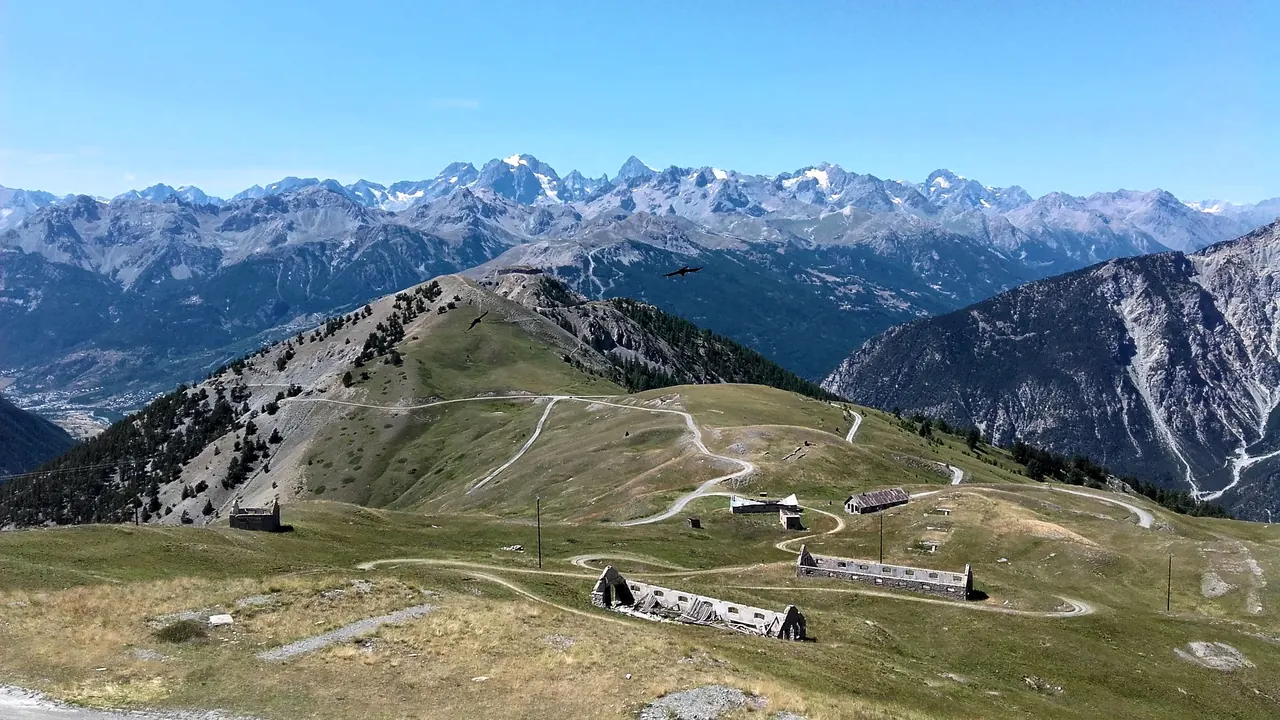
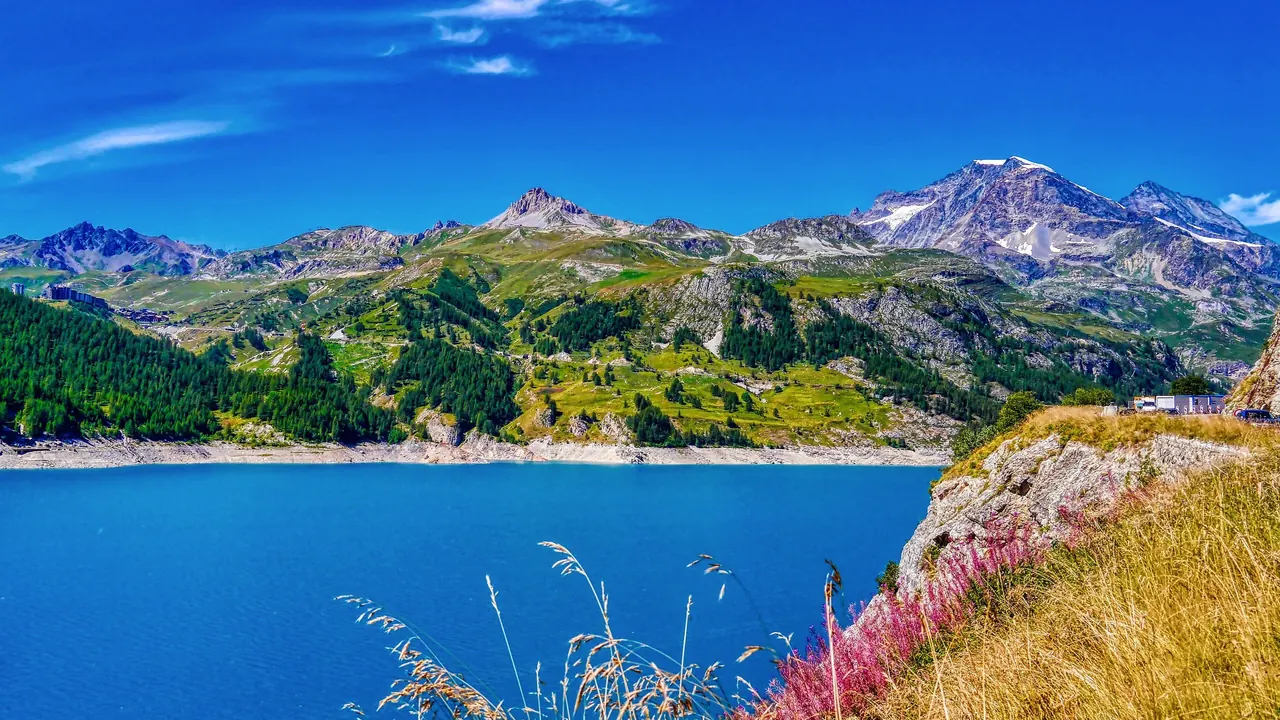
Photos: Montgenèvre by Jonathan Queutois, CC0; Tignes by Zairon, CC BY-SA 4.0, cropped.
Montgenèvre or Tignes?
Our verdict in twelve categories, each scored against the same fixed benchmark cities, and the climate month by month, so you can choose for your trip.
Choose Montgenèvre for
- day trips
- prices
- wellness
Montgenèvre suits families and couples who want a calmer, more affordable mountain week with plenty to do off the slopes. The Milky Way gives sunny, wooded skiing that runs across the border into Italy. The spa centre and the thermal baths down the valley take care of tired legs, and with a car the Vauban forts of Briançon, the Susa valley and even Turin are within reach.
Choose Tignes for
- nightlife
- getting around
- food and drink
Keen skiers and groups of friends who want altitude, a long season and loud evenings are better off in Tignes. The glacier above the lake keeps the snow reliable from autumn, the link with Val d'Isère opens up one of the biggest ski areas in the Alps, and the bars of Val Claret stay open late. It costs more, and the long valley road makes it a place to stay put rather than a base for exploring.
Scoreboard
Twelve categories on one fixed scale from 0 to 100. The shaded stretch is the gap between the two.
Your match
Pick a travel style or drag the sliders, and both match scores follow your weighting.
Too close to call, 2 points apart
Wins on day trips and prices with your weighting.
Wins on nightlife and getting around with your weighting.
What matters to you?
Category by category
What the scores mean for a trip.
Beaches & swimming
Neither resort has a sea, but Tignes at least has somewhere to swim right on the doorstep. In July and August a supervised bathing area with a small sandy shore opens on the lake below Tignes Le Lac, although the snowmelt water stays bracingly cold. The indoor aquatic centre with slides is where most people actually swim.
At Montgenèvre summer swimming means the leisure centre pools or a very chilly alpine lake. The warm water and sandy shores of Serre-Ponçon are more than an hour's drive away, so they make a separate day out.
Food & drink
Both serve the Savoyard staples of fondue, raclette and tartiflette, mostly to hungry skiers. Montgenèvre's best card is Italy. Piedmontese dishes turn up on its menus, and Claviere, a few minutes away, has trattorias and proper espresso, but the village itself offers little choice, and for a serious meal you drive down to Briançon.
Tignes has a bit more range. A handful of kitchens in Le Lac and Val Claret cook a modern Alpine menu, and the delicatessens selling Beaufort, Reblochon and Savoie wines are worth a visit in their own right, even if most menus look alike.
Culture & sights
Neither resort is somewhere you go for sights, but each has a different kind of story. Montgenèvre has some real age: old stone houses, a small parish church and the Napoleonic obelisk on a pass that has been crossed since Roman times.
Tignes was built from scratch in the 1960s and 1970s and is mostly apartment blocks. Its heritage is the old village drowned by the Chevril dam, remembered by the huge mural painted on the dam wall.
Nightlife
Evenings are where the two differ most sharply. In the ski season Tignes goes out hard. Après-ski starts with music on the mountain terraces and carries on in the bars of Val Claret and Le Lac, full of seasonal workers and young British and Scandinavian groups, until the small clubs close well after midnight.
Montgenèvre has an early après-ski round at the foot of the slopes, a few pubs and a single small club in peak weeks, and a crowd of families who go to bed early to be first on the lifts. Outside the winter season both are quiet.
Nature & outdoors
Both are first-rate mountain bases, and the difference is one of character. Montgenèvre sits on its pass at about 1,860m, with sunny, larch-wooded skiing that runs across the Milky Way into Italy. In summer it has more kinds of landscape within reach: the Clarée valley above Névache, the Écrins and the Queyras, with climbing, via ferrata and rafting on the Durance.
Tignes is higher and starker. It is a lake village below the Grande Motte glacier, which rises to nearly 3,500m, with the Vanoise, France's oldest national park, on its doorstep. Its snow is more reliable and its off-piste terrain bigger, and in summer the trails pass ibex and marmots on the way to high alpine lakes.
Day trips
Montgenèvre is much the better base for outings. Briançon's UNESCO-listed Vauban walls are just down the hill, Mont-Dauphin and Embrun make an easy pairing, and on the Italian side there are the Sacra di San Michele, the Roman arch at Susa, the Fenestrelle fortress and Turin, about an hour and a half away.
Tignes sits at the end of a long, winding valley. Apart from Val d'Isère's older centre, a short bus ride away, outings mean driving down to Bourg-Saint-Maurice, Conflans or Beaufort, or crossing to Aosta in summer when the Little St Bernard Pass is open.
Good for families
Both run ski classes for very young children and have an indoor pool with a lagoon for the bad-weather afternoons. Montgenèvre is slightly easier. It is one small village set right on broad, sunny beginner slopes, with sledging, snowshoeing and husky rides for anyone not skiing, and it sits a little lower, so altitude is less of a worry.
Tignes has ski-in, ski-out apartments and beginner areas right beside Le Lac and Val Claret, but the greater height can tire small children. The busiest villages are also noisy at night, so families often stay in the lower hamlets.
Getting around
Inside either resort a car is not needed. Free shuttles and lifts link Tignes's string of villages, and many guests ski from door to door. The station at Bourg-Saint-Maurice is about forty minutes below by bus.
Montgenèvre's compact village is easy to walk and has seasonal shuttles, plus rail links via Briançon's night train from Paris or Oulx on the Turin line. But it is the more car-dependent of the two, because the valleys and day trips that make it attractive need a car with chains or winter tyres.
Shopping & style
Both offer ski hire, outdoor gear and supermarkets for self-caterers, and nobody comes to either for the shops. Tignes adds a few sportswear boutiques and good Beaufort to take home. From Montgenèvre, the shopping worth doing is Italian food over the border or the weekly market in Briançon.
Affordability
Montgenèvre is clearly the cheaper of the two. It is a mid-range French resort, more modest than the big Savoie names, with apartments and chalets where families can cook. Eating and drinking on the Italian side keeps costs down further, and in summer prices fall a long way.
Tignes is one of those big Savoie names, and peak school vacation weeks are expensive. Self-catering and early or late season weeks help, but eating out stays at resort prices all year.
Live music & performing arts
Neither resort has a theatre or concert hall. In Tignes live music means DJs on the mountain terraces, bands in the après-ski bars and free outdoor concerts during resort events. Montgenèvre has similar but smaller occasional events, and its real stages are in Briançon or Turin, both within driving distance.
Wellness & relaxation
Montgenèvre is the more restful choice. Its balneo centre has warm indoor and outdoor pools, a sauna and a hammam, and the natural hot springs at Le Monêtier-les-Bains are about 40 minutes away. The evenings are quiet too.
Tignes has a spa area at the aquatic centre and pools in the larger residences, but the nearest thermal waters at Brides-les-Bains are about an hour away. In winter the pace is set by early lifts and late bars, and only summer feels truly unhurried.
When should you go?
Pick your month. The climate figures are measured averages, not a forecast.
Montgenèvre in July
Tignes in July
Daytime high, °C
Rainfall in the month, mm
Where the figures come from
Montgenèvre has no weather station within reach, so its figures come from a gridded climate model rather than a measured record, and read a broad area rather than one spot.
Tignes has no weather station within reach, so its figures come from a gridded climate model rather than a measured record, and read a broad area rather than one spot.
Temperature and rainfall are climate normals, averaged over the years shown. Montgenèvre: 2001-2020 normals, NASA POWER reanalysis grid, no weather station within 90 km. Tignes: 2001-2020 normals, NASA POWER reanalysis grid, no weather station within 90 km.
The two resorts share almost the same climate, and neither is a beach destination at any time of year. From December to February daytime highs stay below freezing in both, which is good for snow but cold for strolling between bars. Tignes gets noticeably more precipitation through the winter, around 73mm in January against 45mm at Montgenèvre, so expect more snowy days there and more clear, dry ones on the Montgenèvre side of the border.
Summer is short and mild in both. July and August reach about 19°C at Montgenèvre and a touch less in Tignes, which is good weather for hiking and biking and just warm enough for a cold lake dip. May and November are the wettest months in both resorts, with Tignes passing 100mm in May. These shoulder months are the least rewarding time to go to either, and Tignes largely closes then anyway.
Which traveller are you?
For a food and nightlife trip, Tignes is clearly the livelier choice. Après-ski moves from the mountain terraces to the bars of Val Claret and Le Lac and goes on past midnight, and its kitchens and cheese delicatessens offer a bit more than Montgenèvre's skier fare.
On a trip with a tight budget, Montgenèvre goes much further. It is a mid-priced French resort with apartments and chalets to cook in, cheaper food and drink just over the Italian border, and summer stays that are genuinely modest. Tignes stays expensive, especially in peak weeks.
Skiers who want snow early in the autumn, or a few turns in early summer, should choose Tignes. The Grande Motte glacier keeps its pistes open long after and before the lower slopes. Montgenèvre's skiing is sunnier and friendlier but follows the normal winter season.
Before you go
| Measure | Montgenèvre | Tignes |
|---|---|---|
| Official language | French | French |
| Currency | Euro (EUR) | Euro (EUR) |
| Sockets | CE230 V, 50 Hz | CE230 V, 50 Hz |
| Driving side | Right | Right |
| Time zone | UTC+1, UTC+2 in summer | UTC+1, UTC+2 in summer |
| Emergency number | 112 | 112 |
| Elevation | 1,360 m | 1,440 m |
| Main airport | Turin Airport (TRN)79 km from centre65 non-stop destinations | Geneva International Airport (GVA)105 km from centre150 non-stop destinations |
| Public holidays this year | 11 days | 11 days |
By the numbers
| Measure | Montgenèvre | Tignes |
|---|---|---|
| Population | 461 | 1,919 |
| People per km² | 11 | 24 |
| Museums within 10 km | 3 | 0 |
| UNESCO World Heritage sites within 50 km | 1 | 0 |
Where else could you go?
Every comparison below shares a destination with this one, so you can follow Montgenèvre or Tignes somewhere new.
- Val d'Isèrevs Tignes
- Serre Chevaliervs Montgenèvre
- Les Arcsvs Tignes
- La Rosièrevs Tignes
- La Plagnevs Tignes
- Val Cenisvs Tignes