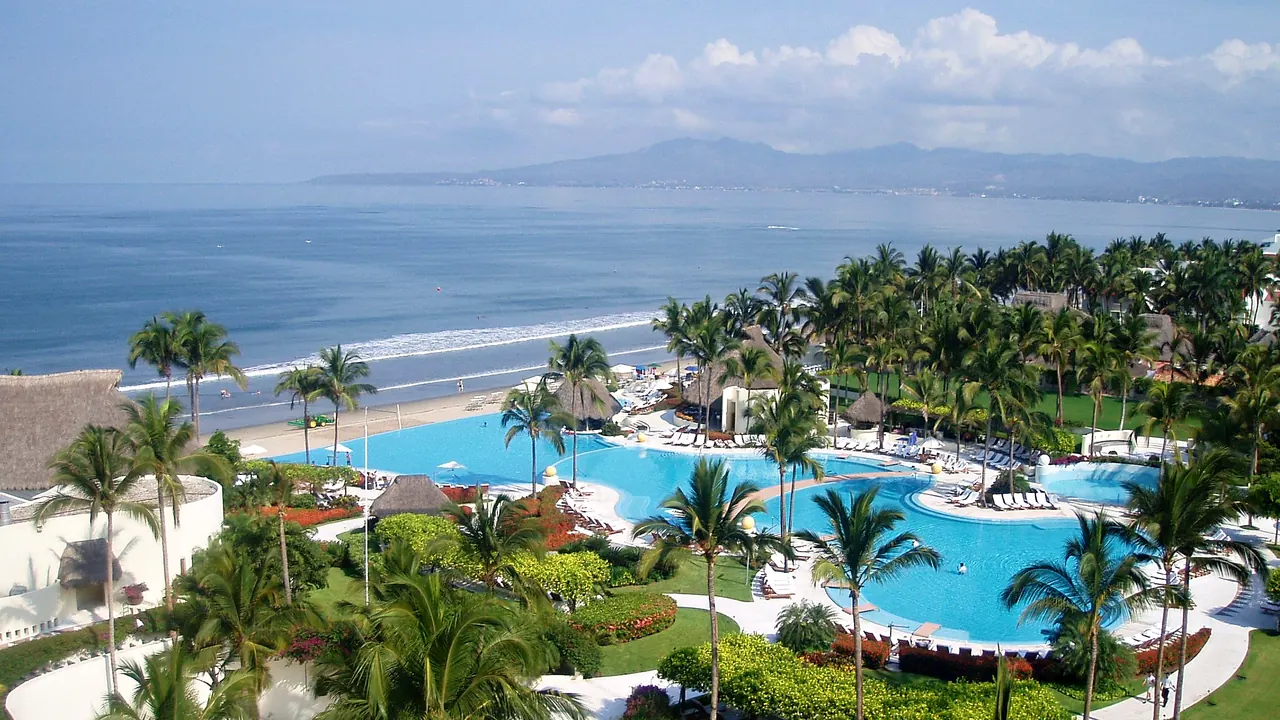
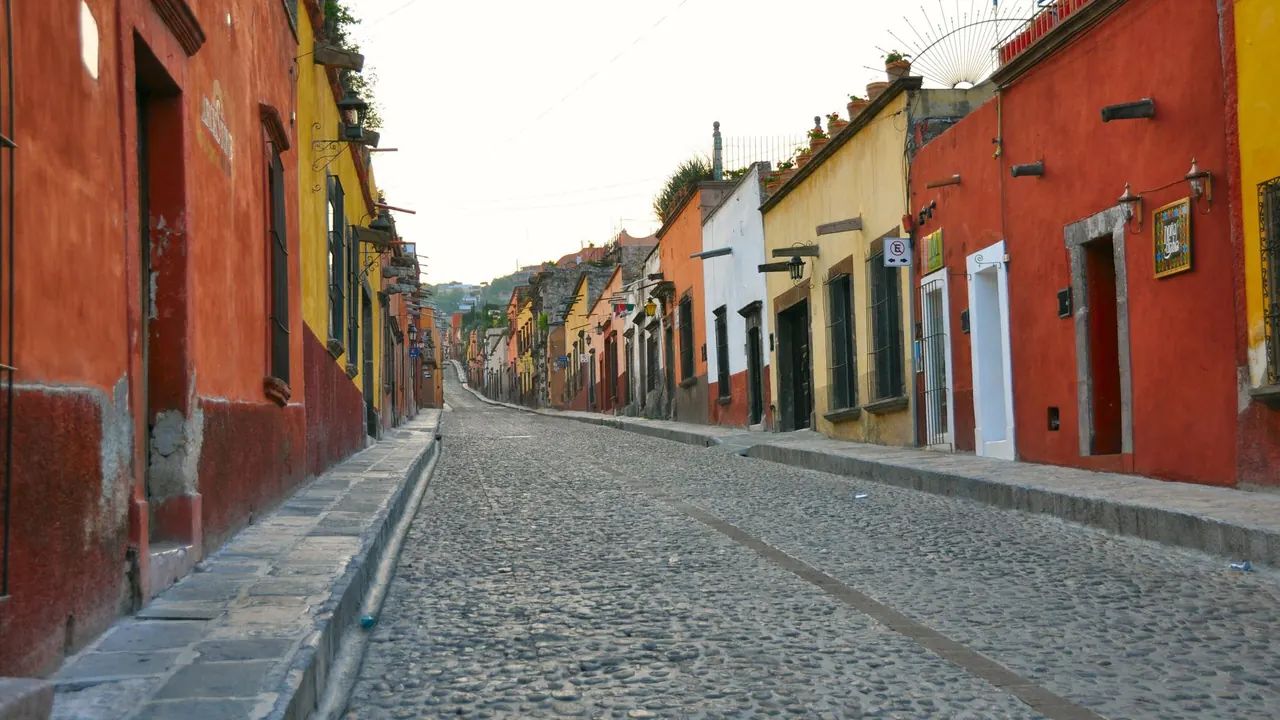
Photos: Nuevo Vallarta by Harpqueen, Public domain; San Miguel de Allende by Russ Bowling, CC BY 2.0, cropped.
Nuevo Vallarta or San Miguel de Allende?
Our verdict in twelve categories, each scored against the same fixed benchmark cities, and the climate month by month, so you can choose for your trip.
Choose Nuevo Vallarta for
- beaches
- families
- nature and the outdoors
Nuevo Vallarta is for a sun-and-sea vacation where the hotel does most of the work. You get a long sandy beach on warm, calm water, resorts built around children, and whales, turtles and the Marietas Islands just offshore. It suits families and couples who want to swim, switch off and take the odd boat trip, and who don't mind a taxi to Puerto Vallarta or Bucerias for a proper meal or a night out.
Choose San Miguel de Allende for
- culture and sights
- shopping
- getting around
Travellers who would rather walk than lie by a pool will be happier in San Miguel de Allende. Its cobbled colonial centre, the pink spires of the Parroquia, the galleries, craft lanes and rooftop dinners make the town itself the reason to go, and Guanajuato, Querétaro and Atotonilco are all within easy reach. The sea is many hours away and there is little for small children, so it is best for adults who want streets, food and history rather than a beach.
Scoreboard
Twelve categories on one fixed scale from 0 to 100. The shaded stretch is the gap between the two.
Your match
Pick a travel style or drag the sliders, and both match scores follow your weighting.
Wins on beaches and families with your weighting.
Wins on culture and sights and shopping with your weighting.
What matters to you?
Category by category
What the scores mean for a trip.
Beaches & swimming
Nuevo Vallarta is built around its beach: kilometres of soft sand on Banderas Bay, a gentle slope and a sea that stays warm all year. For variety, the coves of Punta Mita and the surf at Sayulita are within an hour.
San Miguel de Allende has no beach at all. The closest it comes is a soak in the spring-fed pools outside town, so anyone combining the two should treat the coast as the swimming part of the trip.
Food & drink
San Miguel de Allende is the better place to eat day to day. Within a short walk of the Jardín you have rooftop terraces over the Parroquia, courtyard dining in colonial houses, cooking built on Bajío ingredients like nopal and mesquite, and market stalls and evening taco carts.
In Nuevo Vallarta most meals are eaten in the resort. The coastal dishes worth seeking out, such as pescado zarandeado, aguachile and ceviche in a coconut with a glass of raicilla, mostly mean a taxi to Bucerias or Puerto Vallarta. The coast has the seafood, but the highland town puts good cooking on your doorstep.
Culture & sights
This is where the two differ most, and San Miguel de Allende is far ahead. The whole centre is the sight: cobbled hillside streets, the neo-Gothic Parroquia, the Oratorio de San Felipe Neri, the Casa de Allende and the art schools that shaped the town. That is enough for two unhurried days.
Nuevo Vallarta is a planned enclave of hotels and golf courses with nothing of the kind. For old streets and a historic church you go to Puerto Vallarta, half an hour away.
Nightlife
Neither is a clubbing destination, but San Miguel de Allende has a real evening life on its streets. Drinks start on a rooftop as the Parroquia lights up, then move to mezcal bars and cantinas, and the centre stays busy late on Fridays and Saturdays.
Nuevo Vallarta goes quiet by midnight, with lobby bars and poolside shows. A late night there, including Puerto Vallarta's well-known gay scene in the Zona Romantica, always starts with a taxi south.
Nature & outdoors
Nuevo Vallarta has the richer outdoors, and nearly all of it is tied to the water. Humpback whales calve in the bay in winter, the Marietas Islands offer snorkelling among rock arches and seabirds, and turtles nest on the beaches. Behind the coast lie the Ameca mangroves and the jungle foothills of the Sierra Madre.
San Miguel's surroundings are dry highland scrub and cactus. The canyon trails of El Charco del Ingenio, horse riding and dawn balloon flights make good mornings out, but there are no forests or water sports to plan a trip around.
Day trips
San Miguel de Allende is the better base for excursions, because it sits in the heart of colonial Mexico. Guanajuato and Querétaro are each about an hour away and the murals of Atotonilco are closer still. Dolores Hidalgo, the pyramid at Cañada de la Virgen and the monolith at Bernal add more history and variety.
Nuevo Vallarta's outings are pleasant but mostly of one kind. There is Puerto Vallarta's old town, then a string of beach towns from Bucerias to Sayulita and San Pancho. For a change of scene, try the boat-only village of Yelapa or the old mining village of San Sebastian del Oeste in the mountains.
Good for families
With children, Nuevo Vallarta is the easy choice. Everything is laid on inside the resorts, the sea is usually calm, and the outings children remember, like turtle hatchlings at dusk, winter whale watching and the water parks, are short trips away. In summer the heat pushes play into the mornings and evenings.
San Miguel de Allende welcomes children warmly, especially on the Jardín in the evening and during the fiestas. But it has almost nothing built for them, and pushchairs struggle on the steep cobbles, so older children will enjoy it far more than toddlers.
Getting around
San Miguel de Allende is compact: every sight is within a walk of the Jardín, although the steep stones and the 1,900m altitude make it hard work. Taxis cheaply cover the climbs. Getting there takes longer, with a shuttle from Querétaro or León.
Nuevo Vallarta is the opposite. The airport is about twenty minutes away, but the resort boulevard is too spread out to walk. Days are organised around taxis, shuttles and tours, and a hire car helps for the northern coast.
Shopping & style
San Miguel de Allende is a real shopping town for crafts and interiors. There is the stepped lane of the Mercado de Artesanías with its tin lanterns and blown glass, design shops selling talavera, rugs and carved furniture, and the artists' studios in a former textile mill.
Nuevo Vallarta itself offers swimwear and souvenirs in resort boutiques and a modest mall. The region's own craft, Huichol beadwork and yarn painting, is well worth buying, but for that you go to Bucerias or the river market in Puerto Vallarta.
Affordability
Both are among Mexico's more expensive places to stay, so the difference is in how you spend the money. Nuevo Vallarta is resort and condo country, where all-inclusive packages fix costs in advance and saving money means leaving the enclave for buses, taxis and taco stands in Bucerias.
In San Miguel de Allende the money goes on boutique hotels in colonial houses and restaurants around the Jardín, which cost most at weekends and festivals. Market lunches, cantinas and churches and streets that cost nothing to enjoy are all a short walk away.
Live music & performing arts
San Miguel de Allende has a genuine music life for a small town. The nineteenth-century Teatro Ángela Peralta stages concerts and dance, chamber music and jazz festivals come round in their seasons, and mariachi bands play on the Jardín every evening. Holy Week and the Alborada bring music and dance into the streets.
In Nuevo Vallarta the stage is the resort: poolside shows, folkloric dinners and one acrobatic dinner theatre. Puerto Vallarta's cabaret and drag stages are the nearest step up.
Wellness & relaxation
Both are made for slowing down, but San Miguel de Allende has the edge because its best places to relax are not tied to a hotel. The hot mineral springs towards Atotonilco, with open-air pools and domed grottoes, are a quarter of an hour away, and there are day spas, yoga classes and temazcal sweat lodges across town.
In Nuevo Vallarta, rest means the pool, the beach and your resort's spa, sometimes with a hydrotherapy circuit and a temazcal ceremony. How good the pampering is depends on where you stay.
When should you go?
Pick your month. The climate figures are measured averages, not a forecast.
Nuevo Vallarta in July
San Miguel de Allende in July
Daytime high, °C
Rainfall in the month, mm
Where the figures come from
Nuevo Vallarta has no weather station within reach, so its figures come from a gridded climate model rather than a measured record, and read a broad area rather than the city itself.
San Miguel de Allende's temperatures are measured 54 km from the centre, at Guanajuato, Gto..
San Miguel de Allende has no rain gauge within 25 km of the centre, so its rainfall comes from a gridded climate dataset read at the city rather than from a gauge further away.
Temperature and rainfall are climate normals, averaged over the years shown. Nuevo Vallarta: 1991-2020 normals, TerraClimate 4 km grid at the town, no weather station within 90 km. San Miguel de Allende: 1991-2020 normals, Guanajuato, Gto. (53.7 km from centre).
Nuevo Vallarta is hot all year, so what you need to watch is the rain. November to May is dry, with highs around 30°C and the bay at about 25°C in late winter, which makes for long beach days and pleasant evenings outdoors. The storms start in June, and the wettest months are August and September, at nearly 300mm each. Summer and early autumn bring the hottest days and the warmest sea, but the humidity means spending them in the water or in the shade.
San Miguel de Allende sits high on its plateau and is milder. December and January are clear and reach about 23°C, and February is a little warmer. This is the best weather for walking the steep streets. The sunniest stretch is March to May, when afternoons climb to 32°C, so go sightseeing early in the day. Over the summer the town gets about half the coast's rain. June is almost as wet in both places, but the gap is widest in August and September, when San Miguel gets far less. By November both are dry again. The best season is the same for both: winter means sunny beach days on the coast and comfortable walking in the highlands.
Which traveller are you?
On a beach and sun trip, Nuevo Vallarta is the only real choice. Its soft golden sand runs for kilometres beside warm, gentle water. San Miguel de Allende sits hours inland and offers only hotel pools and spring-fed soaking pools.
For a culture and arts trip, San Miguel de Allende wins easily. Its UNESCO-listed centre, baroque churches, Bellas Artes with its Siqueiros mural, galleries and festival concerts fill several days. Nuevo Vallarta is a planned resort with no historic fabric at all.
On a family trip with young children, Nuevo Vallarta is far easier. Resorts offer shallow pools, slides and kids' clubs beside a gently shelving beach, with turtle releases and whale watching close by. San Miguel's steep cobbles and adult pace soon tire small children.
Before you go
| Measure | Nuevo Vallarta | San Miguel de Allende |
|---|---|---|
| Official language | Spanish, Nahuatl, Yucatec Maya | Spanish, Nahuatl, Yucatec Maya |
| Currency | Mexican Peso (MXN) | Mexican Peso (MXN) |
| Sockets | AB127 V, 60 Hz | AB127 V, 60 Hz |
| Driving side | Right | Right |
| Time zone | UTC-6 | UTC-6 |
| Emergency number | 911 | 911 |
| Elevation | 3 m | 1,900 m |
| Main airport | Puerto Vallarta International Airport (PVR)4 km from centre52 non-stop destinations | Guanajuato International Airport (BJX)77 km from centre22 non-stop destinations |
| Public holidays this year | 9 days | 9 days |
By the numbers
| Measure | Nuevo Vallarta | San Miguel de Allende |
|---|---|---|
| City population | 1,301 | 69,811 |
| Museums within 10 km | 0 | 2 |
| UNESCO World Heritage sites within 50 km | 1 | 2 |
| Swim season, months above 21 °C | 12 months | - |
Where else could you go?
Every comparison below shares a destination with this one, so you can follow Nuevo Vallarta or San Miguel de Allende somewhere new.