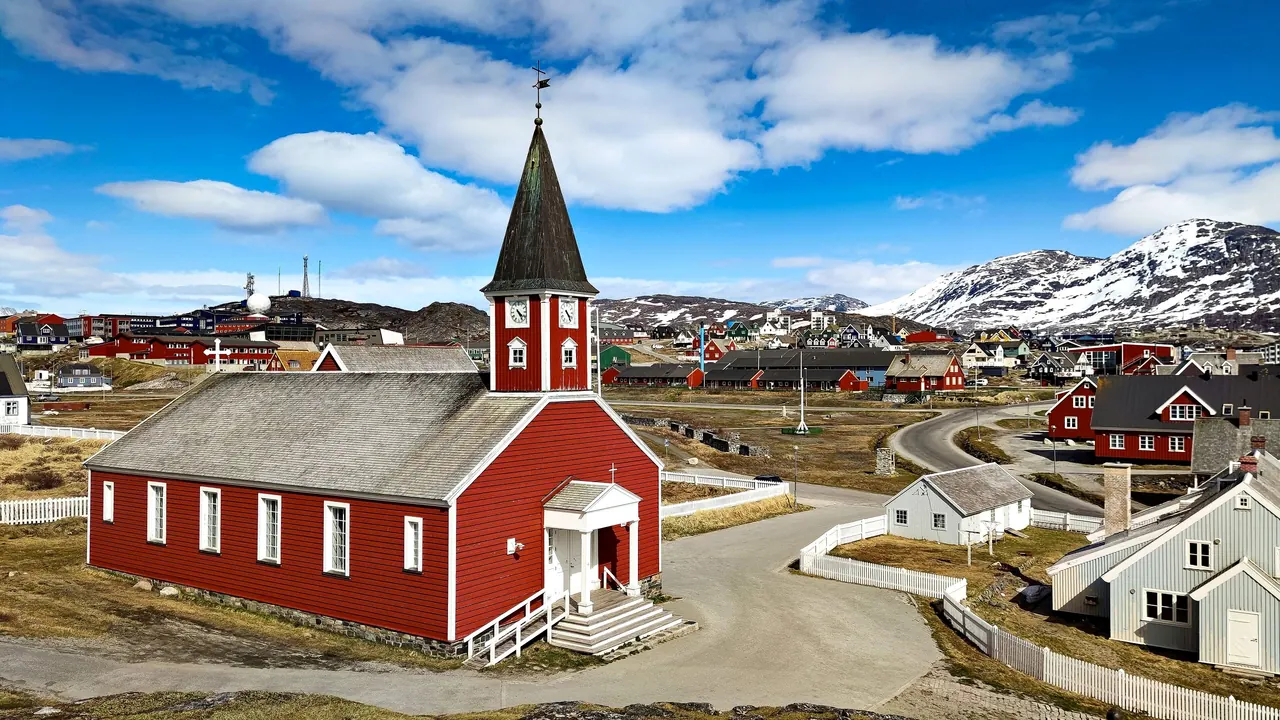
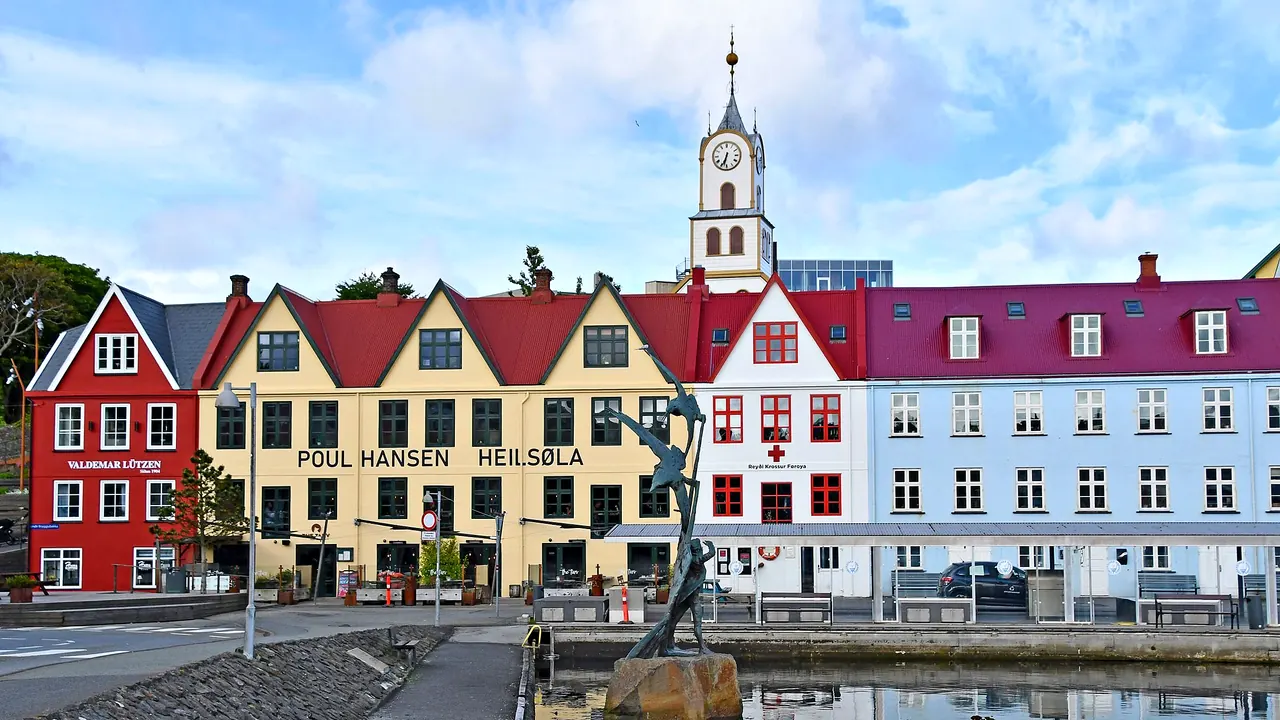
Photos: Nuuk by Kert Martma, CC BY-SA 4.0, cropped; Tórshavn by Pasztilla aka Attila Terbócs, CC BY-SA 4.0, cropped.
Nuuk or Tórshavn?
Our verdict in twelve categories, each scored against the same fixed benchmark cities, and the climate month by month, so you can choose for your trip.
Choose Nuuk for
- getting around
- nightlife
Nuuk suits the traveller who wants the Arctic in its full form: icebergs drifting down a vast fjord, humpbacks feeding near town, and winters of snow, skiing and northern lights. Everything is reached by boat, and since there are no roads out of town you never need a car. Come for the ice, the whales and the Inuit history at the national museum, and accept that the town itself is small and plain.
Choose Tórshavn for
- day trips
- food and drink
- nature and the outdoors
Tórshavn is better for someone who wants to explore green, cliff-bound islands at their own pace by car, stopping at waterfalls, puffin colonies and turf-roofed villages along the way. It also has the more distinctive table, with wind-dried and fermented Faroese food and home dining in family kitchens, and a medieval site at Kirkjubøur close by. The old wooden quarter on Tinganes gives the town more character underfoot.
Scoreboard
Twelve categories on one fixed scale from 0 to 100. The shaded stretch is the gap between the two.
Your match
Pick a travel style or drag the sliders, and both match scores follow your weighting.
Wins on getting around and nightlife with your weighting.
Wins on day trips and food and drink with your weighting.
What matters to you?
Category by category
What the scores mean for a trip.
Beaches & swimming
Swimming is off the menu in both towns, and the main difference is how cold the water is. Nuuk's sea runs off the ice sheet and hardly gets above freezing for half the year. Its shore is rock and gravel, so you would only go in for a dare.
Tórshavn's water is noticeably less cold, though still far too cold for a beach day. The islands also have proper sandy bays, such as the black-sand cove at Tjørnuvík and the beach at Sandur, which are worth a windy walk. Year-round harbour dips are a local habit you can join. In both towns, the indoor pool is the only real place to swim.
Food & drink
Tórshavn has the stronger food culture. It is built around ræst and wind-dried lamb and fish, and you can book heimablídni, home dining in a farmhouse or a family kitchen. That gives a visitor a way into local life that Nuuk has no real equivalent for. Its best kitchens are known for Faroese langoustine and scallops.
Nuuk's best meals are about Arctic ingredients: musk ox, reindeer, halibut and snow crab, served in a few fjord-view rooms. The Brædtet market by the harbour, where hunters and fishers sell their catch straight from the tables, is the most vivid food experience in town. Beyond that, both towns quickly run out of everyday options.
Culture & sights
Both towns can be seen in a day or two, but their stories are different. Nuuk's pull is Inuit history. The national museum covers four thousand years of Arctic settlement, and its Qilakitsoq mummies are the single most striking exhibit in either town. Around it are a small colonial harbour and murals on concrete housing blocks.
Tórshavn's draw is the town itself. The turf-roofed government buildings on Tinganes, where an assembly met in the Viking age, the tarred lanes of Reyn and the ramparts of Skansin make it far more pleasant to wander. Nuuk is mostly modern, and its handful of old buildings sit together around the harbour.
Nightlife
After dark the two towns are about equally small, but the evenings feel different. In Nuuk the best nights come with a band. At weekends, and loudest after payday, Greenlandic groups play covers to a crowd that dances late into the night. A hotel bar with a fjord view gives you a quieter drink. It suits a visitor who wants to end the evening on a dance floor among locals.
Tórshavn is a pub town rather than a dancing one. A short cluster of bars near the harbour fills up at the weekend as people come in from the villages. The pleasure is talking over a local beer, and strangers there are quick to join in. If you want conversation rather than music, it is the better fit. Midweek, both towns are quiet by late evening.
Nature & outdoors
The Faroes give you more landscape for less effort. From Tórshavn you can drive to the Gásadalur waterfall, the northern sea stacks and the trailheads for Slættaratindur. Short ferries and boats reach the Mykines puffins and the bird cliffs at Vestmanna. The constant limit is the fog, which can close a hike within the hour.
Nuuk's scenery is bigger and wilder. Sermitsiaq rises across the water, icebergs float in from the inland ice and humpbacks feed close to town, none of which the Faroes have. Trails up Quassussuaq start from the houses, but almost everything else needs a boat. In exchange, Nuuk offers real winter activities: snowshoeing, skiing and the aurora.
Day trips
Tórshavn has far more within reach. Kirkjubøur, a short drive away, has a roofless medieval cathedral and a farmhouse lived in by the same family for centuries. Klaksvík is under an hour away through a subsea tunnel, and villages such as Saksun and Gjógv are easy stops on a drive.
From Nuuk, every outing is a boat trip up the fjord, to the small settlement of Kapisillit or the stone ruins of the Norse Western Settlement. These trips are mostly about the voyage itself, and you can't reach any other town without flying.
Good for families
Both towns are safe and calm, and neither has much built for children. Tórshavn is the easier choice with a family, though. Its small aquarium, sheep along the roads and puffins on Mykines are low-effort treats, and with a car you can make short outings to suit young legs.
Nuuk's appeal is more of an adventure: icebergs, whales, snow and the museum's mummies, which suit older and hardier children. Its long winter cold and long boat trips make it harder going with toddlers.
Getting around
Getting around Nuuk is simpler. The centre is walkable, buses run to Nuussuaq and Qinngorput, and with no roads leading out of town there is no reason to hire a car. Everything beyond the town is a booked boat or a flight.
Tórshavn's centre is just as easy on foot, but the islands are what you came for. Their village buses and ferries are too infrequent for a day of sightseeing, so most visitors end up driving narrow roads through single-lane tunnels, with sheep on the tarmac. Fog and wind can delay ferries and flights in both places.
Shopping & style
Neither town is a place to shop, so the real question is which one thing you will bring home. In Nuuk it is Arctic craft. You can buy sealskin garments, qiviut from the musk ox (lighter and warmer than sheep's wool), beaded jewellery and the small carved figures called tupilaks. Countries have different rules on importing seal and other animal products, so look up your own before you pay.
Tórshavn's answer is the Faroese sweater, knitted from the islands' own undyed wool in old patterns or reworked by local designers. It is sold alongside ceramics and prints in a handful of shops in the old centre, and you can carry it home without worrying about customs. Apart from these crafts, each town has one modest shopping centre and little else.
Affordability
Nuuk is about as expensive as travel gets. Almost everything arrives by ship or plane, so groceries, meals and drinks cost far above European norms. The boat excursions that are the point of a visit add a heavy cost of their own, and only walking and the town buses come cheap.
Tórshavn is expensive too, but a little less punishing. Hotels and restaurants cost well above most of Europe, and car hire adds to the bill. Self-catering apartments, supermarket shopping and a landscape that is free to walk in give you more ways to keep the budget in check.
Live music & performing arts
Neither town has much on most evenings, so in both you need to check what falls during your dates. Almost everything on stage in Nuuk happens at Katuaq, the wave-shaped cultural centre on the waterfront, which mixes concerts, film and touring shows. The small national theatre performs in Greenlandic. What you get here and nowhere else is Greenland in its own language, whether that is a local rock band or a drum dance.
In Tórshavn, music is more a part of ordinary life. Singing is a strong habit across the islands, and at the summer festival of Ólavsøka the chain dance turns old ballads into something the whole crowd joins. Very few places in Europe still keep up a tradition like it. The Nordic House adds classical concerts and theatre, and the annual jazz festival is a second fixed date in the calendar.
Wellness & relaxation
In both towns, the way to unwind is the quiet, and the spa offer is thin. Tórshavn gives you slightly more: a hotel spa, a sauna paired with a cold sea dip, and long summer evenings by a slow harbour. Nuuk has its swimming-hall saunas, and the rest comes from silence and wide views over the fjord.
When should you go?
Pick your month. The climate figures are measured averages, not a forecast.
Nuuk in July
Tórshavn in July
Daytime high, °C
Rainfall in the month, mm
Temperature and rainfall are climate normals, averaged over the years shown. Nuuk: 1991-2020 normals, Godthaab / Nuuk (1.2 km from centre). Tórshavn: 1991-2020 normals, Thorshavn (0.8 km from centre).
Neither place has a beach season, and the two climates are very different. Nuuk stays below freezing from November to April, which is when snowshoeing, skiing and the northern lights take over. Its short walking and boating season runs from June to August, with daytime highs of about 8°C to 11°C, and November is by far its wettest month. Even in late summer the fjord water barely reaches 5°C.
Tórshavn is mild and damp all year round. Highs only move between about 6°C in winter and 13°C in July and August, so it never freezes the way Nuuk does, but from October to January it often gets more than 150mm of rain a month, along with short, stormy days. May and June are the driest months and the best time for hiking, and summer is when the sea is at its least cold.
Which traveller are you?
On an outdoors trip, Tórshavn has the edge. Roads and subsea tunnels take you straight to sea cliffs, Slættaratindur, Sørvágsvatn and the puffins on Mykines, all without a boat charter. Nuuk's fjord trips are spectacular, but most of them mean booking a long and expensive boat outing.
On a food and nightlife trip, Tórshavn is the better choice for eating. Ræst, wind-dried lamb and a farmhouse heimablídni dinner give it a food culture of its own. Going out is small in both towns, so plan your evenings around the meal and a harbour pub.
For a winter trip built around the northern lights and snow, choose Nuuk. From autumn to spring it sits under frozen skies, with snowshoeing and cross-country skiing on its doorstep. Tórshavn's winters are mild, wet and stormy and give you none of that.
Before you go
| Measure | Nuuk | Tórshavn |
|---|---|---|
| Official language | Greenlandic | Danish, Faroese |
| Currency | Danish Krone (DKK) | Danish Krone (DKK) |
| Sockets | CEFK230 V, 50 Hz | CEFK230 V, 50 Hz |
| Driving side | Right | Right |
| Time zone | UTC-2, UTC-1 in summer | UTC, UTC+1 in summer |
| Emergency number | 112 | 112 |
| Elevation | 5 m | 24 m |
| Main airport | Nuuk International Airport (GOH)3 km from centre11 non-stop destinations | Vágar Airport (FAE)27 km from centre11 non-stop destinations |
| Public holidays this year | 16 days | 17 days |
By the numbers
| Measure | Nuuk | Tórshavn |
|---|---|---|
| Population | 18,326 | 14,038 |
| People per km² | 27 | 120 |
| Museums within 10 km | 3 | 3 |
| UNESCO World Heritage sites within 50 km | 0 | 0 |
| Swim season, months above 21 °C | None | None |
Where else could you go?
Every comparison below shares a destination with this one, so you can follow Nuuk or Tórshavn somewhere new.
- Bergenvs Tórshavn
- Reykjavikvs Tórshavn
- Lofotenvs Tórshavn
- Tromsovs Tórshavn
- Reykjavikvs Nuuk
- Svalbardvs Nuuk