Palawan or Siargao?
Our verdict in twelve categories, each scored against the same fixed benchmark cities, and the climate month by month, so you can choose for your trip.
Choose Palawan for
- nature and the outdoors
- beaches
- culture and sights
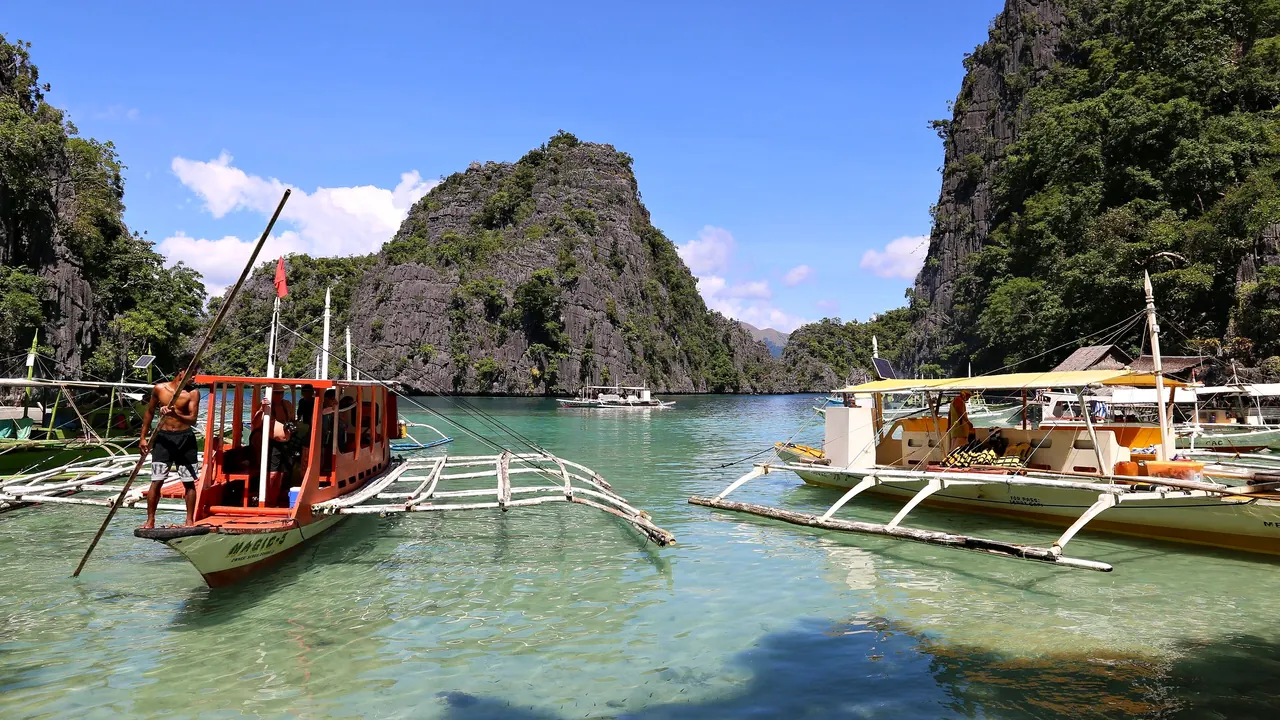
Palawan is the choice for travellers who want the landscape at its most dramatic: the limestone islands of Bacuit Bay, the cliff-ringed lakes and wartime wrecks around Coron, the Underground River near Puerto Princesa. Its beaches are the finer of the two as well, though most are reached by boat. It rewards a longer trip with time to move between bases and patience for the long transfers between them.
Choose Siargao for
- nightlife
- food and drink
- shopping
Surfers and sociable travellers will be happier on Siargao. Cloud 9 and the east-coast breaks draw people for the waves, and General Luna gives the island livelier evenings and a wider spread of cafés and eateries than El Nido or Coron, all within a short scooter ride. In return you get gentler scenery than Palawan's, and on the main island you swim around the tides.
Scoreboard
Twelve categories on one fixed scale from 0 to 100. The shaded stretch is the gap between the two.
Your match
Pick a travel style or drag the sliders, and both match scores follow your weighting.
Too close to call, 1 point apart
Wins on nature and the outdoors and beaches with your weighting.
Wins on nightlife and food and drink with your weighting.
What matters to you?
Category by category
What the scores mean for a trip.
Beaches & swimming
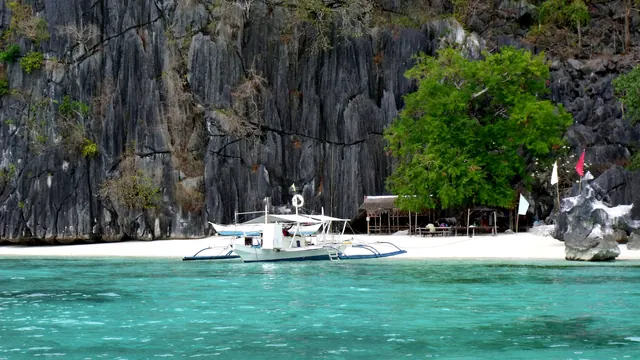
Both islands do their best swimming from a boat, but Palawan's beaches are the more spectacular. Around El Nido, white-sand coves sit between sheer limestone islands in Bacuit Bay. Nacpan and Duli add long, open, palm-backed sand on the mainland, and Port Barton and San Vicente are quieter still.
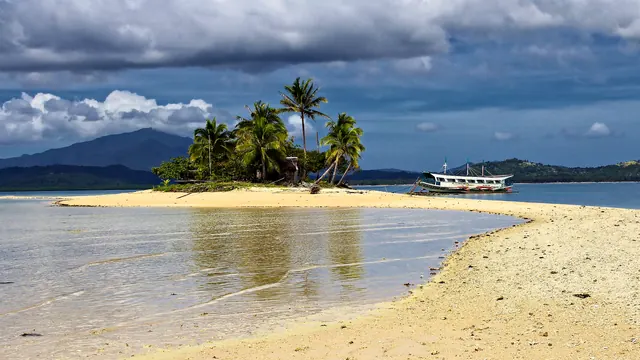
Siargao's best sand is offshore too, at the bare sandbar of Naked Island and on palm-fringed Daku and Guyam. They are lovely but smaller in scale. Off General Luna the reef flat drains to ankle depth at low tide, so swims are timed around the tide, with the Magpupungko rock pools as the low-water reward.
Food & drink
Neither island is worth the journey for food alone, but Siargao eats better. General Luna and the road to Cloud 9 have a wide range for a small island, from good coffee, poke and Mediterranean plates to grilled fish and kinilaw, raw fish cured in coconut vinegar.
Palawan's traveller towns lean on pizza and international comfort food. Its most local cooking is in Puerto Princesa, with bowls of chao long and tamilok, the mangrove woodworm eaten raw on a dare, a long way by road from El Nido.
Culture & sights
Sightseeing is thin on both islands, but Palawan at least has some history to visit. There are the Tabon Caves, where remains of some of the earliest known people in the Philippines were found, the former leper colony on Culion with its museum and church, Plaza Cuartel in Puerto Princesa, and coral-stone forts at Taytay and on Cuyo. Siargao has no museums or historic quarters, only the Cloud 9 boardwalk and plain small-town churches, so a rainy day there has nothing to fill it.
Nightlife
Siargao has the livelier nights. In General Luna, surfers and backpackers move to a different party spot each night of the week, with open-air dance floors under the palms and reggae and house nights that run past midnight.
On Palawan, going out mostly means El Nido's short strip of bars and sunset drinks on the beach at Las Cabanas. Coron and Puerto Princesa are quieter still, and early boat departures send most people to bed. Neither island has clubs in the city sense.
Nature & outdoors
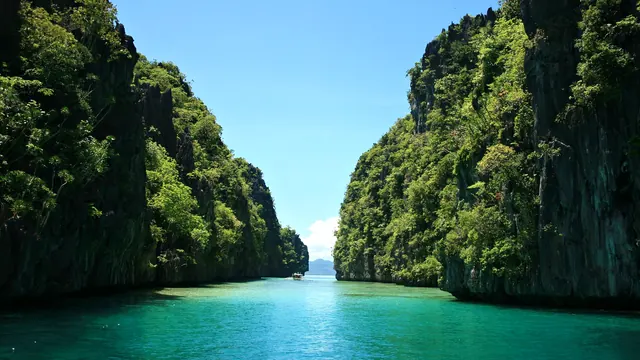
Palawan's scenery is on another scale. Black limestone islands rise from turquoise water in Bacuit Bay. Coron has Kayangan and Barracuda lakes and the Japanese wrecks sunk in 1944, and near Puerto Princesa the Underground River runs through a cave system into the sea. Divers can also take a liveaboard out to Tubbataha Reef, and inland there is rainforest trekking on Cleopatra's Needle.
On Siargao the outdoors centres on the surf. The scenic outings are Sugba Lagoon, reached through the Del Carmen mangroves, and the jellyfish lakes and caves of Sohoton Cove. The island itself is low and green, with little real hiking.
Day trips
On both islands an outing means a boat to lagoons, sandbars and reefs rather than a visit to another town. Palawan's distances mean travellers move between bases, and Taytay with its old fort is the only real road excursion from El Nido. Siargao is compact enough for a scooter loop through Pilar, Del Carmen and Burgos, which are pleasant stops but not places to spend a day.
Good for families
Palawan is a little easier with children, especially older ones who swim confidently. The shallow lagoons of Bacuit Bay suit kayaking and snorkelling, there are easy beach resorts on the islands, and Puerto Princesa has the crocodile conservation centre and better medical care. The price is long, winding van rides and open boats.
Siargao has nothing built for children, the roads have no pavements and medical care is basic. The tides also make swimming off General Luna awkward. It suits teenagers best, who can take surf lessons and enjoy the sandbars and rock pools.
Getting around
On Palawan the hours go on the journeys between bases. Most visitors fly into Puerto Princesa and then spend five to six hours in a shared van on the winding road to El Nido. The ferry on to Coron takes about four hours and can be cancelled in rough weather, though the smaller airport near El Nido shortens the trip for those prepared to pay for it.
Siargao is compact by comparison, and once you are there a hired scooter or tricycle gets you easily around its mostly paved, quiet roads. The effort lies in arriving, by domestic flight or ferry from the mainland, and in riding the unlit road to Cloud 9 with care at night or in the rain.
Shopping & style
Shopping is an afterthought on both islands. Palawan has a little more local character in Puerto Princesa's markets, with cashew nuts, woven baskets and South Sea pearl jewellery. Siargao's shopping is surf gear, linen and swimwear along General Luna's main strip, which is enough to replace a forgotten rash guard.
Affordability
Costs are much the same on both: cheap at guesthouse level, dearer at the top. On Palawan the extras are internal flights, private boats and the conservation fees for the lagoons and the Underground River, and its private-island resorts are among the most expensive in the country.
On Siargao the extra money goes on General Luna's international cafés, boutique stays near Cloud 9 and imported drinks. Rooms on both islands cost more in high season, which on Siargao means the peak surf months.
Live music & performing arts
Neither island offers an evening of performance, and on both live music means a cover band or acoustic set in a beach bar. Palawan's closest thing to a show is the folk dancing Puerto Princesa sometimes stages, while on Siargao it is fire dancers or a DJ at a party.
Wellness & relaxation
The two islands are close here, but they relax in different ways. Palawan has the one real bathing place, the warm, slightly salty Maquinit hot spring near Coron. It also has full spas at the private-island resorts of Bacuit Bay and the Calamian islands, though these only suit guests staying there.
Siargao has no springs and few spas. Instead, the yoga shalas, small retreat stays and massage huts of General Luna suit a slow routine shaped by the tides. To find that pace on Palawan, stay in a village such as Port Barton, because El Nido town is noisy.
When should you go?
Pick your month. The climate figures are measured averages, not a forecast.
Palawan in July
Siargao in July
Daytime high, °C
Rainfall in the month, mm
Where the figures come from
Palawan has no weather station within reach, so its figures come from a gridded climate model rather than a measured record, and read a broad area rather than one spot.
Siargao's temperatures are measured 72 km from the centre, at Surigao.
Siargao has no rain gauge within 25 km of the centre, so its rainfall comes from a gridded climate dataset read at the destination rather than from a gauge further away.
Temperature and rainfall are climate normals, averaged over the years shown. Palawan: 2001-2020 normals, NASA POWER reanalysis grid, no weather station within 90 km. Siargao: 1991-2020 normals, Surigao (71.9 km from centre).
Palawan is driest from January to April, with February down to about 34mm of rain, and those are the months when the boats run on calm, glassy water. Rain builds from May and stays heavy from June to October, when choppy seas can cancel island trips and crossings. Days hold at around 28°C to 30°C all year, so it is the rain, not the heat, that decides when to go.
Siargao's seasons run almost the other way. November to February is very wet, with close to 893mm falling in January alone, while June to September is far drier, about 136mm in August, and suits beach days and island-hopping. The sea stays warm around both islands through the year. So late winter and spring point to Palawan, mid-year to Siargao, and surfers chasing Siargao's biggest swells from August to November will see the rain return towards the end of that stretch.
Which traveller are you?
On a beach and sun trip, Palawan is the stronger pick. The coves hidden among the islands of Bacuit Bay, the open sand at Nacpan and Duli and the islets around Coron outclass Siargao's sandbars, and in the dry months the lagoons are calm enough to swim straight off the boat.
For a food and nightlife trip, Siargao gives you more. General Luna packs surfer cafés, wood-fired pizza and kinilaw into one short strip, and each night of the week has its party spot. In Palawan the bars are mostly along one short strip in El Nido, and most of the island sleeps early.
For surfers, Siargao is the obvious answer. Cloud 9 is a powerful reef break, gentler waves along the east coast make lessons easy, and the swell peaks from about August to November. Palawan's sheltered bays are made for kayaking and snorkelling rather than waves.
Before you go
| Measure | Palawan | Siargao |
|---|---|---|
| Official language | English, Filipino, Taglish | English, Filipino, Taglish |
| Currency | Philippine Peso (PHP) | Philippine Peso (PHP) |
| Sockets | ABC220 V, 60 Hz | ABC220 V, 60 Hz |
| Driving side | Right | Right |
| Time zone | UTC+8 | UTC+8 |
| Emergency number | 911 | 911 |
| Main airport | Puerto Princesa International Airport / PAF Antonio Bautista Air Base (PPS)5 non-stop destinations | Siargao Airport (IAO)3 non-stop destinations |
| Public holidays this year | 18 days | 18 days |
By the numbers
| Measure | Palawan | Siargao |
|---|---|---|
| Population | 968,795 | 200,000 |
| People per km² | 66 | 481 |
| Swim season, months above 21 °C | 12 months | 12 months |
Where else could you go?
Every comparison below shares a destination with this one, so you can follow Palawan or Siargao somewhere new.
- Cebu Islandvs Siargao
- Boholvs Siargao
- Boracayvs Palawan
- Boracayvs Siargao
- Boholvs Palawan
- Cebu Islandvs Palawan