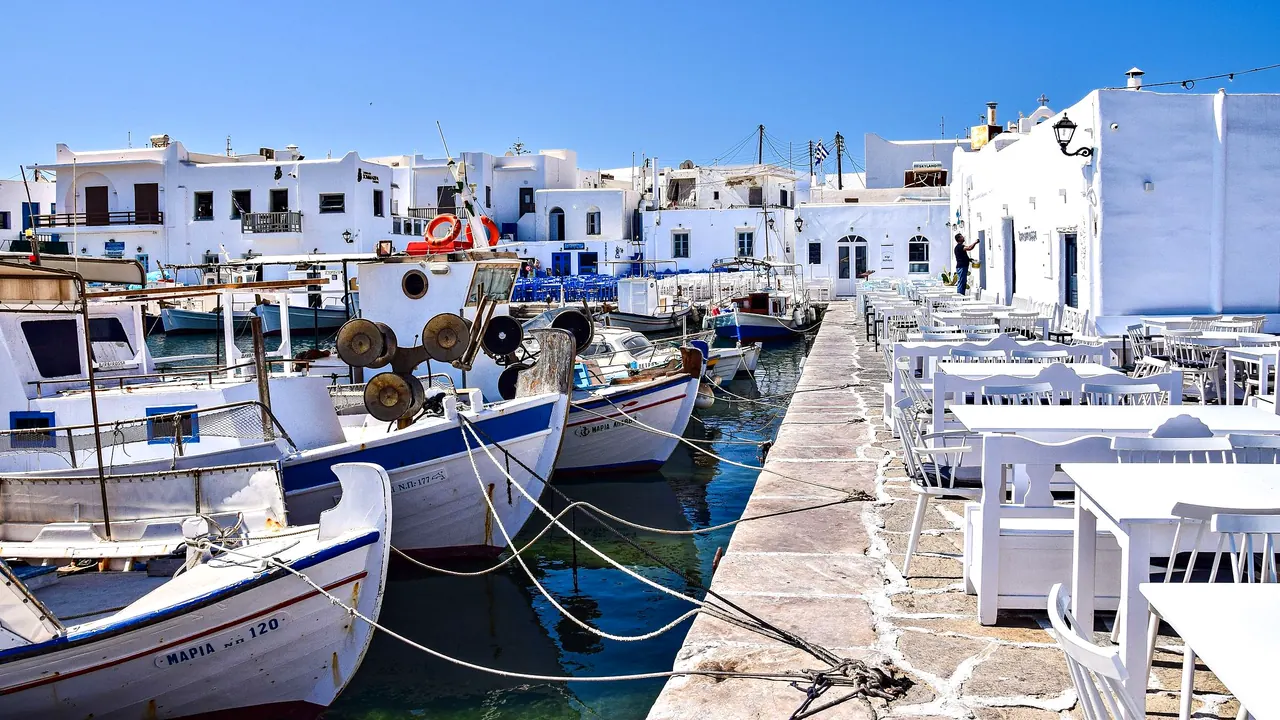
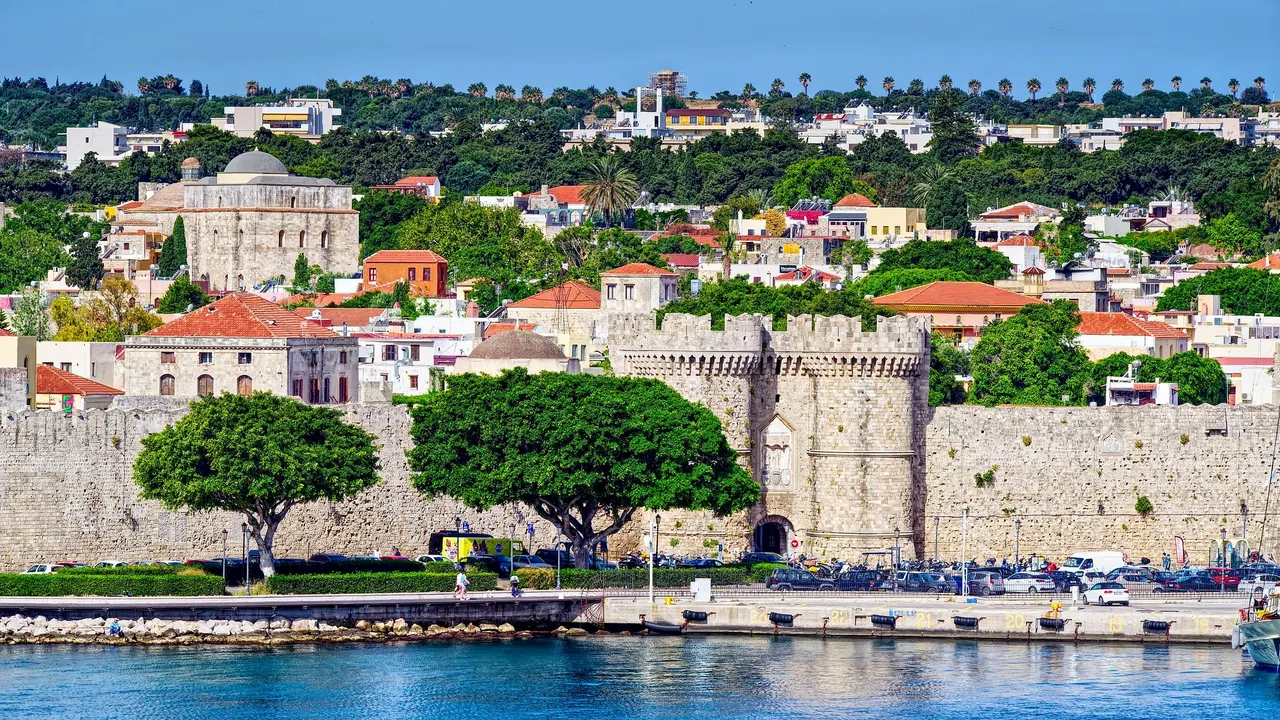
Photos: Paros by AXP Photography, Pexels License; Rhodes by Mark Thomas, Pexels License.
Paros or Rhodes?
Our verdict in twelve categories, each scored against the same fixed benchmark cities, and the climate month by month, so you can choose for your trip.
Choose Paros for
- food and drink
- shopping
- day trips
Paros suits travellers who want a small, easy Cycladic island where the beach is the whole point. The bays are sandy, nowhere is far from anywhere else, and when the meltemi blows there is always a calmer shore on the other side. Evenings revolve around Naoussa's harbour and its tables of grilled octopus, and Antiparos and Naxos sit a short boat ride away. It is best for couples and friends who are happy to trade history and kids' attractions for whitewashed villages and a slow rhythm.
Choose Rhodes for
- culture and sights
- prices
- families
Rhodes is the stronger choice when the trip needs more than a beach. The walled medieval Old Town and the acropolis at Lindos give it days of real sightseeing, the resort coast is set up for children with kids' clubs, a water park and an aquarium, and the big stock of package hotels keeps a week noticeably cheaper. It is also greener and hillier inland, which suits people who like to drive and explore between swims.
Scoreboard
Twelve categories on one fixed scale from 0 to 100. The shaded stretch is the gap between the two.
Your match
Pick a travel style or drag the sliders, and both match scores follow your weighting.
Wins on food and drink and shopping with your weighting.
Wins on culture and sights and prices with your weighting.
What matters to you?
Category by category
What the scores mean for a trip.
Beaches & swimming
The two are closely matched for swimming, but the beaches are different in character. Paros has sandy bays all round its coast, from the granite-boulder coves of Kolymbithres to the wide sand at Golden Beach and Santa Maria. Because the island is small, you can simply cross to the sheltered south or west shore when the meltemi is blowing.
Rhodes puts nearly all its good swimming on one long east coast, a chain of sheltered bays from Faliraki down to Lindos where the sand is often mixed with fine shingle. It is better for snorkelling, at the rocky inlets of Anthony Quinn Bay and Ladiko, and its water is a little warmer. Its busiest beaches are lined with rows of sunbeds in high summer.
Food & drink
The food is much the same standard on both islands, but finding it is a different job. On Paros, good eating is part of the everyday scene: octopus drying along Naoussa's harbour, clay-pot chickpeas, the island's own Monemvasia and Mandilaria wines, and a few polished modern Greek kitchens in Naoussa.
On Rhodes you have to leave the resort strips, with their buffets and identical menus, for the inland villages, the quieter harbours and the meze places in the newer part of Rhodes Town. There you get pitaroudia, matsi pasta and slow-cooked goat, with wine and honey from Embonas.
Culture & sights
This is where Rhodes pulls far ahead. Its walled Old Town, built by the Knights of St John, has the Street of the Knights, the Palace of the Grand Master, mosques, a synagogue and the Archaeological Museum in the Knights' Hospital. Add the cliff-top acropolis of Lindos, ancient Kamiros and the stadium on Monte Smith, and you have several full days of sightseeing.
Paros has one major monument, the early Christian Ekatontapiliani in Parikia, plus a small museum, a Frankish castle built from reused marble and the ancient quarries at Marathi. These make pleasant mornings out rather than a programme.
Nightlife
The nightlife is just as lively on both, but the crowds differ. Paros's evenings centre on Naoussa, where cocktail bars spill out around the harbour and a well-dressed crowd stays out past midnight, with a looser, younger strip on Parikia's seafront.
Rhodes splits into separate scenes: Faliraki's loud bar-and-club strip that runs until dawn for young package travellers, a late lane in the Old Town, and stylish rooftop bars in Lindos for an older crowd. Most other resorts on Rhodes go quiet after the hotel bar.
Nature & outdoors
Rhodes has more varied countryside. Its pine-covered hills, Mount Attavyros above the wine villages, the shaded Valley of the Butterflies and the wooded stream at Seven Springs give it green walking country. Paros is bare, dry Cycladic terraces with no forest or mountain to speak of, though the marble-paved Byzantine path from Lefkes to Prodromos is a fine short walk.
Both islands draw windsurfers and kitesurfers. Paros has three spots, Golden Beach, New Golden Beach and Pounta, while Rhodes has the single famous sandbar at Prasonisi, with flat water on one side and waves on the other.
Day trips
The day trips are about equally good, and both depend on boats. Paros sits in the middle of the Cyclades, so Antiparos with its stalactite cave is a quick crossing, Naxos is under an hour away, and Mykonos, Ios, Sifnos and Delos are all reachable in summer.
From Rhodes the classic outing is Symi's pastel harbour, often combined with the Panormitis monastery. Marmaris, about an hour away by ferry, lets you step across into Turkey. On the island itself there are castles at Monolithos and Kritinia and the Kallithea rotunda.
Good for families
Rhodes is the easier island with children. Big east-coast resorts are built around pools and kids' clubs, there is a large water park above Faliraki and an aquarium in Rhodes Town, and Tsambika and Kolymbia have shallow sandy water. The drawbacks are midsummer heat and the steep stepped lanes of Lindos.
Paros offers gentle bays such as Livadia, Golden Beach and Logaras and a safe village feel, but nothing made for children beyond the sea. It suits young families content with a simple beach routine based in Parikia or the east-coast villages.
Getting around
Getting around is about as easy on one island as the other, but the scale is very different. Paros is compact, so in summer the buses from Parikia and the small boats across Naoussa's bay cover most of a beach-and-village stay without a car, and a scooter fills in the gaps. Outside the summer the buses run much less often, so a spring or autumn visit relies more on hired wheels.
Rhodes is a much bigger island, and the bus is only really useful along the east-coast corridor from Rhodes Town to Lindos. Based there you can manage without a car. To reach the west-coast castles, the inland wine villages or Prasonisi in the far south, you will want one for a few days. In return, Rhodes Town gives you a car-free Old Town and harbour to explore on foot, a larger walkable base than anything Paros has.
Shopping & style
Shopping on Paros leans towards resort style. Boutiques in Naoussa's whitewashed lanes and on Parikia's old market street sell linen, sandals and Greek designer jewellery, alongside ceramics, capers, honey and island wine, and Lefkes has a few craft workshops. Prices in Naoussa are high, and most shops close when the season ends.
Rhodes is more about souvenirs. Sokratous Street in the Old Town is lined with sponges, leather and copies of ancient pottery. Its advantage is local craft and everyday shopping: hand-painted Lindian-style ceramics from Archangelos, lace and embroidery in the villages, and ordinary Greek high-street fashion in the new town around Mandraki.
Affordability
Rhodes is noticeably cheaper for most trips. Its many package hotels and all-inclusive resorts keep the north and east coasts at moderate prices, and only Lindos and the Old Town boutique hotels push costs up.
Paros is pricey in July and August, especially in Naoussa and at the well-known beaches, and hire cars, sunbeds and ferry hops add up. It becomes fairer value if you stay in Parikia or the inland villages and come in June or September.
Live music & performing arts
Neither island has much formal performance, but each has its own tradition. On Paros, the music is at the summer village feast days with island violin and lute, the great mid-August feast at the Ekatontapiliani, and Naoussa's pirate-raid re-enactment with fireworks.
Rhodes offers a long-established folk-dance company in a small Old Town theatre, plus summer concerts in the medieval moat and the ancient stadium.
Wellness & relaxation
Relaxing on Paros means slowing down rather than booking treatments. There are a handful of yoga and retreat centres, but mostly it is long lunches, siestas and evenings in Lefkes, Marpissa or Prodromos, or across the water on Antiparos. Staying inland or on the south-east coast keeps you away from Naoussa at its busiest.
Rhodes relies more on the big resort spas along the east coast and around Lindos, which are polished but have no local character. For real quiet you go to the far south. Lahania, Asklipio and Gennadi have church squares, kafeneia where older men play backgammon, and calm evenings under clear skies, and they are most restful in spring and autumn.
When should you go?
Pick your month. The climate figures are measured averages, not a forecast.
Paros in July
Rhodes in July
Daytime high, °C
Rainfall in the month, mm
Where the figures come from
Paros's temperatures are measured 82 km from the centre, at Santorini Island / Monólithos.
Paros has no rain gauge within 25 km of the centre, so its rainfall comes from a gridded climate dataset read at the destination rather than from a gauge further away.
Rhodes has no rain gauge within 25 km of the centre, so its rainfall comes from a gridded climate dataset read at the destination rather than from a gauge further away.
Temperature and rainfall are climate normals, averaged over the years shown. Paros: 2000-2025, 12 years observed (rainfall 1991-2020) normals, Santorini Island / Monólithos (81.8 km from centre). Rhodes: 1991-2020 normals, Rhodes Airport (12.6 km from centre).
Both islands are hot and almost rainless from June to August, with highs around 30°C. That is ideal for the beach but heavy going for long walks in the middle of the day. On Paros the sea is warm enough to swim from June to early October and reaches about 24°C in August. Rhodes is a little warmer in both air and water. Its sea is swimmable from late May, reaches about 27°C in August and stays pleasant through October.
That extra warmth comes with more rain either side of summer. In October, Paros gets about 33mm of rain and Rhodes 74mm. From November to April, Rhodes is roughly twice as wet, with its heaviest rain in midwinter. For walking and sightseeing, May and late September suit both islands. Rhodes has the warmer sea for an autumn swim, but Paros is the drier choice for a spring or October trip.
Which traveller are you?
For a culture and arts trip, Rhodes is the clear pick. The Knights' Old Town, the Palace of the Grand Master, Lindos and ancient Kamiros fill several days, while Paros offers the Ekatontapiliani and village lanes that fit into a few half-days.
On a family trip with children, Rhodes has the easier set-up. East-coast resorts come with pools and kids' clubs, and there is a water park and an aquarium for days away from the sand. Paros has gentle beaches but almost nothing else built for children.
On a tight budget, Rhodes goes further. Its package hotels and all-inclusive resorts keep the north and east coasts moderately priced. Paros is expensive in high summer, especially in Naoussa, and only gets more reasonable in Parikia, the inland villages or in June and September.
Before you go
| Measure | Paros | Rhodes |
|---|---|---|
| Official language | Greek | Greek |
| Currency | Euro (EUR) | Euro (EUR) |
| Sockets | CF230 V, 50 Hz | CF230 V, 50 Hz |
| Driving side | Right | Right |
| Time zone | UTC+2, UTC+3 in summer | UTC+2, UTC+3 in summer |
| Emergency number | 112 | 112 |
| Main airport | Paros National Airport (PAS)5 non-stop destinations | Rhodes International Airport "Diagoras" (RHO)136 non-stop destinations |
| Public holidays this year | 15 days | 15 days |
By the numbers
| Measure | Paros | Rhodes |
|---|---|---|
| Population | 13,715 | 127,613 |
| People per km² | 71 | 91 |
| Swim season, months above 21 °C | 5 months | 6 months |
Where else could you go?
Every comparison below shares a destination with this one, so you can follow Paros or Rhodes somewhere new.