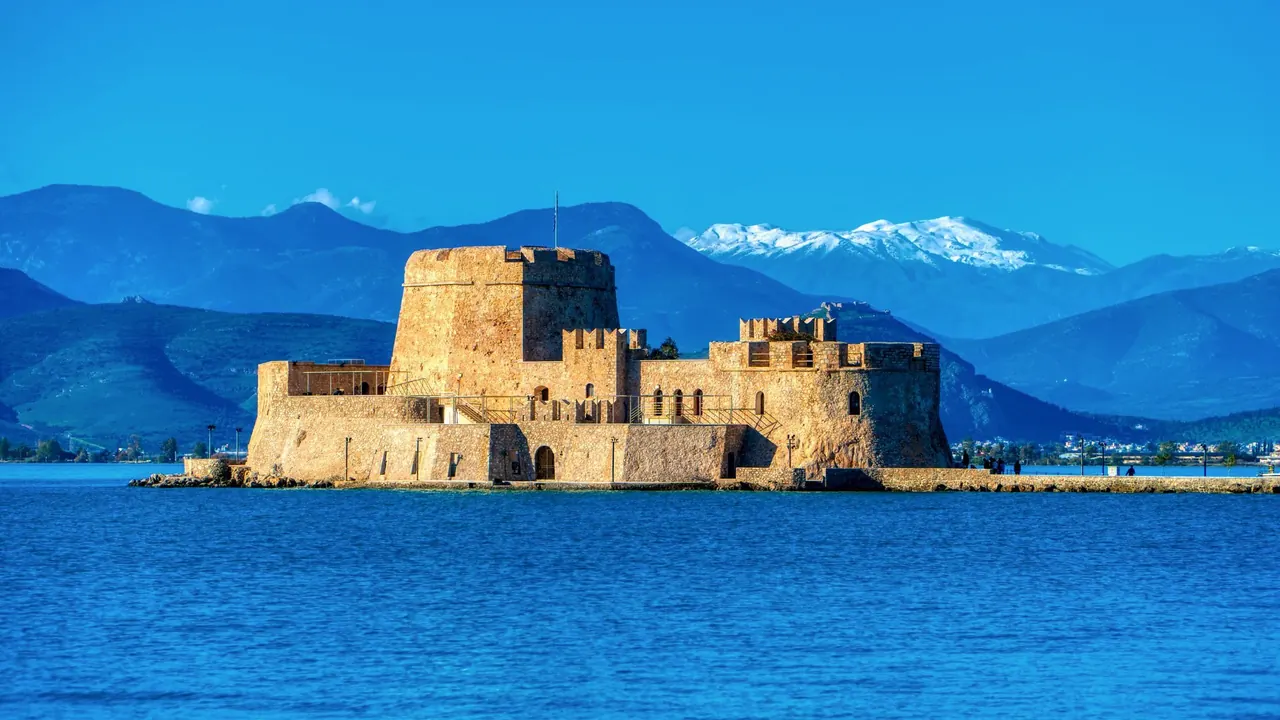
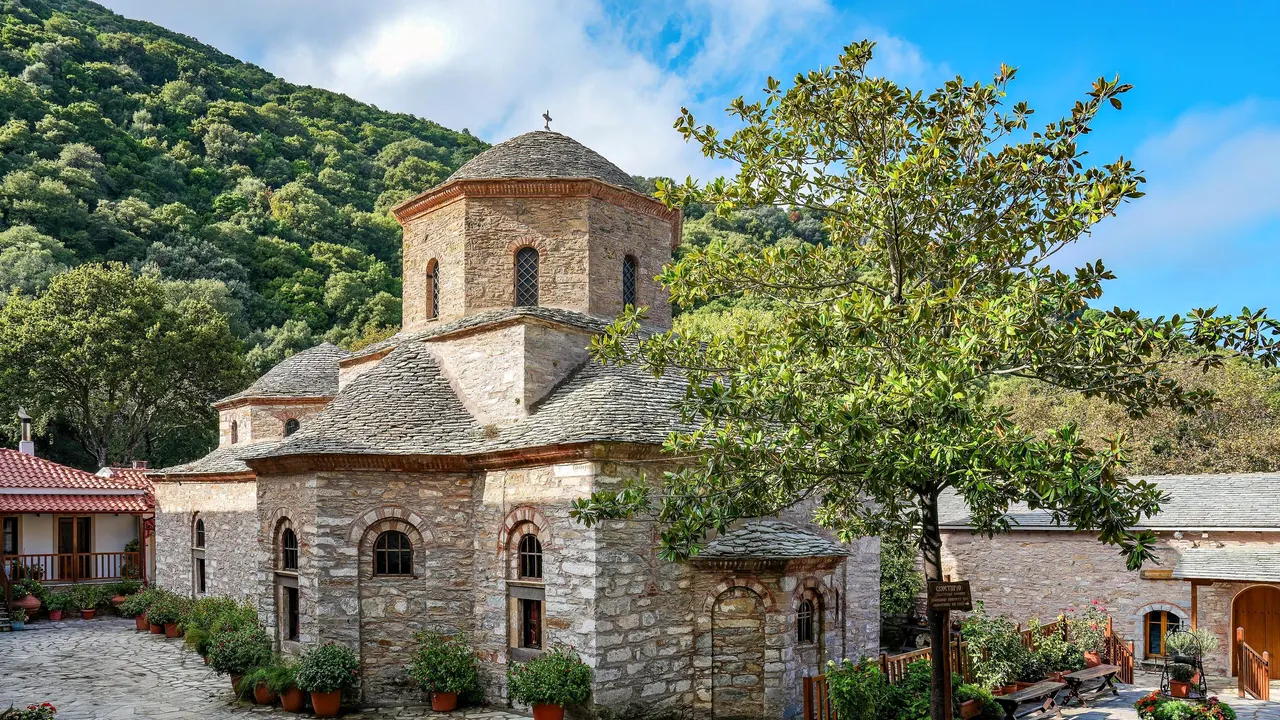
Photos: Peloponnese by Alex Ravvas, Pexels License; Skiathos by Giles Laurent, CC BY-SA 4.0, cropped.
Peloponnese or Skiathos?
Our verdict in twelve categories, each scored against the same fixed benchmark cities, and the climate month by month, so you can choose for your trip.
Choose Peloponnese for
- culture and sights
- day trips
- nature and the outdoors
The Peloponnese suits travellers who want a road trip with real depth. Mycenae, Epidaurus, Olympia and Mystras sit within a few hours of each other, the Arcadian mountains and the Mani give serious walking country, and the cooking and Nemea wine are worth planning meals around. You will need a hire car and probably more than one base, but you get far more to see, eat and explore, and it usually costs less.
Choose Skiathos for
- nightlife
- getting around
- beaches
Skiathos is the easier choice for anyone who mainly wants to swim and lie on a beach. Dozens of pine-backed beaches line one short coast road, the airport is minutes from most rooms, and the bar street above the harbour keeps summer nights going. Beyond the sand and a ferry to Skopelos there is little to see, so it works best for people happy to stay in one place.
Scoreboard
Twelve categories on one fixed scale from 0 to 100. The shaded stretch is the gap between the two.
Your match
Pick a travel style or drag the sliders, and both match scores follow your weighting.
Wins on culture and sights and day trips with your weighting.
Wins on nightlife and getting around with your weighting.
What matters to you?
Category by category
What the scores mean for a trip.
Beaches & swimming
Skiathos has the edge because its beaches are packed close together. Pale sand and fine shingle backed by pines line the south coast from town to Koukounaries. There are wilder bays on the north side, and you can take a boat to the white pebbles and rock arch of Lalaria. The popular sunbed beaches get crowded in high summer, but a quieter cove is rarely more than a short ride away.
The Peloponnese has more variety but spreads it over far greater distances. On the Messinian coast there are the horseshoe of Voidokilia and the sands of Navarino Bay. Elafonisos has water that looks tropical, and the Mani is good for swimming off the rocks. Each of these is a separate base or a long drive from the next, but outside July and August many of them are almost empty.
Food & drink
The Peloponnese is the place to eat well. Kalamata olives and oil, slow-cooked goat, the Mani's cured pork and fish grilled on the harbour all come from the surrounding land and sea. Nemea's Agiorgitiko reds and the Moschofilero whites from around Tripoli give you a wine region to explore, and Kalamata's covered market is worth a morning.
Skiathos serves pleasant island food, such as grilled octopus, Sporades-style pies and good tomatoes with local cheese. Many menus are aimed at package visitors, though, and there is no market or wine culture to build a trip around.
Culture & sights
This is the widest gap between the two. The Peloponnese holds the Lion Gate at Mycenae, the theatre of Epidaurus, the stadium at Olympia and the remote temple at Bassae. Above Sparta it adds the Byzantine town of Mystras, and there are the Venetian castles at Methoni and Koroni. Nafplio is a handsome base for the Argolid sites.
Skiathos has the clifftop ruins of the Kastro, the Evangelistria Monastery in the woods and the small house museum of Papadiamantis. They are enjoyable to see, but they make a pleasant break from the beach rather than a reason to come.
Nightlife
Skiathos has more of a night out in summer. The bar street climbing from the harbour fills after midnight, a few waterfront clubs stay open until morning in July and August, and the beach bars around Banana Beach hold sunset parties. The crowd is young and international, and it all stops when the season ends.
Evenings in the Peloponnese are slower: a late dinner, then drinks on the waterfront in Nafplio or Kalamata. The only proper club scene is in Patras, a university city on the north coast and a long way from most bases.
Nature & outdoors
The Peloponnese has far more to offer outdoors. Taygetos climbs to about 2,400m above the Mani. Arcadia has cliff monasteries along the Lousios gorge and the long, well-marked Menalon Trail, there is a rack railway up the Vouraikos gorge, and Chelmos has winter skiing. The Gialova lagoon near Pylos adds migrating birds.
Skiathos is unusually green for an Aegean island, with pine and oak forest, old footpaths between chapels and the protected Strofilia wetland. Boat trips run to the marine park off Alonissos. It is gentle walking and paddling country with nothing high or wild.
Day trips
From a base in the Peloponnese there are far more outings. From Nafplio you can reach the car-free islands of Hydra and Spetses, the wineries of Nemea, or Athens about two hours away. From the south there are Monemvasia, Elafonisos and the Mani tower villages. Almost all of them need a car.
Skiathos has one really good day out, the ferry to Skopelos with its steep white town and the clifftop chapel of Agios Ioannis. Alonissos makes a longer day. Pelion and Volos are better saved for an overnight stay.
Good for families
Both suit a simple beach vacation with children equally well, and neither has theme parks or zoos. Skiathos is easier to manage, with gently shelving sand at Koukounaries, an airport transfer of minutes and boat trips for older children. Watch out for the busy coast road, which has few pavements.
The Peloponnese offers shallow bays at Tolo and on Elafonisos, plus resort kids' clubs in Messinia. Older children can explore Mycenae or Olympia early in the morning, but families should expect long hours in the car.
Getting around
Skiathos is easier to get around. One road of about 12km runs along the south coast, with a summer bus stopping at numbered beach stops, and water taxis leave from the old harbour. You only need a scooter or jeep for the rough hill roads to the north coast and the Kastro.
The Peloponnese is car country. Motorways reach Kalamata and Olympia quickly, but mountain and Mani roads turn short distances into hour-long drives, and the buses rarely go anywhere near the sites or beaches.
Shopping & style
Neither is a shopping destination, but the Peloponnese has a little more to take home. Nafplio's old lanes have jewellery, worry beads and ceramics, Nemea wineries sell bottles at the door, and weekly markets in Kalamata and Tripoli sell honey, herbs and olives. Skiathos has a single main street of summer clothes, sandals and souvenirs, and most of it closes for the winter.
Affordability
Your money goes further in the Peloponnese, which costs noticeably less than Greece's famous islands. Family-run rooms in Mani and Arcadian villages and meals at village tavernas are good value, though a hire car and the entry fees at the big sites add to the bill.
Skiathos is a mid-priced island in July and August, and sunbeds, boat trips and rooms near the best beaches all add up. Plenty of studios and the cheap island bus help keep costs down. On both, June and September are the best-value months.
Live music & performing arts
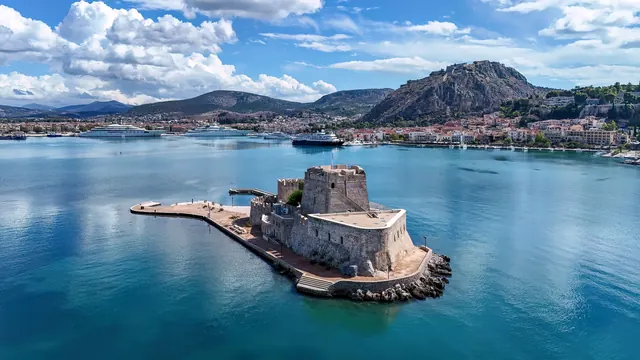
The Peloponnese has one great reason to plan around: ancient drama performed at night in the theatre of Epidaurus on summer weekends, with no amplification needed. Kalamata adds a dance festival in July. Skiathos has summer concerts in the open-air theatre on the Bourtzi peninsula and traditional music at saints' day festivals in the villages, which are nice to come across but not worth travelling for.
Wellness & relaxation
The Peloponnese has real places to bathe as well as a slow pace. There are the old spa town of Loutraki, the thermal waters of the Methana peninsula and the sulphur-fed lake at Kaiafas, and the Messinian resorts have the most complete spas.
Skiathos has no bathing tradition, only hotel spas along the south coast. Its restful side is cool pine shade and the quieter north coast. In high season you should stay away from the loud nights of the town.
When should you go?
Pick your month. The climate figures are measured averages, not a forecast.
Peloponnese in July
Skiathos in July
Daytime high, °C
Rainfall in the month, mm
Where the figures come from
Peloponnese's temperatures are measured 89 km from the centre, at Kalamata Airport.
Peloponnese has no rain gauge within 25 km of the centre, so its rainfall comes from a gridded climate dataset read at the destination rather than from a gauge further away.
Skiathos's temperatures are measured 60 km from the centre, at Anchialos Airport.
Skiathos has no rain gauge within 25 km of the centre, so its rainfall comes from a gridded climate dataset read at the destination rather than from a gauge further away.
Temperature and rainfall are climate normals, averaged over the years shown. Peloponnese: 1991-2020 normals, Kalamata Airport (89 km from centre). Skiathos: 1998-2020 (rainfall 1991-2020) normals, Anchialos Airport (59.8 km from centre).
On the Peloponnese coast and in the lowlands, where most visitors stay, summer is much the same as on Skiathos. Both are dry and hot from June to September, with highs around 32°C in July and August, and the sea is warm enough for swimming from June into October, reaching about 26°C in August. The heat matters more in the Peloponnese, because a trip there often means climbing ancient sites with little shade. May, late September and October are better for touring and walking, with long sunny days and comfortable afternoons. Higher up, in the Arcadian villages and on the slopes of Taygetos, summer days are noticeably less hot, so the mountains are a good place to escape the midsummer heat.
The two differ most in winter. On the Peloponnese coast, January highs stay near 15°C, against about 12°C on Skiathos, so Nafplio, Kalamata and the lowland sites are the milder choice for a trip out of season. Inland it is another matter. The plateau around Tripoli and the Arcadian highlands are much colder, and there is enough snow on Chelmos for skiing. The Peloponnese coast also gets the heavier rain, about 95mm in November and December. Skiathos is a little drier through the winter but cooler from November to March, and once the sea turns cold there is little to do there except walk the pine paths.
Which traveller are you?
For a beach and sun trip, Skiathos is the better pick. Koukounaries, Banana Beach and the coves near town are all within a short bus or water-taxi ride, so every day can be spent on a different beach without driving long distances.
On a culture and arts trip, the Peloponnese wins easily. Mycenae, Olympia, Messene, Mystras and Monemvasia are all here, and on summer weekends there is drama in the theatre of Epidaurus. On Skiathos you would run out of sights within two days.
For an outdoors trip, choose the Peloponnese. It has Taygetos to climb, the Lousios gorge and the Menalon Trail in Arcadia, and the bare walking country of the Mani down to Cape Tainaron. The pine footpaths on Skiathos are pleasant, but they are low and gentle.
Before you go
| Measure | Peloponnese | Skiathos |
|---|---|---|
| Official language | Greek | Greek |
| Currency | Euro (EUR) | Euro (EUR) |
| Sockets | CF230 V, 50 Hz | CF230 V, 50 Hz |
| Driving side | Right | Right |
| Time zone | UTC+2, UTC+3 in summer | UTC+2, UTC+3 in summer |
| Emergency number | 112 | 112 |
| Main airport | Athens Eleftherios Venizelos International Airport (ATH)176 non-stop destinations | Skiathos Island National Airport (JSI)37 non-stop destinations |
| Public holidays this year | 15 days | 15 days |
By the numbers
| Measure | Peloponnese | Skiathos |
|---|---|---|
| Swim season, months above 21 °C | 5 months | 5 months |
Where else could you go?
Every comparison below shares a destination with this one, so you can follow Peloponnese or Skiathos somewhere new.
- Skopelosvs Skiathos
- Aeginavs Peloponnese
- Hydravs Peloponnese
- Halkidikivs Skiathos
- Aeginavs Skiathos
- Zakynthosvs Peloponnese