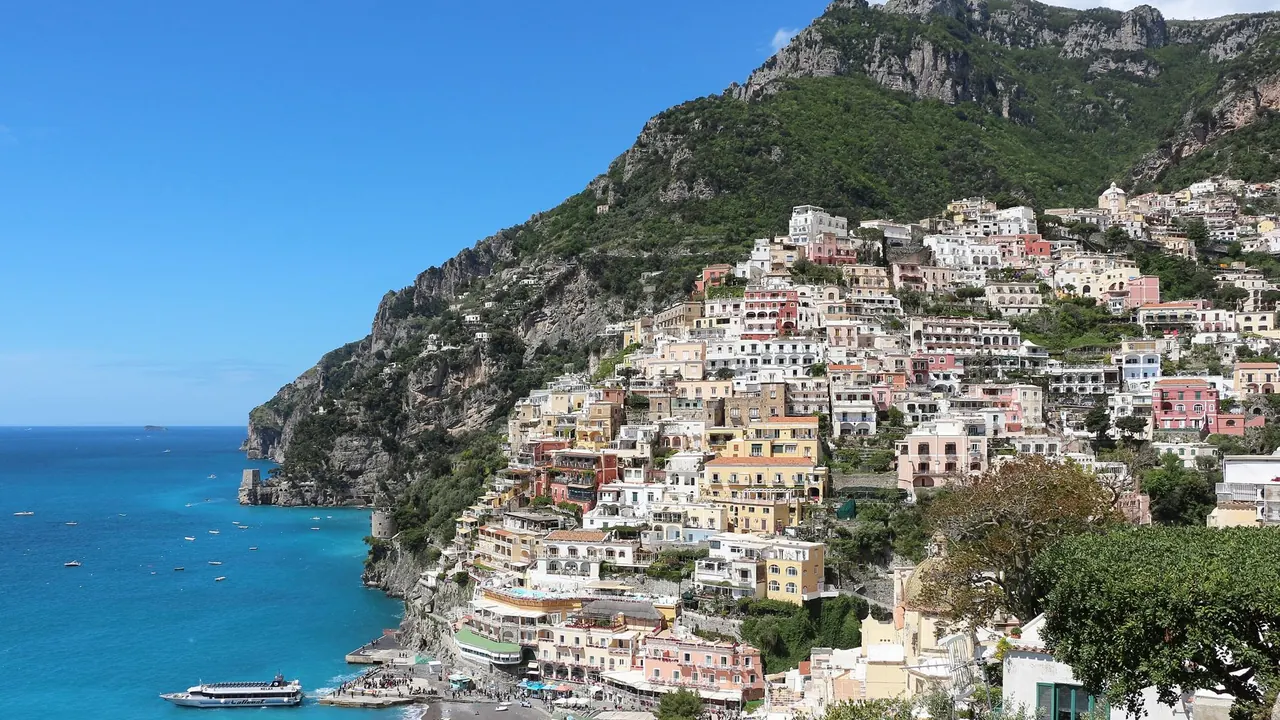
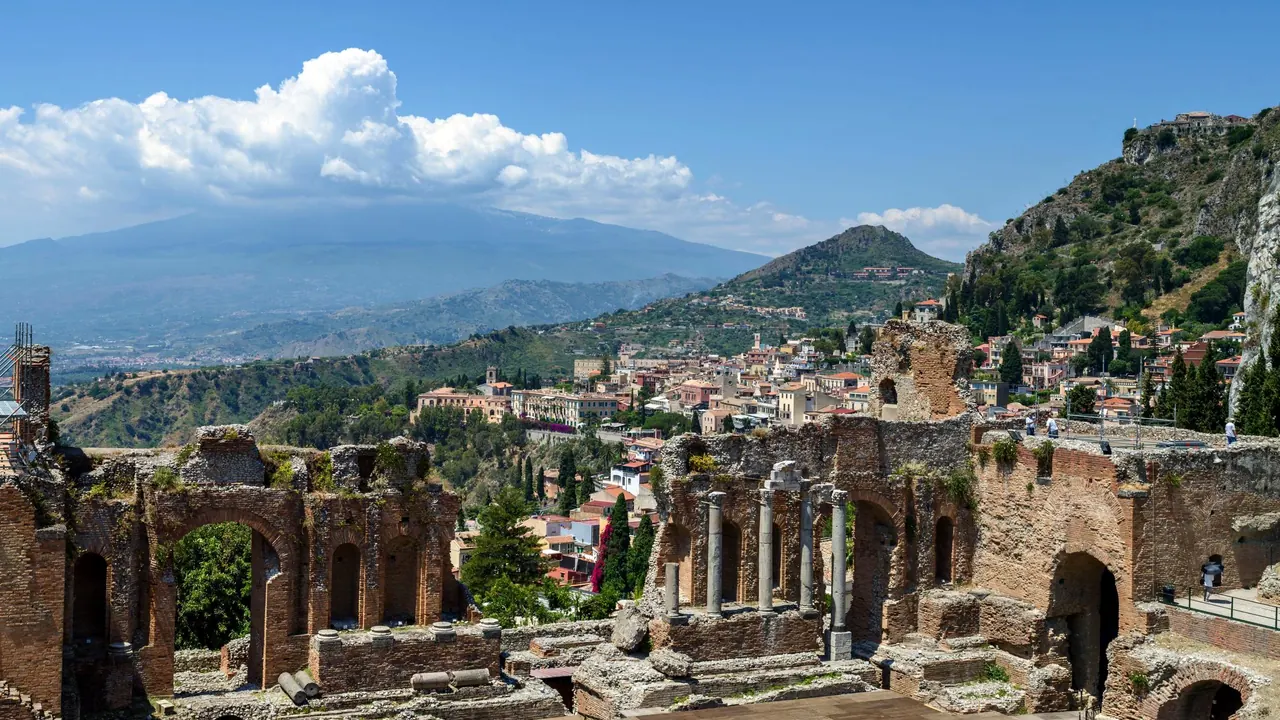
Photos: Positano by Bernard Gagnon, CC BY 4.0, cropped; Taormina by Reinhard Bruckner, Pexels License.
Positano or Taormina?
Our verdict in twelve categories, each scored against the same fixed benchmark cities, and the climate month by month, so you can choose for your trip.
Choose Positano for
- day trips
- beaches
- shopping
Positano suits a vacation built around the sea and the cliffs. The town beach lies right below the houses, boats leave from the sand for coves, Capri and the rest of the Amalfi Coast, and the Path of the Gods runs along the slopes above. It is best for couples who want to swim, walk and take boats, and who are ready to pay a great deal more and climb a great many stairs.
Choose Taormina for
- culture and sights
- getting around
- prices
For a stay with more to do on land, Taormina is the better pick. The Greek theatre, the medieval Corso and Sicilian cooking with Etna wines give the days substance beyond the beach, and summer concerts play on a stage with a volcano behind it. The town is easier to get around and costs substantially less, though it is not cheap. That makes it the choice for families with school-age children and for anyone who wants sights alongside the sea.
Scoreboard
Twelve categories on one fixed scale from 0 to 100. The shaded stretch is the gap between the two.
Your match
Pick a travel style or drag the sliders, and both match scores follow your weighting.
Wins on day trips and beaches with your weighting.
Wins on culture and sights and getting around with your weighting.
What matters to you?
Category by category
What the scores mean for a trip.
Beaches & swimming
The two are close on the sea, and both have clear water that warms to about 26°C in August. Positano is a little better for swimming because the beach is part of the town. Spiaggia Grande is a broad curve of dark sand and pebbles directly below the houses, Fornillo is a short walk along the cliff, and boats from the shore reach Laurito, Arienzo and other coves.
Taormina's swimming means a cable car or a steep path down to Mazzarò and Isola Bella. Those are narrow pebble strips, but the glassy water there is better for snorkelling. For longer sand you take the bus to Giardini Naxos or Letojanni.
Food & drink
Taormina eats better and more variously. Sicily gives it pasta alla Norma, raw red prawns, arancini, cannoli, and granita with brioche for breakfast. The wine lists are full of Etna's Nerello Mascalese and Carricante, and there is everyday eating in the side streets and down in Giardini Naxos.
Positano's table is mostly a single coastal menu repeated: clams, grilled fish, scialatielli and lemon desserts, eaten on terraces where the view is part of the bill. It is a lovely lunch, but there is little beyond it, and many kitchens close in winter.
Culture & sights
Taormina has far more to visit. The Greek theatre alone is worth the trip, and the Corso adds the Duomo, Palazzo Corvaja and Badia Vecchia, with their mix of Arab, Norman and Catalan influences. Seeing it all properly fills a day.
In Positano the town itself is the sight: houses stacked up the ravine, the majolica dome of Santa Maria Assunta and the Roman villa beneath it. A couple of hours covers it, and serious sightseeing means going to Naples or Pompeii.
Nightlife
Neither town is for a big night out. Taormina has a bit more to do after dark: an aperitivo in Piazza IX Aprile, the passeggiata along the Corso, then piano bars and wine terraces, with beach clubs at Mazzarò in summer. Positano's evenings are dinner and a few bars by the beach, plus the cave club at the end of Spiaggia Grande for a late, dressed-up crowd. Both go quiet once the season ends.
Nature & outdoors
Both are superb for time outdoors, but the days they offer are different. In Positano the landscape starts at the hotel door: the stairways climb straight to Nocelle, Montepertuso and the Path of the Gods, so you can walk out after breakfast with the sea in view all day, then take a kayak along the cliffs in the afternoon. It suits walkers who want great views more than summits and would rather not join an organised outing.
Taormina's big outdoor day is a volcano, and that makes it an excursion. Etna is about an hour away, usually with a guide or a hired car, and gives you craters, lava fields and, in winter, skiing, none of which the Amalfi Coast can match. Closer to town the walking is gentler, up to Castelmola and Monte Tauro. In both places spring and autumn are the seasons for it, because summer heat makes the climbs hard.
Day trips
Positano has more within easy reach, and much of it is by boat. Amalfi and Ravello are short ferry hops, Capri is about half an hour across the water, and Pompeii, Herculaneum and Paestum are all realistic days out. The catch is that most ferries stop in winter.
Taormina's day trips are longer. Catania is about an hour away, and Syracuse with Ortigia is about two, with Noto possible if you start early. Nearer to hand are the hill villages of Castelmola and Savoca and the wineries on Etna's northern slopes.
Good for families
Taormina is the easier of the two with children. The pedestrian centre feels safe, the cable car to the sea is fun in itself, and school-age children usually love snorkelling at Isola Bella or seeing Etna's lava fields. Giardini Naxos below has sandier beaches and flatter streets for small children.
Positano is built almost entirely of stairs, so a pushchair is useless. The pebble beaches shelve steeply and there is nothing aimed at children beyond the sea. Teenagers who like boats will be happy, but toddlers won't.
Getting around
Taormina is simpler to get around. The Corso is flat and walkable, the cable car links the town to the beaches, and a railway station by the sea connects to Catania, its airport and Syracuse.
Positano has no railway. There is a single looping road, buses that crawl along the coast in summer, and hundreds of steps for almost any walk. Ferries are the best way out, but mostly in season, and a car is more trouble than help.
Shopping & style
Both towns are better for an afternoon of browsing than for serious shopping, but they sell different things. Positano has a look of its own: loose white linen and brightly printed resort wear in the lanes down to the beach, and sandals cut to fit while you wait.
Taormina's single street sells coral and cameos, lace, painted moor's-head vases and Caltagirone majolica, along with edible souvenirs such as Bronte pistachio cream and Etna wine. For department stores, Catania is about an hour away by train. From Positano, Naples means getting to Sorrento first and then taking the train, which takes rather longer.
Affordability
Neither is cheap, but Positano costs a good deal more. Summer sea-view rooms there cost more than in most European capitals, and loungers, boat trips and transfers keep adding to the bill. The cheaper bases, Praiano or Sorrento, mean a slower trip in each day.
Taormina is expensive in its own right. It is far dearer than the rest of eastern Sicily, with grand hotels setting the tone and resort prices along the Corso. Even so, it is clearly the easier of the two on the wallet. Granita, bakery snacks and buses stay cheap, and staying in Giardini Naxos or Letojanni cuts costs further.
Live music & performing arts
Taormina has the better stage, by some margin. On summer nights the Greek theatre hosts opera, ballet and international concerts with Etna behind the stage, and the film festival has long drawn performers.
Positano has little beyond the occasional church concert. Its best evening of music is Ravello's classical festival further along the coast, on a terrace above the sea. For year-round opera, one town looks to Naples and the other to Catania's Teatro Massimo Bellini.
Wellness & relaxation
Rest works much the same way in both. Neither has a bathing tradition, so wellness means hotel spas with pools cut into the cliff or set on terraces, and both are calmest in May, June and late September.
What changes is the backdrop. Taormina has shaded gardens in the Villa Comunale and spa treatments using volcanic mud. Positano has a slow afternoon above the sea, though its stairs make even short errands tiring.
When should you go?
Pick your month. The climate figures are measured averages, not a forecast.
Positano in July
Taormina in July
Daytime high, °C
Rainfall in the month, mm
Where the figures come from
Positano's temperatures are measured 25 km from the centre, at Capri.
Positano has no rain gauge within 25 km of the centre, so its rainfall comes from a gridded climate dataset read at the city rather than from a gauge further away.
Positano's sunshine is measured 59 km from the centre, at Grazzanise.
Taormina's temperatures are measured 45 km from the centre, at Messina.
Taormina has no rain gauge within 25 km of the centre, so its rainfall comes from a gridded climate dataset read at the city rather than from a gauge further away.
Temperature and rainfall are climate normals, averaged over the years shown. Positano: 2005-2025 (sunshine 1991-2020, rainfall 1991-2020) normals, Capri (25.3 km from centre). Taormina: 1991-2020 normals, Messina (45.1 km from centre).
Both towns follow the same Mediterranean pattern. June to August is hot and almost rainless, and the sea is warm enough to swim from June into October, reaching about 26°C in August off both coasts. Taormina runs a little hotter and sunnier, with highs near 31°C in July and August, so the climb back up from the bays and any walking in the middle of the day are hard work. Positano is a degree or so cooler, but its stairways tire the legs just as much.
September brings the rain back to both, and October and November are the wettest months. Positano has the heavier rain of the two, about 127mm in November. May and June are the best months for walking in both towns, and late September is a good second despite the first showers. In winter Taormina stays milder, with January highs of 15°C against 13°C, so it is the better choice for a cool-season visit to the sights.
Which traveller are you?
For a beach and sun trip, Positano has the edge. Spiaggia Grande is right below the town, Fornillo is a short cliff walk away, and boats leave from the sand for coves and Capri. Taormina's bays are lovely, but you have to go down to them and the pebble strips are narrow.
On a culture and arts trip, Taormina is the clear choice. It has the Greek theatre with Etna behind the stage, Norman and Gothic palaces along the Corso, and summer opera and concerts in the ancient theatre. Positano has one church and a buried Roman villa.
On a tight budget, neither town is cheap, but Taormina asks less. Bakery snacks, granita and local buses stay inexpensive, and Giardini Naxos is an easy base below. Positano ranks among Italy's most expensive places to stay, and loungers, terraces and boats all add to the bill.
Before you go
| Measure | Positano | Taormina |
|---|---|---|
| Official language | Italian | Italian |
| Currency | Euro (EUR) | Euro (EUR) |
| Sockets | CFL230 V, 50 Hz | CFL230 V, 50 Hz |
| Driving side | Right | Right |
| Time zone | UTC+1, UTC+2 in summer | UTC+1, UTC+2 in summer |
| Emergency number | 112 | 112 |
| Elevation | 142 m | 204 m |
| Main airport | Naples International Airport (NAP)33 km from centre131 non-stop destinations | Catania-Fontanarossa Airport (CTA)47 km from centre96 non-stop destinations |
| Public holidays this year | 13 days | 13 days |
By the numbers
| Measure | Positano | Taormina |
|---|---|---|
| City population | 3,729 | 10,471 |
| People per km² | 429 | 799 |
| Museums within 10 km | 10 | 5 |
| UNESCO World Heritage sites within 50 km | 5 | 2 |
| Swim season, months above 21 °C | 5 months | 5 months |
Where else could you go?
Every comparison below shares a destination with this one, so you can follow Positano or Taormina somewhere new.
- Sorrentovs Positano
- Amalfivs Positano
- Salernovs Positano
- Naplesvs Positano
- Cataniavs Taormina
- Syracuse, Sicilyvs Taormina