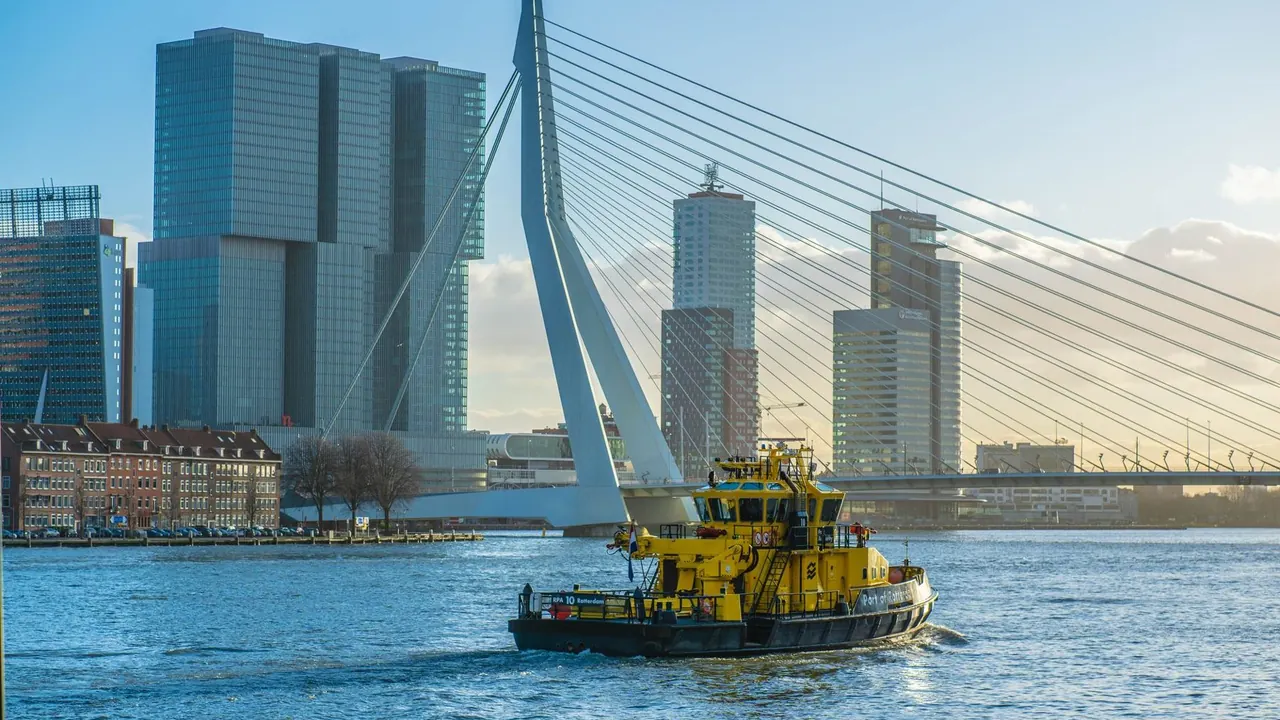
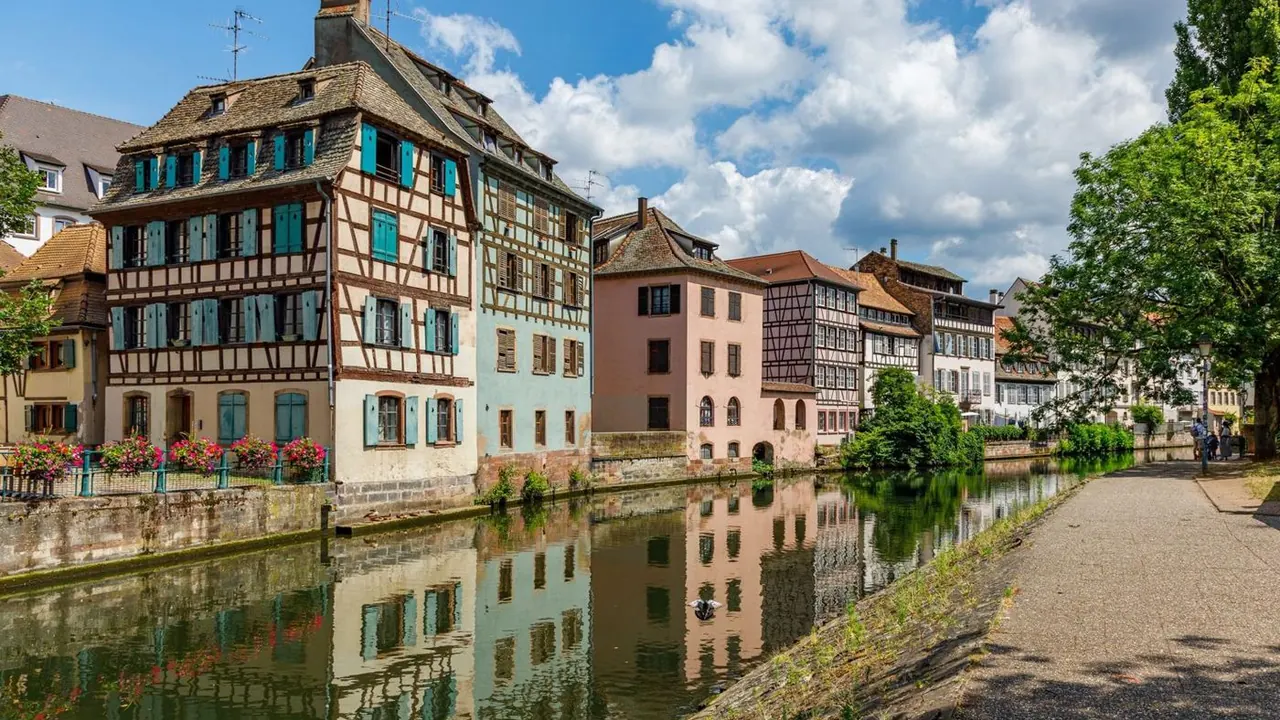
Photos: Rotterdam by Bas Geerlings, Pexels License; Strasbourg by Edoardo Colombo, Pexels License.
Rotterdam or Strasbourg?
Our verdict in twelve categories, each scored against the same fixed benchmark cities, and the climate month by month, so you can choose for your trip.
Choose Rotterdam for
- beaches
- nightlife
- day trips
Rotterdam suits travellers who want a modern port city rather than a postcard. Its draw is the postwar architecture along the Maas, an international street-food scene and a club culture rooted in hard electronic music. It also makes a well-connected base for touring the Dutch cities by train, with a real North Sea beach on the metro for a windy afternoon walk.
Choose Strasbourg for
- nature and the outdoors
- food and drink
- wellness
Strasbourg is the better pick for history, regional cooking and a slower pace. The cathedral and the timber-framed Grande Ile give it the stronger sightseeing, and winstub dinners with Alsace wine beat anything Rotterdam does in the Dutch tradition. The Vosges, the wine villages and the Black Forest bring proper countryside and spa towns within an hour, so it suits couples and walkers more than people looking for late nights.
Scoreboard
Twelve categories on one fixed scale from 0 to 100. The shaded stretch is the gap between the two.
Your match
Pick a travel style or drag the sliders, and both match scores follow your weighting.
Too close to call, 2 points apart
Wins on beaches and nightlife with your weighting.
Wins on nature and the outdoors and food and drink with your weighting.
What matters to you?
Category by category
What the scores mean for a trip.
Beaches & swimming
Rotterdam at least has the sea. Hoek van Holland is a broad sandy strand with dunes behind it and container ships passing close by, and the metro runs all the way there. The North Sea stays chilly and the wind is constant, though, so it is a place for long walks more than swimming.
Strasbourg is far inland, and its swimming means the lifeguarded gravel-pit lakes such as the Baggersee, which you can reach by tram. They are fine for a hot afternoon on the grass but no substitute for a coast.
Food & drink
Strasbourg has a regional cuisine of its own, and Rotterdam does not. In Strasbourg you eat choucroute, baeckeoffe and tarte flambée in wood-panelled winstubs with a pichet of Riesling, and there is a solid fine-dining tier in the city and the wine villages. The heavy cooking suits colder months, and the places right by the cathedral mostly serve tourist menus.
Rotterdam's strength is variety rather than tradition. Surinamese roti, Turkish bakeries and Cape Verdean and Indonesian kitchens line the Witte de Withstraat and the Nieuwe Binnenweg, and the Markthal is the easy place to start. That range of world cooking is exactly what Strasbourg lacks.
Culture & sights
Strasbourg has the richer sightseeing. The pink sandstone cathedral, with its astronomical clock, stands over an island of timber-framed streets, and Petite France, the covered bridges and the German-built Neustadt complete a UNESCO-listed townscape. The Palais Rohan, the Oeuvre Notre-Dame and the Alsatian Museum fill out the museum side.
Rotterdam lost most of its old centre in 1940, so its interest is modern buildings: the Erasmus Bridge, the Cube Houses and the mirrored Depot Boijmans. Its history survives mainly in Delfshaven and the Old Harbour. Both cities take two or three days, one spent among medieval streets, the other among twentieth-century buildings.
Nightlife
Rotterdam is the better city for a late night, mainly because of its clubs. It is where gabber started, and its warehouse and harbour venues hold techno and house nights that draw people from across the country. The Oude Haven and the Witte de Withstraat supply the bar terraces before that.
Strasbourg goes out at the bar. Student cellars in the Krutenau and the riverside terraces make for pleasant evenings, but there are only a handful of clubs, and on weeknights the streets are mostly quiet by midnight.
Nature & outdoors
Strasbourg gives far better access to real landscapes. Within about an hour you can reach the forested Vosges, with castle ruins and the ridge at Mont Sainte-Odile, or the higher fir-covered ridges of the Black Forest. Closer in, the Rhine forests have storks and beavers, and level cycle routes run across into Germany.
Rotterdam's outdoors is man-made and flat: the lake and woods of the Kralingse Bos, dyke-top cycling through the polders, kitesurfing at Hoek van Holland and canoeing in the Biesbosch creeks. It is pleasant, but walkers will find no real hiking nearby.
Day trips
Both cities are excellent bases. Rotterdam's trips are mostly to cities. Delft is a quarter of an hour away, The Hague, Amsterdam, Utrecht and Leiden are all within an hour by fast train, Antwerp is about an hour over the border, and a water bus runs to the windmills at Kinderdijk. Almost all of it works without a car.
From Strasbourg you go out into the countryside as much as to towns. Colmar and the Alsace wine route villages such as Riquewihr and Eguisheim lie to the south, and Baden-Baden, Freiburg and Heidelberg lie across the Rhine. Trains handle the cities, but a car or a bike makes the vineyard villages much easier.
Good for families
Both are easy with children: flat, safe and well served by trams. In Rotterdam the best things are in the city itself. Diergaarde Blijdorp, with its ocean section, the hands-on harbour area at the Maritime Museum and the water taxis keep most ages busy.
In Strasbourg there is less in town beyond the boats in the Orangerie, the storks, Le Vaisseau and the clock's moving figures. Its big family draw is Europa-Park, about an hour away across the border.
Getting around
Getting around is about equally easy, and in both places a bike is often the quickest option. Rotterdam's postwar centre is spread out and windy, so you rely on the metro and trams more, and water taxis across the Maas join in. Strasbourg's old town island can be crossed on foot in twenty minutes, much of it is pedestrianised, and a tram line even runs over the Rhine to Kehl.
Shopping & style
Neither is a luxury destination, but they are good for different things. Rotterdam is the place for browsing. The Lijnbaan and the Bijenkorf cover the chains, and the Meent and the Nieuwe Binnenweg add vintage clothes, records and independent design.
Strasbourg is better for things to take home: Alsace wine, Soufflenheim pottery, printed linens and gingerbread. In December the Christmas market takes over, though plenty of what it sells is mass-produced.
Affordability
Strasbourg is a little easier on the wallet, and the difference shows most at the table. Winstub meals, tarte flambée and wine by the pichet are fair value, whereas in Rotterdam eating out and drinking cost as much as anywhere in the Netherlands, so the Markthal counters and Surinamese snack shops are what keep lunch reasonable.
Hotels work the other way round. Rotterdam has plenty of rooms and little tourist pressure, while Strasbourg's fill up and climb sharply during the Christmas market and the weeks when the European Parliament sits.
Live music & performing arts
The two are well matched, each with a good orchestra and a full concert season, but their strengths differ. Strasbourg has the Opéra national du Rhin and one of France's leading theatres, and its Musica festival makes autumn the time for contemporary music. Rotterdam has no resident opera, and much of its theatre is in Dutch, but in July it holds the North Sea Jazz Festival, and the conservatory keeps its small jazz venues busy through the year.
Wellness & relaxation
Strasbourg is the easier place to unwind. The tiled Bains municipaux are in town, the thermal baths of Baden-Baden are under an hour away, and canal-side walks and long winstub lunches set a slow pace outside December.
Rotterdam is brisker. Its offer is the Dutch sauna complex on the city's edge, with steam rooms and gardens, mostly textile-free in the sauna areas. For simple calm, locals head to the Kralingse Bos.
When should you go?
Pick your month. The climate figures are measured averages, not a forecast.
Rotterdam in July
Strasbourg in July
Daytime high, °C
Rainfall in the month, mm
Where the figures come from
Rotterdam has no rain gauge within 25 km of the centre, so its rainfall comes from a gridded climate dataset read at the city rather than from a gauge further away.
Rotterdam's sunshine is measured 52 km from the centre, at De Bilt.
Temperature and rainfall are climate normals, averaged over the years shown. Rotterdam: 1993-2020 (sunshine 1991-2020, rainfall 1991-2020) normals, Rotterdam Airport Zestienhoven (3.9 km from centre). Strasbourg: 1991-2020 normals, Strasbourg (9.1 km from centre).
Both cities are at their best from late May to September, but summer feels quite different in each. Rotterdam stays mild, peaking around 22°C in July and August, and those are also its wettest months at about 86mm. The North Sea is only warm enough for a brief swim in August, at about 19°C, and the wind rarely drops. Strasbourg warms up more, reaching about 26°C in high summer with noticeably more sunshine, which makes the gravel-pit lakes and riverside terraces inviting. Neither city gets too hot for walking.
Spring and autumn are cool in both. Strasbourg is the warmer of the two in May and early autumn, though May is its wettest month, while Rotterdam gets a little more sun in October. Winters are cold and grey in both, but they differ in rain. Rotterdam stays damp right through, while Strasbourg's winter months are much drier, at around 35mm in January, which helps if you are coming for the December market.
Which traveller are you?
On a culture and arts trip, Strasbourg is the stronger choice. The cathedral, Petite France and the Neustadt make up a UNESCO-listed old town, the Palais Rohan has three museums under one roof, and the city has its own opera house.
For an outdoors trip, choose Strasbourg. The Vosges forests and castle ridges lie to the west and the Black Forest trails to the east, each about an hour away, while Rotterdam's outdoors stays flat: parks, polder cycling and the creeks of the Biesbosch.
Travellers who come for modern architecture should head to Rotterdam. Rebuilt after 1940 as the country's testing ground for new building, it offers the Cube Houses, the Markthal, the Erasmus Bridge and the Kop van Zuid towers, a postwar skyline Strasbourg has nothing to match.
Before you go
| Measure | Rotterdam | Strasbourg |
|---|---|---|
| Official language | Dutch | French |
| Currency | Euro (EUR) | Euro (EUR) |
| Sockets | CF230 V, 50 Hz | CE230 V, 50 Hz |
| Driving side | Right | Right |
| Time zone | UTC+1, UTC+2 in summer | UTC+1, UTC+2 in summer |
| Emergency number | 112 | 112 |
| Elevation | 10 m | 132 m |
| Main airport | Rotterdam The Hague Airport (RTM)5 km from centre53 non-stop destinations | Strasbourg Airport (SXB)10 km from centre43 non-stop destinations |
| Public holidays this year | 11 days | 11 days |
By the numbers
| Measure | Rotterdam | Strasbourg |
|---|---|---|
| City population | 664,311 | 293,771 |
| People per km² | 2,080 | 3,752 |
| Museums within 10 km | 40 | 21 |
| UNESCO World Heritage sites within 50 km | 5 | 1 |
| Swim season, months above 21 °C | None | - |
Where else could you go?
Every comparison below shares a destination with this one, so you can follow Rotterdam or Strasbourg somewhere new.