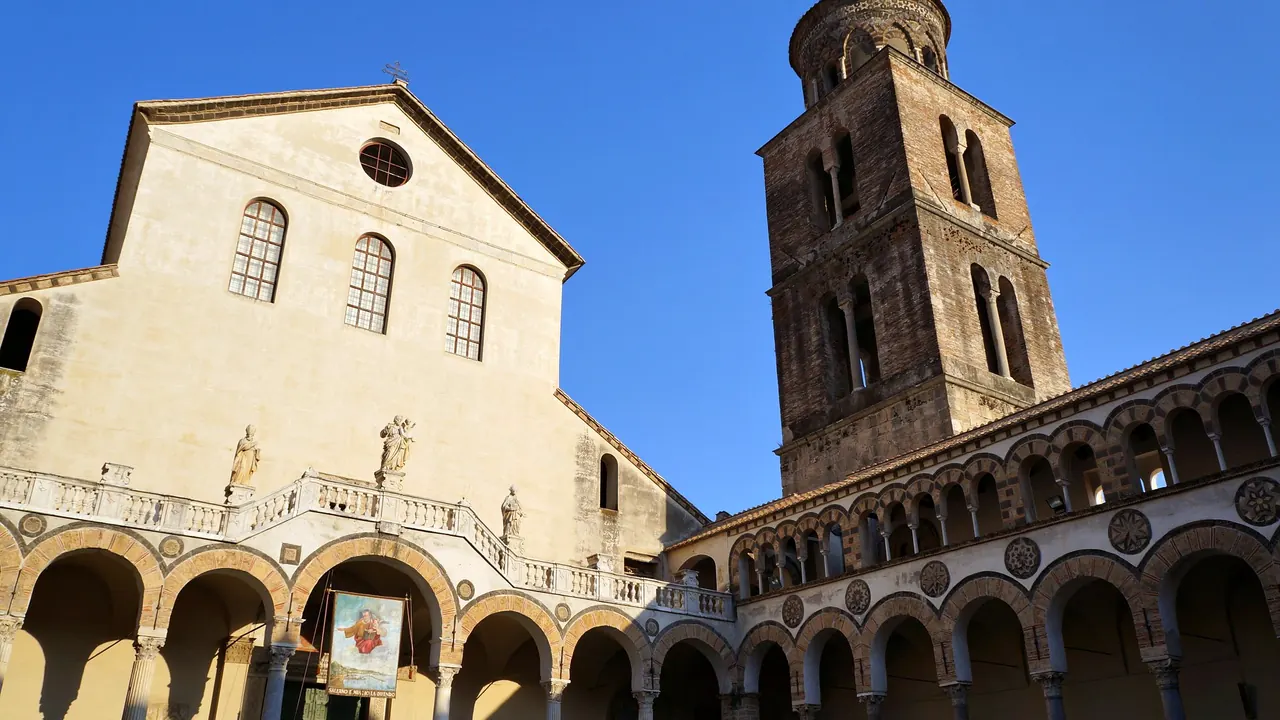
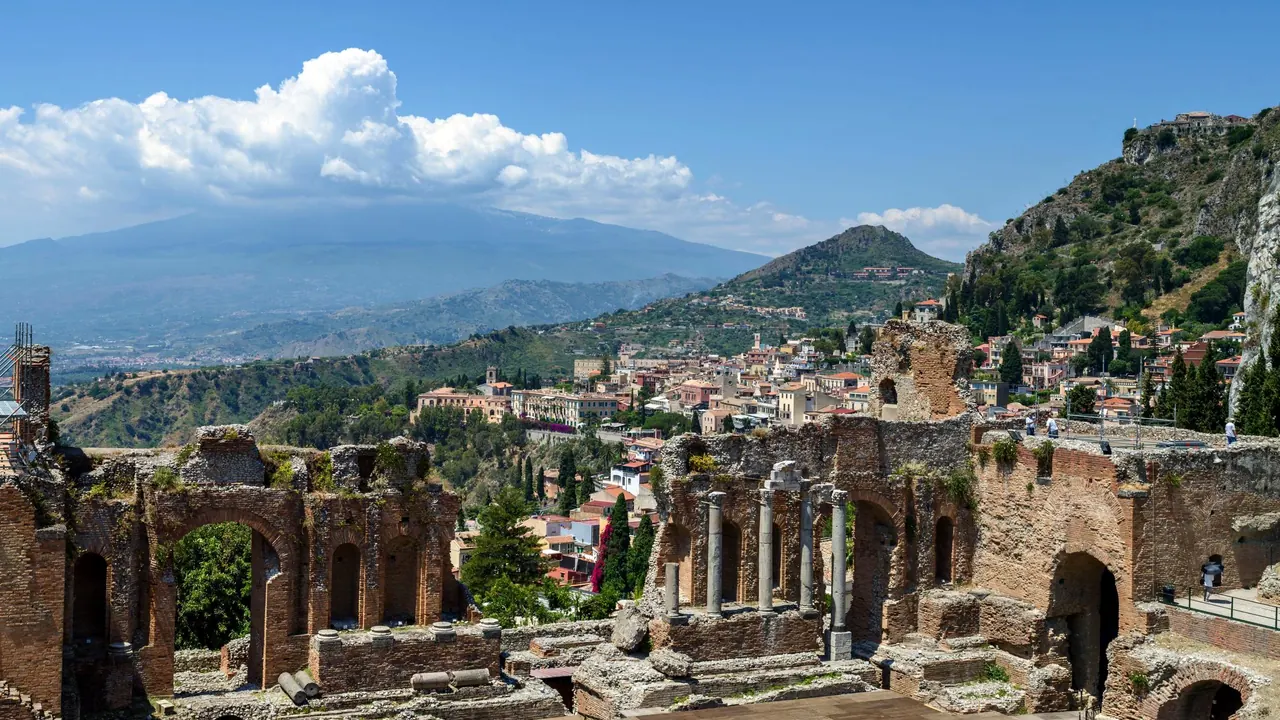
Photos: Salerno by Leandro Neumann Ciuffo, CC BY 2.0, cropped; Taormina by Reinhard Bruckner, Pexels License.
Salerno or Taormina?
Our verdict in twelve categories, each scored against the same fixed benchmark cities, and the climate month by month, so you can choose for your trip.
Choose Salerno for
- prices
- day trips
- families
Salerno suits the traveller who wants a practical base and plans to spend most days elsewhere. Pompeii, Paestum, Naples and the Amalfi Coast are all within easy reach by train or ferry. Rooms cost far less than on the cliffs, the trattorias in the old town are full of locals, and the flat seafront makes life easy with children. It is a working city rather than a postcard, and that is a large part of why it works so well as a base.
Choose Taormina for
- wellness
- beaches
- nature and the outdoors
Taormina is for a slower, more scenic stay where the place itself is the point. The Greek theatre looks across to Etna, the clear coves at Isola Bella sit below the town, and the hotel spas have terraces over the sea. It suits couples and anyone happy to pay resort prices for the setting, and to give up nightlife and an easy run of day trips in return.
Scoreboard
Twelve categories on one fixed scale from 0 to 100. The shaded stretch is the gap between the two.
Your match
Pick a travel style or drag the sliders, and both match scores follow your weighting.
Wins on prices and day trips with your weighting.
Wins on wellness and beaches with your weighting.
What matters to you?
Category by category
What the scores mean for a trip.
Beaches & swimming
Taormina has the better swimming close by. The cable car drops straight to Mazzarò and Isola Bella, where the water is clear enough for snorkelling. The catch is that these are narrow pebble strips that fill up early, and the longer sandy beaches are a bus ride away at Giardini Naxos.
Salerno's own beaches are grey sand near a working port, so the water is not at its clearest. A good beach day usually means travelling south to the wide sands towards Paestum, or taking a ferry to the coves of the Amalfi Coast.
Food & drink
Salerno gives you more choice and more honest everyday eating. Buffalo mozzarella comes fresh from the plain around Paestum and colatura from neighbouring Cetara, and the trattorias and friggitorie in the old town serve locals at local prices.
Taormina's Sicilian cooking has its own strong character: pasta alla Norma, granita with brioche for breakfast and Etna wines on every list. It also has a refined upper tier with sea views. Being a small resort, though, its main street leans towards tourist menus, and the good everyday places take some finding in the side streets.
Culture & sights
Neither town takes more than a day or two to see, but their heritage is very different. Salerno's is medieval and spread across several sights: the Norman cathedral with the crypt of Saint Matthew, the Giardino della Minerva with its link to Europe's first medical school, and the Arechi Castle above the gulf.
Taormina has one great monument. Its Greek theatre frames Etna and the coast, and around it runs a single street of palazzi showing Arab, Norman and Catalan influences. Neither town has a major museum.
Nightlife
Salerno has the livelier evenings. On weekends and through the summer, young locals fill the lanes around Largo Campo and Via dei Mercanti outside the wine bars, and Naples is close enough for a proper club night.
Taormina's nights are quieter and older: aperitivo in Piazza IX Aprile, then a piano bar on a terrace over the sea. Outside summer the town is quiet soon after dinner.
Nature & outdoors
Both have outstanding landscapes, and the difference is coast against volcano. From Salerno you walk old mule tracks such as the Path of the Gods above Positano, among limestone cliffs and lemon terraces, and the wooded hills and headlands of the Cilento lie to the south.
From Taormina, Etna is the main outing: lava flows, the Silvestri craters, guided trips towards the summit and even skiing in winter. The Alcantara gorges and the marine reserve for diving are close by. Both are best for hiking in spring and autumn.
Day trips
Salerno is the stronger base for day trips, and it is hard to beat in southern Italy. Paestum and Pompeii are each about half an hour away by train, Naples is a short fast-train ride, and in season ferries reach Amalfi and Positano without the coast road.
Taormina's outings are excellent but further apart. Catania is about an hour away and Syracuse about two, with Noto possible if you start early. Etna's wine villages usually need a tour or a car, so most days out from Taormina take more planning.
Good for families
Salerno is the easier place with children. Its long seafront promenade is flat, car-free and has playgrounds, the beaches to the south are shallow and sandy, and in winter the Luci d'Artista lights are a treat.
Taormina is built on a slope of steps, and its nearest beaches are pebbly and crowded in August. Snorkelling and a trip up Etna do suit school-age children. Families with younger children often stay down in Giardini Naxos instead.
Getting around
Salerno is the easier place to move about in. The station, the Corso, the seafront and the old town follow one flat strip that you can cover on foot, with a short metro line and city buses for the eastern districts and a bus up to the castle. In summer the boat beats the road along the coast, because the coastal buses crawl and fill up and parking on the cliffs is scarce.
In Taormina distances are short but steep, and stairways come into almost every walk. A cable car runs down to the bays at Mazzarò, and local buses climb to Castelmola or drop to Giardini Naxos. The coastal railway is handy for the airport, but the station sits far below the town, so arriving with luggage means a bus or taxi up the hill. Drivers have to leave the car in the garages at the edge of the centre.
Shopping & style
Neither is a shopping destination, and each sells something different. Salerno's Corso Vittorio Emanuele is an everyday street of Italian chains, and the best things to take home come from nearby: Vietri majolica and colatura from Cetara.
Taormina's Corso Umberto is aimed at visitors, with coral, cameos, linen and Caltagirone ceramics alongside Bronte pistachio cream. For bigger shops, Salerno has Naples nearby and Taormina has Catania.
Affordability
Salerno costs much less. As a working city it charges local prices for rooms, pizza and trains, which makes it a sensible base for an expensive stretch of coast. Summer adds costs in ferries and sunbeds.
Taormina is the priciest stay in eastern Sicily, with grand hotels and resort prices along the main street. Staying in Giardini Naxos or Letojanni, or coming in spring or autumn, lowers the bill noticeably.
Live music & performing arts
Salerno has more to offer through the year. The Teatro Verdi, a gilded opera house modelled on Naples' San Carlo, runs a full season of opera, concerts and ballet, and in summer the Ravello Festival's cliff-top concerts are within reach.
Taormina's big moment is a summer night in the Greek theatre, with Etna behind the stage, and that is hard to beat as a setting. Outside summer, though, there is little beyond chamber concerts, and serious opera means going to Catania.
Wellness & relaxation
Taormina is better for unwinding. Its large hotels have proper spas with terrace pools above the sea and treatments using volcanic mud and citrus, and the Villa Comunale gardens offer shade, though the town is calmest in May, June and late September.
Salerno's calm lies in sunset walks along the palm-lined promenade, set against a port city's traffic. Its nearest thermal pools are about an hour inland at Contursi Terme.
When should you go?
Pick your month. The climate figures are measured averages, not a forecast.
Salerno in July
Taormina in July
Daytime high, °C
Rainfall in the month, mm
Where the figures come from
Salerno's temperatures are measured 71 km from the centre, at Grazzanise.
Salerno has no rain gauge within 25 km of the centre, so its rainfall comes from a gridded climate dataset read at the city rather than from a gauge further away.
Taormina's temperatures are measured 45 km from the centre, at Messina.
Taormina has no rain gauge within 25 km of the centre, so its rainfall comes from a gridded climate dataset read at the city rather than from a gauge further away.
Temperature and rainfall are climate normals, averaged over the years shown. Salerno: 1991-2020 normals, Grazzanise (71.3 km from centre). Taormina: 1991-2020 normals, Messina (45.1 km from centre).
The two towns are almost equally warm through the year. Both reach about 31°C in July and August, which is hot for climbing steps and stairways at midday, and both have pleasant walking weather in May and from late September into October. The sea is warm enough to swim in from June to October in both, at its warmest in August. Taormina is slightly milder in winter.
Rain is the real difference. Taormina's summers are almost completely dry, and its wet season, from October to December, is moderate. Salerno gets more rain in every month. Showers return in September, and November is very wet at 154mm, so late autumn and winter suit Taormina better for walking about in dry weather.
Which traveller are you?
On a trip on a tight budget, Salerno is the clear choice. Rooms and meals come at working-city prices, while Taormina is the costliest stay in eastern Sicily. Cheap regional trains also mean the great ancient sites can be reached without paying for a tour.
On a family trip with children, Salerno asks less of parents. Days can be spent at sea level without much climbing, the lower costs leave room for outings, and Pompeii is a short train ride for older children. Taormina is geared to couples, and its slopes soon tire small legs.
For a relaxing and wellness trip, Taormina is the better pick. It is a resort town where the hotels themselves are built for unwinding, and outside high summer the days slow to long lunches and evenings watching Etna. Salerno is a working port, pleasant for strolling but rarely a retreat.
Before you go
| Measure | Salerno | Taormina |
|---|---|---|
| Official language | Italian | Italian |
| Currency | Euro (EUR) | Euro (EUR) |
| Sockets | CFL230 V, 50 Hz | CFL230 V, 50 Hz |
| Driving side | Right | Right |
| Time zone | UTC+1, UTC+2 in summer | UTC+1, UTC+2 in summer |
| Emergency number | 112 | 112 |
| Elevation | 4 m | 204 m |
| Main airport | Naples International Airport (NAP)46 km from centre131 non-stop destinations | Catania-Fontanarossa Airport (CTA)47 km from centre96 non-stop destinations |
| Public holidays this year | 13 days | 13 days |
By the numbers
| Measure | Salerno | Taormina |
|---|---|---|
| City population | 127,186 | 10,471 |
| People per km² | 2,123 | 799 |
| Museums within 10 km | 9 | 5 |
| UNESCO World Heritage sites within 50 km | 5 | 2 |
| Swim season, months above 21 °C | 5 months | 5 months |
Where else could you go?
Every comparison below shares a destination with this one, so you can follow Salerno or Taormina somewhere new.
- Amalfivs Salerno
- Positanovs Salerno
- Sorrentovs Salerno
- Cataniavs Taormina
- Naplesvs Salerno
- Syracuse, Sicilyvs Taormina