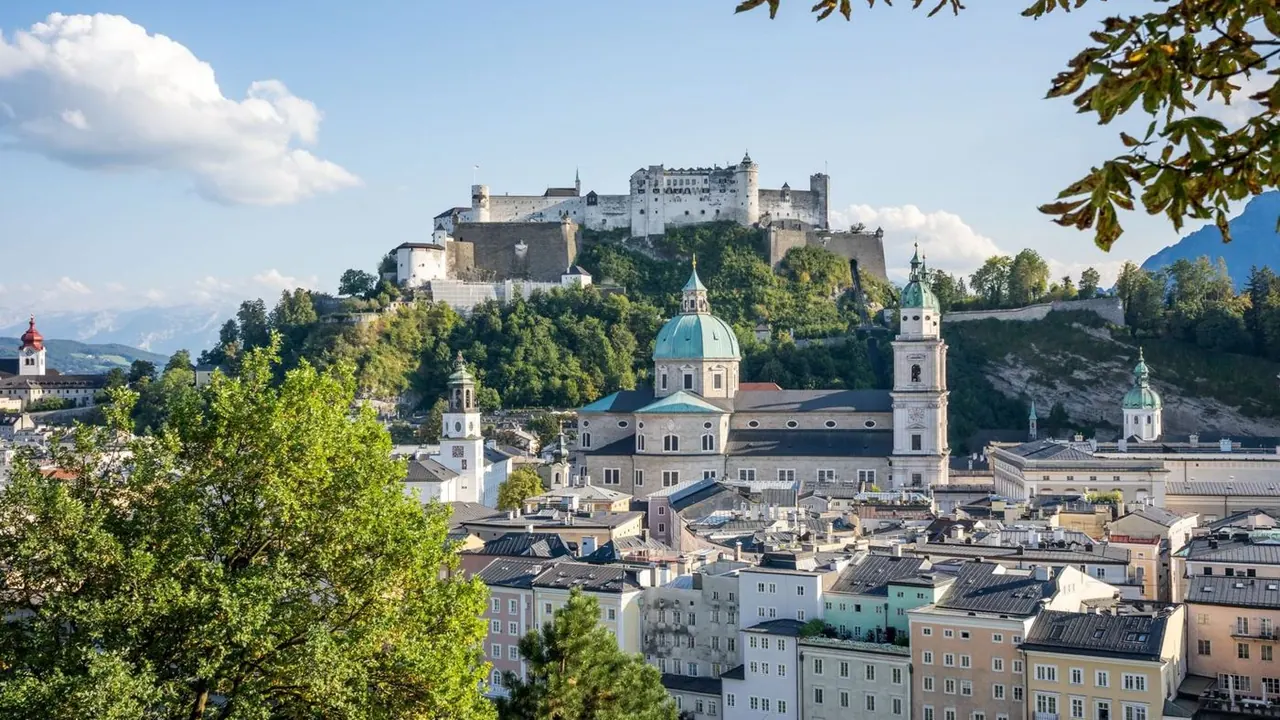
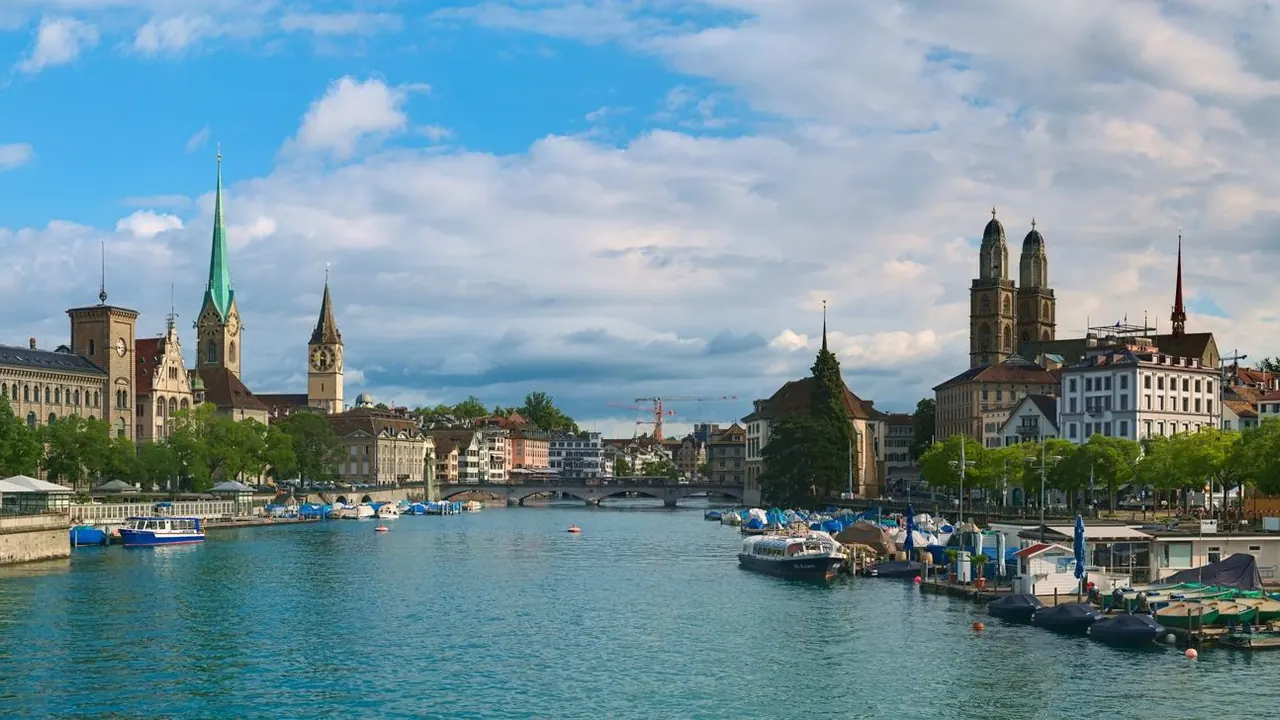
Photos: Salzburg by Leonhard Niederwimmer, Pexels License; Zurich by Daniel Kraft, CC BY-SA 3.0, cropped.
Salzburg or Zurich?
Our verdict in twelve categories, each scored against the same fixed benchmark cities, and the climate month by month, so you can choose for your trip.
Choose Salzburg for
- prices
- culture and sights
- live music and the arts
Salzburg is the choice when music and Baroque architecture are the point of the trip. Its old town is a single preserved ensemble with the fortress on the cliff above it, its summer festival draws leading performers, and the Alps begin at the edge of town. Evenings are a concert and a beer hall rather than a club, and although it is not cheap, it costs far less than Zurich.
Choose Zurich for
- nightlife
- getting around
- shopping
Zurich makes more sense for travellers who want a city that runs smoothly and keeps going after dark. Trams, trains and lake boats share one ticket and reach half of Switzerland without a car. The clubs in the old industrial districts stay open until morning, and swimming in the lake and river is part of summer life in the city itself. Families find it easier too. The cost is the main drawback, because Zurich is among the most expensive places in Europe to spend a few days.
Scoreboard
Twelve categories on one fixed scale from 0 to 100. The shaded stretch is the gap between the two.
Your match
Pick a travel style or drag the sliders, and both match scores follow your weighting.
Wins on prices and culture and sights with your weighting.
Wins on nightlife and getting around with your weighting.
What matters to you?
Category by category
What the scores mean for a trip.
Beaches & swimming
Neither city has sand, and both swimming seasons run only through the warm months. Zurich is the better place for a swim because the water is right in the city. Wooden bathing houses and lawned lidos line the lake shore, and at the Letten river baths swimmers float downstream on the Limmat current.
In Salzburg the Salzach is too cold and fast for swimming, so a dip means a half-hour or longer trip to Fuschlsee, Wolfgangsee or Mondsee. Their water is clear and green, and you get in from jetties and small pebble shores. That makes a lovely afternoon out, but it takes more planning than walking down to the lake after a museum.
Food & drink
Zurich has a slight edge, mostly because it offers more variety. Beyond veal in cream sauce with rösti and winter fondue in the guild houses, the districts around Langstrasse have casual international cooking, and the city's chocolate and confectionery are excellent.
Salzburg's cooking is hearty Austrian food: Kasnocken, Tafelspitz and the peaked Salzburger Nockerl. Its best moments are coffee and cake in the old coffee houses and a mug of beer in the Augustiner monastery brewery's chestnut garden. Avoid the tour-group menus in the old town and head for the inns on the outskirts. A few days covers the range in either city, and both are expensive places to eat out.
Culture & sights
Salzburg is the place to come for sights. The whole UNESCO-listed old town feels like one Baroque composition, with the cathedral, the Residenz and the arcaded squares beneath one of Europe's largest medieval fortresses. Mozart's birthplace, the rock-cut catacombs of St Peter and the Mirabell gardens add to it.
Zurich's strength lies in its museums more than its streets. The Kunsthaus, with Monet, Munch and Giacometti, and the Museum Rietberg's world art collection have no real equal in Salzburg. Its Altstadt, with the Grossmünster and the Chagall windows of the Fraumünster, is attractive but less of a spectacle.
Nightlife
The difference here is large. Zurich has a serious electronic music scene, with clubs in Kreis 4 and 5 and the Zurich West warehouses running until morning, Langstrasse lively late into the night, and the Street Parade taking over the lake shore each August. In summer, people drink at the lake bathing houses and along the river.
Salzburg goes to bed early. A good night there means a concert followed by long tables and litre mugs in a beer hall, perhaps with a late drink at the student pubs on Rudolfskai. Anyone who wants to dance usually takes the train to Munich.
Nature & outdoors
Both cities have outstanding scenery, and Salzburg has slightly more of it close at hand. The mountains start at the edge of the city. A cable car lifts you to about 1,800m on the Untersberg, the Gaisberg is used for paragliding, and the Königssee fjord in Berchtesgaden National Park is about half an hour away.
Zurich's landscape is centred on its lake, with the snowy Glarus Alps on the horizon and the Uetliberg ridge a short train ride away. The high peaks of Rigi and Pilatus take about an hour to reach. Be ready for long foggy spells over the water in winter.
Day trips
Both are excellent bases for day trips, and the real difference is how you travel. From Zurich, trains reach Lucerne, Bern, Basel, St Gallen and the Rhine Falls within about an hour, so a different Swiss city or town each day is easy without a car.
Salzburg's day trips are about Alpine lakes and salt. Hallstatt sits under its prehistoric mine, Hallein and Berchtesgaden have show mines to go down into, and the Werfen fortress stands on its cliff, with Munich available for a change of scene. Several of the lake villages are much easier to reach with a hire car.
Good for families
Zurich is easier with children. Trams and trains take buggies without fuss, the zoo's Madagascar rainforest hall and elephant park make a full day out, and the lake lidos have shallow areas and lawns made for small swimmers. The Technorama in Winterthur is twenty minutes away by train.
Salzburg has some memorable treats, such as the soaking trick fountains at Hellbrunn and the miners' slides in the salt mines. However, the cobbles and steep lanes are hard going with a pushchair, and the family sights run out after a couple of days.
Getting around
In both cities the centre is easy to walk. Beyond that, Zurich is far ahead. Its trams reach every neighbourhood, and the same ticket covers S-Bahn trains, funiculars, the Uetliberg railway and even the lake boats. The airport is a short ride from the main station.
Salzburg manages well with trolleybuses and flat riverside cycle paths, but it has no trams. The regional buses to the Salzkammergut are slow enough that many visitors hire a car for the lakes.
Shopping & style
Zurich is the better place to shop, as long as you are looking for luxury. Bahnhofstrasse runs from the station to the lake past watchmakers, jewellers and long-established department stores, and the railway viaduct arches in Zurich West hold design shops and a covered food market.
Salzburg has a speciality of its own in Tracht. Workshops around the old town make dirndls and loden jackets to measure, and the farmers' market by the Andräkirche and the Advent market on Domplatz have their own charm. Beyond that, Getreidegasse is mostly chain shops and souvenirs behind guild signs.
Affordability
Neither city is a bargain, but Salzburg is much the easier on the wallet. Staying across the river or in the suburbs, eating in the beer halls and outer-district inns and using the city card keep costs reasonable, though rooms become scarce and expensive during the festival and Advent.
Zurich is expensive at every level, from a simple hotel room to a casual lunch or a round of drinks. Supermarket picnics, the free public lidos and the travel pass help a little, but they do not change the overall picture.
Live music & performing arts
For classical music, Salzburg leads. The summer festival fills the Grosses Festspielhaus and the Felsenreitschule, carved into the cliff, Jedermann is staged in front of the cathedral, and Mozart Week and the Easter Festival add further seasons. Book festival tickets well in advance.
Zurich has more variety. The Opernhaus and the Tonhalle are first-rate, the Schauspielhaus is a leading German-language theatre, and the old Rote Fabrik and the Kreis 4 and 5 venues bring jazz, indie and electronic acts that Salzburg mostly lacks.
Wellness & relaxation
The two are broadly level, but the bathing is found in different places. Zurich's best options are in the city: the thermal pools and rooftop pool in the stone vaults of the old Hürlimann brewery, and winter saunas in the wooden lake bathing houses with plunges into cold water. Baden's Roman hot springs are twenty minutes away by train.
Salzburg has little in town beyond the Paracelsus Bad, but it is close to real spa traditions. The salt-water brine of Bad Reichenhall is just across the border, and the Gastein valley has radon springs and Belle Époque spa hotels. The Mönchsberg woods and the Mirabell gardens also make good quiet walks once the day-trippers have gone.
When should you go?
Pick your month. The climate figures are measured averages, not a forecast.
Salzburg in July
Zurich in July
Daytime high, °C
Rainfall in the month, mm
Temperature and rainfall are climate normals, averaged over the years shown. Salzburg: 1991-2020 normals, Salzburg (3.4 km from centre). Zurich: 1991-2020 normals, Zurich Town / Ville. (2.2 km from centre).
The two cities follow almost the same temperature curve. Winters are cold, with highs around 4°C, and spring warms steadily through April. Both are at their warmest in July and August, with Salzburg a degree or so ahead at about 25°C. That is warm enough for lake swimming from June to early September and comfortable for walking the streets all summer. Summer is also the wettest season in both. Salzburg gets the heavier share, with about 168mm in June against Zurich's 128mm, and that often comes as afternoon downpours against the mountains, so pack a rain jacket for hiking days.
September is a good month in either city: still mild, with noticeably less rain. The real difference shows from late autumn into winter. Salzburg keeps a little more sunshine, while Zurich turns grey, with only about 43 hours of sun in December as fog settles over the lake. Late spring and early autumn suit sightseeing in both. For time on the water and in the mountains, aim for midsummer and expect some wet days.
Which traveller are you?
For a culture and arts trip, Salzburg is the stronger pick. The prince-archbishops' Baroque old town, the Hohensalzburg fortress and the Mozart houses sit within a short walk of each other, and the festival and the Mozarteum bring world-class classical music.
On a food and nightlife trip, Zurich wins clearly. Langstrasse and the converted industrial spaces of Zurich West have clubs running until morning at weekends, and Kreis 4 and 5 offer a far wider range of food than Salzburg's narrow menu of schnitzel and dumplings.
On a tight budget, Salzburg is the more realistic choice, though it is still not cheap. You can stay across the river, eat in the outer-district inns and use the city card. In Zurich, even a supermarket picnic by the lake only slightly eases the cost.
Before you go
| Measure | Salzburg | Zurich |
|---|---|---|
| Official language | German, Austrian Sign Language | French, German, Italian, Romansh |
| Currency | Euro (EUR) | Swiss Franc (CHF) |
| Sockets | CF230 V, 50 Hz | CJ230 V, 50 Hz |
| Driving side | Right | Right |
| Time zone | UTC+1, UTC+2 in summer | UTC+1, UTC+2 in summer |
| Emergency number | 112 | 112 |
| Elevation | 424 m | 408 m |
| Main airport | Salzburg Airport (SZG)3 km from centre64 non-stop destinations | Zürich Airport (ZRH)9 km from centre226 non-stop destinations |
| Public holidays this year | 16 days | 10 days |
By the numbers
| Measure | Salzburg | Zurich |
|---|---|---|
| City population | 155,021 | 440,935 |
| People per km² | 2,360 | 5,016 |
| Museums within 10 km | 38 | 63 |
| UNESCO World Heritage sites within 50 km | 3 | 1 |
Where else could you go?
Every comparison below shares a destination with this one, so you can follow Salzburg or Zurich somewhere new.