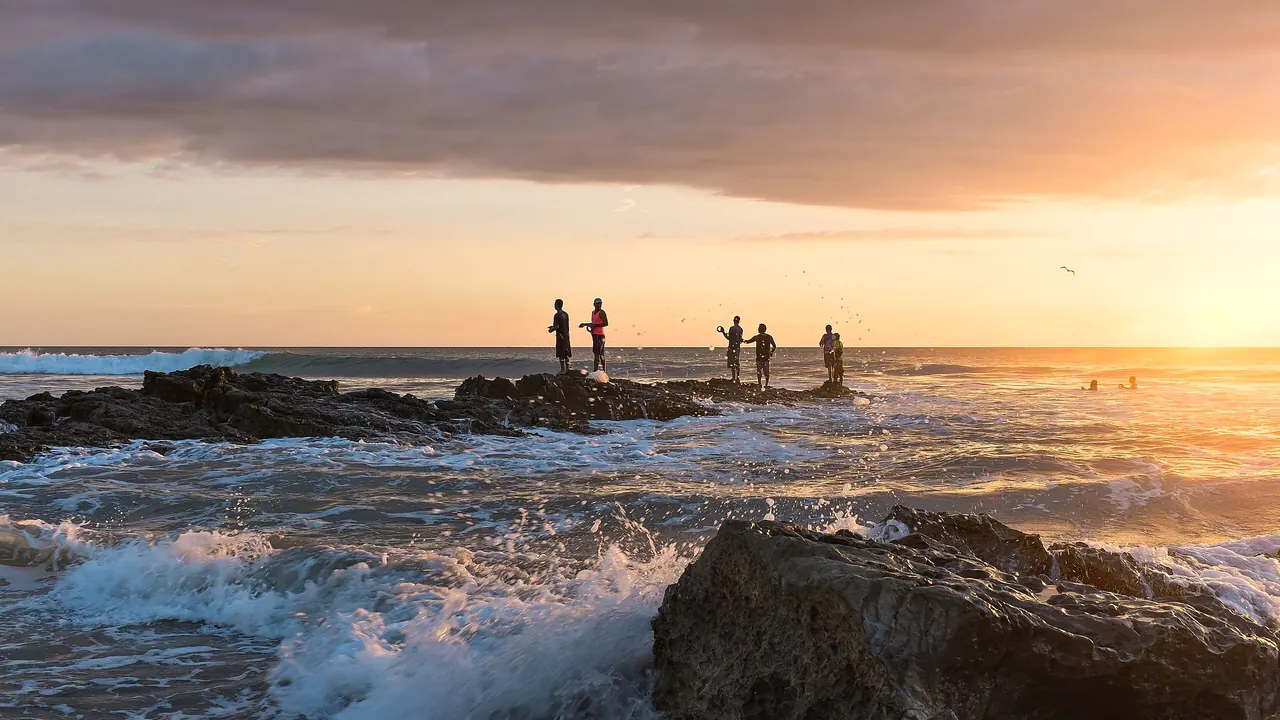
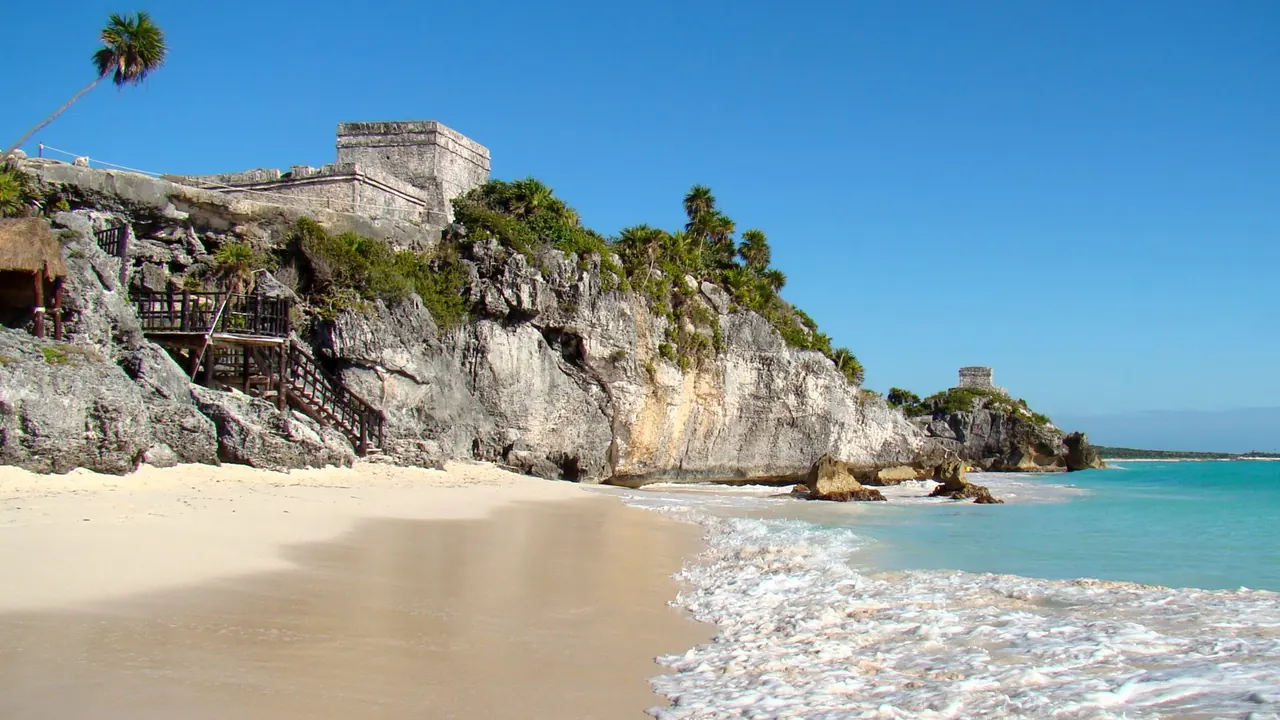
Photos: Santa Teresa, Costa Rica by Christopher Crouzet, CC BY-SA 4.0, cropped; Tulum by Bjørn Christian Tørrissen, CC BY-SA 3.0, cropped.
Santa Teresa, Costa Rica or Tulum?
Our verdict in twelve categories, each scored against the same fixed benchmark cities, and the climate month by month, so you can choose for your trip.
Choose Santa Teresa, Costa Rica for
- nature and the outdoors
Santa Teresa is for travellers who want the surf and the forest and very little else. Days run to the tides, from beginner waves at Playa Carmen to the points, with howler monkeys behind the beach and yoga in shalas above it. You come for a wild Pacific coast and a small village. You won't find sights, shopping or much of a night out, and getting there takes real effort.
Choose Tulum for
- day trips
- nightlife
- culture and sights
Tulum makes more sense if you want a wider trip from one base. The calm turquoise Caribbean comes with a cliff-top Maya city, cenotes to swim in, Coba and Chichen Itza within reach, a well-known electronic music scene and a deeper wellness offer. It also works better for families. The cost is a more commercial feel, sargassum in some seasons and a town set back from the sand.
Scoreboard
Twelve categories on one fixed scale from 0 to 100. The shaded stretch is the gap between the two.
Your match
Pick a travel style or drag the sliders, and both match scores follow your weighting.
Wins on nature and the outdoors with your weighting.
Wins on day trips and nightlife with your weighting.
What matters to you?
Category by category
What the scores mean for a trip.
Beaches & swimming
Both have a long stretch of pale sand with palms growing almost to the water and a warm sea, so the difference lies in what the water does. Santa Teresa faces the open Pacific. It is a surf beach first, with rip currents on many days, so careful swimmers head for the rock pools at Mal País at low tide or the calmer corners near the points.
Tulum's Caribbean water is calmer and turquoise, with the cliff-top ruins behind it and a sheltered bay at Akumal. Sargassum can pile up on the sand in the warmer months, though, and the town is a few kilometres inland. In Santa Teresa the village runs right along the shore.
Food & drink
Santa Teresa eats well for a village on a dirt road, but almost everything on the menu has come from somewhere else: wood-fired pizza, poke, Israeli plates and Argentine grills served under thatched roofs along the main road. The Costa Rican part is casados in the small sodas, and fresh seafood is the best local produce. There is no market and no street food.
Tulum goes further because it has a regional kitchen to draw on. The taco stands and evening stalls in the town centre serve al pastor and cochinita pibil, and sopa de lima and fish grilled with achiote are worth seeking out. Both have their own sameness, though. Santa Teresa's strip repeats one laid-back café after another, and many of Tulum's menus fall back on smoothie bowls and ceviche, so neither is a reason to travel for food.
Culture & sights
Tulum has one major sight: the walled Maya port on the cliff edge, where El Castillo stands above the sea. A visit takes a couple of hours and is best done early. Santa Teresa grew from a fishing hamlet into a surf town and has nothing to visit. Its appeal is its setting and its relaxed international community.
Nightlife
Tulum's nightlife is known well beyond Mexico. DJs play in jungle clearings, beach clubs run from late afternoon into the night, and big outdoor events peak in winter and around New Year. Santa Teresa has a smaller version: a few venues take turns hosting DJ nights and beach or jungle parties through the week.
On most nights Santa Teresa offers little choice, and many visitors go to bed early to surf at dawn. Neither place has a proper bar district. Tulum's mezcal bars on the main avenue are as close as either comes.
Nature & outdoors
Both are excellent for the outdoors and both are flat, but in different ways. Santa Teresa's outdoors is on and above the water. There is consistent surf, howler monkeys and coatis in the dry forest, a trail through Cabo Blanco to a remote beach, the waterfalls at Montezuma and snorkelling trips to Isla Tortuga.
Tulum's best is underwater. Cenotes and flooded caves around the town are among the best places on earth for cavern snorkelling and cave diving. The lagoons and mangroves of Sian Ka'an, explored by boat, add dolphins and wading birds.
Day trips
This is where the two differ most. From Tulum, the forest pyramid at Coba is under an hour away. Chichen Itza, paired with colonial Valladolid, is about two hours, and Playa del Carmen, with ferries to Cozumel, is under an hour up the coast. You can reach them by car, on a tour or by the Tren Maya.
Santa Teresa is near the remote tip of the Nicoya Peninsula. Montezuma's small seafront, about forty minutes away, is the only town worth an afternoon. Other outings go to reserves, islands and waterfalls rather than towns.
Good for families
Tulum is easier with children. It has the warm, calm sea, shallow snorkelling with turtles at Akumal, cenotes with wooden steps into clear water, and the purpose-built eco-parks at Xel-Ha and Xcaret a short drive away. Santa Teresa suits outdoorsy families who will enjoy monkeys, rock pools and gentle surf lessons.
In Santa Teresa the open sea is often unsafe for young swimmers, the main road has no pavements and carries a steady stream of quads, and medical care is basic and some distance away. In both places, a pool at your villa or resort does much of the work.
Getting around
Neither is easy, but Tulum takes a little less effort. Its centre is walkable, the flat roads suit bicycles for reaching the beach and ruins, and colectivo vans run along the highway. Santa Teresa stretches along one rough road with no pavements and no public transport, so visitors rent quads or scooters, take taxis or walk along the beach.
Getting there differs too. Tulum is on the main highway down the Riviera Maya. Santa Teresa means a car ferry across the gulf to Paquera, a long drive around the peninsula, or a small plane to Tambor followed by a transfer.
Shopping & style
Tulum has more to browse. Boutiques on the beach road sell linen dresses, woven bags and macramé, and the town's main avenue has silver jewellery, embroidered huipiles and hammocks that make proper Mexican souvenirs. Santa Teresa's boutiques sell swimwear, surf brands and boards, which is handy for gear but has little local craft. Neither has a real market.
Affordability
Both are among the most expensive places to stay in their countries, with boutique hotels and restaurants priced for foreign visitors. They differ in where you can save. In Tulum the cheaper option is the inland town, with guesthouses, taco stands and bicycle hire, as long as you accept riding to the beach each day.
In Santa Teresa you can save with hostels, shared surf houses and local sodas, often close to the sand. The journey there, quad rental, surf lessons and boat trips add up quickly, though.
Live music & performing arts
Neither has a theatre or a concert season, but Tulum offers a little more. There are bands and acoustic sets in bars on the main avenue, and staged ceremonial dance at the eco-parks up the coast. In Santa Teresa, live music means a set at a beach bar, drumming and fire dancing at sunset, or a DJ at the weekly parties.
Wellness & relaxation
Yoga is what the two share, and in Santa Teresa it is nearly the whole offer: shalas in the forest above the beach, week-long retreats, drop-in breathwork and massage. Spa treatments mostly happen in small studios and hotel spas. Tulum offers more depth. It has a bathing tradition of its own in the temazcal, the domed Maya sweat lodge used for cleansing ceremonies, and open-air spas, sound baths and retreat hotels line the beach road and the jungle behind it.
What breaks the calm differs. In Santa Teresa it is the dust and quad traffic on the main road, so the quietest stays are up the hill. In Tulum it is party nights and highway noise, and the scene can feel commercial, so choose somewhere well away from the clubs.
When should you go?
Pick your month. The climate figures are measured averages, not a forecast.
Santa Teresa, Costa Rica in July
Tulum in July
Daytime high, °C
Rainfall in the month, mm
Where the figures come from
Santa Teresa, Costa Rica's temperatures are measured 52 km from the centre, at Puntarenas.
Santa Teresa, Costa Rica has no rain gauge within 25 km of the centre, so its rainfall comes from a gridded climate dataset read at the city rather than from a gauge further away.
Tulum has no weather station within reach, so its figures come from a gridded climate model rather than a measured record, and read a broad area rather than the city itself.
Temperature and rainfall are climate normals, averaged over the years shown. Santa Teresa, Costa Rica: 1961-1990 (rainfall 1991-2020) normals, Puntarenas (51.5 km from centre). Tulum: 2001-2020 normals, NASA POWER reanalysis grid, no weather station within 90 km.
Santa Teresa has two very different seasons. From December to April it hardly rains at all, only 2mm in January, and these are its sunniest months. Afternoons get close to 35°C, though, so walk in the early morning or around sunset. In May heavy rain sets in and lasts until October, peaking near 400mm in both September and October. Sunshine drops, the side roads turn to mud and the swell gets bigger.
Tulum's climate is milder and steadier. Winter highs are around 27°C and summer highs rarely go past 31°C, which makes it the easier of the two for sightseeing on foot. Rain falls in every month but stays light from February to April, then gets heavier from June to October, with October the wettest. In both places the sea is warm enough to swim all year, and December to April is the best window for both.
Which traveller are you?
On a culture and arts trip, choose Tulum. Its walled Maya city sits on the cliff above the sea, and the forest pyramid at Coba and the great site of Chichen Itza are both an easy day out. Santa Teresa has no museums or historic sights at all.
On a family trip with children, Tulum is easier too. Turtles graze in the shallows at Akumal, cenotes have steps down into calm, clear pools, and the eco-parks at Xel-Ha and Xcaret are built for children. Santa Teresa's currents and its road without pavements both need constant care.
If you are travelling to surf, pick Santa Teresa. The Pacific swell is consistent, with beach breaks for learners along Playa Carmen and stronger reef and point waves nearby, and surf schools everywhere. Tulum's Caribbean side is a place for swimming and snorkelling, not for waves.
Before you go
| Measure | Santa Teresa, Costa Rica | Tulum |
|---|---|---|
| Official language | Spanish | Spanish, Nahuatl, Yucatec Maya |
| Currency | Costa Rican Colon (CRC) | Mexican Peso (MXN) |
| Sockets | AB120 V, 60 Hz | AB127 V, 60 Hz |
| Driving side | Right | Right |
| Time zone | UTC-6 | UTC-5 |
| Emergency number | 911 | 911 |
| Elevation | 19 m | 5 m |
| Main airport | Daniel Oduber Quirós International Airport (LIR)113 km from centre30 non-stop destinations | Felipe Carrillo Puerto International Airport Tulum (TQO)21 km from centre9 non-stop destinations |
| Public holidays this year | 11 days | 9 days |
By the numbers
| Measure | Santa Teresa, Costa Rica | Tulum |
|---|---|---|
| City population | - | 33,374 |
| Museums within 10 km | 0 | 0 |
| UNESCO World Heritage sites within 50 km | 0 | 0 |
| Swim season, months above 21 °C | 12 months | 12 months |
Where else could you go?
Every comparison below shares a destination with this one, so you can follow Santa Teresa, Costa Rica or Tulum somewhere new.