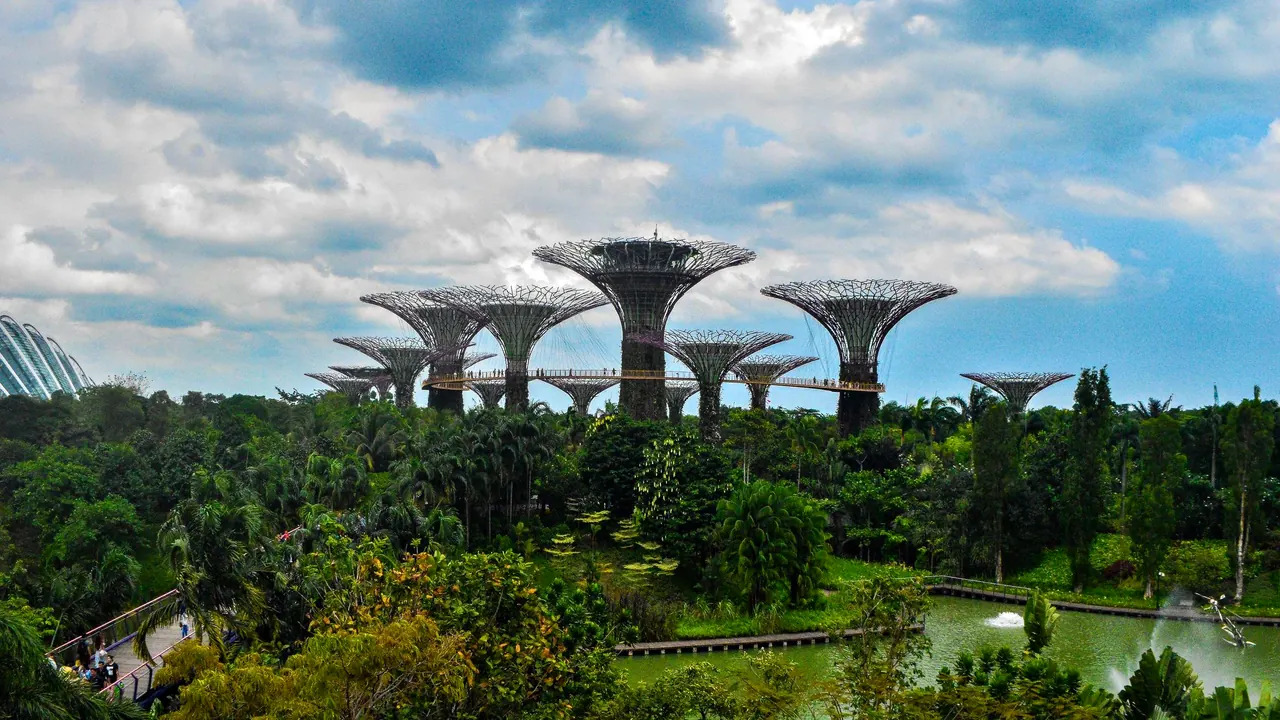
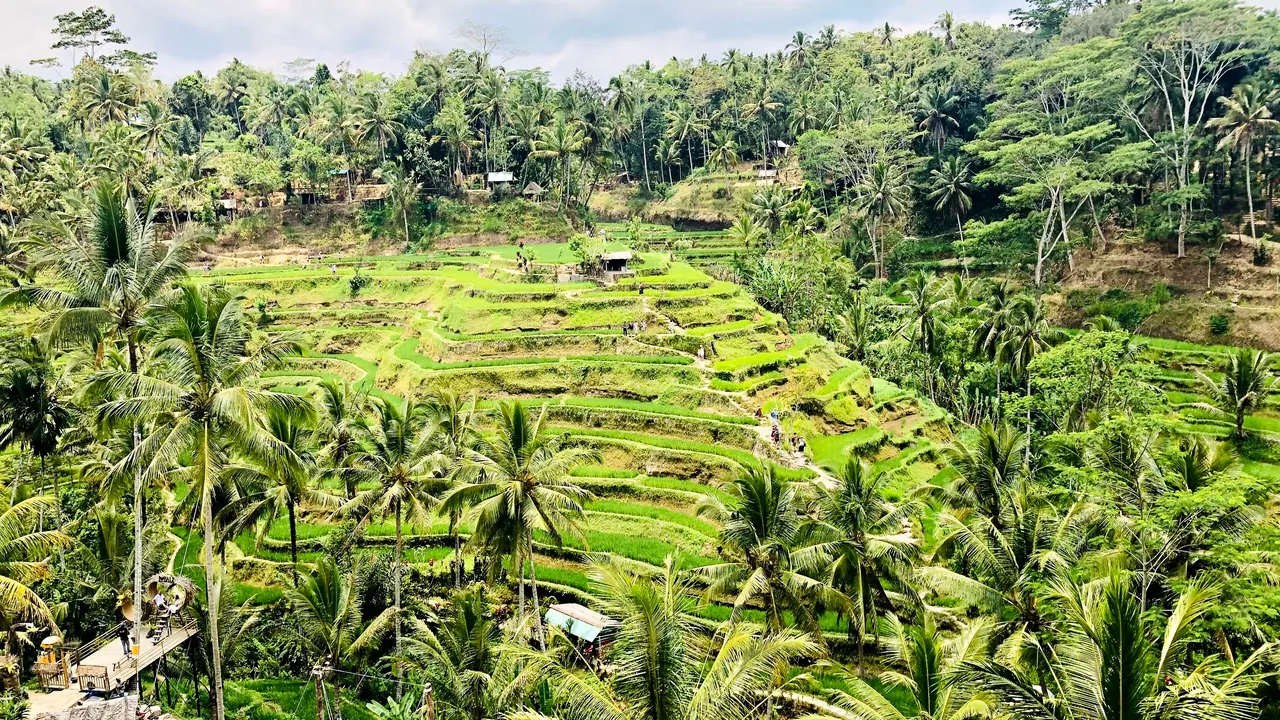
Photos: Singapore by Kai Kai, Pexels License; Ubud by Pinterpandai, CC BY-SA 3.0, cropped.
Singapore or Ubud?
Our verdict in twelve categories, each scored against the same fixed benchmark cities, and the climate month by month, so you can choose for your trip.
Choose Singapore for
- getting around
- families
- nightlife
Singapore is the better pick for travellers who want everything to work: a metro that reaches almost every sight, hawker centres serving four cuisines side by side, wildlife parks and Sentosa for children, and rooftop bars for the evening. It suits a short city break, a family trip or a stopover built around eating, and it asks very little planning. The price is a costly room and a small island with little to explore beyond it.
Choose Ubud for
- wellness
- prices
- day trips
Ubud rewards a slower trip with a looser plan. Choose it for yoga and massage among the rice fields, dawn walks and volcano sunrises, and temple visits across Bali with a hired driver. It is far kinder to a modest budget, but evenings end early, the roads are slow, and small children find the narrow lanes and grabbing monkeys hard work.
Scoreboard
Twelve categories on one fixed scale from 0 to 100. The shaded stretch is the gap between the two.
Your match
Pick a travel style or drag the sliders, and both match scores follow your weighting.
Too close to call, 2 points apart
Wins on getting around and families with your weighting.
Wins on wellness and prices with your weighting.
What matters to you?
Category by category
What the scores mean for a trip.
Beaches & swimming
Neither place is a beach destination, and both send most visitors to the pool. The difference is in reach: Singapore's sand is on its own doorstep, on Sentosa's man-made lagoons or the sheltered Southern Islands, though the water is cloudy and tankers line the horizon.
Ubud has no shore at all, and the calm reef water at Sanur is nearly an hour's drive away, with the black-sand Gianyar beaches better for watching surfers. What Ubud offers instead is a villa pool looking over the rice terraces.
Food & drink
Singapore is the stronger food city by some distance. Its hawker centres, from Maxwell to Old Airport Road and Tekka, put Chinese, Malay, Indian and Peranakan cooking under one roof, and you can eat well at almost any hour, from kaya toast at breakfast to murtabak late in Kampong Glam.
Ubud's best eating is Balinese: babi guling at lunchtime counters, bebek betutu and nasi campur in family warungs. Around that sits a layer of plant-based cafés and a few tasting-menu kitchens, but the main street leans towards visitors and the range is narrower.
Culture & sights
The two are closely matched, but in opposite ways. Singapore's culture sits in institutions: the National Gallery's Southeast Asian art, the Asian Civilisations and Peranakan museums, the temples and mosque of its ethnic quarters, and a modern skyline that is a sight in itself.
In Ubud you see culture in daily life, in doorstep offerings, compound shrines and processions on feast days. Its painting museums trace an artists' town back to the 1930s, and the eleventh-century Goa Gajah gives it an older layer that Singapore lacks.
Nightlife
Singapore gives you a real night out, Ubud largely does not. Singapore's rooftop terraces over Marina Bay, cocktail bars in the Keong Saik and Telok Ayer shophouses, and clubs along Clarke Quay make for a polished evening, even if drinks are expensive and few people stay out until dawn.
Ubud winds down after a long garden dinner and perhaps a band in one of a few music bars. Its visitors rise for dawn yoga, and anyone wanting clubs faces the long drive to Seminyak or Canggu.
Nature & outdoors
Ubud is the place for landscape. Rice terraces at Tegallalang and along the Campuhan Ridge, rafting on the Ayung gorge, jungle waterfalls and the night climb up Mount Batur for sunrise give you days of outdoor activity right from town.
Singapore does well for a city-state, with rainforest trails at Bukit Timah and MacRitchie, the Southern Ridges walkways and cycling on Pulau Ubin. But the island is flat and small, and a few mornings exhaust it.
Day trips
Ubud sits at the centre of Bali's temple country, with Tirta Empul's holy spring and the cliff tombs of Gunung Kawi close by, and Besakih, Klungkung, the Jatiluwih terraces and lakeside Ulun Danu Bratan further out. The slow roads limit how much fits into one day, and almost everything needs a hired driver.
Singapore has little within a day's reach: Johor Bahru across a causeway with tiresome border queues, resort islands by ferry, and Malacca, which really wants a night. Most visitors fly on instead.
Good for families
Singapore is far easier with children, mainly because its fun is ready-made and close together. Universal Studios and the aquarium on Sentosa, the children's garden at Gardens by the Bay and the Science Centre are all built with families in mind. A pushchair can go from the hotel door to the ticket gate without a single kerb to fight, and a cool indoor break is never far away, so toddlers are as well served as teenagers.\n\nUbud asks more of a family.
What it offers is landscape and tradition, not attractions designed for children. A day out might be a waterfall, a rafting trip or an evening of Barong dance, with a stretch in the car before and after each one. Children old enough to manage a ridge path and sit through a performance will find plenty to love, along with a warm Balinese welcome, but the very young will get far less from it.
Getting around
This is where the two differ most. Singapore's MRT is step-free, air-conditioned and takes a contactless card, reaching the airport, Chinatown, Marina Bay and the rainforest edge, so a car is never needed and only the heat limits walking.
Ubud has no usable public transport at all. Narrow pavements, steep valley roads and longer distances than they appear mean planning each day around a driver, ride-hailing or hotel shuttles.
Shopping & style
Singapore is the shopping destination: Orchard Road's long line of malls and the designer flagships at Marina Bay cover every brand, with independent boutiques on Haji Lane and in Tiong Bahru's Art Deco blocks. The malls blur together, though, and markets with character are rare.
Ubud is about handmade goods rather than fashion. Haggle in the Art Market by the palace, then buy carvings in Mas, silver in Celuk and paintings in Batuan, or linen and yoga wear on Jalan Hanoman.
Affordability
Ubud is much the cheaper stay. Homestay rooms with breakfast, warung meals, massages and full-day drivers all cost little, though its luxury jungle resorts and visitor-facing restaurants can run up a large bill if you let them.
In Singapore the room dominates the budget, alcohol is heavily taxed and the wildlife parks and Sentosa charge steep entry. Hawker meals, cheap trains and free gardens soften the cost but do not close the gap.
Live music & performing arts
Both offer a good evening rather than a reason to travel, but the evenings are very different. Singapore gives range: concerts by the Singapore Symphony Orchestra at the Esplanade, free bayside performances, chamber music at the Victoria Concert Hall and touring musicals at Marina Bay.
Ubud gives one tradition done nightly: Legong, Barong and Kecak with live gamelan in the palace courtyard and village temples, performed by local troupes. Beyond that there is no theatre or concert hall.
Wellness & relaxation
Ubud is built around wellness. Dawn-to-dusk yoga in open pavilions, retreats lasting weeks, riverside spas above the Ayung gorge, flower baths, traditional healers and the purification ritual at Tirta Empul shape the town's whole rhythm.
Singapore has no comparable tradition. You will find skyline hotel spas, Chinatown reflexology parlours and Ayurveda in Little India, plus early mornings in the Botanic Gardens, but it remains a fast, work-focused city.
When should you go?
Pick your month. The climate figures are measured averages, not a forecast.
Singapore in July
Ubud in July
Daytime high, °C
Rainfall in the month, mm
Where the figures come from
Ubud's temperatures are measured 29 km from the centre, at Denpasar / Ngurah-Rai.
Ubud's station stands 209 m below the city centre, so the centre is likely a little cooler than the figures say.
Ubud has no rain gauge within 25 km of the centre, so its rainfall comes from a gridded climate dataset read at the destination rather than from a gauge further away.
Temperature and rainfall are climate normals, averaged over the years shown. Singapore: 1991-2020 (rainfall 1961-1990) normals, Singapore / Changi Airport (17 km from centre). Ubud: 1991-2020 normals, Denpasar / Ngurah-Rai (29 km from centre).
Singapore barely changes through the year. Daytime highs sit around 31°C in every month, the sea stays warm enough to swim at any time, and rain can fall in any season. The wettest stretch runs from November to January, peaking at 333mm in December, when sunshine is also at its thinnest. February to September is a little drier and brighter, but the heat makes walking a matter of mornings, evenings and shade all year.
Ubud has a much clearer pattern. May to October is the dry season, with August the driest month at 36mm and also the sunniest, and July and August are slightly cooler, which helps on the rice-field walks and the Batur climb. December to February is properly wet, with 297mm in January, though this is when the terraces are greenest. The sea at Sanur stays around 29°C for much of the year and dips a little in mid-year. Both places are wettest around the turn of the year, so a trip between May and September catches both at their best, and Ubud then has far more sunshine.
Which traveller are you?
On a family trip with young children, Singapore is far easier. The Mandai zoo, Night Safari and Sentosa's rides fill days, the MRT has lifts throughout, and air conditioning is everywhere, while Ubud's missing pavements, scooters and long car rides suit older children better.
For a relaxing and wellness trip, Ubud is the obvious choice. Yoga pavilions, multi-week retreats, Balinese massage on every street and villas facing quiet paddies shape the whole town, whereas Singapore offers polished hotel spas in a city that moves fast.
On a trip on a tight budget, Ubud goes much further. Homestays with breakfast, warung meals, cheap massages and modest temple fees keep costs low, while Singapore's hotel rooms, alcohol taxes and attraction fees strain a budget even when you eat at hawker stalls.
Before you go
| Measure | Singapore | Ubud |
|---|---|---|
| Official language | English, Tamil, Malay, Standard Chinese | Indonesian |
| Currency | Singapore Dollar (SGD) | Rupiah (IDR) |
| Sockets | G230 V, 50 Hz | CF50 Hz |
| Driving side | Left | Left |
| Time zone | UTC+8 | UTC+8 |
| Emergency number | Police 999, ambulance 995, fire 995 | 112 |
| Elevation | 21 m | 210 m |
| Main airport | Singapore Changi Airport (SIN)17 km from centre168 non-stop destinations | Denpasar I Gusti Ngurah Rai International Airport (DPS)29 km from centre64 non-stop destinations |
| Public holidays this year | 11 days | - |
By the numbers
| Measure | Singapore | Ubud |
|---|---|---|
| Population | 5,866,139 | - |
| People per km² | 8,158 | - |
| Museums within 10 km | 40 | 14 |
| UNESCO World Heritage sites within 50 km | 1 | 1 |
| Swim season, months above 21 °C | 12 months | 12 months |
Where else could you go?
Every comparison below shares a destination with this one, so you can follow Singapore or Ubud somewhere new.
- Malaccavs Singapore
- Kuala Lumpurvs Singapore
- Yogyakartavs Ubud
- Penangvs Singapore
- Kuchingvs Singapore
- Jakartavs Singapore