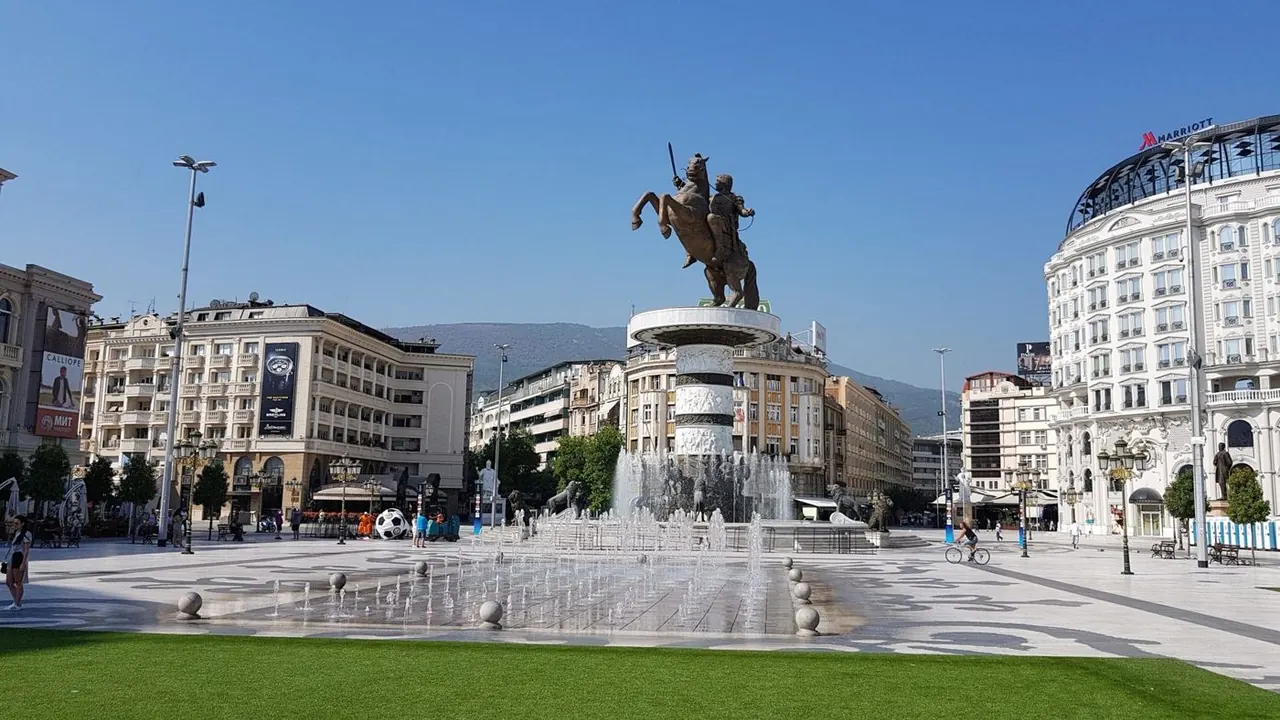
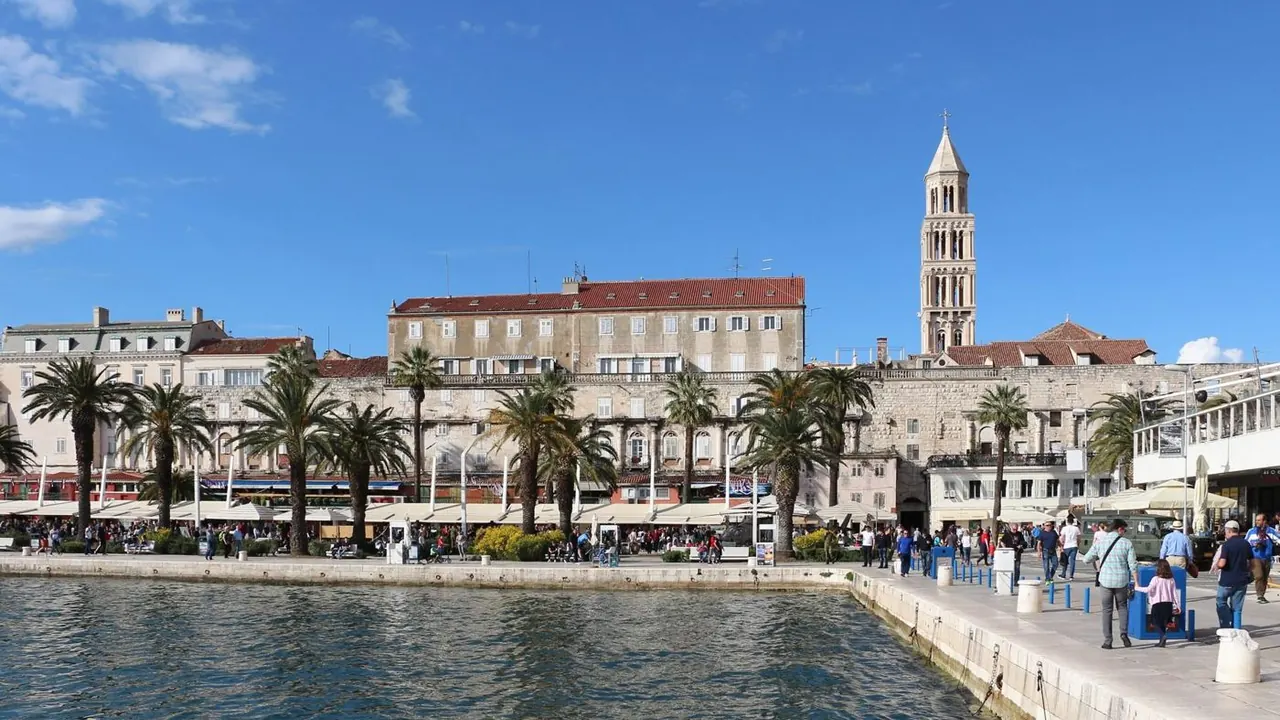
Photos: Skopje by George M. Groutas, CC BY 2.0, cropped; Split by Bernard Gagnon, CC BY-SA 4.0, cropped.
Skopje or Split?
Our verdict in twelve categories, each scored against the same fixed benchmark cities, and the climate month by month, so you can choose for your trip.
Choose Skopje for
- prices
- shopping
- live music and the arts
Skopje suits a traveller who wants a few inexpensive days in an unpolished Balkan capital. It has the Ottoman lanes of the Old Bazaar, the much-debated statues south of the river, long tavern dinners with Tikves wine, and Vodno and Matka Canyon at the edge of town. Your money goes much further here, and the bazaar workshops make it the more interesting place to shop. There is no sea, though, so anyone who wants to swim has to add a stay at Lake Ohrid.
Choose Split for
- beaches
- day trips
- getting around
Choose Split for a summer trip built around the Adriatic. You can walk from a Roman palace that people still live in to a swim, take a ferry from the harbour to Brač or Hvar, and reach Trogir, Krka and the Cetina canyon easily. It is easier with children and simpler to get around, but noticeably dearer in July and August.
Scoreboard
Twelve categories on one fixed scale from 0 to 100. The shaded stretch is the gap between the two.
Your match
Pick a travel style or drag the sliders, and both match scores follow your weighting.
Wins on prices and shopping with your weighting.
Wins on beaches and day trips with your weighting.
What matters to you?
Category by category
What the scores mean for a trip.
Beaches & swimming
On swimming the two are not close. Skopje is landlocked, so summer swimming means hotel or public pools. The reservoir in Matka Canyon is too cold for bathing and better for kayaks, and Lake Ohrid is about three hours away by road.
In Split the Adriatic starts at the end of the street. Locals play picigin in the shallow sandy water at Bačvice, the coves around Marjan are quieter with deeper water, and ferries to Brač, Šolta and Hvar reach longer beaches. Most of the city shore is pebble or concrete platforms rather than sand.
Food & drink
Both cities serve generous home cooking, and neither has much fine dining or international choice, so the difference is in what you eat. Skopje means meat, beans and peppers: tavche gravche in a clay dish, kebapi from the Old Bazaar grill houses, and ajvar with sheep's cheese at the long tavern tables of Debar Maalo, with Vranec and rakija to drink.
Split cooks from the sea, with grilled fish, black risotto, pašticada, and peka that is usually ordered ahead, plus Plavac Mali or Pošip to drink. Its best meals are in the konobas of Varoš rather than inside the palace walls, and the choice shrinks in winter.
Culture & sights
Split has the single greater sight. Diocletian's Palace is a Roman emperor's residence that became a lived-in quarter. Its cathedral was once his mausoleum, and the vaulted substructures show the original layout. The Meštrović Gallery on the Marjan slopes adds a strong museum.
Skopje's sights are more varied but less grand: the Ottoman Old Bazaar with its caravanserais and the Mustafa Pasha Mosque, the carved walnut iconostasis in the Holy Saviour, and the 1963 earthquake remembered by the stopped clock of the old railway station. Neither city needs more than two or three days.
Nightlife
Split has the busier summer nights. Small bars fill the palace alleys and stairways, and beach bars and clubs around Bačvice stay open into the early hours. From October to May, though, it shrinks to a handful of bars.
Going out in Skopje means café-bars, with terraces in Debar Maalo moving from coffee to rakija as the evening goes on, and bazaar courtyards that stay busy late in summer. It fills up at weekends but is quiet midweek, and it is a local, sociable scene rather than a reason to travel.
Nature & outdoors
Both cities have mountains on the doorstep, and Split adds the sea. Marjan's pine woods and cliffs begin at the edge of the old town, and Mosor and Kozjak have ridge walks. The Cetina canyon at Omiš is known for rafting and canyoning, and you can kayak and sail among the islands.
Skopje has Vodno, which you can walk up or ride by cable car, and Matka Canyon about half an hour away. Further out are the high ridges of the Sar mountains and Mavrovo, with skiing in winter, which Split cannot match. A car matters more here. In both cities, high summer is too hot for hiking.
Day trips
Split is the far better base for day trips. Trogir is half an hour away, Šibenik and Krka about an hour, and Salona and Klis are on the edge of the city. In summer, ferries from the harbour make Hvar and Brač an easy day out.
Skopje still has a good spread: the painted Sarena Mosque in Tetovo, the mosaics at Stobi, the Tikves wineries, Kratovo in its volcanic crater, and Prizren across the border in Kosovo. Its most famous town, Ohrid, is too far for a day, and the rest are easier to combine by car.
Good for families
Neither city has much built for children, but Split is the easier of the two. Bačvice is shallow enough for paddling, Marjan has shade and room to run, and a ferry to an island is often the best day of the trip.
Skopje's cafés and restaurants welcome children, and the Vodno cable car and a boat on Matka go down well. Hot summers, traffic and uneven pavements tire small children quickly, though, so families usually pair Skopje with time at a lake.
Getting around
Split is the easier of the two to get around, although both have a walkable core. In Skopje the Old Bazaar, the Stone Bridge, Macedonia Square and Debar Maalo lie along a flat stretch of the Vardar. Away from that strip there is no metro or tram, and newcomers find the red buses hard to work out, so cheap and plentiful taxis take most visitors to Vodno, Matka and the bus station.
Split fits the palace, Varoš, the markets and Bačvice into about fifteen minutes on foot, with no cars in the centre. Ferries, intercity buses and trains all leave from the same place at the harbour. Its weak points are slow summer traffic on the coast road and stepped stone lanes that are hard work with a pushchair.
Shopping & style
Neither city is a shopping destination, but Skopje has more worth browsing. Workshops in the Old Bazaar still sell silver filigree, copperware and embroidery, and Bit Pazar next door is a real everyday market full of spices, cheese and peppers.
Inside Split's palace the shops are mostly souvenirs, lavender and ties. Its Pazar green market by the east gate, with dried figs, honey and local brandies, is the better place to spend time. For fashion, both cities fall back on chains and malls.
Affordability
Skopje is much the cheaper of the two. A tavern dinner with wine, burek and coffee, taxis and central rooms all cost little, and the main sights are free or close to it.
Split is mid-priced overall but expensive in July and August. Rooms near the old town then cost as much as in a large Western European city, waterfront fish is sold by weight, and island ferries add up. Going in May, June or late September, and eating in konobas away from the Riva, keeps costs reasonable.
Live music & performing arts
The two are closely matched here. Each has a national theatre with opera, ballet and plays in the local language, and each is at its best in festival season. Split's summer festival uses the palace Peristyle as an open-air stage, and its own sound is klapa, unaccompanied harmony singing that you can often hear in the domed vestibule.
Skopje's highlight is its autumn Jazz Festival, which has run since the early 1980s. It also has summer concerts at the fortress and in the bazaar, and starogradska music late into the night in the Debar Maalo taverns.
Wellness & relaxation
Neither city has a tradition of bathing. Skopje's Ottoman hamams now serve as art galleries. Its one thermal option, Katlanovska Banja, is an old sanatorium-style spa half an hour out of town, so relaxing mostly means long coffees on shaded terraces.
Split has more to offer: resort spas along the coast east of the centre, the pine woods of Marjan, and the Dalmatian habit of fjaka, unhurried idling over coffee on the Riva. For real quiet, avoid midsummer or escape to one of the islands.
When should you go?
Pick your month. The climate figures are measured averages, not a forecast.
Skopje in July
Split in July
Daytime high, °C
Rainfall in the month, mm
Where the figures come from
Skopje has no rain gauge within 25 km of the centre, so its rainfall comes from a gridded climate dataset read at the city rather than from a gauge further away.
Skopje's sunshine is measured 68 km from the centre, at Stip.
Temperature and rainfall are climate normals, averaged over the years shown. Skopje: 1991-2020 (sunshine 1961-1990) normals, Skopje-Petrovec (18.3 km from centre). Split: 1991-2020 normals, Split / Marjan (0.9 km from centre).
Skopje has an inland valley climate with strong seasons. July and August are hot, with highs around 32°C, which makes midday walking hard work. Winters are cold, close to 5°C in January. Rain is light all year, so May, September and early October are the best months for the bazaar and for Vodno: warm, sunny and without the summer heat.
Split is milder at both ends of the year. The sea is warm enough for swimming from June to September and reaches about 25°C in August. Summer is also its driest and sunniest season. Autumn turns wet, and November is the rainiest month at around 117mm. Winter days near 11°C are still fine for walking the palace streets, while Skopje is properly cold at that time of year.
Which traveller are you?
On a beach and sun trip, Skopje cannot compete. It is landlocked, and Lake Ohrid needs a stay of its own. Split has Bačvice and the Marjan coves within walking distance of the old town, and ferries out to island beaches.
For a trip on a tight budget, Skopje stretches further. Wandering the Old Bazaar and the Stone Bridge costs nothing, a terrace coffee fills an afternoon, and buses run to Tetovo and Stobi. Split's best free pleasures are a swim and browsing the Pazar.
On a family trip with children, Skopje's friendly cafés count for less than its hot summers and busy roads. Split is easier, with a compact centre, shallow water at Bačvice for paddling, and boat trips to the islands that children enjoy.
Before you go
| Measure | Skopje | Split |
|---|---|---|
| Official language | Albanian, Macedonian | Croatian |
| Currency | Denar (MKD) | Euro (EUR) |
| Sockets | CF230 V, 50 Hz | CF230 V, 50 Hz |
| Driving side | Right | Right |
| Time zone | UTC+1, UTC+2 in summer | UTC+1, UTC+2 in summer |
| Emergency number | 112 | 112 |
| Elevation | 251 m | 0 m |
| Main airport | Skopje International Airport (SKP)16 km from centre52 non-stop destinations | Split Saint Jerome Airport (SPU)12 km from centre69 non-stop destinations |
| Public holidays this year | 12 days | 14 days |
By the numbers
| Measure | Skopje | Split |
|---|---|---|
| City population | 422,540 | 160,577 |
| People per km² | 739 | - |
| Museums within 10 km | 17 | 11 |
| UNESCO World Heritage sites within 50 km | 0 | 4 |
| Swim season, months above 21 °C | - | 4 months |
Where else could you go?
Every comparison below shares a destination with this one, so you can follow Skopje or Split somewhere new.