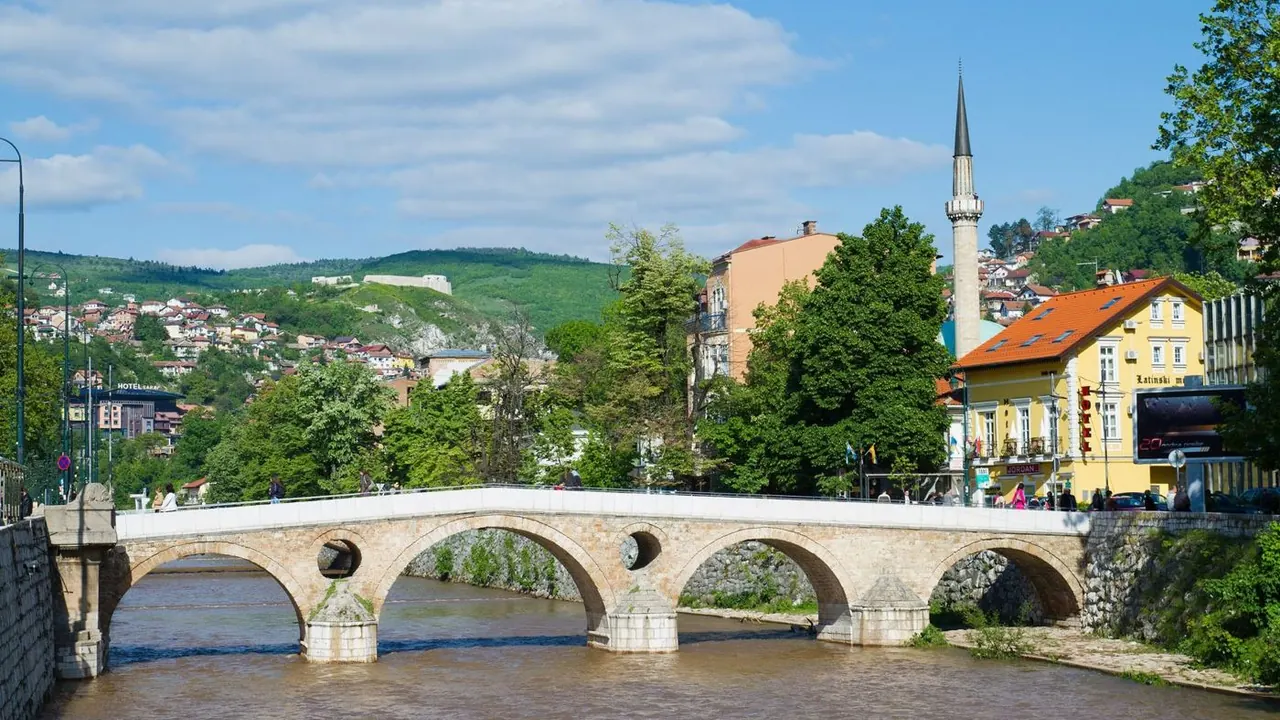
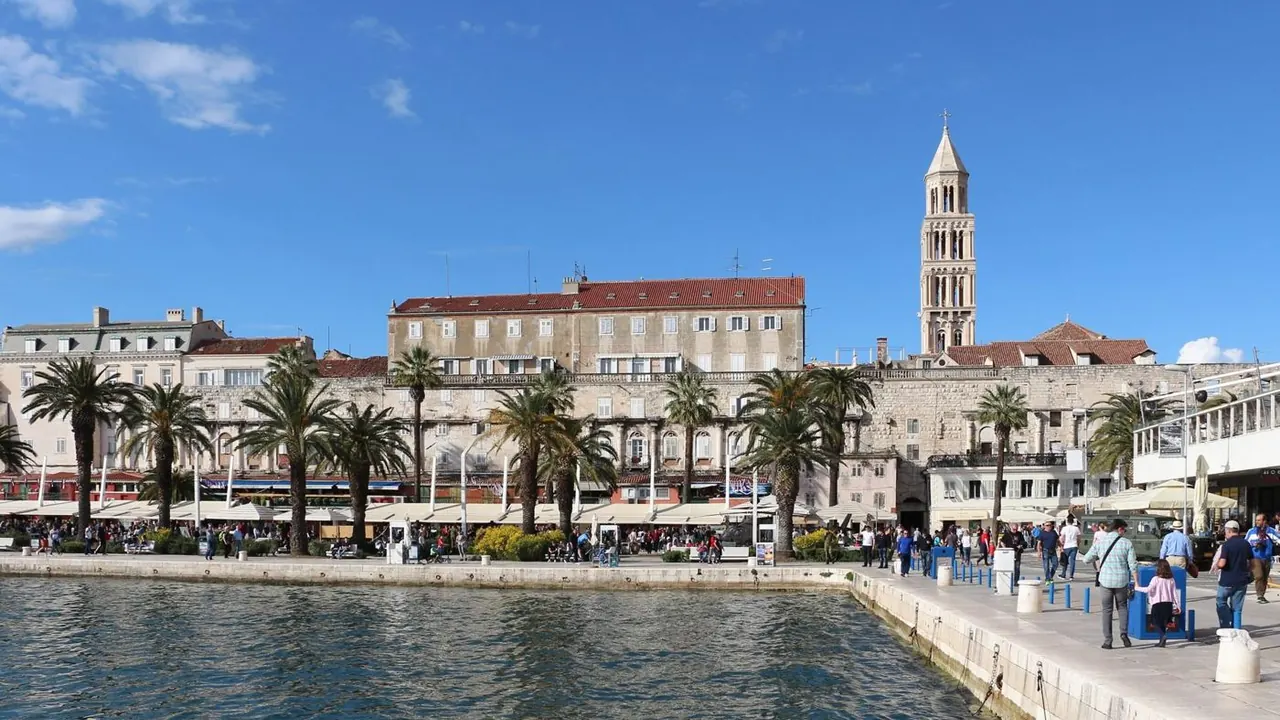
Photos: Sarajevo by Tumi-1983, CC0; Split by Bernard Gagnon, CC BY-SA 4.0, cropped.
Sarajevo or Split?
Our verdict in twelve categories, each scored against the same fixed benchmark cities, and the climate month by month, so you can choose for your trip.
Choose Sarajevo for
- prices
- shopping
- food and drink
Sarajevo suits travellers who want a city that makes them think, where Ottoman bazaar lanes, Austro-Hungarian avenues and the memory of the 1990s siege all lie within a short walk. Mountains rise straight from its edges, with real skiing in winter and ridge walks in summer. It is also much the cheaper of the two. You just have to accept that there is no sea, and that winter can bring smog to the valley.
Choose Split for
- beaches
- day trips
- families
Split is the choice for a summer vacation built around the sea. You can swim within walking distance of a Roman palace, ferries leave for Brač and Hvar from the harbour, and Trogir and Šibenik are easy outings. It is simpler with children and livelier on a summer night. The price is higher in high season, when the old town is hot and crowded.
Scoreboard
Twelve categories on one fixed scale from 0 to 100. The shaded stretch is the gap between the two.
Your match
Pick a travel style or drag the sliders, and both match scores follow your weighting.
Wins on prices and shopping with your weighting.
Wins on beaches and day trips with your weighting.
What matters to you?
Category by category
What the scores mean for a trip.
Beaches & swimming
This is the biggest gap between the two. Split has the Adriatic on its doorstep. Bačvice is a shallow sandy bay where locals play picigin in knee-deep water, Kašjuni and the Marjan coves are quieter, and ferries to Brač, Šolta and Hvar open up longer beaches.
Sarajevo has no beach to speak of. In summer, swimming means cold mountain rivers, Jablanica lake on the road south or a pool, and the coast is too far for a day trip. Beach lovers going to Sarajevo would do better to add a few days in Split afterwards.
Food & drink
Both cities cook a narrow, regional menu with care, and neither has much fine dining or international food, so the choice comes down to taste. Sarajevo is meat, bread and pastry: ćevapi in somun from the Baščaršija grills, burek sold by weight, slow-cooked lamb and a coffee ritual with rahat lokum.
Split cooks from the sea: grilled fish and squid, black risotto, octopus under the peka, with Plavac Mali and Pošip from the nearby vineyards. Its best meals are in the konobas of Varoš rather than inside the palace, and the scene goes quiet in winter.
Culture & sights
The two are about equal for sightseeing but feel very different. Sarajevo is a city of layers: mosque, cathedrals and synagogue within a few streets, the Latin Bridge of 1914, and the siege remembered at the Tunnel of Hope and in the Sarajevo roses set into the pavements. It is the more varied and the more emotionally demanding of the two.
Split's culture is centred on one extraordinary monument. Diocletian's Palace is a Roman complex that people still live in, with a cathedral that began as the emperor's mausoleum. Add the Meštrović Gallery and you have seen the essentials in about two days.
Nightlife
Split is the livelier choice in summer. Bars fill the stone alleys and stairways of the palace, and the beach bars and clubs around Bačvice keep going into the early hours. Out of season, though, it shrinks to a handful of bars.
Sarajevo's going out is smaller but steadier across the year. Café-bars around Ferhadija get louder as the evening goes on, and students keep cellar bars and pubs busy at weekends. A night there is more likely to end over rakija than on a dancefloor.
Nature & outdoors
Both cities have great outdoors close by, but of different kinds. Sarajevo is all mountains: a cable car to Trebević and the overgrown Olympic bobsleigh track, skiing and grassy ridges on Jahorina and Bjelašnica, and the shepherds' village of Lukomir above the Rakitnica canyon.
Split combines limestone mountains and the sea. Marjan's pine woods start at the edge of the old town, Biokovo rises over 1,700m, the Cetina canyon at Omiš is good for rafting and canyoning, and kayaking or sailing among the islands takes you out on the water. Split's summer heat limits hiking, while Sarajevo's winter smog does not reach the peaks.
Day trips
Sarajevo's day trips are fewer and harder to reach than Split's, but they are rewarding. The scenic train down the Neretva gorge reaches Mostar in about two hours, passing Konjic, with its old stone bridge and Tito's Cold War bunker, and Jablanica with its wartime bridge. Blagaj's dervish house below its cliff and the fortress village of Počitelj lie south of Mostar and go well with a visit there, while Travnik and the Višegrad bridge are separate outings. The roads are slow and winding, so most of these trips need a car or a tour.
Split is the easier base, with more close at hand. Trogir is about half an hour away and Šibenik about an hour, both with UNESCO-listed sights, and Salona and Klis Fortress sit on the edge of the city. Ferries from the harbour make Hvar and Brač simple outings in summer, though island trips take more planning in winter.
Good for families
Split is easier with children. Bačvice is shallow enough for toddlers to paddle in, Marjan has shade and room to run, and a ferry ride to an island tends to be the moment children remember. The main drawback is the July and August heat and crowds.
Sarajevo welcomes children warmly, and the cable car, the carriage ride to the streams at Vrelo Bosne and the small zoo make good outings. Much of what the city is about, though, is war and history, its hillside streets are steep, and grill smoke and winter smog are hard on small lungs.
Getting around
Split is simpler for a visitor. The palace, Riva, markets and Bačvice are all within about fifteen minutes' walk, and the ferry port and the bus and train stations sit side by side at the harbour. The polished stone steps inside the palace are the main difficulty.
Sarajevo has a real transit system, with a historic tram running along the valley floor from Baščaršija to Ilidža. Beyond that single line, the buses and minibuses climbing the steep slopes are harder to work out. Cheap taxis make up the difference, and they are the easiest way to reach the Tunnel of Hope and the ski mountains.
Shopping & style
Neither is a shopping destination, but Sarajevo has more to find. On Kazandžiluk you can still hear coppersmiths hammering coffee sets and trays, and the Bezistan and nearby lanes sell kilims, slippers and filigree. You need to look carefully to tell real craftwork from souvenir stock.
In Split, the palace shops are mostly lavender, coral and ties, and the chains are on Marmontova. The Pazar market is the best place to browse, and Dalmatian wine and olive oil make the best things to take home.
Affordability
Sarajevo costs far less. Grill meals, coffee in the bazaar, museum tickets, trams and central guesthouses all stay well below Western European levels, and prices rise only a little in the Old Town and during the summer film festival.
Split's costs depend heavily on the season. In July and August, rooms near the old town and fish sold by weight on the waterfront cost about what you would pay in a big Western city, and ferries add up quickly for a family. Travel in May, June or late September and it becomes much more reasonable.
Live music & performing arts
Both cities have a modest stage life with a national theatre staging opera, ballet and drama, and each has its own traditional singing. The difference is mostly timing and setting. Split's high point is summer, when its festival puts opera and concerts on the Peristyle courtyard and klapa harmonies fill the palace's domed vestibule.
Sarajevo's best moments come in autumn, with MESS bringing international theatre and the jazz festival in November. The rest of the year there is the Philharmonic, and sevdah love songs sung in traditional restaurants and small clubs.
Wellness & relaxation
Neither city is built for a wellness vacation. Sarajevo has the one real bathing tradition: the thermal springs at Ilidža, used since Roman times and reached by the tram, with the shaded streams of Vrelo Bosne next door. Winter smog in the valley is the downside.
Split relies on hotel spas and massage studios. What it offers instead is fjaka, the Dalmatian art of idling over a long coffee on the Riva, best enjoyed in May, June or September or in the pine woods of Marjan, away from the noise of the old town in midsummer.
When should you go?
Pick your month. The climate figures are measured averages, not a forecast.
Sarajevo in July
Split in July
Daytime high, °C
Rainfall in the month, mm
Temperature and rainfall are climate normals, averaged over the years shown. Sarajevo: 1991-2020 normals, Sarajevo-Bejelave (2 km from centre). Split: 1991-2020 normals, Split / Marjan (0.9 km from centre).
Sarajevo sits in an inland valley and has proper seasons. Summer days reach about 28°C in July and August, the sunniest and most comfortable months for walking the Old Town and the mountain trails, while May, June and September are mild and good for sightseeing. Winters are cold, with highs near 4°C from December to January, which is good for the ski mountains but grey in the city. Rain is spread fairly evenly through the year, a little heavier in late spring and late autumn.
Split is warmer and much sunnier in every month. June to September is beach season, with highs around 31°C in midsummer and the sea at about 25°C in August, warm enough for long swims. That heat makes July and August tiring for walking, so May, June and late September are better for sightseeing. Summers are dry, but the rain arrives in autumn and peaks at about 117mm in November. Winters are mild but quiet.
Which traveller are you?
On a beach and sun trip, Split wins easily. The shallow sandy bay at Bačvice and the pine-shaded coves around Marjan are a walk from the old town, and island ferries reach longer beaches. Sarajevo is three hours from any coast.
For a trip on a tight budget, Sarajevo is the clear choice. Grill meals, bakery pastries, trams, taxis and central guesthouses all cost very little, while Split in summer charges close to Western European prices for rooms and waterfront fish.
For skiers, Sarajevo has something Split simply lacks. Jahorina and Bjelašnica, the slopes of the 1984 Winter Olympics, are under an hour's drive away with reliable snow, so you can ski by day and eat ćevapi in Baščaršija by evening.
Before you go
| Measure | Sarajevo | Split |
|---|---|---|
| Official language | Croatian, Serbian, Bosnian | Croatian |
| Currency | Convertible Mark (BAM) | Euro (EUR) |
| Sockets | CF230 V, 50 Hz | CF230 V, 50 Hz |
| Driving side | Right | Right |
| Time zone | UTC+1, UTC+2 in summer | UTC+1, UTC+2 in summer |
| Emergency number | 112 | 112 |
| Elevation | 518 m | 0 m |
| Main airport | Sarajevo International Airport (SJJ)7 km from centre38 non-stop destinations | Split Saint Jerome Airport (SPU)12 km from centre69 non-stop destinations |
| Public holidays this year | 8 days | 14 days |
By the numbers
| Measure | Sarajevo | Split |
|---|---|---|
| City population | 275,524 | 160,577 |
| People per km² | 1,947 | - |
| Museums within 10 km | 25 | 11 |
| UNESCO World Heritage sites within 50 km | 1 | 4 |
| Swim season, months above 21 °C | - | 4 months |
Where else could you go?
Every comparison below shares a destination with this one, so you can follow Sarajevo or Split somewhere new.