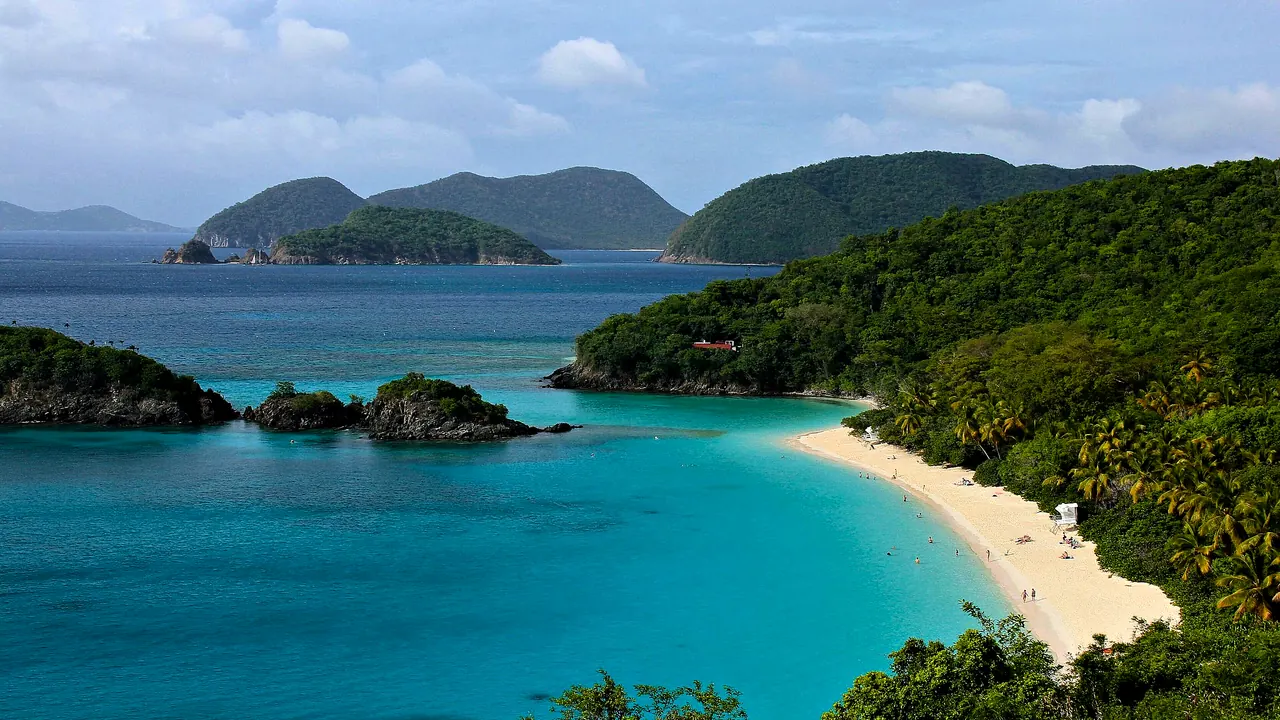
Photos: US Virgin Islands by Navin75, CC BY-SA 2.0, cropped.
Saint-Martin or US Virgin Islands?
Our verdict in twelve categories, each scored against the same fixed benchmark cities, and the climate month by month, so you can choose for your trip.
Choose Saint-Martin for
- food and drink
- day trips
- nightlife
Saint-Martin suits travellers who want their beach days followed by a good dinner and the choice of a late night. Grand Case gives it a dining scene that is unusual for an island this size, French bakeries and supermarkets come with the French side, and the open border puts the Dutch side's clubs and casinos a short drive away. It is also the better base for island-hopping, with Anguilla, St Barths and the small Dutch islands all within reach by boat.
Choose US Virgin Islands for
- culture and sights
- nature and the outdoors
- live music and the arts
The US Virgin Islands are the better pick for a slower vacation built around the sea and the land behind it. St John's north-shore bays and the national park that covers most of the island give the best beaches and walking of the pair. The Danish-era towns of Christiansted and Charlotte Amalie give you more history to look at between swims, and the calm, turtle-filled bays make it the easier choice for families.
Scoreboard
Twelve categories on one fixed scale from 0 to 100. The shaded stretch is the gap between the two.
Your match
Pick a travel style or drag the sliders, and both match scores follow your weighting.
Wins on food and drink and day trips with your weighting.
Wins on culture and sights and nature and the outdoors with your weighting.
What matters to you?
Category by category
What the scores mean for a trip.
Beaches & swimming
Both are first-rate beach destinations, but the US Virgin Islands come out a little ahead, mostly thanks to St John. Trunk, Cinnamon and Maho bays sit inside the national park with reef just offshore, and Magens Bay on St Thomas adds a long, sheltered curve of sand. In winter the north shores can pick up swell, and then the south-facing coves are the calmer swim.
Saint-Martin fits a lot of variety into a smaller space. Orient Bay is the long, social beach with sunbeds and water sports, while Baie Rouge and Baie Longue on the leeward coast are quieter and very clear. Le Galion's reef-sheltered shallows are the gentlest. Its Atlantic-facing bays sometimes collect seaweed, so in some months the west coast is the better bet.
Food & drink
Saint-Martin eats noticeably better. Grand Case alone is worth the trip for food lovers, with waterfront French and creole restaurants on one side and the lolos' grilled lobster and ribs at shared tables on the other. The French side's bakeries and supermarket cheese and wine also make self-catering a pleasure.
The US Virgin Islands have a real West Indian kitchen of kallaloo, fungi, goat stew and pates, but you find it at roadside stands and food fairs rather than in restaurants, and it is strongest on St Croix. Around the St Thomas resorts and Cruz Bay, menus lean towards American dishes made for visitors.
Culture & sights
The US Virgin Islands have much more history on show. Nearly two centuries of Danish rule left Christiansted's protected arcades and fort, Charlotte Amalie's stepped lanes and its sand-floored synagogue of 1833, and plantation ruins such as Annaberg and Whim that tell the sugar and slavery story.
On Saint-Martin, the sights come down to Fort Louis above Marigot, a few streets of balconied creole houses and a small museum, which most visitors finish in a morning. Neither is a cultural destination, but the Virgin Islands give you several outings to Saint-Martin's one.
Nightlife
Evenings are equally low-key on the two, but they differ in what a late night means. Saint-Martin's French side is about long dinners and a drink in Grand Case or at Orient Bay's sunset bars. Anyone who wants to dance past midnight crosses to Simpson Bay and Maho, where there are proper clubs and casinos.
The US Virgin Islands have no real club scene. The liveliest evenings are in the open-air bar strips of Red Hook and Cruz Bay, full of charter-boat sailors, and most nights end early. The exceptions are St Thomas carnival and the Crucian Christmas festival, which keep the streets busy late for weeks.
Nature & outdoors
The US Virgin Islands offer more to do outdoors, both on land and at sea. Park land covers most of St John, and the Reef Bay trail runs down through dry forest past petroglyphs to the shore. Offshore there are protected reefs, Buck Island's underwater trail, some of the Caribbean's most sheltered sailing water and the bioluminescent bay at Salt River.
Saint-Martin's outdoor offer is pleasant but smaller. You can climb the forested trails up Pic Paradis at about 424m, snorkel with turtles and rays in the Tintamarre reserve, and kitesurf in Orient Bay's steady trade winds.
Day trips
Saint-Martin is the better place for island-hopping. Anguilla's quiet beaches are a short ferry from Marigot, polished St Barths is a longer crossing, and the small volcanic Dutch islands of Saba and Sint Eustatius make a full day out. Philipsburg and the low-flying planes at Maho are also an easy half-day on the island itself.
From the US Virgin Islands, the classic outing is the ferry from St Thomas to St John. The British Virgin Islands are within reach but need a passport and depend on ferry schedules, and St Croix is too far away for a day trip, so the choice is narrower.
Good for families
The US Virgin Islands are the easier choice with children. At Maho Bay on St John, turtles feed in water shallow enough for young snorkellers, and the Coki Point marine park adds touch pools and an underwater observatory. For American families, the familiar currency and no need for a passport make the trip simpler.
Saint-Martin has its own gentle bays in Le Galion and Pinel, plus villas with kitchens and pools, but it has less made for children beyond a treetop park. Both have hilly, narrow roads, so a self-contained resort or villa saves a lot of driving with tired children.
Getting around
Getting around is about as awkward on both, but in different ways. Saint-Martin is a single island where nearly everyone hires a car, the minibuses suit hops between towns better than beach days, and the unmarked Dutch border is just another stretch of road.
The US Virgin Islands are split across three islands. Open-sided safari taxis cover the routes between towns and beaches on St Thomas and St John, ferries link the two easily, and St Croix is a separate flight away. Driving is on the left, in American cars.
Shopping & style
Shopping is similar on the two, and each has a duty-free street built for cruise passengers: Front Street in Philipsburg and the old Danish warehouses along Main Street in Charlotte Amalie, both full of watches, jewellery and liquor.
Where they differ is in what is local. Saint-Martin adds Marigot's waterfront market of spices and fabrics, French boutiques and guavaberry liqueur. The US Virgin Islands lean towards island-made crafts, with the studios at Mongoose Junction and in Christiansted and St Croix's hook bracelets.
Affordability
Both are expensive, and the cost is high in winter on either. The ways to save differ, though. On Saint-Martin, the lolos and supermarket picnics are what keep the food bill down.
In the US Virgin Islands, St Croix and the campgrounds on St John are the cheaper places to stay, and the beaches and park trails cost little or nothing. Per-person safari taxi fares add up quickly for a family.
Live music & performing arts
The US Virgin Islands have more of a music culture of their own. Quelbe scratch bands, steel pan and the mocko jumbie stilt dancers have deep local roots, and the university amphitheatre on St Thomas hosts touring concerts and dance from time to time.
Saint-Martin has no stage at all. Its music is the zouk, soca or reggae band playing over dinner in Grand Case or at a hotel, with Carnival as the one big moment of the year.
Wellness & relaxation
Neither has a spa tradition, so rest on both comes down to resort spas, some yoga and a slow pace. The US Virgin Islands do quiet a little better. St John and the east end of St Croix have little traffic and long, shaded afternoons, well away from the cruise crowds of Charlotte Amalie.
On Saint-Martin, a villa above Anse Marcel or a cove on the west coast is the place to switch off. Traffic around Marigot and the lagoon bridges can break the calm on days you have to drive.
When should you go?
Pick your month. The climate figures are measured averages, not a forecast.
Saint-Martin in July
US Virgin Islands in July
Daytime high, °C
Rainfall in the month, mm
Temperature and rainfall are climate normals, averaged over the years shown. Saint-Martin: 1991-2020 normals, Juliana Airport, Saint Maarten (4.1 km from centre). US Virgin Islands: 1991-2020 normals, C. Amalie / St. Thomas Airport (5.6 km from centre).
Saint-Martin and the US Virgin Islands have very nearly the same climate, so timing works much the same on both. Daytime highs stay around 29°C from December to March. This is the most comfortable stretch for walking around Marigot or Christiansted, and late winter and early spring are also the driest months on both. From June the heat builds, a little earlier in the Virgin Islands, reaching about 32°C in August and September, when the middle of the day is better spent in the water than in the streets.
The rain increases through late summer and peaks in October and November at around 160mm a month, mostly in short tropical downpours. These months fall in the hurricane season and suit travellers who can be flexible. Saint-Martin stays wet a little longer, with December still fairly damp, while the Virgin Islands dry out sooner. On Saint-Martin there is plenty of sunshine all year, and the most in March. On both, the sea runs from about 26°C in winter to 29°C in late summer, so no month is too cool for swimming.
Which traveller are you?
For a food and nightlife trip, Saint-Martin is the clear choice. Grand Case pairs French and creole dining rooms over the water with smoky lolo barbecues, and when dinner ends the Dutch side's clubs and casinos stay open long after the Virgin Islands' bars have closed.
On a culture and arts trip, the US Virgin Islands give you far more. Christiansted's arcaded streets and yellow fort, the old synagogue in Charlotte Amalie and the Annaberg ruins fill several good half-days, and quelbe and the mocko jumbie stilt dancers give the islands music of their own.
For an outdoors trip, choose the US Virgin Islands. St John is mostly national park, with trails down to petroglyphs and the sea, and the islands add sheltered sailing, the snorkelling trail at Buck Island and bioluminescent nights in Salt River Bay.
Before you go
| Measure | Saint-Martin | US Virgin Islands |
|---|---|---|
| Official language | French | English |
| Currency | Euro (EUR) | US Dollar (USD) |
| Sockets | CF60 Hz | - |
| Driving side | Right | Left |
| Time zone | UTC-4 | UTC-4 |
| Emergency number | - | 911 |
| Main airport | Princess Juliana International Airport (SXM)44 non-stop destinations | Cyril E. King Airport (STT)26 non-stop destinations |
| Public holidays this year | 11 days | 18 days |
By the numbers
| Measure | Saint-Martin | US Virgin Islands |
|---|---|---|
| Population | 32,358 | 87,146 |
| People per km² | 578 | 252 |
| Swim season, months above 21 °C | 12 months | 12 months |
Where else could you go?
Every comparison below shares a destination with this one, so you can follow Saint-Martin or US Virgin Islands somewhere new.
- Sint Maartenvs Saint-Martin
- British Virgin Islandsvs US Virgin Islands
- Culebravs US Virgin Islands
- Viequesvs US Virgin Islands
- Puerto Ricovs US Virgin Islands
- British Virgin Islandsvs Saint-Martin