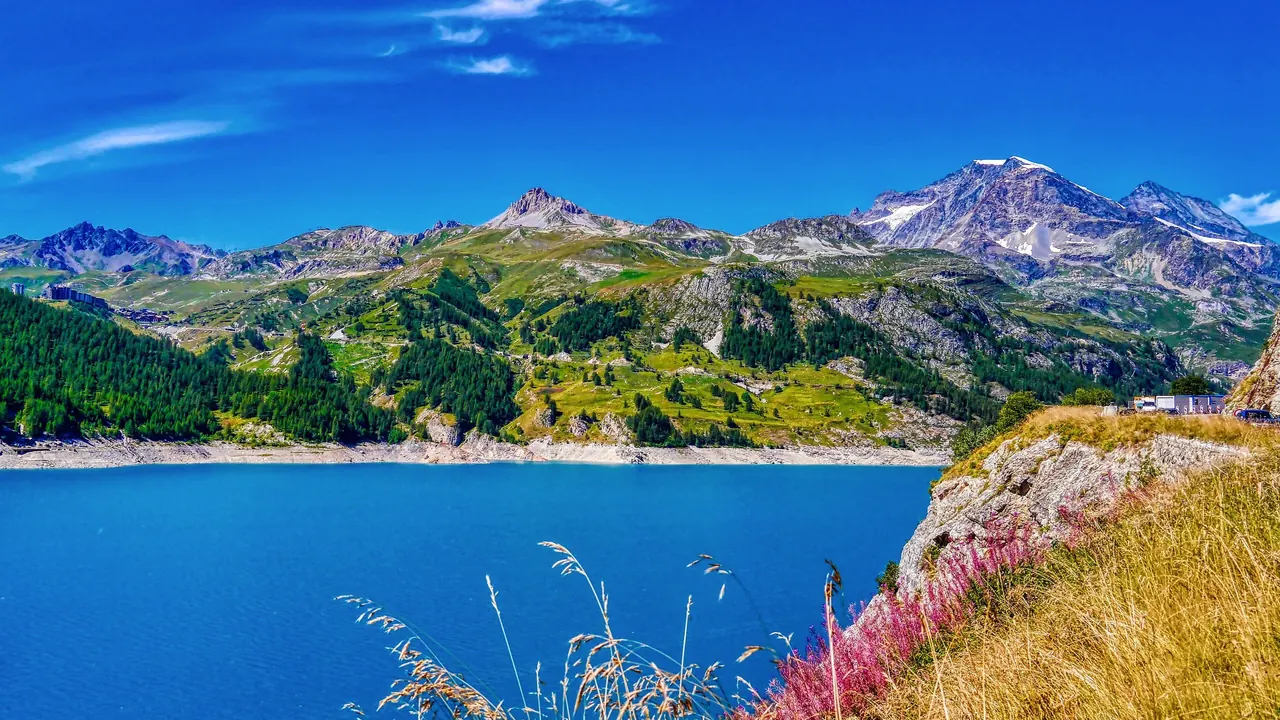
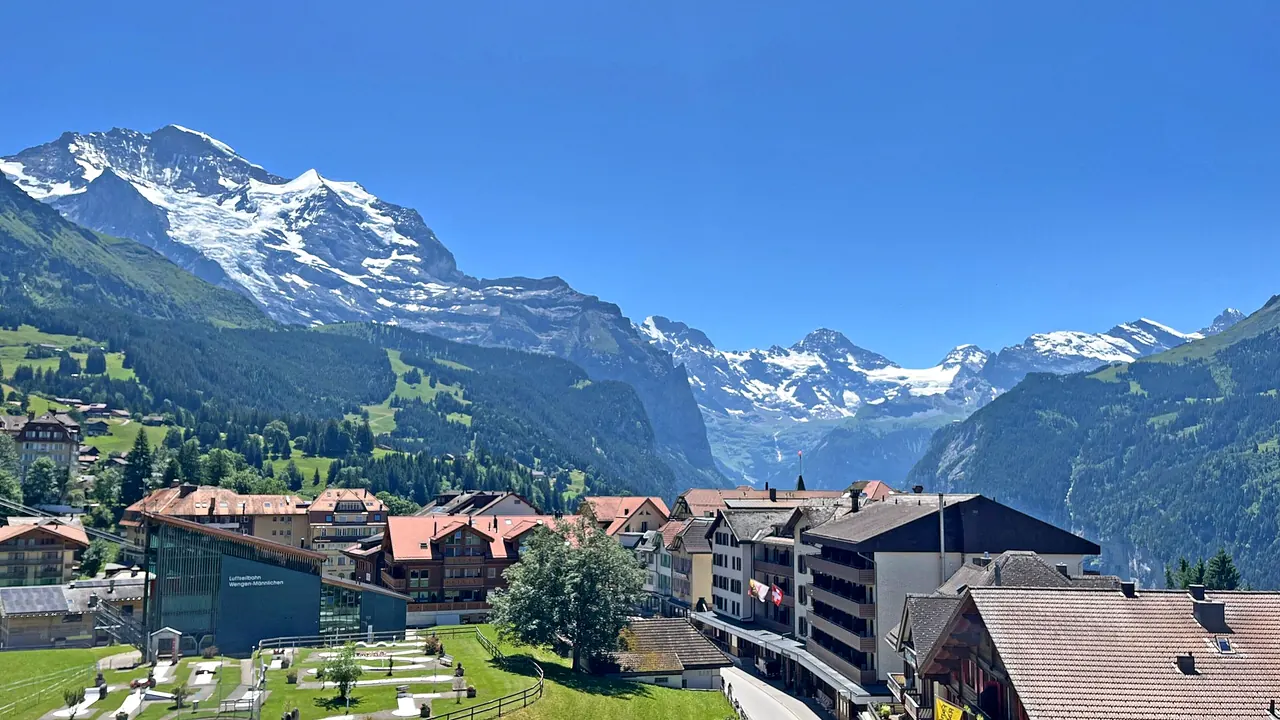
Photos: Tignes by Zairon, CC BY-SA 4.0, cropped; Wengen by Charles J. Sharp, CC BY-SA 4.0, cropped.
Tignes or Wengen?
Our verdict in twelve categories, each scored against the same fixed benchmark cities, and the climate month by month, so you can choose for your trip.
Choose Tignes for
- nightlife
- food and drink
- prices
Tignes is the better pick for a skier who wants mileage and a lively evening. Its lifts link with Val d'Isère into a huge, high, snow-sure area with a long season on the glacier, après-ski runs loud until late in Val Claret and Le Lac, and self-catering apartments keep the bill lower than in Switzerland. It suits groups of friends and families who ski hard and care more about the terrain than the setting.
Choose Wengen for
- day trips
- getting around
- wellness
Wengen is for travellers who want the mountains to look as good as they feel underfoot. The car-free village faces the Jungfrau across the waterfalls of the Lauterbrunnen valley, and trains and cable cars take you to ridge walks, Kleine Scheidegg and the Jungfraujoch without driving. The evenings are quiet and the prices are steep, but for walkers, couples and anyone who wants calm and a classic view, it is the stronger choice.
Scoreboard
Twelve categories on one fixed scale from 0 to 100. The shaded stretch is the gap between the two.
Your match
Pick a travel style or drag the sliders, and both match scores follow your weighting.
Too close to call, level with your weighting
Wins on nightlife and food and drink with your weighting.
Wins on day trips and getting around with your weighting.
What matters to you?
Category by category
What the scores mean for a trip.
Beaches & swimming
Neither place is for a swimming trip, but Tignes at least has water on the doorstep. In July and August there is a supervised bathing area with a little sandy shore on the Lac de Tignes, cold with snowmelt, and the indoor aquatic centre beside it with slides and a lagoon pool works in any season.
Wengen has nothing to swim in at the village. A swim means taking the train down for about an hour to the lidos on Lake Thun, slightly warmer than the Tignes lake, and that turns it into an afternoon outing rather than part of the day.
Food & drink
Tignes offers more choice. Le Lac and Val Claret have pizzerias, crêperies and burger places alongside Savoyard classics like tartiflette and raclette, a few kitchens try a modern Alpine menu, and the delicatessens selling Beaufort and Savoie wines are a pleasure in themselves.
In Wengen most meals happen in hotel dining rooms, often on half-board, or in mountain huts along the runs and trails. The rösti and veal in cream sauce are solid, but there is little casual eating, and the terrace lunch facing the Jungfrau is remembered for the view.
Culture & sights
Both are mountain stays with almost nothing to visit, but they feel different on foot. Tignes was built in the 1960s and 1970s as functional apartment blocks, and its heritage is the story of the old village drowned by the Chevril dam, told at the dam wall with its giant mural.
Wengen is the more pleasant place to stroll, with wooden chalets, Belle Époque hotels from its days as an English resort and a long ski racing history. Real museums and old towns in either case mean leaving the mountain.
Nightlife
Tignes is in a different league after dark in winter. Après-ski starts with music on the mountain terraces and moves into the bars of Val Claret and Le Lac, where seasonal workers and young British, Scandinavian and French groups keep going until the small clubs close well after midnight.
Wengen has a few bars that fill at the end of the ski day and a hotel bar or two, and only the Lauberhorn race weekend in January turns into a real party. In summer both are quiet, but Wengen is quieter still.
Nature & outdoors
Both rank among the great Alpine settings, and the difference is in what they do best. Tignes is about height and skiing: a resort at about 2,100m below the Grande Motte glacier, linked with Val d'Isère into one of the largest ski areas in the Alps, with big off-piste and a season that starts in autumn, and the Vanoise National Park for summer hikes past ibex and marmots.
Wengen has the edge for scenery and walking. It looks straight across the sheer, waterfall-lined Lauterbrunnen valley to the Jungfrau, with classic trails to Kleine Scheidegg and beneath the Eiger north face, and the railway up to the Jungfraujoch, though cloud can hide it all for days.
Day trips
Wengen is far better placed for outings. Within about an hour you can be in Interlaken, take a steamer to the castles at Oberhofen and Spiez, walk Thun's old town below its castle or visit Brienz and the Ballenberg open-air museum, and arcaded Bern makes a long but rewarding day.
Tignes sits at the end of a long valley road. Val d'Isère is close, but beyond it you need a car for the market town of Bourg-Saint-Maurice, medieval Conflans or the cheese village of Beaufort, and Aosta in Italy is about two hours away only when the summer pass is open.
Good for families
Both make good family ski bases for different reasons. Tignes offers convenience: ski-in, ski-out apartments, beginner areas beside the villages and an indoor aquatic centre for bad-weather days, plus pedalos on the lake in summer, though the high altitude and cold can tire small children.
Wengen offers safety and ease: with no cars, children can walk the village freely, nursery slopes and sledging runs are close to the hotels, and summer trains make short mountain outings. Rainy days are harder to fill there, and steep paths are tough on buggies.
Getting around
Wengen is easier to reach and to use without a car. You take the train to Lauterbrunnen and the rack railway up, hotel carts collect your luggage, and the same line continues to Kleine Scheidegg and the Jungfraujoch, with a cable car to the Männlichen, though any trip lower down starts with a slow descent.
Within Tignes, free shuttle buses and the lifts link the villages and many people ski from door to door. The problem is arriving: the nearest station is at Bourg-Saint-Maurice, about forty minutes below by road, and going anywhere beyond the valley needs a car or transfer.
Shopping & style
Shopping is not a reason to visit either place, but Tignes has slightly more to offer. Its several villages have plenty of ski and outdoor shops, a few sportswear boutiques, and delicatessens with Beaufort, cured sausages and mountain honey worth packing for home. Wengen has one short main street with gear hire, a souvenir and chocolate counter or two and a small grocery, and real choice means a trip down to Interlaken.
Affordability
Tignes is expensive in peak winter weeks, but there are ways to save. Its many self-catering apartments, cheaper early and late season weeks and lower summer lodging with free activities around the lake keep the cost more manageable.
Wengen has none of that slack. Rooms, meals and drinks are at Swiss resort prices, and the railways and cable cars that are the point of being there add a heavy charge to almost every outing, the Jungfraujoch above all. Even with a chalet and a rail pass, it stays the dearer of the two.
Live music & performing arts
Neither has theatre or a concert programme, and the little live music there is reflects each place's character. In Tignes it means bands in après-ski bars, DJs on the mountain terraces and occasional free outdoor concerts during resort events. Wengen's version is yodelling or alphorn evenings in a hotel and a brass band at village celebrations, with anything more formal a trip down to Interlaken or Bern.
Wellness & relaxation
The two are broadly level, but they offer different kinds of rest. Tignes has more facilities: the aquatic centre's spa with hammam and massage, hotel pools and saunas, and Brides-les-Bains about an hour away for real thermal waters. The resort itself moves at an energetic pace, especially in winter.
Wengen's appeal is quiet. With no traffic, cowbells and waterfalls are the loudest sounds, and an afternoon on a balcony facing the Jungfrau does the work, though spas are confined to the larger hotels.
When should you go?
Pick your month. The climate figures are measured averages, not a forecast.
Tignes in July
Wengen in July
Daytime high, °C
Rainfall in the month, mm
Where the figures come from
Tignes has no weather station within reach, so its figures come from a gridded climate model rather than a measured record, and read a broad area rather than one spot.
Wengen has no weather station within reach, so its figures come from a gridded climate model rather than a measured record, and read a broad area rather than one spot.
Temperature and rainfall are climate normals, averaged over the years shown. Tignes: 2001-2020 normals, NASA POWER reanalysis grid, no weather station within 90 km. Wengen: 1991-2020 normals, TerraClimate 4 km grid at the town, no weather station within 90 km.
Tignes sits much higher and has the harder winter. Daytime highs stay below freezing from December to February, around -4°C in January, which keeps the snow reliable but makes standing still cold work, and April still brings spring skiing on the high slopes in softer air. Summer is short and fresh, peaking at about 18°C in July. That is good weather for hiking and biking, and just warm enough in July and August for a brief dip in the lake. May is the wettest month, and the between-season weeks of late spring and of late October and November are grey and quiet.
Wengen is milder in winter, with highs hovering around freezing, and a little cooler in summer at about 16°C. It is also clearly wetter through the warm months, with around 110mm a month from May to August, so summer walking means planning around showers and cloud. September is the more settled month for walking in both places, and January to March is the heart of the snow season in each.
Which traveller are you?
On a food and nightlife trip, Tignes is the clear choice. Its villages have more places to eat, from Savoyard fondue to modern Alpine menus, and winter evenings run from terrace après-ski to bars and small clubs well after midnight, while Wengen goes to bed early.
For an outdoors trip, especially walking without a car, Wengen wins. Trails leave from the village to the Männlichen ridge and beneath the Eiger, and rack railways and cable cars reach the high ground easily, with Thun, Brienz and Bern as easy rainy-day outings.
On a trip on a tight budget, Tignes is the less painful option, though neither is cheap. Self-catering apartments, quieter early and late season weeks and cheaper summer lodging help, whereas in Wengen Swiss prices and the cost of every mountain train add up.
Before you go
| Measure | Tignes | Wengen |
|---|---|---|
| Official language | French | French, German, Italian, Romansh |
| Currency | Euro (EUR) | Swiss Franc (CHF) |
| Sockets | CE230 V, 50 Hz | CJ230 V, 50 Hz |
| Driving side | Right | Right |
| Time zone | UTC+1, UTC+2 in summer | UTC+1, UTC+2 in summer |
| Emergency number | 112 | 112 |
| Elevation | 1,440 m | 1,274 m |
| Main airport | Geneva International Airport (GVA)105 km from centre150 non-stop destinations | Zürich Airport (ZRH)106 km from centre226 non-stop destinations |
| Public holidays this year | 11 days | 10 days |
By the numbers
| Measure | Tignes | Wengen |
|---|---|---|
| Population | 1,919 | 1,116 |
| People per km² | 24 | 31 |
| Museums within 10 km | 0 | 2 |
| UNESCO World Heritage sites within 50 km | 0 | 1 |
Where else could you go?
Every comparison below shares a destination with this one, so you can follow Tignes or Wengen somewhere new.
- Mürrenvs Wengen
- Val d'Isèrevs Tignes
- Grindelwaldvs Wengen
- Les Arcsvs Tignes
- La Rosièrevs Tignes
- La Plagnevs Tignes