United States
Philadelphia
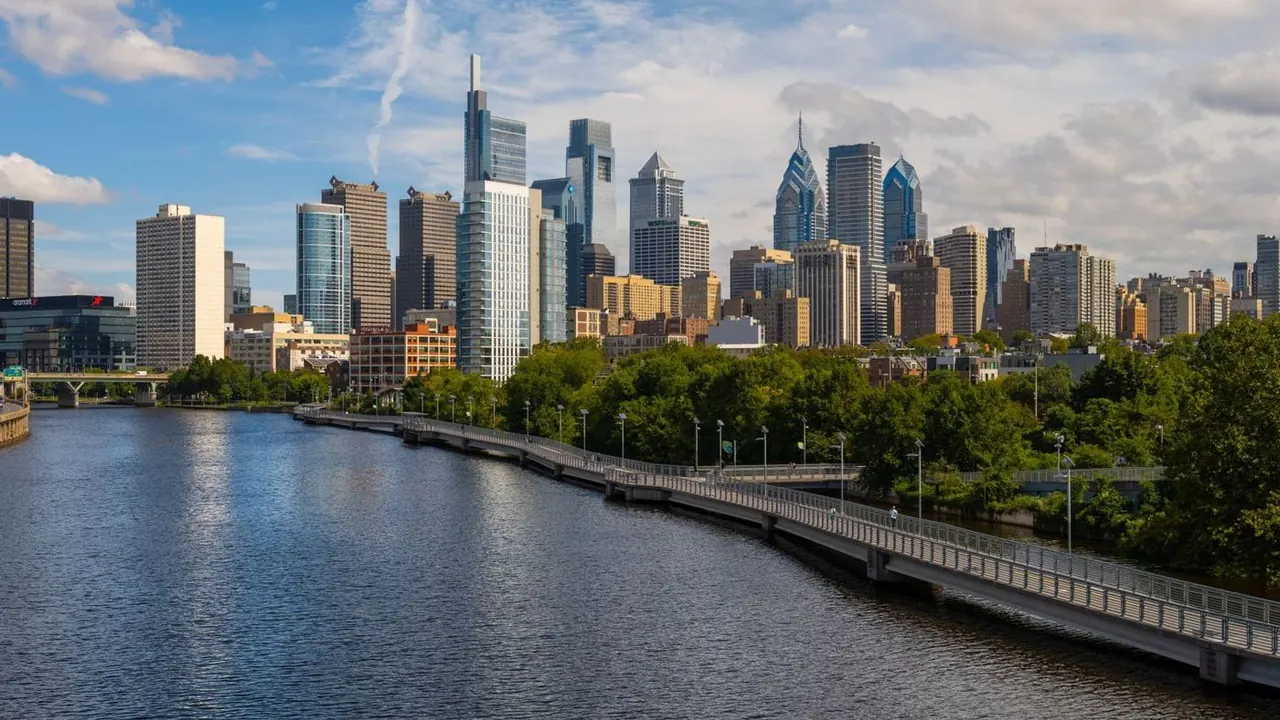
The skyline over the Schuylkill
- Day trips80
- Culture & sights72
- Live music & the arts72
Photo: Trev W. Adams, Pexels License
Match
57
Every category weighted equally
- Beach & sun51
- Culture & arts63
- Food & nightlife59
- Family trip57
- Outdoors57
- Relax & unwind52
- Shopping & style59
- On a budget55
Philadelphia in twelve categories
Our verdict on each, scored 0 to 100 against the same fixed benchmark cities, so a score means the same thing on every page.
Beaches & swimming. Scores 36 out of 100.
Food & drink. Scores 62 out of 100.
Culture & sights. Scores 72 out of 100.
Nightlife. Scores 55 out of 100.
Nature & outdoors. Scores 52 out of 100.
Day trips. Scores 80 out of 100.
Good for families. Scores 68 out of 100.
Getting around. Scores 66 out of 100.
Shopping & style. Scores 57 out of 100.
Affordability. Scores 40 out of 100.
Live music & performing arts. Scores 72 out of 100.
Wellness & relaxation. Scores 26 out of 100.
Philadelphia category by category
Beaches & swimming
36Philadelphia sits on two rivers, not the sea, and nobody swims in the city itself. Beach days mean the Jersey Shore: Atlantic City, Ocean City and Wildwood are a drive of an hour and a quarter or so, and Victorian Cape May is closer to two hours. The sand is wide and the Atlantic reaches about 22-24°C in late summer, so the swimming is real between late June and early September.
That makes it a summer side trip rather than part of the stay. Locals head 'down the shore' on weekends, which brings heavy traffic. Out of season the coast is cold and quiet, and the beaches play no part in a visit.
Food & drink
62Philadelphia eats with a strong local accent. The cheesesteak, the roast pork sandwich with broccoli rabe, the Italian hoagie, soft pretzels and water ice are all daily food, sold from corner delis and steak shops rather than kept for tourists. Reading Terminal Market, a Victorian train shed full of stalls including Pennsylvania Dutch bakers, and the open-air Italian Market along South 9th Street are the two places to start.
Beyond the sandwiches the restaurant scene is deep for a city of its size. Small chef-run dining rooms where you bring your own wine are a local tradition, and East Passyunk, Fishtown and Center City carry good Mexican, Vietnamese and modern American cooking. Craft beer is taken seriously too. Fine dining exists but is not why people come.
Culture & sights
72This is where the United States was founded, and the evidence is still there in brick. Independence Hall, where the Declaration and the Constitution were signed, stands with the Liberty Bell in the national park blocks of Old City. Nearby are Elfreth's Alley, Christ Church, Carpenters' Hall and streets of Georgian rowhouses in Society Hill. Further west, the ornate City Hall tower marks the centre of William Penn's grid.
The museums are serious. The Barnes Foundation holds one of the finest collections of Impressionist and early modern painting anywhere. The Philadelphia Museum of Art crowns the Benjamin Franklin Parkway, with the Rodin Museum close by. Add the Penn Museum's archaeology, the medical oddities of the Mütter Museum and the ruined cellblocks of Eastern State Penitentiary, and there is easily four or five days of sightseeing.
Nightlife
55A night out in Philadelphia is built on neighbourhood bars rather than big clubs. Fishtown and Northern Liberties have the converted warehouses, dive bars and craft-beer halls. Rittenhouse Square draws a cocktail crowd, and East Passyunk has corner taverns. The Gayborhood around 13th Street is one of the older LGBTQ+ districts in the country. With so many universities, weekends are busy and casual.
The limits are clear. Last call is 2am, the dance-club scene is small, and most nights are spent in pubs. It is a good drinking city, but not one people visit for its nightlife.
Nature & outdoors
52Fairmount Park is among the largest urban park systems in the country. Its best part is the Wissahickon Valley, a steep wooded gorge in the northwest of the city with a gravel path along the creek and rough trails above it. The Schuylkill River Trail runs from Center City past Boathouse Row, where rowing crews train, out towards Valley Forge, so it is easy to cycle or run out of town.
Further out the land stays gentle: the sandy pine forests of the Pine Barrens about an hour away, the rolling Brandywine country, and the Poconos and Delaware Water Gap near the edge of a day's reach for hiking and paddling. It is pleasant, green country without any real drama.
Day trips
80Philadelphia's position on the Northeast rail corridor is its great asset. New York is about an hour and a quarter by fast train, Baltimore a little over an hour, and Washington around two hours. Each of those makes a full day out on its own. Princeton's college town is about an hour away, and the river towns of New Hope and Lambertville make an easy drive.
To the west, Lancaster County's Amish farm country is about an hour by train. Gettysburg's battlefield is around two hours by car. Closer in are Valley Forge, the du Pont estates and Longwood Gardens in the Brandywine Valley, and the Victorian seaside town of Cape May. Many of the best outings need a car.
Good for families
68Philadelphia works well with children, mostly thanks to its museums. The Franklin Institute, with its walk-through giant heart, is a classic science museum. The Please Touch Museum in Fairmount Park is designed for under-eights, and the Academy of Natural Sciences has its dinosaur hall. The Philadelphia Zoo is the oldest in the country, a large aquarium sits across the river in Camden, and a Sesame Street theme park is about forty minutes north.
The historic sights also suit older children, since the Liberty Bell and the costumed guides of Old City make history easy to grasp. Center City is flat and compact. Some streets and transit stations are grubby, and summer heat and winter cold both limit park time.
Getting around
66Center City is one of the easiest American downtowns to walk. William Penn's flat grid runs between the two rivers, and Old City, Society Hill, Rittenhouse Square and the Museum District along the Parkway are all reachable on foot. Most visitors spend their time inside that rectangle and never need a car.
Beyond it, SEPTA runs two subway lines, trolleys, buses and regional rail, including a direct train to the airport, and the PATCO line crosses to New Jersey. The system covers the basics but is plain and sometimes rough round the edges, and its stations are not always pleasant. Outlying neighbourhoods and day trips into the countryside are easier with a car.
Shopping & style
57Shopping centres on Walnut Street around Rittenhouse Square, where national brands sit beside a few upscale boutiques. Independent shops spread through Old City, Fishtown and South Philadelphia. Jewelers' Row, one of the oldest diamond districts in the country, fills a few blocks near Washington Square. The markets add character: Reading Terminal for local food gifts and the Italian Market for cheeses, cookware and imported goods.
For scale, many visitors drive half an hour to the King of Prussia mall, one of the largest in the United States. Pennsylvania charges no sales tax on clothing, which helps. The city has no luxury street of its own and no strong fashion identity.
Affordability
40Philadelphia costs less than the larger cities of the American East Coast but is not cheap by international standards. Center City hotels charge typical American rates, and sit-down restaurants, with tax and tip on top, add up quickly. The savings come from the city's character. The founding sights in Independence National Historical Park are free, a cheesesteak or hoagie makes a filling lunch, and bringing your own wine to many restaurants cuts the cost of dinner. The big art museums charge full admission.
Live music & performing arts
72Classical music is the backbone here. The Philadelphia Orchestra, long one of the leading American ensembles, plays at the modern concert halls on the Avenue of the Arts. Next door is the Academy of Music, a richly decorated 1857 opera house that is home to Opera Philadelphia and the city's ballet company. Students of the Curtis Institute, one of the world's top conservatories, give regular recitals.
The Walnut Street Theatre is the oldest working theatre in the country, and a cluster of resident companies stages plays through the season. Touring Broadway shows come through. The city's jazz and soul history lives on in small clubs, and there are rock and indie venues across Fishtown and University City. Early autumn brings a fringe festival.
Wellness & relaxation
26Philadelphia has no bathing culture of its own. Relaxing means a hotel spa, a day spa near Rittenhouse Square or a drive to one of the Korean-style bathhouses in the suburbs. The city's pace is quick and a little gruff. The calmest hours are spent on a bench in one of Penn's leafy squares, on a quiet walk in the Wissahickon gorge, or among the planted courtyards of Society Hill.
When should you go?
Pick a month to see what it is like. The climate figures are measured averages, not a forecast.
Philadelphia in July
Daytime high, °C
Rainfall in the month, mm
The whole year
Shaded against this city’s own year: the deepest cell is its best month for that figure and the palest its weakest.
Temperature and rainfall are climate normals, averaged over the years shown. Philadelphia: 1991-2020 normals, Philadelphia International Airport (11.3 km from centre).
Before you go
| Measure | Philadelphia |
|---|---|
| Currency | US Dollar (USD) |
| Sockets | AB120 V, 60 Hz |
| Driving side | Right |
| Time zone | UTC-5, UTC-4 in summer |
| Emergency number | 911 |
| Elevation | 12 m |
| Main airport | Philadelphia International Airport (PHL)11 km from centre129 non-stop destinations |
| Public holidays this year | 12 days |
By the numbers
| Measure | Philadelphia |
|---|---|
| City population | 1,603,797 |
| People per km² | 4,339 |
| Museums within 10 km | 54 |
| UNESCO World Heritage sites within 50 km | 1 |
Compare Philadelphia with
Every comparison with a written verdict behind it.