Uzbekistan
Bukhara
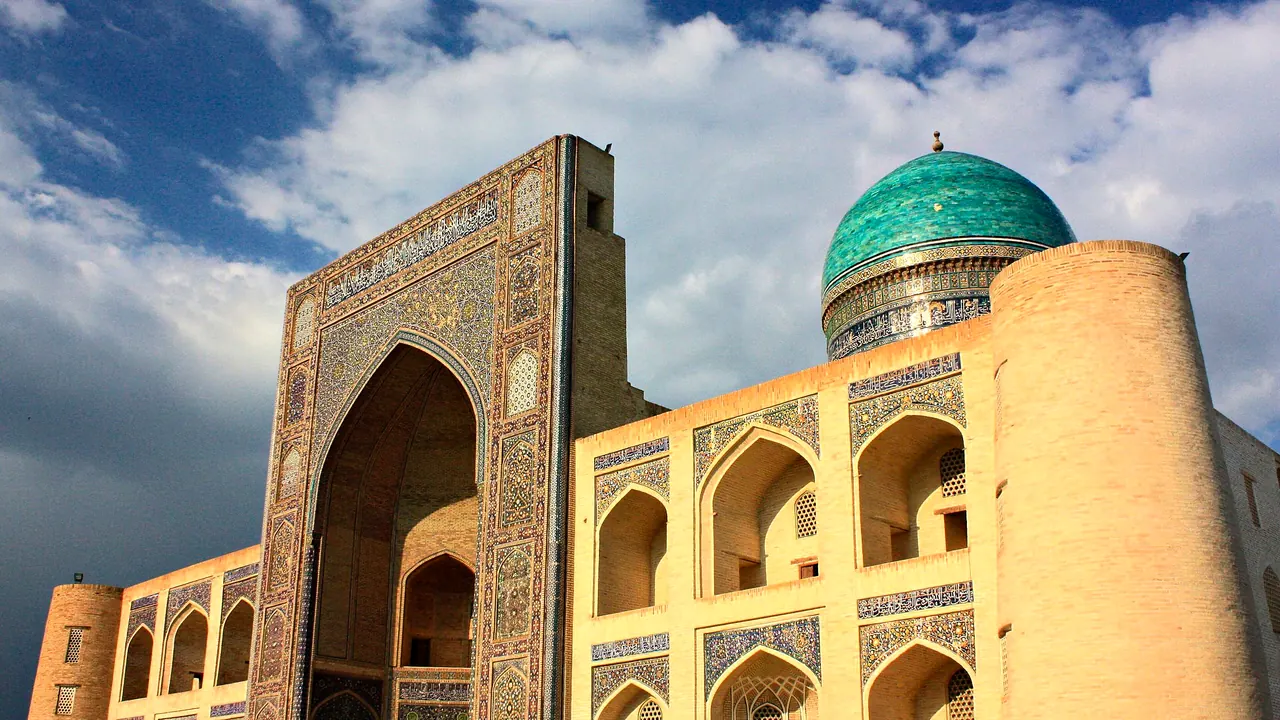
The Mir-i-Arab madrasa in evening light
- Affordable cities83
- Culture & sights80
- Getting around62
Photo: RK, CC BY-SA 4.0, cropped
Match
42
Every category weighted equally
- Beach & sun38
- Culture & arts49
- Food & nightlife41
- Family trip44
- Outdoors41
- Relax & unwind41
- Shopping & style46
- On a budget47
Bukhara in twelve categories
Our verdict on each, scored 0 to 100 against the same fixed benchmark cities, so a score means the same thing on every page.
Beaches & swimming. Scores 4 out of 100.
Food & drink. Scores 40 out of 100.
Culture & sights. Scores 80 out of 100.
Nightlife. Scores 10 out of 100.
Nature & outdoors. Scores 12 out of 100.
Day trips. Scores 55 out of 100.
Good for families. Scores 35 out of 100.
Getting around. Scores 62 out of 100.
Shopping & style. Scores 55 out of 100.
Affordability. Scores 83 out of 100.
Live music & performing arts. Scores 18 out of 100.
Wellness & relaxation. Scores 52 out of 100.
Bukhara category by category
Beaches & swimming
4Bukhara is a desert city deep in Central Asia, about as far from an ocean as anywhere on earth. There is no beach or bathing lake within reach. The historic pools of the old town, such as Lyabi-Hauz, are for sitting beside, not swimming in. In the hot summer months a hotel pool is the only way to swim, so it is worth choosing a place to stay that has one.
Food & drink
40Eating in Bukhara means Uzbek cooking, and it is very good inside a narrow range. Plov is the centrepiece: rice, carrots, mutton and fat cooked in huge iron pots and best eaten at lunchtime, when it is freshest. Around it come samsa from tandoor ovens, shashlik grilled over charcoal, hand-pulled noodles, flat round bread stamped with patterns, and pots of green tea poured over and over.
The pleasure lies in the setting. You eat on raised platforms in teahouses, sit at tables under the mulberry trees around the old pools, or walk through the central bazaar with its dried fruit, nuts and spices. There is little else to choose from, and the menus in the old town are much alike. Vegetarians will find the options limited, and fine dining barely exists.
Culture & sights
80Bukhara has one of the most complete historic centres in the Islamic world, and nearly all of it can be walked. The Poi Kalon ensemble forms the heart: the twelfth-century Kalon Minaret, which Genghis Khan is said to have spared, stands between a great Friday mosque and a working madrasa with turquoise domes. Close by are the Ark fortress of the emirs, the tenth-century Samanid Mausoleum in patterned brick, the wooden-columned Bolo Hauz mosque and the four small towers of Chor Minor.
The Lyabi-Hauz pool and its madrasas, the domed trading halls and dozens of smaller mosques and caravanserais fill the gaps, and the old residential lanes still feel lived in. On the edge of town are the emirs' summer palace, Sitorai Mohi Hosa, and the Bahauddin Naqshband shrine. Museums are the weak side: the collections inside the Ark and the madrasas are modest, and the architecture is the main thing to see.
Nightlife
10Evenings in Bukhara are quiet. After dark, life gathers around the Lyabi-Hauz pool, where families and visitors sit over tea and dinner under the lit-up madrasas. Then the town goes to bed. Beer and wine are served in some restaurants and hotels, and there are a few hotel bars, but there is no real bar district and nothing that could be called a club scene. Come for the floodlit domes on an evening walk, not for a night out.
Nature & outdoors
12Bukhara stands in a flat irrigated oasis at the edge of the Kyzylkum desert. The landscape around it is cotton fields, mulberry-lined canals and then open scrub desert. Desert yurt camps and camel rides can be arranged further out, towards the lakes of the Nurata region, but that takes a long drive and is more an overnight trip than a base for outdoor activity. In town, green space is limited to a few parks and the shaded courtyards. Summers are very hot, so walking and cycling suit spring and autumn.
Day trips
55The great day trip is Samarkand, a little under two hours away by high-speed train. You can see the Registan, Shah-i-Zinda and the Bibi-Khanym mosque in a long day, although many travellers prefer to stay a night or two. Closer to Bukhara, Gijduvon is a ceramics town where family workshops still fire the region's ochre and green pottery. Vabkent has a slender twelfth-century minaret, and the Chor Bakr necropolis is a quiet walled city of tombs just outside town.
After that the choice runs out. Khiva and the desert fortresses of Khorezm are several hours away and need a night, and so does Shahrisabz, Timur's birthplace. Most visitors treat Bukhara as one stop on a route rather than a hub.
Good for families
35Bukhara is safe, compact and very welcoming to children. Uzbek families go out together in the evenings, and strangers will fuss over small children. The old town is mostly pedestrian and flat, which makes pushchairs easier to use than in many historic centres. Very little is made for children, though. The sights are mosques, madrasas and fortresses, and a puppet show or a camel at the summer palace counts as entertainment. Summer heat often passes 40°C, so spring and autumn are the only comfortable seasons with young children, and a hotel with a pool or a shaded courtyard helps.
Getting around
62Most of what a visitor comes for lies within a walk of 20 minutes or so across a flat, largely car-free old town. You can get from Lyabi-Hauz to the Kalon Minaret, the Ark and Bolo Hauz on foot, through the trading domes and shaded lanes. The summer palace, the Naqshband shrine, Chor Bakr and the railway station, which lies some distance out of town, are a different matter. City buses and minibuses exist but are hard for visitors to use, so people rely on taxis and ride-hailing apps, which are cheap and easy. You do not need a car. In midsummer even short walks are tiring in the middle of the day.
Shopping & style
55Bukhara is a craft market. The sixteenth-century trading domes and the madrasa courtyards around them are lined with stalls and workshops selling suzani embroidery, silk and cotton ikat, carpets, gold-thread embroidered caps and robes, miniature paintings, hammered copper and hand-forged knives. The best-known item is the stork-shaped scissors made by local blacksmiths. Often you can watch the work being done in the next room.
The quality varies. Some pieces are fine old textiles, while many stalls carry the same printed fabrics and souvenirs, so it pays to take your time and bargain gently. There are no fashion streets, design boutiques or department stores worth a visitor's time. The central bazaar is for spices, dried fruit and everyday life rather than gifts.
Affordability
83Bukhara is a cheap place to travel. A plate of plov, a pot of tea and bread cost very little, taxis across town are a small expense, and entry to the monuments is modest. Family-run guesthouses in old merchant houses, many with tiled courtyards and generous breakfasts, are good value. The boutique hotels in restored mansions charge more, and dinner beside the old pools costs more than in the backstreets, but even a comfortable stay here costs far less than in most of Europe.
Live music & performing arts
18Live performance in Bukhara is mostly staged for visitors. On many evenings, folk dance, music and costume shows are held in the courtyard of a madrasa beside Lyabi-Hauz, and small puppet shows tell local folk tales. The city has a music and drama theatre with performances in Uzbek, but it is rarely part of a visitor's trip. You will find traditional instruments and Shashmaqam singing now and then at weddings and festivals, but there is no regular classical, theatre or live-music scene to plan an evening around.
Wellness & relaxation
52Bukhara still has a few working bathhouses that are centuries old, tucked under brick domes near the trading halls. Here you can take a traditional steam, a scrub and a vigorous massage with herbs in a setting that has hardly changed in generations. Some baths keep separate hours or rooms for men and women. Beyond these, wellness means a few hotel spas.
The pace of the town is what makes it restful. Mornings in courtyard guesthouses, slow afternoons over tea on the platforms by the pools, and empty lanes at dusk make it one of the calmer stops in Central Asia. In midsummer the heat sets the rhythm, and most visitors do as the locals do and rest through the middle of the day.
When should you go?
Pick a month to see what it is like. The climate figures are measured averages, not a forecast.
Bukhara in July
Daytime high, °C
Rainfall in the month, mm
The whole year
Shaded against this city’s own year: the deepest cell is its best month for that figure and the palest its weakest.
Temperature and rainfall are climate normals, averaged over the years shown. Bukhara: 2004-2020 (rainfall 1991-2020) normals, Bukhara / Tsyplan (3.4 km from centre).
Before you go
| Measure | Bukhara |
|---|---|
| Official language | Uzbek |
| Currency | Uzbekistan Sum (UZS) |
| Sockets | CFI220 V, 50 Hz |
| Driving side | Right |
| Time zone | UTC+5 |
| Emergency number | 112 |
| Elevation | 225 m |
| Main airport | Bukhara International Airport (BHK)5 km from centre11 non-stop destinations |
By the numbers
| Measure | Bukhara |
|---|---|
| City population | 280,187 |
| People per km² | 7,111 |
| Museums within 10 km | 2 |
| UNESCO World Heritage sites within 50 km | 1 |
Compare Bukhara with
Every comparison with a written verdict behind it.