Uzbekistan
Khiva
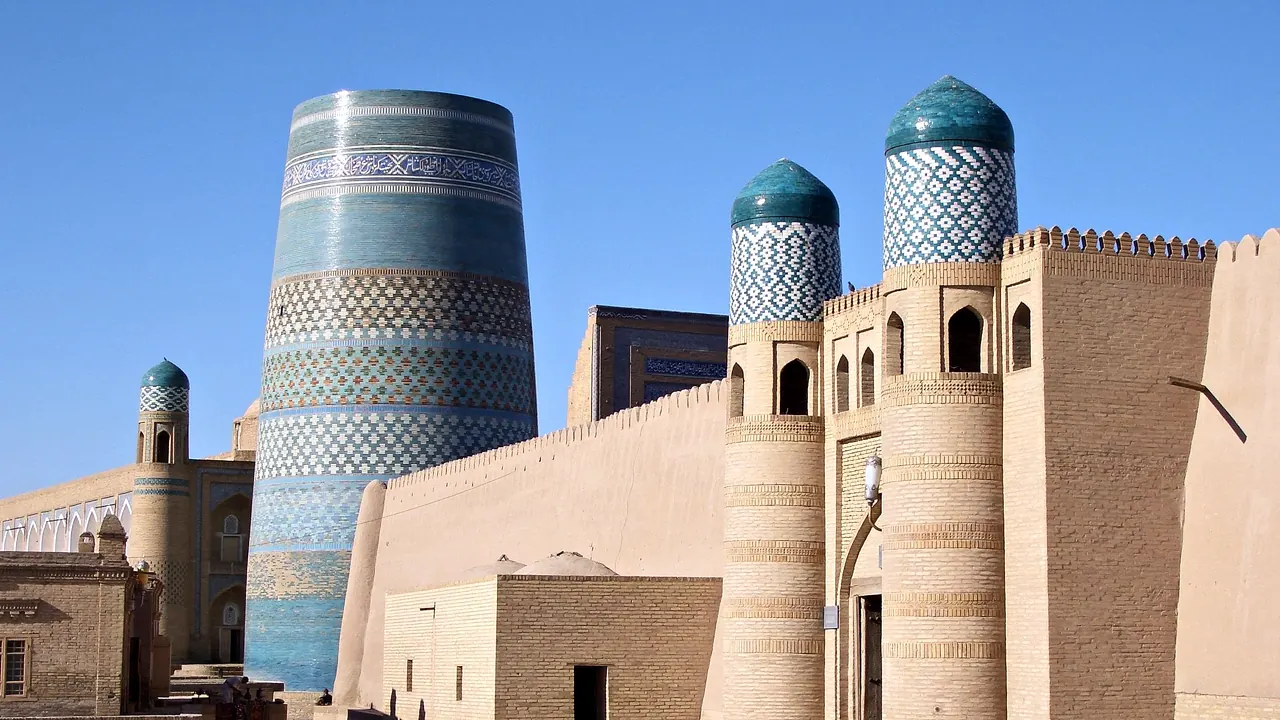
The Kalta Minor minaret in the Itchan Kala
- Affordable cities85
- Culture & sights72
- Getting around62
Photo: Bosinus, CC BY-SA 3.0, cropped
Match
33
Every category weighted equally
- Beach & sun30
- Culture & arts40
- Food & nightlife33
- Family trip37
- Outdoors32
- Relax & unwind31
- Shopping & style35
- On a budget39
Khiva in twelve categories
Our verdict on each, scored 0 to 100 against the same fixed benchmark cities, so a score means the same thing on every page.
Beaches & swimming. Scores 3 out of 100.
Food & drink. Scores 30 out of 100.
Culture & sights. Scores 72 out of 100.
Nightlife. Scores 5 out of 100.
Nature & outdoors. Scores 15 out of 100.
Day trips. Scores 28 out of 100.
Good for families. Scores 28 out of 100.
Getting around. Scores 62 out of 100.
Shopping & style. Scores 32 out of 100.
Affordability. Scores 85 out of 100.
Live music & performing arts. Scores 15 out of 100.
Wellness & relaxation. Scores 25 out of 100.
Khiva category by category
Beaches & swimming
3Khiva sits in the desert of Khorezm, deep inside the continent and farther from the open sea than almost any town you are likely to visit. There is no beach life of any kind. On hot summer afternoons, swimming means the pool at one of the larger hotels.
Food & drink
30The cooking here is Khorezmian, and it is not the same as the food in the rest of Uzbekistan. Look for shivit oshi, bright green noodles made with dill and served under a meat and vegetable stew with yoghurt. There is also tuhum barak, a soft dumpling filled with egg, plus local plov, flatbread from tandyr ovens and green tea poured at every meal.
The choice is small, though. Most meals are eaten on rooftop terraces or in family guesthouses inside the walls, and the menus repeat from one to the next. There is little street food, almost no café culture and very little wine. Two or three days of eating well is easy, but variety runs out after that.
Culture & sights
72The reason to come is Ichan Kala, the inner walled town. Its mud-brick ramparts enclose a whole Silk Road city of madrasas, mosques, minarets and palaces, kept almost completely intact. The turquoise stump of the Kalta Minor minaret is the town's emblem. The Juma Mosque stands on a forest of carved wooden columns, some of them centuries old. The Tash Hauli palace has harem courtyards covered in blue tilework, and the Islam Khoja minaret can be climbed for views across flat roofs to the desert.
It is a compact set. Most sights are inside a walled area you can cross on foot in ten minutes, and the small museums in the madrasas add context rather than major collections. Outside the inner walls, the Nurullaboy palace in the outer town is worth the short walk. Walk the walls at sunset, when the brick turns gold.
Nightlife
5Khiva has essentially no nightlife. Evenings mean a late dinner on a terrace overlooking the minarets and a walk through the lit-up lanes of the old town, which empty quickly after dark. A few hotel restaurants serve beer or local wine, but there are no bars or clubs to speak of.
Nature & outdoors
15Khiva lies in a flat, irrigated oasis on the left bank of the Amu Darya, with the Karakum desert closing in to the south and west. Cotton fields and canals lined with mulberry trees run out into sand and scrub. The main outdoor experience is across the river, in the Kyzylkum, where the ruined fortresses stand among dunes and visitors ride camels and sleep in yurt camps under a very dark sky.
There are no hills, no walking trails and little else to do outdoors. Summers are fiercely hot, often above 40°C, and winters are cold and windy. Spring and autumn are the only comfortable seasons to be out in the open.
Day trips
28The one real day out is the Elliq Qala, the ruined fortresses of ancient Khorezm. Ayaz Kala, Toprak Kala and their neighbours are huge mud-brick walls rising out of the desert, roughly one and a half to two hours away by car, and most visitors hire a driver and see several in one day. Urgench, about 30km away, is a modern regional city with the airport and the railway station, but little to see. Kunya-Urgench is just across the border in Turkmenistan and needs a separate visa. Bukhara and the Savitsky Museum in Nukus are both too far for a day trip.
Good for families
28Khiva is safe and calm, and it is small enough that children are never far from a shady courtyard or the hotel. Uzbek families are openly fond of children. Older children often enjoy climbing a minaret, walking the walls or riding a camel in the desert. There are, however, no attractions made for children. A visit is a series of madrasas and palaces, and in summer the heat makes any sightseeing in the middle of the day hard work. Families do best in spring or autumn and with a short stay.
Getting around
62Within the old town, getting around could hardly be easier. Ichan Kala is tiny, flat and mostly closed to traffic, and every major sight is a few minutes' walk from the next. Most visitors stay inside or just outside the walls and never need a vehicle during their stay. Khiva has its own railway station a short walk from the walls, with direct trains from Bukhara and Tashkent, so rail travellers arrive straight into town.
Beyond that it is a different story. The nearest airport is in Urgench, about 30km away, and the desert fortresses can only be reached with a hired driver or on a tour. Taxis cover the gaps, but there is no public transport a visitor would rely on.
Shopping & style
32Shopping here means crafts, and some of them are made in front of you. Khiva has long been known for carved wooden doors and columns, and woodcarvers work in the madrasa cells, turning out boxes, Quran stands and panels. Silk carpets are knotted on looms in workshops inside the old town. Stalls along the main lanes sell suzani embroidery, ceramics, and the shaggy sheepskin hats of Khorezm. Much of the rest is repeated souvenirs, and there are no boutiques, fashion or markets of note beyond the local bazaar by the eastern gate.
Affordability
85Khiva is an inexpensive place to travel. Family-run guesthouses inside and around the walls are comfortable and modestly priced, and they often include a large breakfast. Meals of noodles, plov and tea cost little, and a driver for the day out to the desert fortresses is affordable, especially when the cost is shared. The main fixed expense is the combined ticket for the old town's monuments. The boutique hotels in restored madrasas cost more, but by Western standards they are still reasonable.
Live music & performing arts
15Khorezm has its own lively folk dance, the lazgi, with quick, shimmering movements of the hands and shoulders. Visitors usually see it at evening shows in madrasa courtyards or with dinner in the larger hotels. Dorboz tightrope walkers sometimes perform on the squares, and folk music is heard at weddings and local festivals. Beyond these occasional staged performances there is no theatre, concert hall or regular live music.
Wellness & relaxation
25Khiva has no real spa or bathing culture to offer a visitor. Its historic bathhouse is something to look at rather than use, and pampering is limited to a sauna or hammam in a few of the larger hotels. What the town does offer is calm. After the day groups leave, the walled lanes go quiet, and evenings pass slowly over tea on a rooftop as the light fades on the minarets. It is restful in that sense, but nobody comes here to be pampered.
When should you go?
Pick a month to see what it is like. The climate figures are measured averages, not a forecast.
Khiva in July
Daytime high, °C
Rainfall in the month, mm
The whole year
Shaded against this city’s own year: the deepest cell is its best month for that figure and the palest its weakest.
Where the figures come from
Khiva's temperatures are measured 27 km from the centre, at Urgench.
Khiva has no rain gauge within 25 km of the centre, so its rainfall comes from a gridded climate dataset read at the city rather than from a gauge further away.
Temperature and rainfall are climate normals, averaged over the years shown. Khiva: 1991-2020 normals, Urgench (26.8 km from centre).
Before you go
| Measure | Khiva |
|---|---|
| Official language | Uzbek |
| Currency | Uzbekistan Sum (UZS) |
| Sockets | CFI220 V, 50 Hz |
| Driving side | Right |
| Time zone | UTC+5 |
| Emergency number | 112 |
| Elevation | 109 m |
| Main airport | Urgench International Airport (UGC)32 km from centre21 non-stop destinations |
By the numbers
| Measure | Khiva |
|---|---|
| City population | 105,300 |
| Museums within 10 km | 0 |
| UNESCO World Heritage sites within 50 km | 1 |
Compare Khiva with
Every comparison with a written verdict behind it.