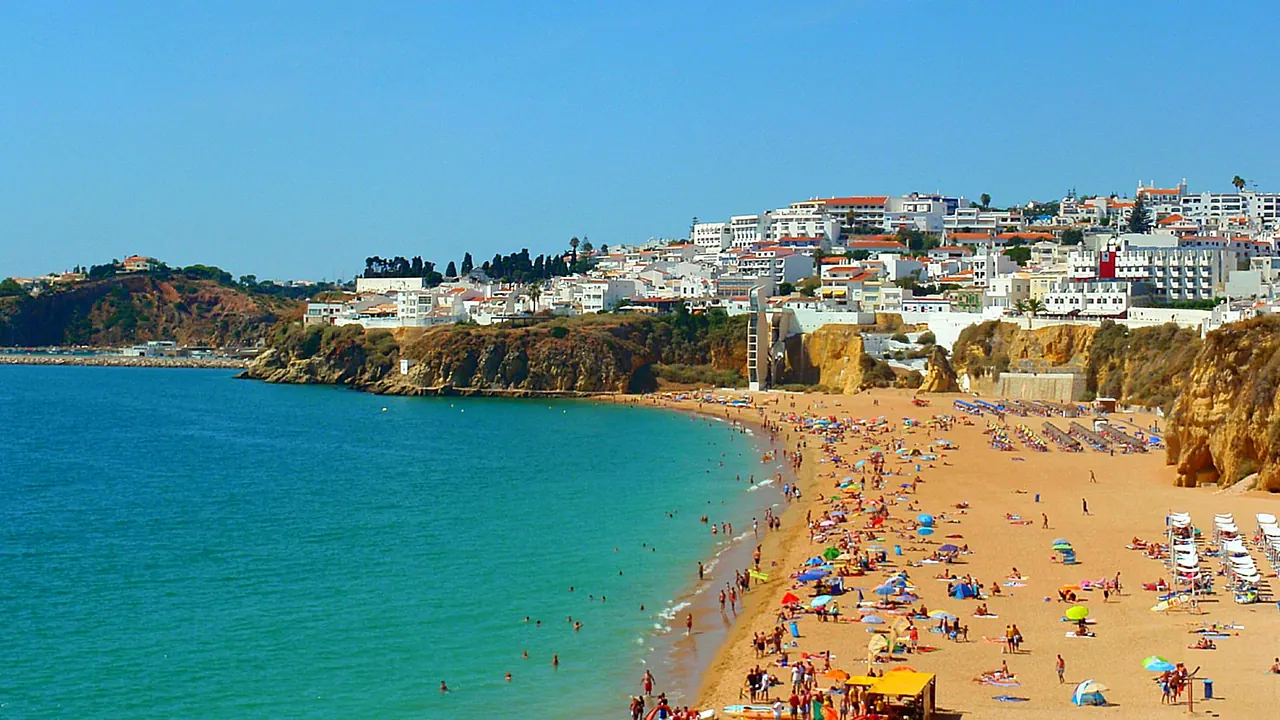
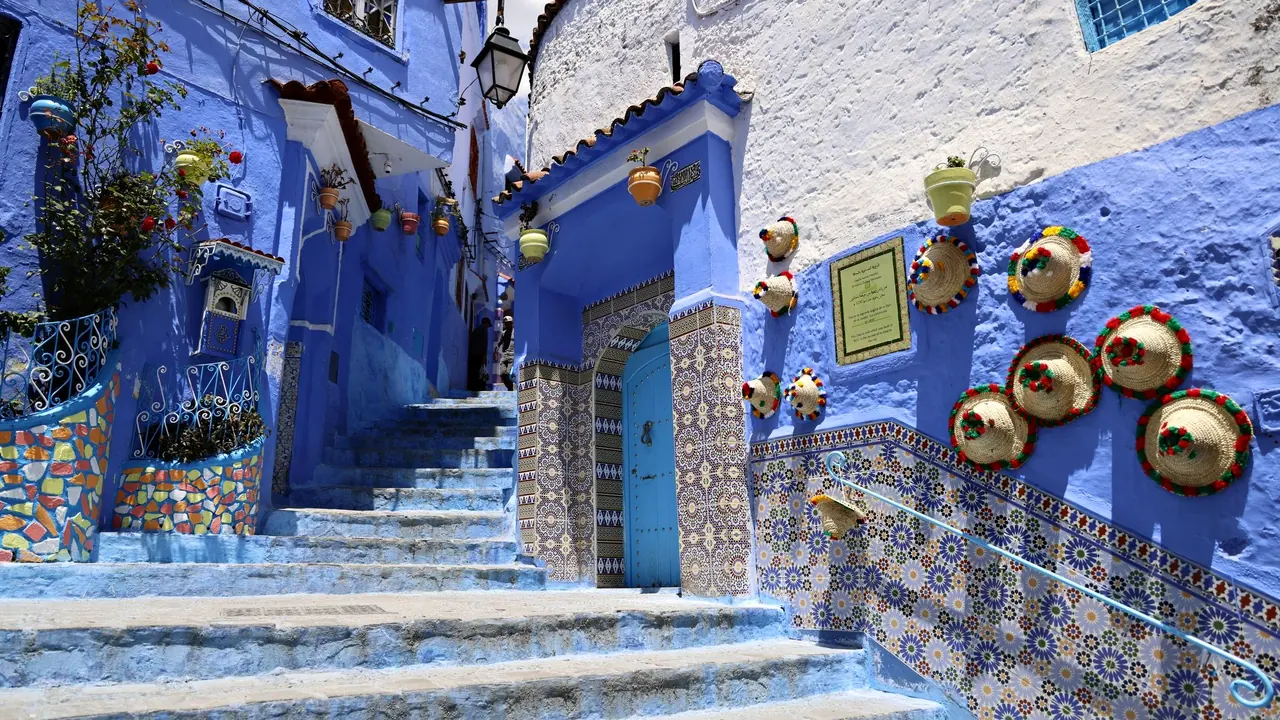
Photos: Albufeira by Jose A., CC BY 2.0, cropped; Chefchaouen by Christophe RASCLE, Pexels License.
Albufeira or Chefchaouen?
Our verdict in twelve categories, each scored against the same fixed benchmark cities, and the climate month by month, so you can choose for your trip.
Choose Albufeira for
- beaches
- nightlife
- families
Albufeira is the choice for a sun-and-sand trip: golden beaches under ochre cliffs, calm water in summer, family resorts with kids' clubs and a party Strip for anyone who wants late nights. With a car it also works as a base for touring the Algarve's older towns, though the town itself has little culture.
Choose Chefchaouen for
- prices
- culture and sights
- getting around
Chefchaouen suits a slower, cheaper trip of a few days. You wander a blue-washed medina, hike into the Rif mountains and spend long afternoons doing very little on a roof terrace. There is no beach to speak of and no nightlife. Still, the town has more character to look at than Albufeira and costs far less, and it fits best as one stop on a route through northern Morocco.
Scoreboard
Twelve categories on one fixed scale from 0 to 100. The shaded stretch is the gap between the two.
Your match
Pick a travel style or drag the sliders, and both match scores follow your weighting.
Wins on beaches and nightlife with your weighting.
Wins on prices and culture and sights with your weighting.
What matters to you?
Category by category
What the scores mean for a trip.
Beaches & swimming
There is no contest here. Albufeira was built around its beaches. Peneco and Pescadores lie right below the old town, long stretches of sand run east through Oura to Falésia, and coves such as São Rafael sit to the west. The Atlantic is calm and clear from June to early October.
Chefchaouen has no beach of its own. The grey sand at Oued Laou is more than an hour away down a winding gorge road. Its sea is a touch warmer in late summer, but the trip is a day out rather than a beach vacation, and the cold pools at Akchour are only good for a quick dip.
Food & drink
Neither is a place for serious food lovers, but Albufeira has more to offer once you look past the multilingual menus of the Strip. Head to the simple places by the fishermen's beach for charcoal-grilled sardines, clam and pork cataplana and octopus, with local wine on the table.
In Chefchaouen most restaurants serve the same tagine, couscous and kefta. The best tastes are local ones: Rif goat cheese wrapped in palm leaf, and bissara soup at breakfast. Alcohol is scarce, and a few days is enough to try it all.
Culture & sights
Albufeira's whitewashed old town fills a morning. It has fragments of Moorish wall, a clock tower with an iron bell cage and two small museums. Anyone keen on history spends their days in other Algarve towns.
Chefchaouen has more to see. Its blue-washed medina, founded in 1471 and settled by refugees from Andalusia, is the sight in itself. Add the red-walled kasbah on Outa el-Hammam square and the sunset walk up to the Spanish Mosque. There are no major monuments, though, and a day or two covers it.
Nightlife
Albufeira is the Algarve's party town. In high summer the neon bars, karaoke and clubs on the Strip stay open until dawn, and Oura and the old town square have calmer terrace bars. It is loud and unsubtle, and much of it closes from November to March.
Chefchaouen has nothing like it. There are a couple of hotel bars, and an evening means mint tea in the square and a stroll through the lit lanes before the medina falls silent.
Nature & outdoors
Both are strong for the outdoors, but the landscapes could hardly be more different. Albufeira's is the eroded limestone coast, with the Seven Hanging Valleys cliff walk, boat and kayak trips into the sea caves at Benagil, and dolphin watching offshore.
Chefchaouen looks to the mountains instead. Trails climb straight from the medina into the Rif, the gorge walk from Akchour leads to God's Bridge in Talassemtane National Park, and the cedar forests hold Barbary macaques. Trails there are poorly marked, so many walkers hire a local guide, which is rarely needed on the Algarve cliffs.
Day trips
Albufeira has the wider choice. Silves and its red sandstone castle, Loulé's domed market hall, walled Faro, Lagos and Tavira are all within easy reach, and they are best reached by car. None is a major heritage site, but there are enough of them to fill a week of outings.
From Chefchaouen there is really one good trip: Tetouan, with its UNESCO-listed medina. Martil and Ouezzane are lesser options. Tangier and Fes are too far to go and come back in a day.
Good for families
Albufeira is built for a family beach vacation. Zoomarine has dolphin shows, water parks are a short drive away, beaches such as Galé and Falésia have lifeguards, and resort hotels come with kids' clubs and shallow pools. Families do best staying away from the Strip and the steep old town.
Chefchaouen is calm and welcoming to children, but nothing there is made for them, and pushchairs are useless on its stepped lanes. It works as a short stop with older children who can walk, ideally with a day at the Akchour river pools.
Getting around
You can walk Albufeira's old town and central beaches, with a public lift and an escalator helping on the climb up from the sand. Beyond that, the resort stretches for kilometres through Montechoro, Oura and Galé, and local buses link these areas only patchily. The station is 6km inland, so most visitors rely on taxis and a hire car.
Chefchaouen is easier because everything you came for is in one place. You can cross the medina on foot in fifteen minutes, though almost every route means steep, polished steps. Petit taxis run to the medina gates and shared grand taxis handle outings, but there is no railway.
Shopping & style
Albufeira's lanes sell mostly beachwear, football shirts and souvenirs. Painted pottery, cork goods and medronho are the better things to take home, and the mall at Guia covers everyday fashion.
Chefchaouen has the more genuine crafts for a town its size. Look for woollen blankets and striped Rif weavings, often made on looms in the shopfronts, along with djellabas, leather slippers and the blue pigment used on the walls. Bargaining is gentle, but the range repeats after a few streets and there are no boutiques at all.
Affordability
For a Western European resort, Albufeira is fair value, with cheap set menus, beer and local wine. July and August push up the cost of rooms, beachfront meals, taxis and car hire, and the real bargains are from October to May.
Chefchaouen is much cheaper on almost every count. Guesthouses cost a fraction of European rates, a tagine with mint tea is inexpensive and shared grand taxis cost little. The town itself is free to explore.
Live music & performing arts
Neither is a place to plan a trip around live performance, but Albufeira at least has some. There are tribute acts and cover bands in bars, hotel cabaret, fado dinner shows and free summer concerts on the square by the fishermen's beach. In Chefchaouen, traditional Andalusian music appears only now and then, mostly around festivals, and the call to prayer over the rooftops is the music most visitors hear.
Wellness & relaxation
For a restful trip Chefchaouen is the better choice, even though Albufeira has the more polished spas. Albufeira has no bathing tradition of its own, so unwinding there means booking a resort hotel with treatment rooms and a heated pool. In summer the area around the Strip is anything but calm, so peace is easier to find in the cliff-top resorts west of town, around Galé, or in the mild, sunny winter. The nearest real thermal waters are at Caldas de Monchique, an hour inland.
Chefchaouen slows you down without any effort on your part. There are few cars inside the walls and nothing to stay out late for, so the days go by on roof terraces and beside the spring at Ras el-Maa, and the mountain air is cooler than in the lowlands. A scrub in a neighbourhood hammam costs little and is the genuine article, which Albufeira's hotel spas cannot offer. What Chefchaouen lacks is pampering: only a handful of riads offer massage, and there are no thermal baths.
When should you go?
Pick your month. The climate figures are measured averages, not a forecast.
Albufeira in July
Chefchaouen in July
Daytime high, °C
Rainfall in the month, mm
Where the figures come from
Albufeira's temperatures are measured 26 km from the centre, at Faro / Aeroporto.
Albufeira has no rain gauge within 25 km of the centre, so its rainfall comes from a gridded climate dataset read at the city rather than from a gauge further away.
Chefchaouen has no weather station within reach, so its figures come from a gridded climate model rather than a measured record, and read a broad area rather than the city itself.
Temperature and rainfall are climate normals, averaged over the years shown. Albufeira: 1991-2020 normals, Faro / Aeroporto (26.4 km from centre). Chefchaouen: 2001-2020 normals, NASA POWER reanalysis grid, no weather station within 90 km.
Albufeira has the gentler year. You can swim from June into early October, when the Atlantic is around 20°C, and summer is almost rainless, with the most sunshine in July. Highs of 29°C in July and August feel hot on the sand but are manageable. The rain comes back in October and builds to the wettest month in December. Winter stays mild and fairly sunny, though, which suits quiet stays and coastal walks.
Chefchaouen is at its best in April and May and again from late September into October, when the medina stairs and mountain trails are comfortable. July and August reach 35°C, which is too hot for steep lanes in the afternoon, although the sea at Oued Laou is warmest then. Winter is cooler and much wetter than on the Algarve. November is the rainiest month at 141mm, and snow sits on the high ground.
Which traveller are you?
For a beach and sun trip, Albufeira wins outright. Golden sand runs for kilometres under sandstone cliffs, with lifeguards and calm water through summer. Chefchaouen is a mountain town, more than an hour from its nearest grey-sand beach.
On a food and nightlife trip, Albufeira is the only real option. Its fish grills and cataplana stews beat Chefchaouen's repeated tagines, and the Strip stays open until dawn in summer. Chefchaouen has almost no alcohol and goes quiet after dinner.
For a trip on a tight budget, Chefchaouen goes much further. Guesthouses cost a fraction of European prices, meals and shared taxis are cheap, and the main sight costs nothing to walk. Albufeira gets expensive in July and August.
Before you go
| Measure | Albufeira | Chefchaouen |
|---|---|---|
| Official language | Portuguese | Arabic, Standard Moroccan Tamazight |
| Currency | Euro (EUR) | Moroccan Dirham (MAD) |
| Sockets | CF230 V, 50 Hz | CE50 Hz |
| Driving side | Right | Right |
| Time zone | UTC, UTC+1 in summer | UTC+1 |
| Emergency number | 112 | Police 19/112, ambulance 15, fire 15 |
| Elevation | 22 m | 564 m |
| Main airport | Faro - Gago Coutinho International Airport (FAO)26 km from centre91 non-stop destinations | Tangier Ibn Battuta Airport (TNG)86 km from centre50 non-stop destinations |
| Public holidays this year | 14 days | 11 days |
By the numbers
| Measure | Albufeira | Chefchaouen |
|---|---|---|
| City population | 44,168 | 46,168 |
| People per km² | 314 | 2,998 |
| Museums within 10 km | 1 | 1 |
| UNESCO World Heritage sites within 50 km | 0 | 1 |
| Swim season, months above 21 °C | None | 3 months |
Where else could you go?
Every comparison below shares a destination with this one, so you can follow Albufeira or Chefchaouen somewhere new.
- Farovs Albufeira
- Lagos, Portugalvs Albufeira
- Tangiervs Chefchaouen
- Fesvs Chefchaouen
- Cadizvs Albufeira
- Rabatvs Chefchaouen