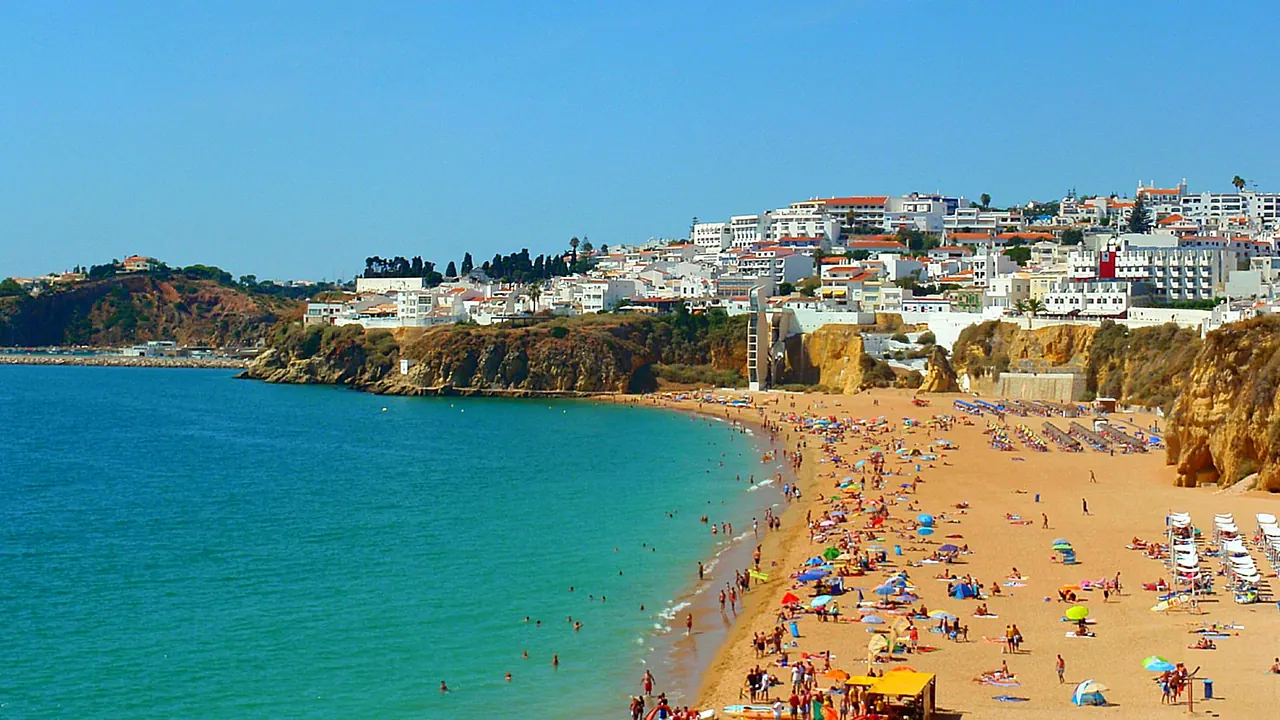
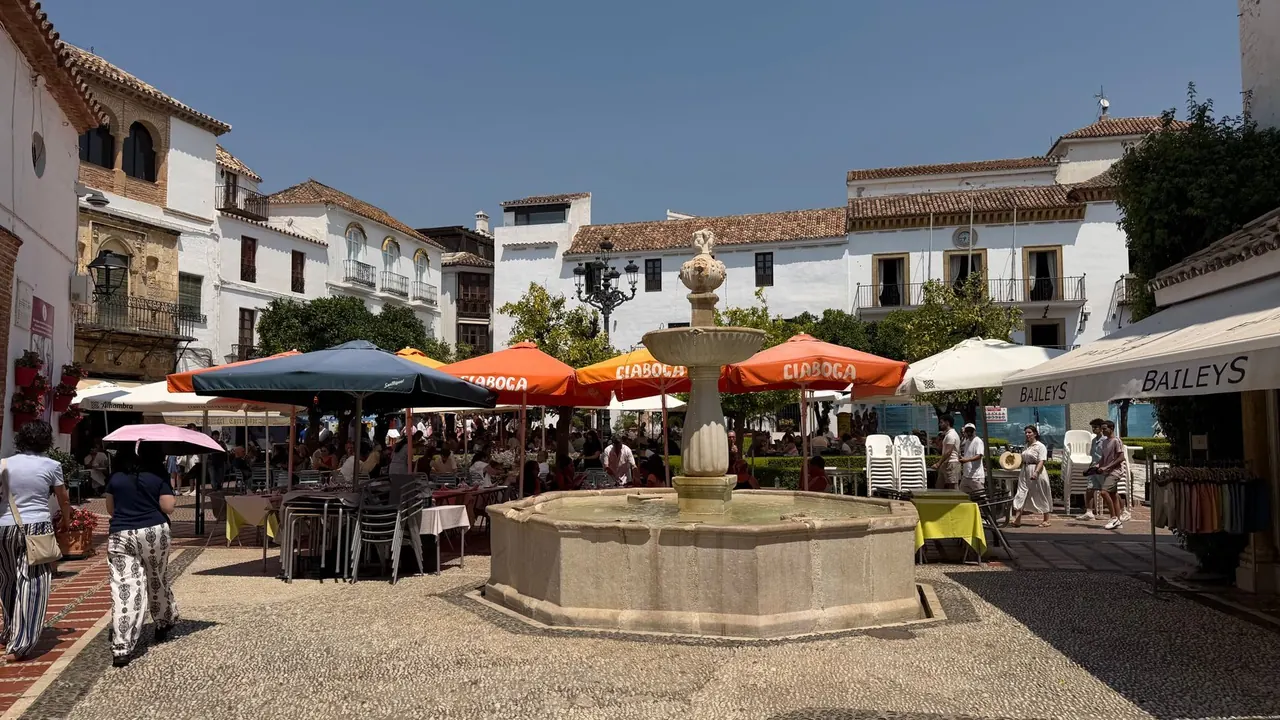
Photos: Albufeira by Jose A., CC BY 2.0, cropped; Marbella by Décio Franchini, Pexels License.
Albufeira or Marbella?
Our verdict in twelve categories, each scored against the same fixed benchmark cities, and the climate month by month, so you can choose for your trip.
Choose Albufeira for
- prices
- beaches
- families
Albufeira suits a straightforward beach vacation on a sensible budget. Its golden sand and sandstone coves start right below the old town, self-catering apartments keep costs down, and the cave boat trips and cliff walks are close by. It is also the place for a loud, cheerful group night out on the Strip, as long as you don't expect much culture or shopping.
Choose Marbella for
- shopping
- wellness
- day trips
Marbella is for travellers with more to spend and more they want to do away from the sand. Ronda, Málaga and the white villages put real Andalusian sightseeing within reach, and Puerto Banús has proper luxury shopping. The best of its food is genuinely accomplished, and the spa resorts on the Golden Mile make a restful off-season stay easy to arrange.
Scoreboard
Twelve categories on one fixed scale from 0 to 100. The shaded stretch is the gap between the two.
Your match
Pick a travel style or drag the sliders, and both match scores follow your weighting.
Wins on prices and beaches with your weighting.
Wins on shopping and wellness with your weighting.
What matters to you?
Category by category
What the scores mean for a trip.
Beaches & swimming
Albufeira has the more striking shoreline. Golden sand is broken by ochre cliffs, sea stacks and small coves, with Peneco and the fishermen's beach right under the old town and a long run of sand heading east to Falésia. Marbella's beaches are longer and more uniform, with fine greyish sand stretching some 27km from La Venus and El Fuerte to Puerto Banús and the dunes at Cabopino.
The beach day is different too. Marbella's shore is lined with beach clubs and chiringuitos grilling sardines, while Albufeira offers lifeguarded sand with sunbeds and quieter coves such as São Rafael to escape to. In both, the sea is on the cool side and good for swimming from June to early October.
Food & drink
Both towns have a divide between menus for passing visitors and honest coastal cooking, and both grill sardines well. Marbella goes much further at the top end, with acclaimed tasting-menu kitchens along the Golden Mile and around Puerto Banús. Add the tapas bars in the Casco Antiguo and behind the Alameda, and a food-minded traveller has far more to plan around.
Albufeira's best eating is simpler: cataplana, grilled bream and octopus in plain places near the fishermen's beach or in the villages inland, once you get away from the Strip's full breakfasts and curry houses. It is good for a long fish lunch but not for a trip built around food.
Culture & sights
Neither town is a cultural destination, but Marbella has more to see. There is the Plaza de los Naranjos with its 16th-century town hall, a respectable museum of Spanish prints, Dalí bronzes along the Avenida del Mar and a Roman villa with mosaics at Río Verde. Albufeira's old town, with fragments of Moorish wall and its clock tower crowned by an iron bell cage, makes a pleasant morning stroll and little more.
Nightlife
Both are big summer party towns that go quiet from November to March, but their crowds are very different. Albufeira's Strip in Montechoro means neon bars, karaoke, sports pubs and drinks offers for a young crowd that includes plenty of stag and hen groups. It is loud and unpretentious.
Marbella keeps Spanish hours and is built around money: champagne bars facing the yachts at Puerto Banús, and daytime beach clubs along the Golden Mile that turn into evening parties. For a quieter drink, both old towns have squares with terrace bars.
Nature & outdoors
The outdoors here differs in kind rather than quality. Albufeira's draw is its sea-carved limestone coast, with the Seven Hanging Valleys cliff walk and boat or kayak trips into the caves at Benagil.
Marbella has mountains as well. Sierra Blanca rises right behind the town, and the climb to La Concha is a hard half-day hike with views towards Morocco. The Sierra de las Nieves and the Caminito del Rey are both within driving distance. Choose Albufeira for the coastline and Marbella for real hill walking.
Day trips
Marbella has much the stronger list of day trips. Ronda's gorge, Málaga's Alcazaba and Picasso Museum, Gibraltar and the hilltop villages of Casares and Mijas are all within about an hour. The Alhambra in Granada is a long but realistic day.
Albufeira's day trips are to pleasant small towns: Moorish Silves with its red castle, Loulé and its market hall, walled Faro and Lagos. None of them is a major sight. From either base, a car makes these trips far easier.
Good for families
Both suit a family vacation built around the pool and the beach, and the difference lies in the layout. Albufeira has Zoomarine and several water parks close by, along with wide lifeguarded beaches such as Oura and Galé, but the steps of its old town are hard work with a pushchair.
Marbella's flat promenade is easy with buggies and scooters, and Spanish restaurants welcome children late into the evening. Its bigger attractions, though, such as the animal park in Estepona and the marine park at Benalmádena, are spread along the coast and need a car. Families in either town stay away from the late-night areas: the Strip in Albufeira and Puerto Banús in Marbella.
Getting around
The problem is much the same in both: a centre you can walk, then kilometres of hotel zones linked by slow buses. Albufeira's centre is steep, with a public lift and an escalator to help, and its railway station sits 6km inland. Marbella is flat along the promenade but has no railway at all, only coaches to Málaga, so a hire car is even more useful there.
Shopping & style
Marbella is much the stronger of the two for shopping. Puerto Banús has a dense row of international fashion and jewellery boutiques along the quay, with a large department store beside the port, and the lanes of the old town add linen, leather and ceramics.
Albufeira mostly sells beachwear, football shirts and souvenirs. Painted pottery, cork goods and medronho are the things worth taking home, and for anything else people drive to the mall at Guia or to the market in Loulé.
Affordability
Albufeira is the cheaper place to stay. Its countless restaurants and bars compete hard, and the large supply of self-catering apartments keeps everyday costs down, though sea-view rooms cost far more in July and August.
Marbella is expensive by Spanish standards, especially for beach clubs, prime sunbeds and dinner around Puerto Banús. Tapas bars in the old town and lower hotel rates outside summer help, and some visitors save by staying in a neighbouring town.
Live music & performing arts
A night of live music in Albufeira usually means a cover band or tribute act in a resort bar, or a fado dinner show put on for visitors. In summer you might also catch a free concert on the square by the fishermen's beach. It is entertainment you happen upon after dinner rather than something to book ahead, and anyone who wants to hear fado sung properly should save it for Lisbon.
Marbella gives a summer evening more to plan around. A big-name pop or rock concert in the old quarry amphitheatre makes a real night out. Beyond that, there is flamenco staged for visitors in the old town and Spanish-language plays at the small municipal theatre, so opera and serious flamenco mean the drive to Málaga.
Wellness & relaxation
Marbella is much the better choice for a restful stay, because pampering has been part of its appeal for decades. Albufeira has no spa tradition of its own. Wellness there means the big resort hotels' spas and a few massage studios, and for real thermal waters you go to the old spa village of Caldas de Monchique, an hour inland.
Marbella has far more choice, with large spa resorts, yoga retreats and detox clinics on the coast and in the hills, as well as a few Andalusian-style bathhouses with hot and cold pools. Both towns are calmest from October to May. In high summer, the cliff-top resorts around Galé and Falésia are the quieter base in Albufeira, and in Marbella it pays to stay well away from Puerto Banús.
When should you go?
Pick your month. The climate figures are measured averages, not a forecast.
Albufeira in July
Marbella in July
Daytime high, °C
Rainfall in the month, mm
Where the figures come from
Albufeira's temperatures are measured 26 km from the centre, at Faro / Aeroporto.
Albufeira has no rain gauge within 25 km of the centre, so its rainfall comes from a gridded climate dataset read at the city rather than from a gauge further away.
Marbella's temperatures are measured 40 km from the centre, at Malaga / Aeropuerto.
Marbella has no rain gauge within 25 km of the centre, so its rainfall comes from a gridded climate dataset read at the city rather than from a gauge further away.
Temperature and rainfall are climate normals, averaged over the years shown. Albufeira: 1991-2020 normals, Faro / Aeroporto (26.4 km from centre). Marbella: 1991-2020 normals, Malaga / Aeropuerto (39.7 km from centre).
The two follow the same pattern: almost no rain from June to August, swimming from June into early October, and wet, mild winters. The difference is one of degree. Marbella is hotter, with August afternoons around 32°C against 29°C in Albufeira, which makes midday sightseeing in Ronda or Málaga hard work. Its sea also warms a little more, to about 22°C. Albufeira gets slightly more sunshine through the year and is noticeably drier in winter.
Spring and autumn suit both for walking, with warm days that are rarely too hot. From October the rain sets in and peaks in December, when Marbella gets about 115mm. From then until spring, the beaches in both towns are for walks rather than swimming.
Which traveller are you?
On a trip on a tight budget, Albufeira makes the money go further. Meals out, a beer on a terrace and a kitchen of your own all come cheap, and the best days, on the sand or the clifftops, cost nothing. Marbella needs constant care to stay affordable.
For a shopping trip, Albufeira is good for a few gifts to take home and not much more. Marbella is the clear choice for anyone who wants to come home with designer clothes, jewellery or a new watch. A day of serious browsing there is easy to fill.
On a relaxing and wellness trip, Albufeira offers a quiet pool and the odd massage, which is enough for some travellers. Marbella makes it easy to plan a whole week of treatments, yoga and proper rest, especially outside the summer months.
Before you go
| Measure | Albufeira | Marbella |
|---|---|---|
| Official language | Portuguese | Spanish |
| Currency | Euro (EUR) | Euro (EUR) |
| Sockets | CF230 V, 50 Hz | CF230 V, 50 Hz |
| Driving side | Right | Right |
| Time zone | UTC, UTC+1 in summer | UTC+1, UTC+2 in summer |
| Emergency number | 112 | 112 |
| Elevation | 22 m | 22 m |
| Main airport | Faro - Gago Coutinho International Airport (FAO)26 km from centre91 non-stop destinations | Málaga-Costa del Sol Airport (AGP)39 km from centre165 non-stop destinations |
| Public holidays this year | 14 days | 12 days |
By the numbers
| Measure | Albufeira | Marbella |
|---|---|---|
| City population | 44,168 | 159,786 |
| People per km² | 314 | 1,398 |
| Museums within 10 km | 1 | 6 |
| UNESCO World Heritage sites within 50 km | 0 | 0 |
| Swim season, months above 21 °C | None | 3 months |
Where else could you go?
Every comparison below shares a destination with this one, so you can follow Albufeira or Marbella somewhere new.
- Farovs Albufeira
- Rondavs Marbella
- Lagos, Portugalvs Albufeira
- Malagavs Marbella
- Jerez de la Fronteravs Marbella
- Cadizvs Marbella