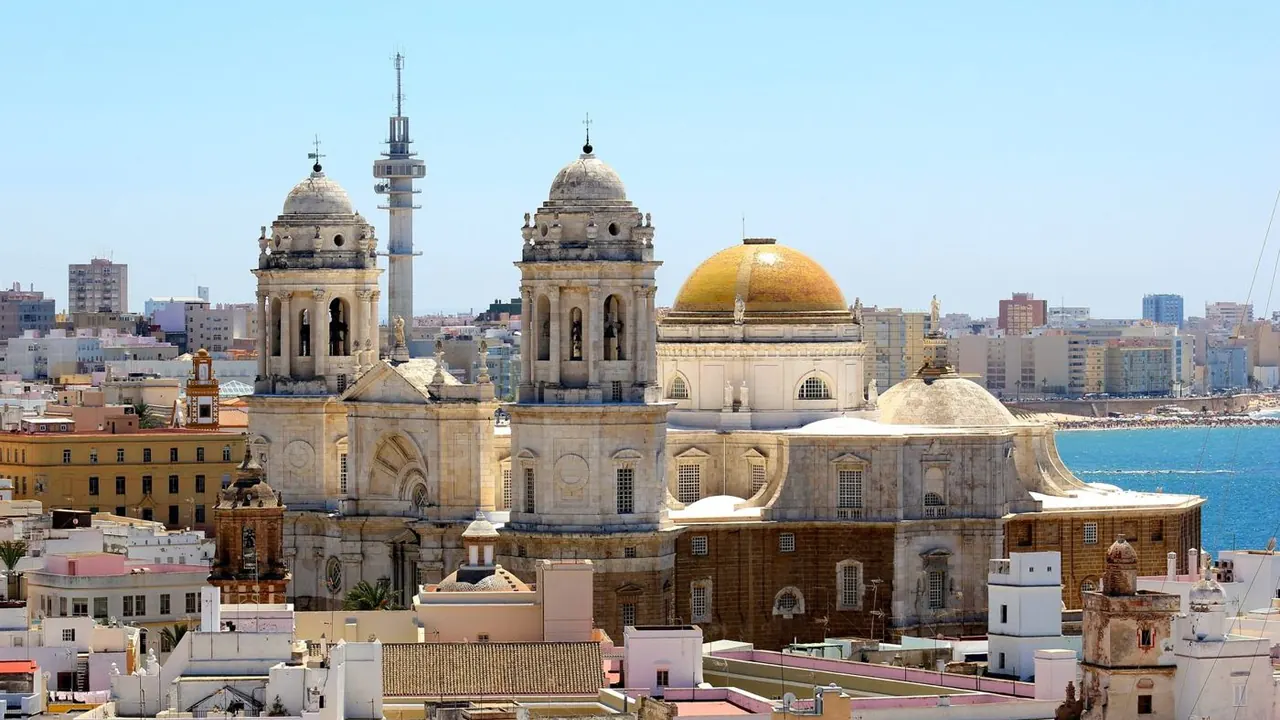

Photos: Cadiz by Bronch, CC BY-SA 3.0 ES, cropped; Marbella by Décio Franchini, Pexels License.
Cadiz or Marbella?
Our verdict in twelve categories, each scored against the same fixed benchmark cities, and the climate month by month, so you can choose for your trip.
Choose Cadiz for
- getting around
- culture and sights
- prices
Cadiz suits travellers who want a real city by the sea. The old town sits on a peninsula and you can walk all of it, with fried fish and sherry in the tapas bars of La Viña, flamenco in the peñas of Santa María and trains to Jerez and Seville. It costs less and is easier to get around without a car, and its beaches are as good as any on this coast.
Choose Marbella for
- shopping
- nightlife
- families
Marbella is the better pick for a resort-style stay with money to spend. It has beach clubs, late nights at Puerto Banús, designer boutiques, spa hotels and a mountain rising straight behind the town. Families with a hire car will find more to fill the days along the coast, but expect to drive everywhere and to pay more for most things.
Scoreboard
Twelve categories on one fixed scale from 0 to 100. The shaded stretch is the gap between the two.
Your match
Pick a travel style or drag the sliders, and both match scores follow your weighting.
Wins on getting around and culture and sights with your weighting.
Wins on shopping and nightlife with your weighting.
What matters to you?
Category by category
What the scores mean for a trip.
Beaches & swimming
The two are close on beaches but feel different. Cadiz has the Atlantic on every side: a sheltered cove between castles in the old town, the long golden sweep of Playa Victoria, and the wild, empty strands of the Costa de la Luz within an hour's drive. The levante wind can blow sand across them for days at a time.
Marbella's 27km of shore is more organised, with greyish sand, calm water, sunbeds, beach clubs and chiringuitos grilling sardines. Go to Cadiz for open, natural beaches and to Marbella for beaches with every service laid on.
Food & drink
Cadiz eats better day to day. Almadraba tuna, cones of fried fish, shrimp fritters and cold manzanilla are found all over the old town, and it is hard to eat badly there.
Marbella has a wider range but less consistency. A tier of tasting-menu kitchens and international restaurants serves the Golden Mile, but many places near the port serve tired menus to passing visitors, so the good tapas take some looking for in the Casco Antiguo.
Culture & sights
Cadiz has far more to see. It claims three thousand years of history, from Phoenician sarcophagi in the Museo de Cádiz to the Roman theatre in El Pópulo, along with watchtowered merchant houses, the gold-domed cathedral and the camera obscura in the Torre Tavira. That fills two or three good days.
Marbella's heritage is a pretty whitewashed quarter around the Plaza de los Naranjos, a prints museum and a Roman villa outside town, which together take about an afternoon.
Nightlife
Marbella is the place to go out. In summer, beach clubs with DJs carry on into evening parties, and Puerto Banús fills with a moneyed crowd at champagne bars and clubs until dawn. The scene is polished and expensive, and it largely shuts down from November to March.
Nights in Cadiz are about late tapas and drinks on the squares and the Playa Victoria promenade, with only a small club scene. The exception is Carnival in February, when the whole city parties through the night for ten days.
Nature & outdoors
Both have a lot to offer outdoors, but different landscapes. Cadiz is flat and watery. Flamingos and spoonbills live in the salt marshes of the bay, Tarifa's kitesurfing and whale-watching are about an hour and a quarter away, and the Sierra de Grazalema and Doñana are further out.
In Marbella the mountains start at the edge of town. You can climb La Concha with views to Morocco, walk among the fir forests of the Sierra de las Nieves or try the Caminito del Rey, though the coast itself is heavily built up.
Day trips
Both make excellent bases, and the difference is mainly in how you travel. From Cadiz the train runs to the sherry bodegas of Jerez and on to Seville, and a ferry crosses to El Puerto de Santa María. The white towns and Baelo Claudia need a car.
From Marbella almost everything means driving: Ronda over its gorge, Málaga's Picasso Museum, Gibraltar, and a long day to the Alhambra in Granada.
Good for families
Marbella offers families more. The sheltered town beaches and long flat promenade are easy with buggies, many complexes are built around pools, and there is a safari park, a zoo, water parks and an aquarium along the coast, all easy to reach by car.
Cadiz has the wide, lifeguarded Playa Victoria, the calm water at La Caleta and a flat old town with shady parks. Beyond that there is little made for children, so older ones will be climbing castle walls rather than going on rides.
Getting around
Cadiz is much easier without a car. The old town is flat, mostly free of traffic and small enough to walk from shore to shore, buses run the length of the isthmus to the beach, and trains and the bay catamaran leave from the centre.
Marbella stretches along a motorway from San Pedro to Cabopino, with no train and slow buses. Most visitors end up hiring a car or using taxis between their hotel, the port and the old town.
Shopping & style
Marbella is far better for shopping, especially at the top end. Puerto Banús has a strip of designer fashion and jewellery shops, with large malls nearby, and the old town adds linen, leather and ceramics.
Cadiz has nothing like that. Calle Ancha and the streets around Plaza de las Flores hold chains and family-run shops, and the best things to bring home are a hand-painted fan or a bottle of fino from the market area.
Affordability
Cadiz is clearly the cheaper stay. Fried fish, sherry, trains and sights all cost little, and the main expense is the old town's small supply of hotel rooms in summer and Carnival week.
In Marbella, high summer pushes hotel and villa rates up steeply, and sunbeds and dinners around the port add up quickly. Its old-town tapas bars charge normal Andalusian prices, and many visitors save by staying in a neighbouring town.
Live music & performing arts
Live performance in Cadiz comes out of the city itself. Alegrías, one of flamenco's brightest forms, were born here, and each February the Gran Teatro Falla judges the satirical Carnival choirs, whose songs mock politicians and neighbours alike. The theatre stays busy with plays the rest of the year, but for opera or a symphony orchestra you need Seville.
In Marbella most of the stage arrives with summer and is brought in from elsewhere. Big international pop and rock names play an open-air amphitheatre set in an old quarry, while the flamenco in old-town restaurants is put on for visitors rather than drawn from a local tradition. For classical music or deeper flamenco, people drive to Málaga.
Wellness & relaxation
Marbella is better set up for a restful stay. Spa resorts, yoga retreats and detox clinics line the Golden Mile and the hills behind it, and from October to May the town is mild and calm. High summer is a different place, crowded and loud.
Cadiz has no spa scene of its own. Resort spas are a drive away at Novo Sancti Petri, and there are Arab-style baths in Jerez. What Cadiz offers instead is its pace: siestas, long lunches and sunset walks on the sea walls.
When should you go?
Pick your month. The climate figures are measured averages, not a forecast.
Cadiz in July
Marbella in July
Daytime high, °C
Rainfall in the month, mm
Where the figures come from
Marbella's temperatures are measured 40 km from the centre, at Malaga / Aeropuerto.
Marbella has no rain gauge within 25 km of the centre, so its rainfall comes from a gridded climate dataset read at the city rather than from a gauge further away.
Temperature and rainfall are climate normals, averaged over the years shown. Cadiz: 1991-2020 normals, Cadiz Bay / Puntales (5.2 km from centre). Marbella: 1991-2020 normals, Malaga / Aeropuerto (39.7 km from centre).
Both cities have long, almost rainless summers, and the beach season runs from June to early October in each. Cadiz stays the more comfortable of the two in high summer. Its daytime highs peak around 28°C and the Atlantic warms to 23°C, so walking the old town at midday is still fine. Marbella gets hotter, around 32°C in August, which makes the middle of the day better spent by the water. Its sea stays a degree or so cooler.
The wet season starts in October in both. Cadiz gets its heaviest rain in November, while Marbella's wettest month is December at about 115mm. Spring and early autumn are the best times for sightseeing in either city: warm, very sunny and drier than winter. Marbella's winters are a little milder, which suits its hiking.
Which traveller are you?
On a culture and arts trip, choose Cadiz. It has a Phoenician and Roman past, a cathedral facing the sea, the 1812 constitution and flamenco kept alive in members' clubs. Marbella's old town, with its prints museum and Dalí sculptures, takes about an afternoon.
For a trip on a tight budget, Cadiz is the clear choice. Freidurías, market counters and tapas bars feed you well for little, and you can walk the compact centre or take cheap trains. In Marbella, rooms, sunbeds and port dining all cost far more.
On a shopping trip, Marbella wins. Puerto Banús has international fashion and jewellery boutiques facing the yachts, plus a department store and malls nearby. Shopping in Cadiz means high-street chains, family shops, fans and sherry, and anything more serious means going to Seville.
Before you go
| Measure | Cadiz | Marbella |
|---|---|---|
| Official language | Spanish | Spanish |
| Currency | Euro (EUR) | Euro (EUR) |
| Sockets | CF230 V, 50 Hz | CF230 V, 50 Hz |
| Driving side | Right | Right |
| Time zone | UTC+1, UTC+2 in summer | UTC+1, UTC+2 in summer |
| Emergency number | 112 | 112 |
| Elevation | 11 m | 22 m |
| Main airport | Jerez Airport (XRY)31 km from centre25 non-stop destinations | Málaga-Costa del Sol Airport (AGP)39 km from centre166 non-stop destinations |
| Public holidays this year | 12 days | 12 days |
By the numbers
| Measure | Cadiz | Marbella |
|---|---|---|
| City population | 109,950 | 159,786 |
| People per km² | 9,087 | 1,398 |
| Museums within 10 km | 11 | 6 |
| UNESCO World Heritage sites within 50 km | 0 | 0 |
| Swim season, months above 21 °C | 3 months | 3 months |
Where else could you go?
Every comparison below shares a destination with this one, so you can follow Cadiz or Marbella somewhere new.