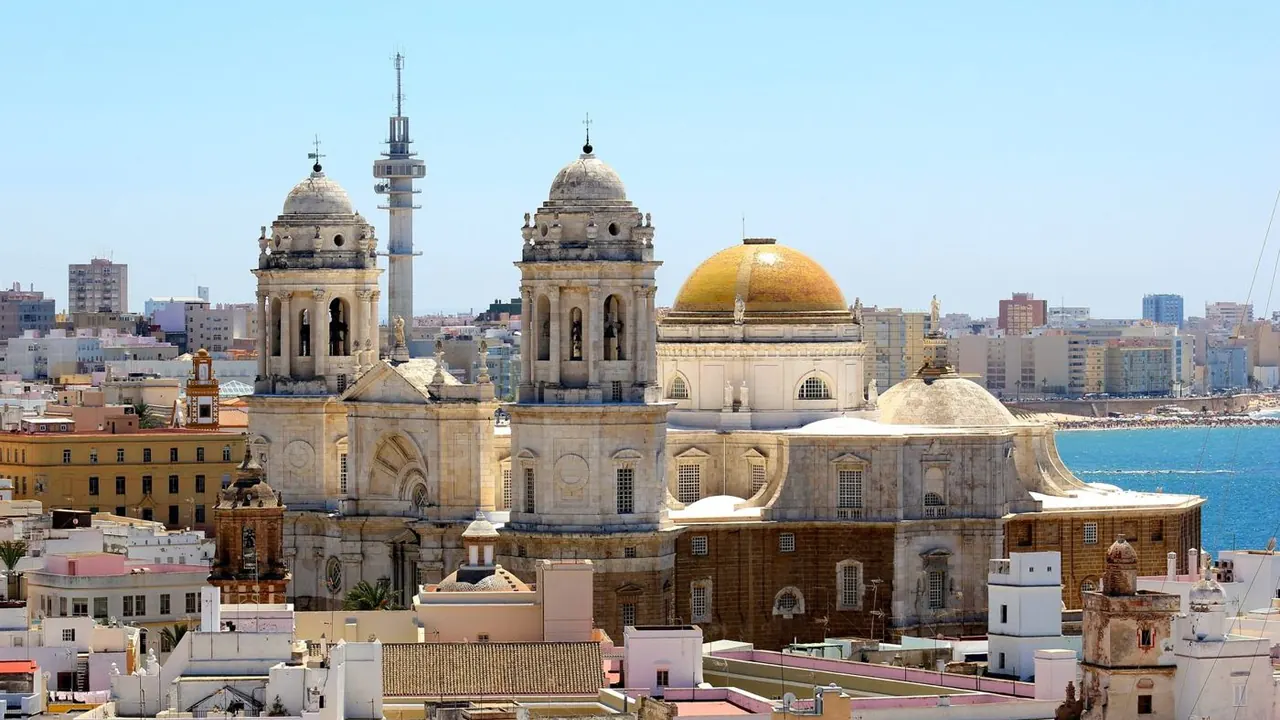

Photos: Cadiz by Bronch, CC BY-SA 3.0 ES, cropped; Jerez de la Frontera by PEPE GADEIRAS, CC BY 4.0, cropped.
Cadiz or Jerez de la Frontera?
Our verdict in twelve categories, each scored against the same fixed benchmark cities, and the climate month by month, so you can choose for your trip.
Choose Cadiz for
- beaches
- families
- getting around
Cadiz suits travellers who want the sea to be part of every day. Its pale old town sits on a peninsula with La Caleta at one end and the long sands of Playa Victoria a short ride away, so swimming, fried fish and evening walks along the walls all fit easily into one day. It is the better choice for a summer beach stay, for families, and for anyone who wants a car-free place to walk.
Choose Jerez de la Frontera for
- live music and the arts
- prices
Jerez is the pick for those who come for sherry, flamenco and horses rather than sand. Bodegas, tabancos and peñas in the old gypsy quarters give it a depth Cadiz cannot match on stage, and rooms cost less. It is best in spring and autumn, with the coast kept for day trips.
Scoreboard
Twelve categories on one fixed scale from 0 to 100. The shaded stretch is the gap between the two.
Your match
Pick a travel style or drag the sliders, and both match scores follow your weighting.
Wins on beaches and families with your weighting.
Wins on live music and the arts and prices with your weighting.
What matters to you?
Category by category
What the scores mean for a trip.
Beaches & swimming
Cadiz is the beach city of the two. La Caleta, the cove between the castles, and the wide golden sands of Playa Victoria are a walk or a short bus ride from almost any room. A swim fits around everything else you do in the day.
Jerez lies about 12km inland, so the sea is always an outing. You take the train to Cadiz or El Puerto, or drive to Sanlúcar, Chipiona or La Barrosa. The water and the levante are the same in both, but from Jerez you have to plan a beach day rather than simply walk to the sand.
Food & drink
The two eat equally well, but the focus is different. Cadiz is about fish: paper cones from the freidurías, tortillitas de camarones, marinated dogfish, and almadraba bluefin tuna in the bars of La Viña, with cold manzanilla to drink.
In Jerez, sherry comes first. It is poured from the barrel in plain tabancos with chacina and cheese, and it goes into the cooking too, in kidneys, oxtail and the hearty berza stew. Neither city offers much range, so choose by whether you would rather eat seafood or drink sherry.
Culture & sights
Cadiz has a slight edge here because of its long history. It was founded by the Phoenicians, whose marble sarcophagi are in the Museo de Cádiz. It also has a Roman theatre, the watchtowers of the merchants who ran the trade with the Americas, and the oratory where the 1812 constitution was signed.
What Jerez offers is more unusual: an Almohad Alcázar with its Arab baths, sherry bodegas that feel like cathedrals, and the royal equestrian school's dressage shows. Each city needs two or three days.
Nightlife
Neither city has a big club scene, but Cadiz is the livelier of the two. In summer the bars and terraces along the Playa Victoria promenade stay open into the early hours. In February, Carnival turns the whole peninsula into a street party that runs through the night for ten days.
Nights in Jerez are more provincial: tabancos and copa bars around Plaza del Arenal, with a few late music bars. The one week that rivals Carnival is the Feria del Caballo in May. In summer, people from Jerez often head down to El Puerto for nights by the sea.
Nature & outdoors
There is little to choose between them, and they share many of the same places, including Grazalema, Doñana, the bay's salt marshes and the kitesurfing coast towards Tarifa. From Cadiz, the outdoors means water: kayaking through the tidal channels on the city's edge, the pine-topped cliffs of La Breña, and whale-watching boats from Tarifa.
Jerez is surrounded by chalky white vineyards that are good for cycling. It is a little closer to the Grazalema trails and the cork-oak forests of Los Alcornocales, and riding is easy to arrange in this horse country. Inland summer heat pushes walking to spring and autumn.
Day trips
Both are excellent bases, only half an hour apart by train, so the real difference is which direction you plan to explore. Cadiz is better placed for the southern coast. Vejer, the Roman ruins of Baelo Claudia at Bolonia, and Tarifa are all within easy reach, and the ferry to El Puerto is a pleasant way to travel.
Jerez gets you to Seville in about an hour and to Arcos in about half an hour. From there, the road continues to Grazalema and Ronda.
Good for families
Cadiz is easier with children because the beach is part of the town. Playa Victoria has lifeguards and plenty of space, La Caleta is sheltered for small swimmers, and the Alameda and Genovés parks give shade in the flat old town.
Jerez has the stronger attractions for a day out: one of Spain's better zoos and botanical gardens, and the dancing horses at the equestrian school. But the sand is a trip away, and the town is very hot in July and August.
Getting around
Cadiz is the easier city to move around. The old town is mostly closed to traffic and you can walk across it from shore to shore. Buses run down the isthmus to the beach, the seafront is good for cycling, and a catamaran crosses the bay.
The centre of Jerez is also flat and compact. Its station is close to the centre and the airport is only minutes away by train, which makes arriving simple. From either city you will need a hire car to reach the white towns and the quieter beaches.
Shopping & style
Both cities are modest for shopping, and serious shoppers go to Seville. In Cadiz, the pleasure is browsing the Mercado Central and the flower stalls. Painted fans and ceramics make the best souvenirs.
Jerez sells what reflects its own trades: brandy and sherry straight from the bodegas, and saddlery and leather riding boots made for the horse world. Flamenco dresses and guitars are sold near the old quarters.
Affordability
Eating and drinking are cheap in both, so the difference lies in where you sleep. Jerez has moderately priced mid-range hotels within walking distance of everything. Rooms only become scarce during the Feria, the winter flamenco festival and the motorcycle race weekends.
Cadiz has few hotels in its old town, and they fill up and cost more in July, August and Carnival week. Staying near Playa Victoria, or coming in spring or autumn, helps keep costs down.
Live music & performing arts
Flamenco runs deeper in Jerez. The bulería belongs to the town, and peñas in Santiago and San Miguel hold regular evenings for visitors. Some tabancos have rough, close-up sessions. The late-winter festival brings major dancers to the Teatro Villamarta, which also stages opera and zarzuela.
Cadiz has its own form, the alegrías, heard in the peñas of Santa María. It also has something Jerez lacks: the satirical Carnival choirs at the Gran Teatro Falla, which hosts an autumn festival of Ibero-American theatre too.
Wellness & relaxation
Neither city has a spa culture, and both are best for simply slowing down. Jerez has the advantage of an Arab-style bathhouse in its old town, which visitors from Cadiz travel to. Its shaded patios make for calm afternoons.
From Cadiz, the larger resort spas with sea-water treatments are a short drive away at Novo Sancti Petri. The best way to unwind in the city itself is a walk on the sea walls and the sunset over La Caleta.
When should you go?
Pick your month. The climate figures are measured averages, not a forecast.
Cadiz in July
Jerez de la Frontera in July
Daytime high, °C
Rainfall in the month, mm
Temperature and rainfall are climate normals, averaged over the years shown. Cadiz: 1991-2020 (sunshine 1961-1990) normals, Cadiz Bay / Puntales (5.2 km from centre). Jerez de la Frontera: 1991-2020 normals, Jerez De La Fronteraaeropuerto (9.9 km from centre).
Summer is when the two differ most. Sea breezes hold Cadiz to about 28°C in July and August, with almost no rain, long sunny days and the Atlantic at its warmest, around 23°C, so this is the time for the beach. The water stays warm enough to swim from June into early October. Jerez lies inland and reaches about 34°C, too hot for walking the streets in the middle of the day. It gets the same sunshine but none of the sea breeze.
Spring suits Jerez best. April and May are warm without being fierce and still fairly dry, so this is the time for the Alcázar, the bodegas and the old quarters on foot. Late September is the other good window, once the worst of the heat has gone. In both cities the rains set in during October and last through December, with up to about 85mm a month. Winters stay mild at around 17°C, so either city is easy to explore on foot between showers, though Cadiz is too cool for swimming then.
Which traveller are you?
For a beach and sun trip, Cadiz is the clear choice. You can swim at La Caleta before lunch and spend the afternoon on Playa Victoria without needing transport. From Jerez, every beach day means a train ride or a drive to the coast.
On a family trip with children, Cadiz also works better. The sandy beaches have lifeguards, the old town is flat and mostly free of cars, and the parks have shade. Jerez has a good zoo and the dancing horses, but the town gets very hot in summer.
On a trip with a tight budget, Jerez goes further. Tapas and sherry are cheap in both cities, but central rooms in Jerez are moderately priced. In Cadiz, the few hotels in the old town fill up and cost more in summer.
Before you go
| Measure | Cadiz | Jerez de la Frontera |
|---|---|---|
| Official language | Spanish | Spanish |
| Currency | Euro (EUR) | Euro (EUR) |
| Sockets | CF230 V, 50 Hz | CF230 V, 50 Hz |
| Driving side | Right | Right |
| Time zone | UTC+1, UTC+2 in summer | UTC+1, UTC+2 in summer |
| Emergency number | 112 | 112 |
| Elevation | 11 m | 58 m |
| Main airport | Jerez Airport (XRY)31 km from centre26 non-stop destinations | Jerez Airport (XRY)10 km from centre26 non-stop destinations |
| Public holidays this year | 12 days | 12 days |
By the numbers
| Measure | Cadiz | Jerez de la Frontera |
|---|---|---|
| City population | 109,950 | 213,634 |
| People per km² | 9,087 | 180 |
| Museums within 10 km | 12 | 14 |
| UNESCO World Heritage sites within 50 km | 0 | 1 |
| Swim season, months above 21 °C | 3 months | 3 months |
Where else could you go?
Every comparison below shares a destination with this one, so you can follow Cadiz or Jerez de la Frontera somewhere new.
- Sevillevs Jerez de la Frontera
- Rondavs Jerez de la Frontera
- Sevillevs Cadiz
- Rondavs Cadiz
- Marbellavs Jerez de la Frontera
- Marbellavs Cadiz