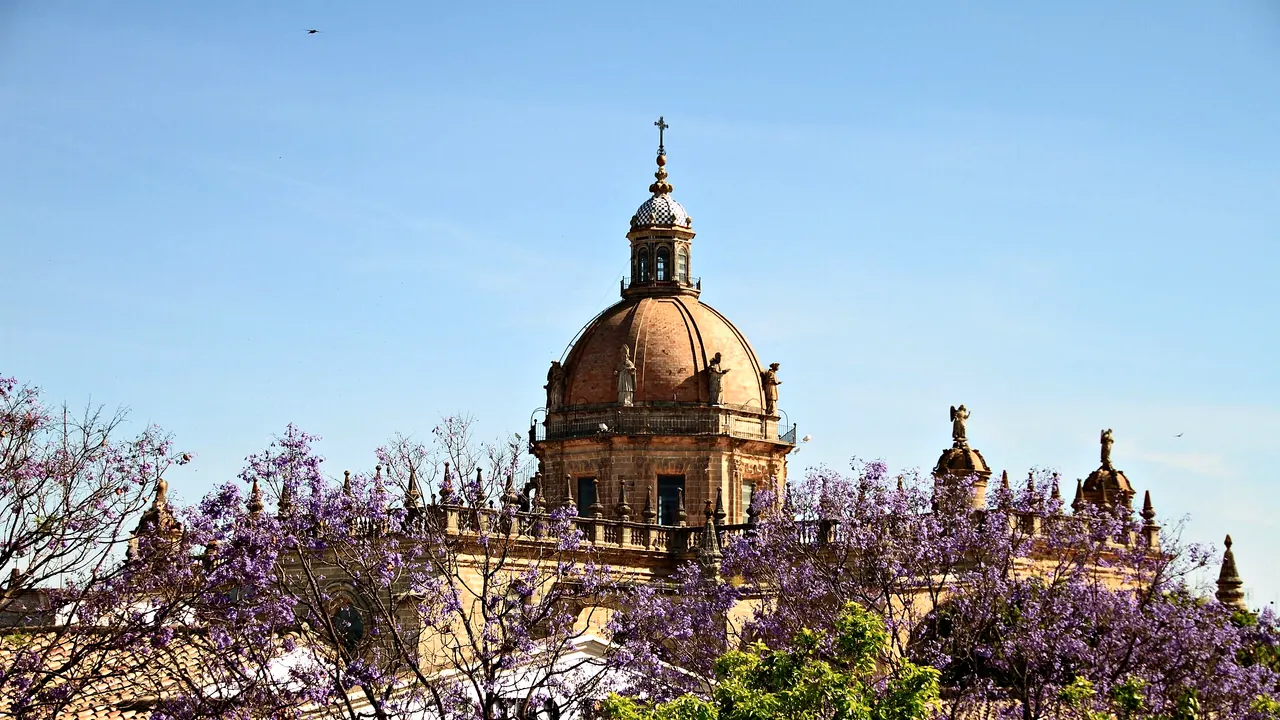
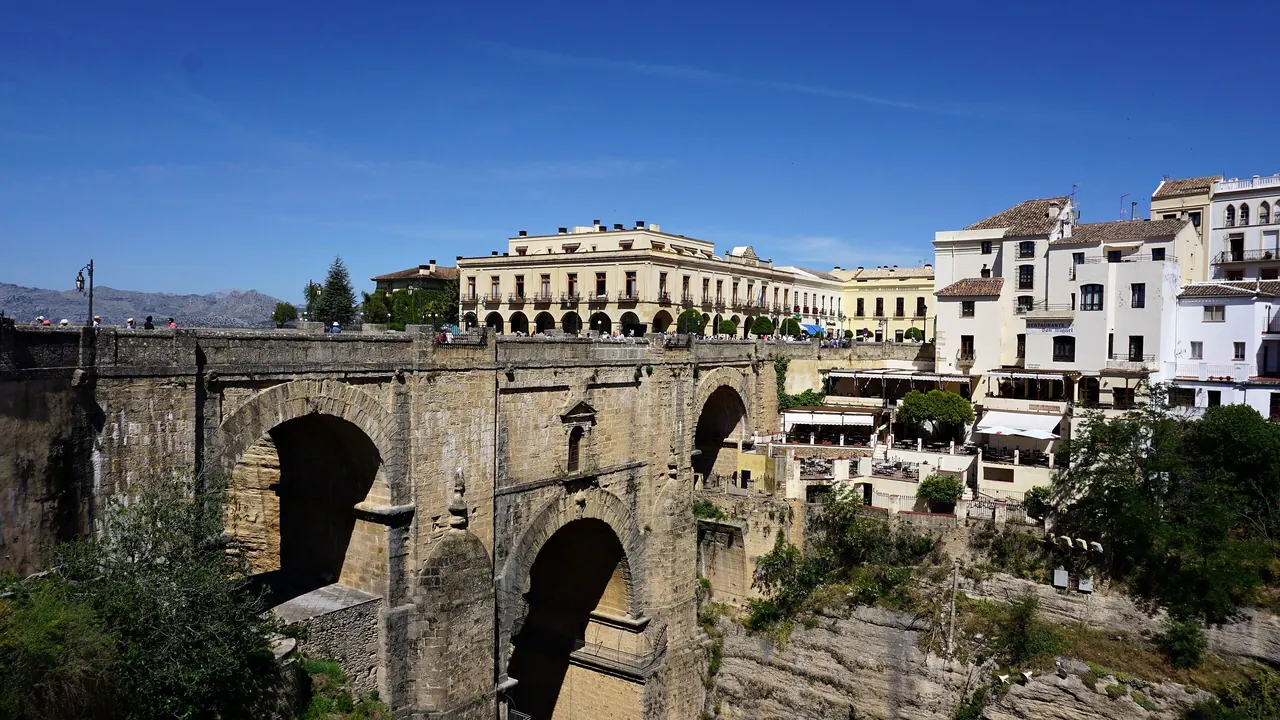
Photos: Jerez de la Frontera by PEPE GADEIRAS, CC BY 4.0, cropped; Ronda by Julia Kostecka, CC BY 2.0, cropped.
Jerez de la Frontera or Ronda?
Our verdict in twelve categories, each scored against the same fixed benchmark cities, and the climate month by month, so you can choose for your trip.
Choose Jerez de la Frontera for
- live music and the arts
- beaches
- food and drink
Jerez suits travellers who want an Andalusian town with plenty going on after dark and the coast close at hand. You get sherry in the bodegas and tabancos, flamenco in the peñas of Santiago and San Miguel, and Atlantic beaches a short train ride away. Seville and Cádiz are easy day trips without a car. It is also the better choice for families and for anyone who wants to travel by train.
Choose Ronda for
- nature and the outdoors
- culture and sights
Ronda is for people who come for the landscape. The town on its gorge is a striking sight in its own right, and the Sierra de Grazalema, the Sierra de las Nieves and the white villages are all close by, so walkers, climbers and people touring by car get more out of it. Evenings are quiet and the sea is a long, winding drive away. It works best as a slow stay in a country house, with a hired car.
Scoreboard
Twelve categories on one fixed scale from 0 to 100. The shaded stretch is the gap between the two.
Your match
Pick a travel style or drag the sliders, and both match scores follow your weighting.
Wins on live music and the arts and beaches with your weighting.
Wins on nature and the outdoors and culture and sights with your weighting.
What matters to you?
Category by category
What the scores mean for a trip.
Beaches & swimming
Neither town has a beach of its own, but Jerez is much better placed for one. Valdelagrana, El Puerto and the Playa de la Victoria in Cádiz are a short train ride away, and the wide Atlantic beaches at Sanlúcar and La Barrosa are within the hour. A day at the beach fits easily into a city stay.
From Ronda, the nearest sea is the built-up Mediterranean coast around Estepona and San Pedro. It is about 50km away, down a road full of hairpin bends. Without a car you cannot really get there, and even with one it takes a whole day, so most visitors use a pool instead.
Food & drink
Jerez is the better place to eat, and sherry is at the centre of it. You can taste in the bodegas, drink fino from the barrel in the tabancos, and eat kidneys and oxtail cooked in sherry or fried fish and prawns from the nearby coast. The tapas streets around Plaza del Arenal and Calle Larga give you plenty to choose from in the evening.
Ronda's mountain cooking is heartier but has less range: game, lamb, cured hams, and chestnuts and mushrooms in autumn, with local Sierras de Málaga wine. Eat in the tapas bars of the Mercadillo rather than on the view terraces by the gorge. A few days covers it.
Culture & sights
The two are about level on heritage, and a couple of days covers either, but the sights are of a different kind. In Ronda the setting is the main attraction: the Puente Nuevo across El Tajo, the cliff-top paths, and a compact group of sights including the Maestranza bullring and some of the best-preserved Arab baths in Spain.
In Jerez the interest is more in traditions that are still alive, spread across a flat old centre. There is the Almohad Alcázar and the Gothic-Mudéjar parish churches, the flamenco quarters of Santiago and San Miguel, the cathedral-like sherry bodegas and the dressage horses of the Royal Andalusian School.
Nightlife
Neither is a town for clubbing, but Jerez gives you a fuller evening. Tabancos, copa bars and the terraces around Plaza del Arenal stay busy well past midnight at weekends, a few clubs stay open later, and for a week in May the Feria del Caballo fills the fairground with dancing until dawn. Ronda winds down earlier, with dinner and a drink around Plaza del Socorro and then quiet streets, except during the September fair.
Nature & outdoors
Ronda is the better base for the outdoors, because the mountains start at the edge of town. A path drops to the foot of the Tajo and climbers use its cliffs. The Sierra de Grazalema, with the Garganta Verde, lies to the west, and the Spanish fir forests of the Sierra de las Nieves lie to the east. The Caminito del Rey is about an hour away.
From Jerez, the same Grazalema range is more than an hour's drive, and the land around town is gentle vineyard country. Its own strengths are on the lowlands and the coast: boats to Doñana from Sanlúcar, birdwatching in the salt marshes of the Bay of Cádiz, kitesurfing towards Tarifa and horse riding.
Day trips
Both make good bases, but the trips point in different directions. Jerez has the edge because of the trains. Seville is about an hour away, Cádiz half an hour, and the sherry towns of El Puerto and Sanlúcar are close, all without a car. Arcos is half an hour away by road.
Ronda sits among the white villages. Setenil is about twenty minutes away, Zahara and Grazalema are within the hour, and the Roman ruins of Acinipo and the cave paintings of the Cueva de la Pileta are close. The big cities are one and a half to two hours away, and you really need a hired car for the villages.
Good for families
Jerez is easier with children. It has one of the better zoos and botanical gardens in Spain, the dancing-horse show and a flat centre, and in summer the wide, gently sloping Atlantic beaches are easy to reach.
Older children in Ronda will enjoy the bridge, the walk into the gorge, the stairway cut through the rock at the Casa del Rey Moro and the nearby caves. Nothing there is built for children, though, and the steep cobbled lanes are hard work with a pushchair. Families usually stay in a country house with a pool.
Getting around
Both centres are easy to walk, but Jerez is flat and Ronda is not: the lanes down into La Ciudad and towards the gorge are steep. Jerez also has better connections, with direct trains to Seville, El Puerto and Cádiz and the airport a few minutes away by rail, while Ronda's trains and buses are slow and infrequent. In both towns you need a car to reach the white towns and the sierras, and parking in Ronda's old town is tight.
Shopping & style
Nobody goes to either town to shop, but Jerez has more worth buying. Beyond the chains on Calle Larga, there are saddlers and makers of leather riding boots who serve the horse world, shops selling flamenco dresses, shawls and guitars, and sherry and brandy straight from the bodegas. Ronda's Carrera Espinel and the souvenir streets near the bridge have less to offer, and the best things to take home are wine, cured meats, olive oil and convent sweets.
Affordability
Costs are much the same in both, and both are cheaper than the big Spanish cities or the coast. In Jerez, sherry in the tabancos and the bodega tours cost little, but rooms are scarce and expensive during the Feria, the flamenco festival and the motorcycle race weekends. In Ronda, the extra costs are the hotels with gorge views and the hired car most visitors need, while the rural houses in the hills are fairly priced for what they offer.
Live music & performing arts
This is the widest gap between the two towns. Jerez is one of the places where flamenco was born, and it is still a local art there. You can hear it in the peñas of Santiago and San Miguel and in informal sessions in the tabancos, as well as at the more polished tablaos. The flamenco festival in late winter brings major dancers to the Teatro Villamarta and students from around the world, and the theatre also runs a modest season of opera, zarzuela and dance.
Ronda offers small flamenco shows for visitors and an occasional programme at its municipal theatre. Its one big event is the Corrida Goyesca at the September fair, a bullfight in eighteenth-century costume.
Wellness & relaxation
Neither town has a bathing culture of its own, but Jerez has a small advantage: an Arab-style bathhouse with warm pools and massage. Ronda's Arab baths are a monument to visit, not a place to bathe. What both offer is a slow pace, which in Jerez means long lunches and shaded patios, while in Ronda the best rest is in a farmhouse hotel in the hills, with a pool and olive groves.
When should you go?
Pick your month. The climate figures are measured averages, not a forecast.
Jerez de la Frontera in July
Ronda in July
Daytime high, °C
Rainfall in the month, mm
Where the figures come from
Ronda has no weather station within reach, so its figures come from a gridded climate model rather than a measured record, and read a broad area rather than the city itself.
Temperature and rainfall are climate normals, averaged over the years shown. Jerez de la Frontera: 1991-2020 normals, Jerez De La Fronteraaeropuerto (9.9 km from centre). Ronda: 1991-2020 normals, TerraClimate 4 km grid at the town, no weather station within 90 km.
Both towns are dry and hot from June to August, but Jerez is a few degrees warmer all year. In summer it reaches 34°C in the afternoon, so July and August are better for the beach and late evenings than for walking the streets. The Atlantic warms to about 23°C and the days are long and sunny. May, late September and early October are the comfortable months for sightseeing. The rain sets in from October and lasts through the winter, when days stay mild at around 17°C.
Ronda stands higher and is cooler and wetter. Summer afternoons are still hot, but spring and autumn are its walking seasons, and April, May and late September are the best of them. Winter brings highs of about 13°C, cold nights and heavy rain. December is the wettest month at around 120mm, and March is wet too. The coast below the town is only warm enough for a swim from July to September.
Which traveller are you?
On a beach and sun trip, Jerez is the clear choice. Trains reach the sandy Atlantic beaches at Cádiz and El Puerto in well under an hour, and summers are hotter and sunnier. Ronda's coast lies at the end of a long road full of hairpin bends.
For a food and nightlife trip, choose Jerez. Sherry tastings in the bodegas, fino from the barrel in the tabancos, late tapas around Plaza del Arenal, flamenco in the peñas and the week-long May feria give you far more than Ronda's quiet mountain evenings.
On an outdoors trip, Ronda wins. You can walk from town down into the Tajo gorge or climb its cliffs. The Sierra de Grazalema, the Sierra de las Nieves and the Caminito del Rey are all close, without the long drives you would need from Jerez.
Before you go
| Measure | Jerez de la Frontera | Ronda |
|---|---|---|
| Official language | Spanish | Spanish |
| Currency | Euro (EUR) | Euro (EUR) |
| Sockets | CF230 V, 50 Hz | CF230 V, 50 Hz |
| Driving side | Right | Right |
| Time zone | UTC+1, UTC+2 in summer | UTC+1, UTC+2 in summer |
| Emergency number | 112 | 112 |
| Elevation | 58 m | 724 m |
| Main airport | Jerez Airport (XRY)10 km from centre26 non-stop destinations | Málaga-Costa del Sol Airport (AGP)60 km from centre165 non-stop destinations |
| Public holidays this year | 12 days | 12 days |
By the numbers
| Measure | Jerez de la Frontera | Ronda |
|---|---|---|
| City population | 213,634 | 33,671 |
| People per km² | 180 | 87 |
| Museums within 10 km | 14 | 5 |
| UNESCO World Heritage sites within 50 km | 1 | 0 |
| Swim season, months above 21 °C | 3 months | 1 month |
Where else could you go?
Every comparison below shares a destination with this one, so you can follow Jerez de la Frontera or Ronda somewhere new.
- Cadizvs Jerez de la Frontera
- Marbellavs Ronda
- Malagavs Ronda
- Sevillevs Jerez de la Frontera
- Sevillevs Ronda
- Cadizvs Ronda