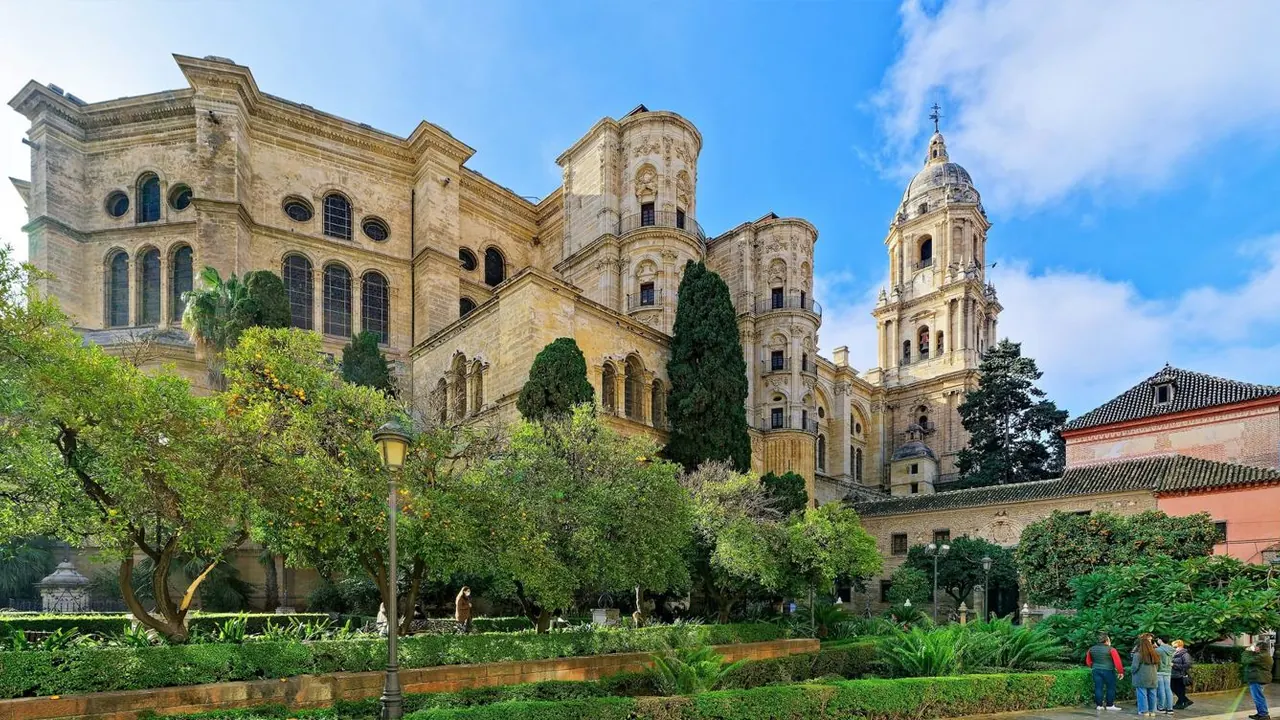
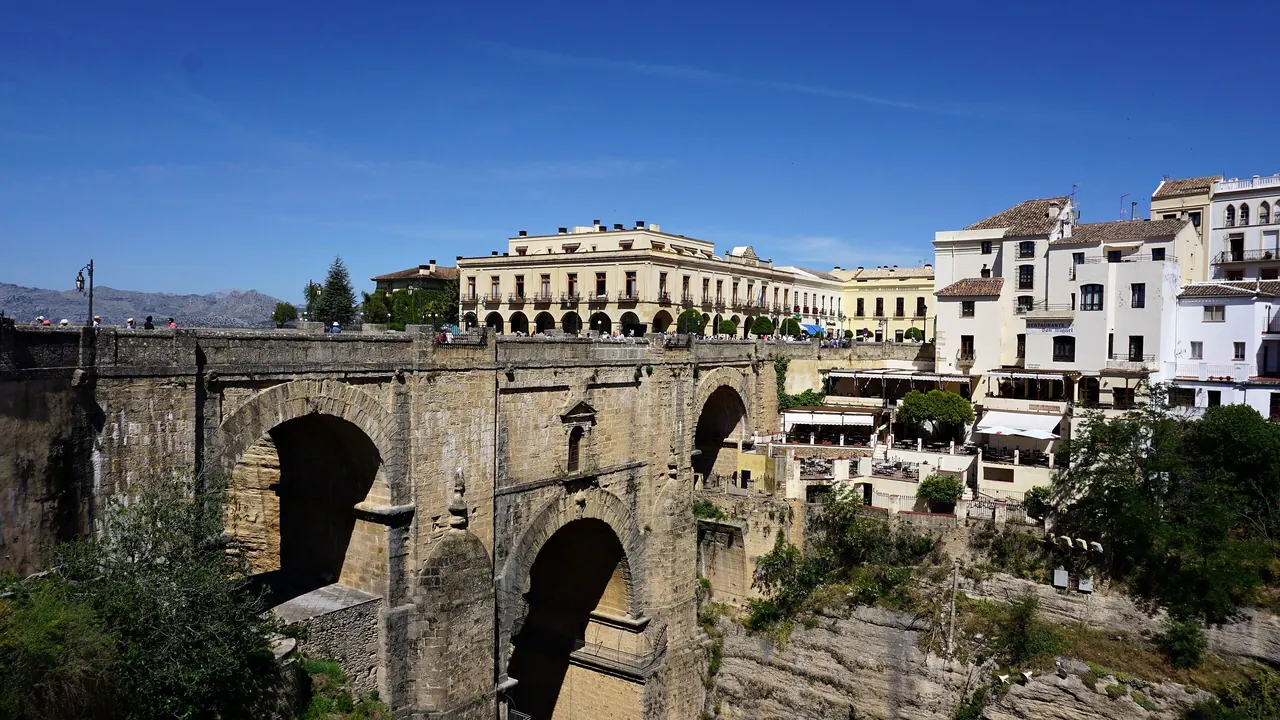
Photos: Malaga by Holger Uwe Schmitt, CC BY-SA 4.0, cropped; Ronda by Julia Kostecka, CC BY 2.0, cropped.
Malaga or Ronda?
Our verdict in twelve categories, each scored against the same fixed benchmark cities, and the climate month by month, so you can choose for your trip.
Choose Malaga for
- beaches
- nightlife
- families
Malaga is the better choice for a rounded trip that mixes beach afternoons, long tapas evenings and a good number of museums, with an airport ten minutes from the centre and fast trains that make Cordoba, Granada and even Ronda easy days out. It suits families, people who want to swim, anyone who cares about going out after dinner, and travellers who would rather not drive.
Choose Ronda for
- prices
- nature and the outdoors
Ronda suits travellers who want the mountains first and the town second. It sits on the edge of a deep gorge in walking country, with white villages twenty minutes to an hour away and quiet country houses where you can stay for a few slow days. Expect to hire a car. Expect quiet evenings, and no beach within easy reach.
Scoreboard
Twelve categories on one fixed scale from 0 to 100. The shaded stretch is the gap between the two.
Your match
Pick a travel style or drag the sliders, and both match scores follow your weighting.
Wins on beaches and nightlife with your weighting.
Wins on prices and nature and the outdoors with your weighting.
What matters to you?
Category by category
What the scores mean for a trip.
Beaches & swimming
Malaga has the beach on its doorstep. You can walk from the cathedral to La Malagueta, follow the shore east to Pedregalejo and El Palo, or take the suburban train west to the resort beaches of Torremolinos and Fuengirola. The sand is plain grey-brown, but you can swim from June to October, and Nerja's coves are an hour away when you want clearer water.
Ronda is a mountain town, and the nearest sea is about 50km away down a road of hairpin bends to Estepona and San Pedro. That trip takes up a whole day, so summer swimming here usually means a hotel or country-house pool.
Food & drink
Malaga eats from the sea and has more choice. You get sardines roasted over driftwood, plates of fried fish at the seafront in El Palo, the Atarazanas market with counters where you can eat, and moscatel poured at old bodegas. The range is wide enough to keep you interested for a long stay.
Ronda's cooking comes from the mountains: oxtail stew, lamb, game, cured meats and chestnuts and mushrooms in autumn, with wine from vineyards just outside town. It is honest food, but the choice is narrow. The good meals are in the Mercadillo's tapas bars, not on the terraces facing the gorge.
Culture & sights
Malaga has more to see indoors. The Alcazaba and the Roman theatre stand together at the foot of Gibralfaro, and in the centre are the Picasso Museum, his birthplace, the Carmen Thyssen and the Museo de Malaga. That is enough to fill two full days.
Ronda's main sight is the place itself: the Puente Nuevo spanning El Tajo, with the Moorish old town on one side and the Mercadillo on the other. Around it are smaller but real sights: the old Maestranza bullring, some of Spain's best-preserved Arab baths and the rock-cut stairway at the Casa del Rey Moro. It is memorable for its views rather than its galleries.
Nightlife
Malaga has a proper night out. After a late dinner the old town fills between Plaza de la Merced, Calle Granada and Plaza Uncibay, and the beach bars at La Malagueta stay open late. Bigger clubs and the gay scene are a short train ride away in Torremolinos.
Ronda's evenings revolve around tapas around Plaza del Socorro. There are a few bars for a drink afterwards, and outside the September fair the town is quiet by the early hours.
Nature & outdoors
Both are fine bases for the outdoors, but the setting differs. From Malaga you get pine-covered hills right behind the city in the Montes de Malaga and the limestone stacks of El Torcal. There is also the sea: you can kayak and snorkel under the Maro cliffs.
Ronda puts you inside mountain country. The gorge path starts in town and its cliffs draw climbers. You have the green crags and vultures of Grazalema on one side and the Spanish fir forests of the Sierra de las Nieves on the other. The Caminito del Rey is about an hour from either.
Day trips
Malaga is the better base for big-name trips, thanks to the railway. Cordoba's Mezquita is about an hour away by fast train, Granada is close behind, and Antequera's dolmens take half an hour. Ronda itself is an easy day trip from Malaga.
Ronda's best trips are smaller and more rural. Setenil de las Bodegas is twenty minutes away, Zahara and Grazalema are within the hour, and Acinipo and the painted Cueva de la Pileta are close by. Seville and Malaga take a long day, and the villages really need a car.
Good for families
Malaga gives children more to do in the city itself. Older ones can climb the ramparts and through the gardens of the Alcazaba and carry on up to the walls of Gibralfaro, and the palm-lined Paseo del Parque has room to run. Little in town is built specially for children, so most families split their days between the sand and outings along the coast.
July and August are hard going with small children, and late spring or early autumn is gentler.\n\nIn both places children stay out late with their parents in the squares and tapas bars. In Ronda, the highlights for them are the bridge, the stairway cut through the rock at the Casa del Rey Moro and the cave visits nearby. With no zoo, aquarium or theme park to fall back on, it works best as a country-house stay with a pool and short trips into the hills.
Getting around
Malaga's flat, largely pedestrian centre puts the cathedral, the market, the port and the beach within a short walk. The suburban train reaches the airport in about ten minutes and continues along the coast, and fast trains leave for Cordoba and Madrid.
You can walk all of Ronda in minutes, though the lanes down into La Ciudad are steep. Trains and buses get you there but are slow for exploring, so outside town Ronda is car country, and parking in the old town is tight.
Shopping & style
Malaga has a real shopping street in marble-paved Calle Larios, with El Corte Ingles across the river, the Muelle Uno promenade and a few independent shops in Soho. Ronda's Carrera Espinel and the souvenir stalls by the bridge are modest. There, the things worth buying are local wine, cured meats and convent sweets.
Affordability
Ronda is a little kinder to the budget. Its tapas bars and set lunches are good value, and country houses outside town are fairly priced, although rooms overlooking the gorge and stays at Easter or fair time cost more. The hire car is usually the biggest extra.
Malaga's food, drink and transport are cheap enough, but its old-town and beachside rooms are in heavy demand from spring to autumn. Coming in winter helps.
Live music & performing arts
Malaga has a proper stage in the nineteenth-century Teatro Cervantes, home to the Malaga Philharmonic, and its peñas offer flamenco that feels like the real thing. There is jazz in small bars and open-air concerts in summer.
Ronda has small flamenco venues and a municipal theatre with occasional shows. Its one great event is the Corrida Goyesca at the September fair, held in the old bullring.
Wellness & relaxation
Malaga has an Arab-style bathhouse in the old town where you can actually soak, and the big resort spas towards Marbella are not far. Ronda's Arab baths are a monument to look at, not to bathe in. Its form of rest is a farmhouse in the hills with a pool and olive groves, and a town that goes quiet once the coaches leave.
When should you go?
Pick your month. The climate figures are measured averages, not a forecast.
Malaga in July
Ronda in July
Daytime high, °C
Rainfall in the month, mm
Where the figures come from
Ronda has no weather station within reach, so its figures come from a gridded climate model rather than a measured record, and read a broad area rather than the city itself.
Temperature and rainfall are climate normals, averaged over the years shown. Malaga: 1991-2020 normals, Malaga / Aeropuerto (8.2 km from centre). Ronda: 1991-2020 normals, TerraClimate 4 km grid at the town, no weather station within 90 km.
Both towns bake in July and August, when afternoons reach about 32°C and sightseeing works best early or late. The real difference is in winter. Malaga stays mild on the coast, with January days near 17°C and plenty of sunshine, so it makes a pleasant winter city break. Ronda sits up on its plateau and is colder and much wetter, with midwinter highs of about 13°C, cold nights and heavy rain from October through March.
For the beach, Malaga's sea is comfortable from June to October and is warmest in August, at around 23°C. The city is almost dry from May to September, and spring and autumn suit its streets and hills. Ronda is at its best from April to early June, when the countryside is green, and again in September into early October, once the heat has eased. By mid-October the rain is back, and it gets heavier through November and December.
Which traveller are you?
On a family trip with young children, Malaga is the easier pick. Its city beaches shelve gently, the flat centre works with a pushchair, and the zoo, aquarium and dolphin park are a short train ride away. Ronda's steep cobbles and exposed viewpoints are harder going with little ones.
For a food and nightlife trip, Malaga wins clearly. You get espetos on the beach, fried fish in El Palo, sweet wine from the barrel and tapas lanes around Plaza de la Merced that stay full past two. Ronda offers a good dinner and then an early night.
On a trip on a tight budget, Ronda stretches the money further. Set lunches in the Mercadillo, modest entry fees and a town you can cross on foot keep costs down, and you avoid Malaga's sought-after old-town rooms. Just set aside money for a hire car if you want the villages.
Before you go
| Measure | Malaga | Ronda |
|---|---|---|
| Official language | Spanish | Spanish |
| Currency | Euro (EUR) | Euro (EUR) |
| Sockets | CF230 V, 50 Hz | CF230 V, 50 Hz |
| Driving side | Right | Right |
| Time zone | UTC+1, UTC+2 in summer | UTC+1, UTC+2 in summer |
| Emergency number | 112 | 112 |
| Elevation | 18 m | 724 m |
| Main airport | Málaga-Costa del Sol Airport (AGP)8 km from centre166 non-stop destinations | Málaga-Costa del Sol Airport (AGP)60 km from centre166 non-stop destinations |
| Public holidays this year | 12 days | 12 days |
By the numbers
| Measure | Malaga | Ronda |
|---|---|---|
| City population | 599,063 | 33,671 |
| People per km² | 1,517 | 87 |
| Museums within 10 km | 32 | 5 |
| UNESCO World Heritage sites within 50 km | 1 | 0 |
| Swim season, months above 21 °C | 3 months | 1 month |
Where else could you go?
Every comparison below shares a destination with this one, so you can follow Malaga or Ronda somewhere new.