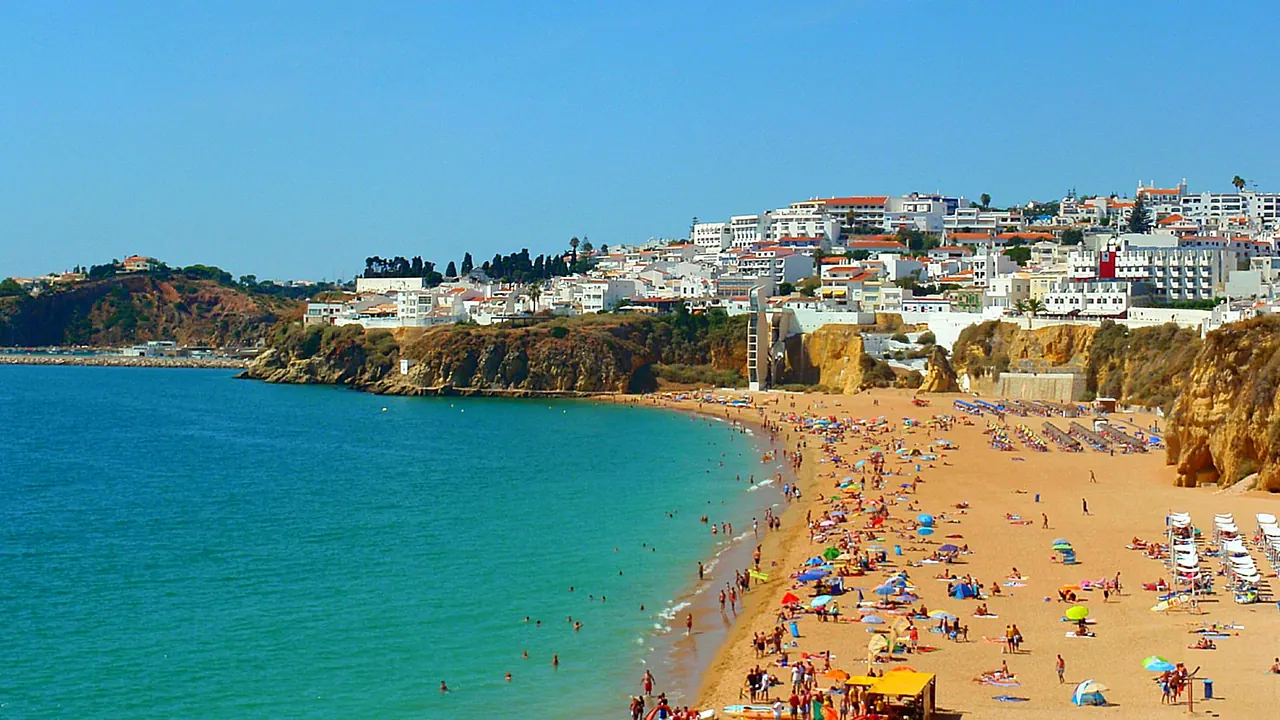
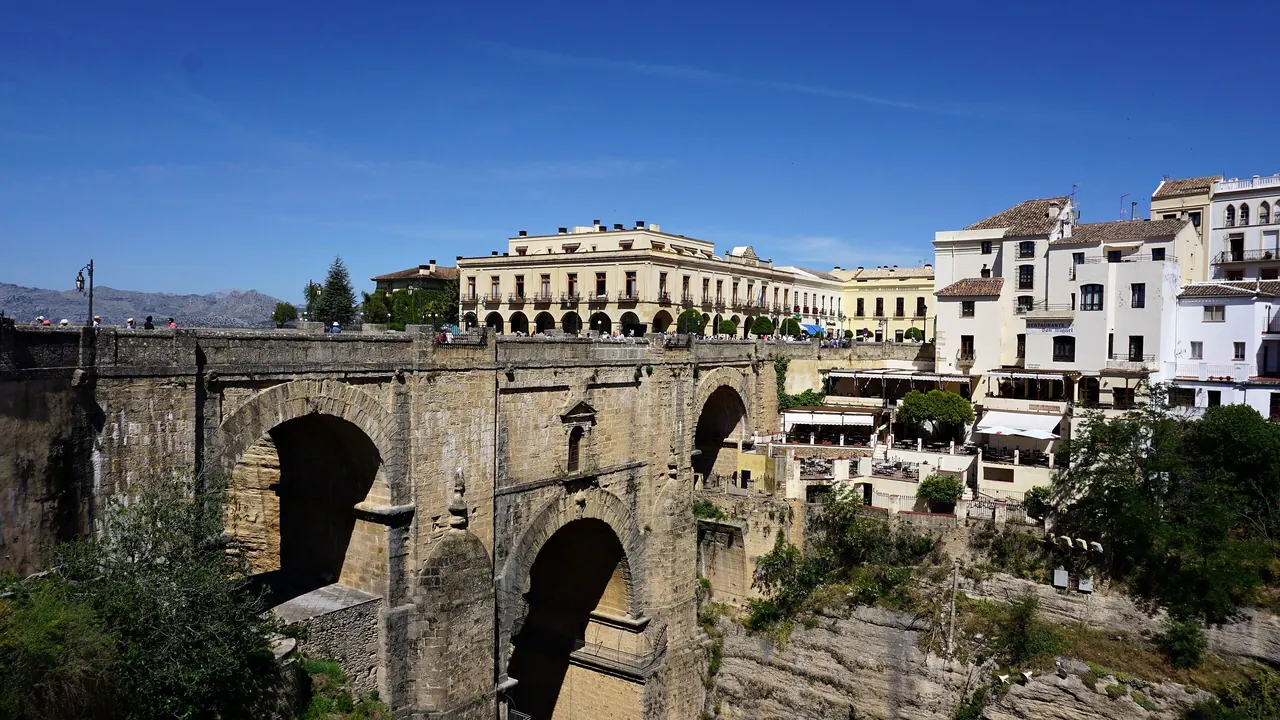
Photos: Albufeira by Jose A., CC BY 2.0, cropped; Ronda by Julia Kostecka, CC BY 2.0, cropped.
Albufeira or Ronda?
Our verdict in twelve categories, each scored against the same fixed benchmark cities, and the climate month by month, so you can choose for your trip.
Choose Albufeira for
- beaches
- nightlife
- families
Albufeira is the pick for a sun and sea vacation. Golden sand and sandstone coves start right below the old town, the water is usually calm enough for children, and a marine park and water parks are close by. For groups who want to stay out until dawn, the bar strip in Montechoro is there too. The town asks little of you beyond choosing which beach to walk to.
Choose Ronda for
- culture and sights
- getting around
- day trips
Travellers who would rather stand over a gorge than lie beside the sea will be happier in Ronda. The town split by El Tajo, the old bullring and the Arab baths fill a day or two. The Sierra de Grazalema, the Sierra de las Nieves and the white villages fill the rest. Evenings here mean tapas rather than clubs, and the coast is a long, winding drive away.
Scoreboard
Twelve categories on one fixed scale from 0 to 100. The shaded stretch is the gap between the two.
Your match
Pick a travel style or drag the sliders, and both match scores follow your weighting.
Wins on beaches and nightlife with your weighting.
Wins on culture and sights and getting around with your weighting.
What matters to you?
Category by category
What the scores mean for a trip.
Beaches & swimming
Albufeira is built around its beaches. Pescadores and Peneco lie right below the old town, the long sands of Oura and Falésia run east, and the quieter coves of São Rafael and Coelha lie to the west. Most have lifeguards in summer. The Atlantic never feels tropical, but the water is clear and swimming is easy from June into early October.
Ronda has no beach of its own. The nearest sand is on the built-up Costa del Sol around Estepona, roughly 50km away down a road of hairpin bends. The sea there is warmer, but the trip takes up a whole day, so most visitors cool off in a hotel or country-house pool instead.
Food & drink
Neither town is a food destination, and the difference is between sea and mountains. In Albufeira, look past the Strip's multilingual menus and you find charcoal-grilled sardines and bream, clam and pork cataplana and octopus, best eaten near the fishermen's beach or in the old town's backstreets.
Ronda cooks for the hills: oxtail stew, lamb, game, cured hams, and chestnuts and mushrooms from the Genal valley in autumn. You can also taste local wines at the vineyards outside town. Its tapas bars in the Mercadillo beat the gorge-view terraces, much as Albufeira's backstreets beat the Strip.
Culture & sights
Ronda has far more to see. The Puente Nuevo spans a gorge more than 100m deep between the Moorish town and the Mercadillo. Around it are the Real Maestranza bullring, where bullfighting on foot took shape, some of Spain's best-preserved Arab baths and the rock-cut stairway at the Casa del Rey Moro.
Albufeira's whitewashed old town, with its fragments of Moorish wall and its clock tower, makes a pleasant early-evening wander, but it fills a morning at most. Visitors with an interest in history drive out to Silves or Faro.
Nightlife
For a night out, Albufeira wins easily. In high summer the Strip at Montechoro runs neon bars, karaoke, sports pubs and clubs until dawn for a young crowd that includes plenty of stag and hen groups. Oura and the old town square are a little calmer. The scene is loud rather than stylish, and much of it closes from November to March.
Ronda's evenings are long dinners and tapas around the Plaza del Socorro, with a few bars afterwards. There is almost no club scene, and the town is quiet by the early hours except during the September fair.
Nature & outdoors
Both have fine scenery, but Ronda is better for walkers. It sits between two mountain ranges: the green, rain-catching Sierra de Grazalema, with griffon vultures and the Garganta Verde, and the Spanish fir forests of the Sierra de las Nieves. Climbers use the Tajo cliffs, and the Caminito del Rey is about an hour away.
Albufeira's nature is mostly found along the coast. The Seven Hanging Valleys cliff walk is half an hour away, boats and kayaks go to the sea caves at Benagil, and dolphin trips head offshore. The Serra de Monchique adds gentler hill walking an hour inland.
Day trips
Ronda has the better outings. Setenil de las Bodegas, with its houses built under overhanging rock, is twenty minutes away, and Grazalema and Zahara de la Sierra are within the hour. The Roman ruins of Acinipo and the cave paintings of the Cueva de la Pileta are close by. Seville and Málaga can be done as long days.
From Albufeira, Silves and its red castle, Loulé's market hall, walled Faro and graceful Tavira are all an easy hour away. They make pleasant trips, though none is a major heritage site. From either base, a hire car makes these trips much easier.
Good for families
Albufeira is much easier with children. Zoomarine's dolphin shows and pools are just outside town, several water parks are a short drive away, and wide, calm, lifeguarded beaches such as Galé and Oura sit beside family resorts with kids' clubs. The trick is to stay well away from the Strip.
Ronda is safe, and children are welcome in its squares late into the evening. Older children enjoy the bridge and the walk down into the gorge, but there is no zoo, aquarium or theme park. The high, exposed viewpoints need watching, so a country house with a pool works best as a base.
Getting around
Ronda is easier to get around on foot. The old town, the bridge, the bullring and the shops of the Mercadillo are a few minutes apart, and the railway station and bus links are in town, although they are slow for exploring.
Albufeira spreads for kilometres along the coast through Montechoro, Oura and Galé, which local buses link only patchily. Its station is about 6km inland, so taxis and ride-hailing do much of the work. Both places need a car for the countryside, and Ronda's old town has very little parking.
Shopping & style
Shopping is an afterthought in both places. Albufeira sells beachwear, football shirts, painted pottery, cork goods and medronho, with a large mall at Guia for ordinary fashion. Ronda's Carrera Espinel has Spanish chain stores and leather and ceramics shops, but its best buys are things to eat and drink: local wine, cured meats, olive oil and convent sweets.
Affordability
Both are reasonable value, and their prices rise at different times. Albufeira's competing restaurants keep set menus and beer cheap, and self-catering apartments are very cheap from October to May, but July and August push up rooms, beachfront meals and car hire.
Ronda's tapas bars, set lunches and modest entry fees keep everyday costs low, and you can walk everywhere for free. Prices rise at the gorge-view hotels and around Easter and the September fair, and a hire car is the biggest extra cost.
Live music & performing arts
Neither is worth choosing for live performance, but Ronda's offering has more local character. Small venues stage flamenco, and in September the Corrida Goyesca, a bullfight in eighteenth-century costume, is held in the old bullring. In Albufeira, performance means tribute bands, hotel cabaret and fado dinner shows for tourists, plus free summer concerts on the square above the fishermen's beach.
Wellness & relaxation
Albufeira offers the quiet of the seaside. You find it at the cliff-top resorts west of town and along the stretches around Galé and Falésia, where the larger hotels have spas with heated pools and massage. Its mild, sunny winters suit a slow stay. For real thermal waters, Caldas de Monchique is an hour away in the hills.
Ronda's calm belongs to a mountain town. It settles once the coach parties leave in the late afternoon, and old farmhouses in the hills add pools, olive groves and big views. The Arab baths are a monument to visit rather than a place to bathe, and spa treatment means one of a few hotel spas.
When should you go?
Pick your month. The climate figures are measured averages, not a forecast.
Albufeira in July
Ronda in July
Daytime high, °C
Rainfall in the month, mm
Where the figures come from
Albufeira's temperatures are measured 26 km from the centre, at Faro / Aeroporto.
Albufeira has no rain gauge within 25 km of the centre, so its rainfall comes from a gridded climate dataset read at the city rather than from a gauge further away.
Ronda has no weather station within reach, so its figures come from a gridded climate model rather than a measured record, and read a broad area rather than the city itself.
Temperature and rainfall are climate normals, averaged over the years shown. Albufeira: 1991-2020 normals, Faro / Aeroporto (26.4 km from centre). Ronda: 1991-2020 normals, TerraClimate 4 km grid at the town, no weather station within 90 km.
Albufeira's swimming season runs from June to early October, when afternoons reach about 29°C and the sea stays around 20°C into October. Summer there is almost rainless and very sunny. Spring and autumn are the better time for cliff walks. From late October the rain returns and is heaviest in December, though winter stays mild enough for strolling in the sun.
Ronda lies inland, so its seasons swing further. July and August are hotter, around 32°C, which makes midday sightseeing hard work. Winter days drop to about 13°C, and December and March are the wettest months, with up to 120mm. May, June, late September and October are the most comfortable months for walking the town and the hills. Ronda's sea temperatures apply to the coast an hour to the south, not to the town.
Which traveller are you?
On a beach and sun trip, Albufeira is the clear choice, with lifeguarded sand from Peneco to Falésia and calm swimming from June to early October. From Ronda the coast is about an hour's winding drive away, and the outing fills a day.
On a family trip with children, Albufeira again does better. Zoomarine, the water parks nearby, shallow hotel pools and kids' clubs are all on hand. Ronda gives older children a gorge walk and cave visits, but nothing built for them.
For a culture and arts trip, choose Ronda. The Puente Nuevo over El Tajo, one of Spain's oldest bullrings and well-preserved Arab baths are a short walk apart, with white villages and prehistoric sites nearby. Albufeira's sights take one morning.
Before you go
| Measure | Albufeira | Ronda |
|---|---|---|
| Official language | Portuguese | Spanish |
| Currency | Euro (EUR) | Euro (EUR) |
| Sockets | CF230 V, 50 Hz | CF230 V, 50 Hz |
| Driving side | Right | Right |
| Time zone | UTC, UTC+1 in summer | UTC+1, UTC+2 in summer |
| Emergency number | 112 | 112 |
| Elevation | 22 m | 724 m |
| Main airport | Faro - Gago Coutinho International Airport (FAO)26 km from centre91 non-stop destinations | Málaga-Costa del Sol Airport (AGP)60 km from centre165 non-stop destinations |
| Public holidays this year | 14 days | 12 days |
By the numbers
| Measure | Albufeira | Ronda |
|---|---|---|
| City population | 44,168 | 33,671 |
| People per km² | 314 | 87 |
| Museums within 10 km | 1 | 5 |
| UNESCO World Heritage sites within 50 km | 0 | 0 |
| Swim season, months above 21 °C | None | 1 month |
Where else could you go?
Every comparison below shares a destination with this one, so you can follow Albufeira or Ronda somewhere new.
- Farovs Albufeira
- Marbellavs Ronda
- Lagos, Portugalvs Albufeira
- Malagavs Ronda
- Jerez de la Fronteravs Ronda
- Sevillevs Ronda