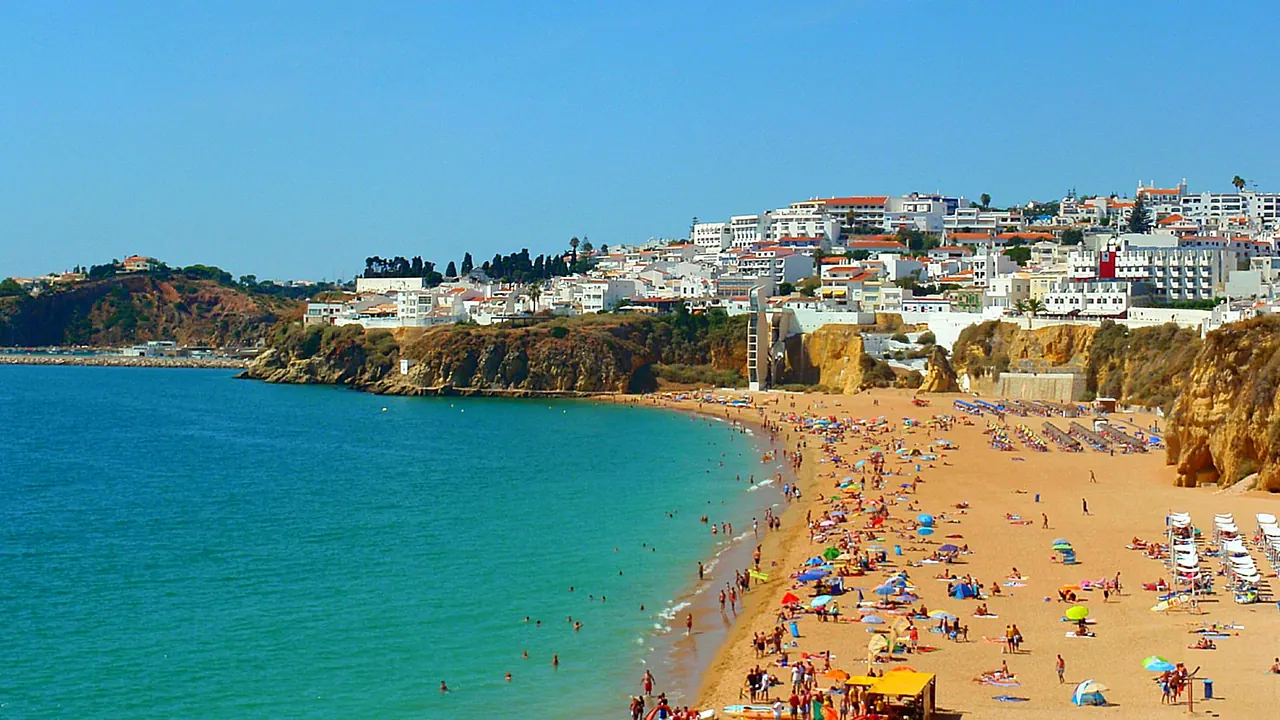
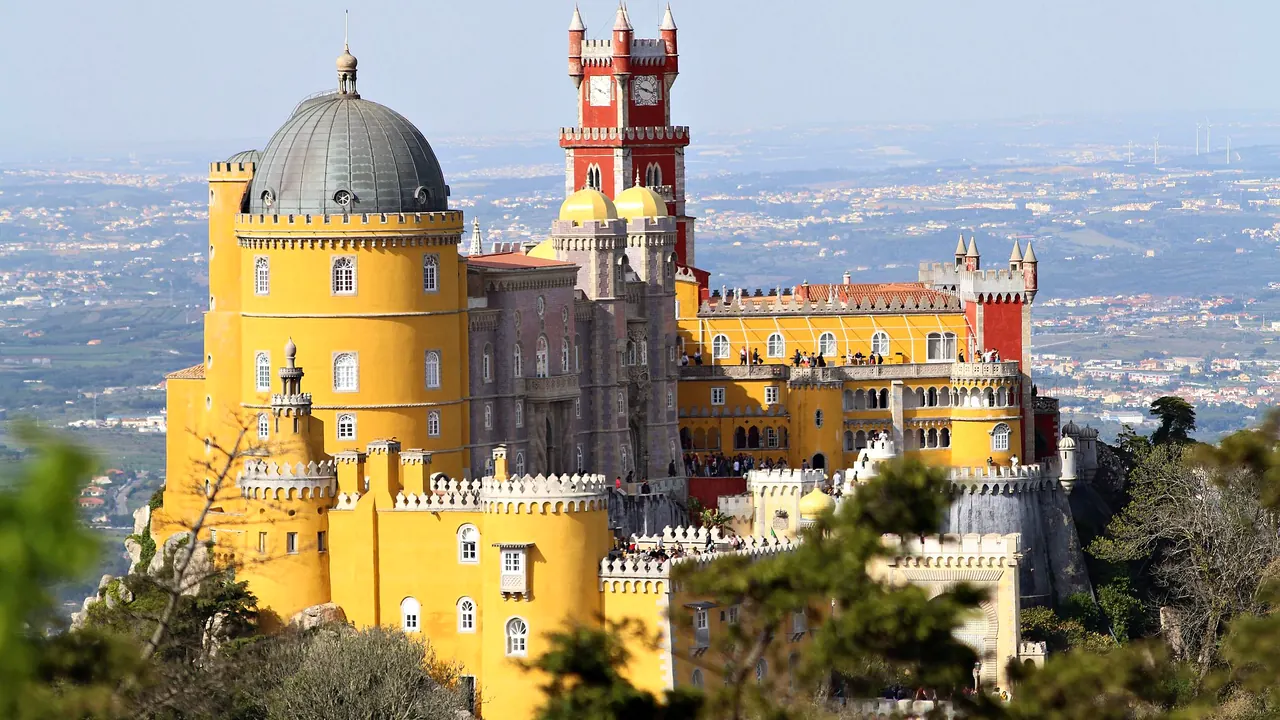
Photos: Albufeira by Jose A., CC BY 2.0, cropped; Sintra by Chabe01, CC BY-SA 4.0, cropped.
Albufeira or Sintra?
Our verdict in twelve categories, each scored against the same fixed benchmark cities, and the climate month by month, so you can choose for your trip.
Choose Albufeira for
- nightlife
- beaches
- families
Albufeira is the pick for a week built around sand and sea. It has a long run of golden beaches with calm water below the ochre cliffs, plenty of resort hotels made for families, and a loud, cheerful party strip through the summer. There is little culture in the town itself, so it suits travellers who want the beach to be the main event, with a boat trip to the Benagil caves or a drive to Silves when they want a change.
Choose Sintra for
- culture and sights
- day trips
- getting around
Travellers who would rather spend their days among palaces and forest than on a sunbed will be happier in Sintra. Pena, the Moorish Castle and Quinta da Regaleira are all close together on one wooded hill, the Serra de Sintra is good walking country, and Lisbon is a short train ride away. Evenings are quiet and the sea is cold, so Sintra is better for a few curious, active days than for a lazy week.
Scoreboard
Twelve categories on one fixed scale from 0 to 100. The shaded stretch is the gap between the two.
Your match
Pick a travel style or drag the sliders, and both match scores follow your weighting.
Too close to call, 2 points apart
Wins on nightlife and beaches with your weighting.
Wins on culture and sights and day trips with your weighting.
What matters to you?
Category by category
What the scores mean for a trip.
Beaches & swimming
Albufeira has the better beaches by a wide margin. Golden sand runs between sandstone stacks right below the old town and continues east to Falésia. The coves are calm, there are lifeguards and sunbeds in summer, and the water is warm enough to swim from June to early October.
Sintra's coast is wilder and further out, a drive or bus ride from town. Praia Grande and Praia das Maçãs are good sandy beaches and Azenhas do Mar has a tidal pool, but the surf is heavy and the water stays cold even in August, so most visitors treat a beach visit as a break from the palaces.
Food & drink
Neither town is a food destination, but Albufeira has a little more to offer if you skip the multilingual menus on the Strip. Its strengths are charcoal-grilled sardines and bream, clam cataplana and octopus in simple places near the fishermen's beach and up in the inland villages.
Sintra's best-known food is its pastry, especially warm travesseiros and queijadas from the old pastry houses in the centre. Restaurant meals in the historic centre are uneven, and the best fish is found down at Azenhas do Mar and Praia das Maçãs.
Culture & sights
On culture the two are in different leagues. Sintra's hill holds the Pena Palace, the Moorish Castle ramparts, the National Palace with its huge conical chimneys, the Initiation Well at Regaleira, Monserrate and the cork-lined Capuchos convent. That is two full days of sightseeing, best started early.
Albufeira's whitewashed old town, clock tower and two small museums take a single morning. Visitors interested in history there spend their time on outings to Silves, Faro or Tavira instead.
Nightlife
Albufeira has a real night out and Sintra does not. Albufeira's centre of gravity is the Strip, Avenida Sá Carneiro in Montechoro, where neon bars, karaoke, sports pubs and clubs draw a young, largely British and Irish crowd, with plenty of stag and hen groups. It is loud and unsubtle rather than stylish. The hotel zones stretch for kilometres along the coast, so many visitors take a taxi there and back. The old town square is a slower place to start the evening, and much of the scene shuts between November and March.
Sintra's evenings come down to a glass of wine in one of the few bars in the old town lanes, with nothing open late and no clubs at all. That suits couples and walkers who want an early night before the morning queues at the palaces. Dancing means taking the train to Lisbon and planning how to get back.
Nature & outdoors
Sintra has the edge for time outdoors, and its landscape is completely different. Trails climb through a damp, mossy forest of oak, cork and giant ferns to Cruz Alta and Peninha, and clifftop paths run out to Cabo da Roca. The cooler hill climate keeps these walks pleasant even in midsummer.
Albufeira's outdoors is the golden limestone coast: the Seven Hanging Valleys trail near Benagil, boat and kayak trips into the sea caves, and dolphin-watching. It is excellent, but it is hot and dry for walking in July and August.
Day trips
Sintra is far better placed for day trips, mainly because Lisbon is a short suburban train ride away. Cascais is just over the hills. With a car you can reach the palace at Mafra, Ericeira, Óbidos and the UNESCO monasteries of Alcobaça and Batalha, with Évora as a long outing.
From Albufeira the choices are pleasant Algarve towns such as Silves with its red castle, Loulé's market hall, walled Faro and Tavira's Roman bridge. None is a major heritage site, and most are easier to reach by car than by the slow buses.
Good for families
Albufeira is set up for families: a marine park with dolphin shows just outside town, several water parks within a short drive, and lifeguarded, calm beaches such as Oura and Galé. Many hotels have kids' clubs and shallow pools. Most families stay well away from the Strip.
Sintra is more of a storybook adventure for school-age children, who love the castle walls and Regaleira's tunnels. It is harder going with toddlers, though, because of the steep cobbles, crowded hill buses and rough surf, and there is nothing built specifically for children.
Getting around
Sintra is the easier of the two without a car. The suburban train from Lisbon stops a short stroll from the small historic centre. A circular bus, tuk-tuks or a stiff climb take you up to Pena and the castle. Driving in the hills is the frustrating part, with narrow one-way lanes and very little parking.
Albufeira spreads for kilometres through hotel zones such as Montechoro, Oura and Galé, which local buses link only patchily. The railway station is about 6km inland. Taxis in the evening and a hire car for the coves and cliff walks are the usual answer.
Shopping & style
Neither town is a place to shop seriously, but the things on sale differ. Albufeira sells beachwear and football shirts, along with painted Algarve pottery and medronho, and visitors drive to the mall at Guia for everyday clothes. Sintra's old town has hand-painted tiles, linen, antique azulejos from a few dealers and boxes of pastries, and its Sunday fair at São Pedro de Penaferrim is good for browsing.
Affordability
The two cost much the same, with Albufeira a little easier on the wallet. Its many competing restaurants and self-catering apartments keep costs down, especially from October to May. July and August cost far more there.
In Sintra, simple tascas and the train are cheap. What adds up is paying separate entry at four or five palaces, plus the higher rates of the manor-house guesthouses in the centre.
Live music & performing arts
Live performance is thin in both, though Sintra offers slightly more worth planning around. Its summer festival of classical music and dance uses the palaces and quintas as settings, and the Olga Cadaval cultural centre puts on concerts and theatre through the year. Albufeira mostly has tribute acts, hotel cabaret and free summer concerts on the square by the fishermen's beach.
Wellness & relaxation
Neither has a bathing tradition, and they offer different kinds of rest. In Sintra the calm comes from staying overnight in a quinta among old gardens and misty forest, where the mornings and evenings are quiet once the crowds have gone. Albufeira relies on resort-hotel spas, the calmer cliff-top areas around Galé and Falésia, and its mild winters. For real thermal waters, Caldas de Monchique is about an hour away.
When should you go?
Pick your month. The climate figures are measured averages, not a forecast.
Albufeira in July
Sintra in July
Daytime high, °C
Rainfall in the month, mm
Where the figures come from
Albufeira's temperatures are measured 26 km from the centre, at Faro / Aeroporto.
Albufeira has no rain gauge within 25 km of the centre, so its rainfall comes from a gridded climate dataset read at the city rather than from a gauge further away.
Temperature and rainfall are climate normals, averaged over the years shown. Albufeira: 1991-2020 normals, Faro / Aeroporto (26.4 km from centre). Sintra: 1991-2020 (rainfall 1961-1990) normals, Lisboa / Geof (22.7 km from centre).
Albufeira is a summer beach resort in the plainest sense. From June to September it is almost completely dry and very sunny, with daytime highs of around 29°C at the peak. The sea warms to about 20°C from July into October, so swimming lasts into early autumn. Spring and autumn are the best seasons for cliff walks. Rain arrives in October and peaks in December at about 95mm. Even so, winter stays mild and fairly bright, which is why people come for long, quiet stays then.
Sintra follows a similar pattern but a little cooler and noticeably wetter. Summer highs are similar on paper, but the forested hills often hold cloud and stay fresher, which makes July and August comfortable for climbing to the palaces. The sea never gets much above 19°C. Winters are wet, with around 120mm of rain in January, and greyer than on the Algarve. Late spring and September are the most pleasant months for walking there.
Which traveller are you?
For a beach and sun trip, choose Albufeira. Its sheltered golden beaches, from Peneco to Falésia, have lifeguards and calm, clear water, and it gets more sunshine. Sintra's Atlantic beaches have heavy surf, colder water and fog, so they make an afternoon out rather than a stay.
On a culture and arts trip, Sintra wins easily. A UNESCO landscape of royal palaces, a Moorish castle, Regaleira's grottoes and a summer classical festival held in palace settings fills two full days. Albufeira's old town takes a morning, and its entertainment is mostly cover bands.
For a food and nightlife trip, Albufeira is the obvious choice. The Strip runs until dawn in summer, Oura has terrace bars, and grilled sardines and cataplana are found near the fishermen's beach. Sintra empties after the last train, and a night out means going to Lisbon.
Before you go
| Measure | Albufeira | Sintra |
|---|---|---|
| Official language | Portuguese | Portuguese |
| Currency | Euro (EUR) | Euro (EUR) |
| Sockets | CF230 V, 50 Hz | CF230 V, 50 Hz |
| Driving side | Right | Right |
| Time zone | UTC, UTC+1 in summer | UTC, UTC+1 in summer |
| Emergency number | 112 | 112 |
| Elevation | 22 m | 193 m |
| Main airport | Faro - Gago Coutinho International Airport (FAO)26 km from centre91 non-stop destinations | Lisbon Humberto Delgado Airport (LIS)22 km from centre157 non-stop destinations |
| Public holidays this year | 14 days | 14 days |
By the numbers
| Measure | Albufeira | Sintra |
|---|---|---|
| City population | 44,168 | 385,606 |
| People per km² | 314 | 1,208 |
| Museums within 10 km | 1 | 12 |
| UNESCO World Heritage sites within 50 km | 0 | 3 |
| Swim season, months above 21 °C | None | None |
Where else could you go?
Every comparison below shares a destination with this one, so you can follow Albufeira or Sintra somewhere new.
- Cascaisvs Sintra
- Lisbonvs Sintra
- Farovs Albufeira
- Lagos, Portugalvs Albufeira
- Coimbravs Sintra
- Cadizvs Albufeira