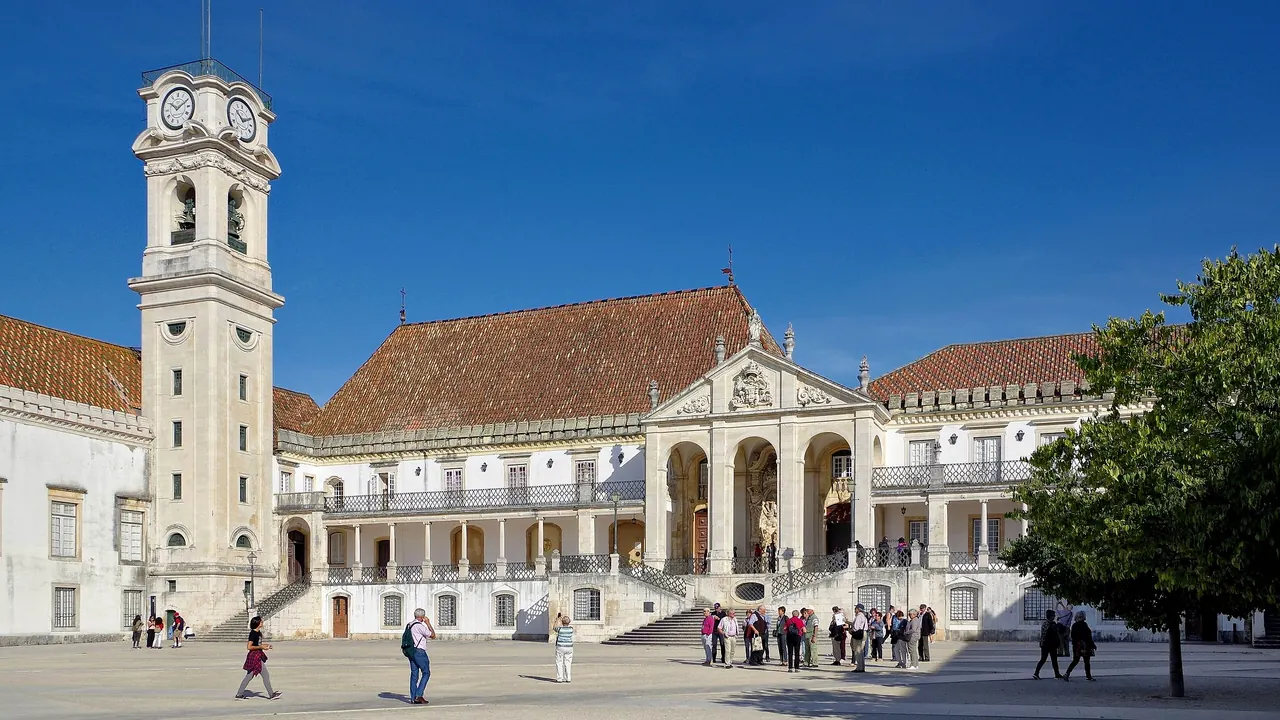

Photos: Coimbra by Berthold Werner, CC BY-SA 3.0, cropped; Sintra by Chabe01, CC BY-SA 4.0, cropped.
Coimbra or Sintra?
Our verdict in twelve categories, each scored against the same fixed benchmark cities, and the climate month by month, so you can choose for your trip.
Choose Coimbra for
- nightlife
- live music and the arts
- prices
Coimbra suits travellers who want a lived-in university city rather than a showpiece. It eats better and for less, it has student bars and its own caped fado in the evenings, and it sits on the Lisbon to Porto line, so Porto, Aveiro, Conímbriga and the great monasteries are easy to reach. Choose it for a slower, inexpensive stay with a real town around you after dark.
Choose Sintra for
- culture and sights
- nature and the outdoors
- beaches
For palaces, forest and a fairy-tale setting, Sintra is the stronger pick. Pena, the Moorish Castle, Regaleira and Monserrate all sit on one wooded ridge, and the cliff paths to Cabo da Roca and the surf beaches are close by. Evenings are very quiet and meals are ordinary. It works best for sightseers and walkers who are happy to go into Lisbon for a night out, or to sleep in a quinta and enjoy the silence.
Scoreboard
Twelve categories on one fixed scale from 0 to 100. The shaded stretch is the gap between the two.
Your match
Pick a travel style or drag the sliders, and both match scores follow your weighting.
Wins on nightlife and live music and the arts with your weighting.
Wins on culture and sights and nature and the outdoors with your weighting.
What matters to you?
Category by category
What the scores mean for a trip.
Beaches & swimming
Neither is a beach destination, but Sintra is closer to the sand. Its coast is about 20 minutes away and has the lifeguarded beaches of Praia Grande and Praia das Maçãs, the cove under the cliffs at Adraga and the tidal pool at Azenhas do Mar. In summer the old tram runs down to the shore.
Coimbra's nearest sea is at Figueira da Foz, around an hour away, with a huge sandy beach and Buarcos at its northern end. To make up for that, it has calmer, warmer river beaches in the hills to the east. On both coasts the Atlantic is cold and often rough.
Food & drink
Coimbra is the better place to eat. It draws on the Bairrada farm country, so you get leitão from Mealhada with the local sparkling wine, chanfana from the eastern hills and cheap set lunches in the tascas of the Baixa. These are honest, filling meals, even if fine dining and foreign food are scarce.
Sintra's strength is narrower: warm travesseiros and queijadas from the old pastry houses. Its old-town restaurants mostly cater to day-trippers, and for the best meals you head out to the coastal villages for grilled fish.
Culture & sights
Sintra has the more spectacular heritage. Its UNESCO landscape fits Pena Palace, the Moorish Castle, the National Palace, Quinta da Regaleira, Monserrate and Capuchos into a few square kilometres of hillside, a run of romantic palaces that few places in Europe can match. It has no museums of any weight, though.
Coimbra's sights are older and more scholarly. The university and its Biblioteca Joanina crown the hill, with the Romanesque Sé Velha, the Machado de Castro museum over its Roman cryptoportico and the royal tombs of Santa Cruz below. It is a fine set, but you get through it sooner and it has less of Sintra's sense of wonder.
Nightlife
Coimbra has a real night out, at least during term. Students fill the bars around Praça da República and in the upper town until late, and a few small clubs stay open. In May the Queima das Fitas turns the city into a week-long party, though July and August are much calmer.
Sintra has almost none of this. A handful of bars and wine spots close early, and anyone who wants more takes the train to Lisbon and keeps an eye on the clock for the trip back.
Nature & outdoors
In Sintra, nature starts at the edge of town. The forested granite ridge has trails to Cruz Alta and Peninha with views over the Atlantic and the Tagus estuary, and cliff paths run out to Cabo da Roca. The cool, damp microclimate keeps walking pleasant even in summer.
Coimbra has greenery in the botanical garden and the Choupal woods, and you can kayak down the Mondego from Penacova. Its best landscapes need a drive, though: the Buçaco forest half an hour north, the slate villages of the Serra da Lousã and the Serra da Estrela, which has higher mountains than anything near Sintra.
Day trips
Both are excellent bases, but they face in different directions. Coimbra's advantage is the main rail line: Porto and Aveiro are each an hour or less away by train, and the Roman mosaics at Conímbriga are just south of the city. Tomar, Batalha and Alcobaça are within driving range.
Sintra's best excursion is Lisbon, a whole capital about 40 minutes away by suburban train, with Cascais and the Estoril coast close by. A car adds Mafra, Ericeira and Óbidos, while Alcobaça, Batalha and Fátima can be reached from either base.
Good for families
Both work for families for a few days, but in different ways. Coimbra has places built for children: the miniature houses and monuments of Portugal dos Pequenitos, the hands-on Exploratório science centre and riverside parks.
Sintra has nothing made for children, but the castle walls, the spiral of the Initiation Well and the tunnels at Regaleira feel like a storybook to school-age children. Both old centres are steep and cobbled and hard going with a buggy, and Sintra adds crowded buses, queues and rough surf.
Getting around
Both are walkable at the centre and steep beyond it. In Coimbra, a public lift and a funicular ease the climb from the Baixa to the university, buses cross the river to Santa Clara, and the main Lisbon to Porto line stops at the edge of town.
Sintra's centre is a short walk from the Lisbon train, but Pena and the Moorish Castle sit high above it, reached by a hard hike or by a tourist bus that fills up. Driving its narrow one-way lanes is frustrating, whereas around Coimbra a car is mainly useful for the countryside.
Shopping & style
Neither town is a place to shop seriously, but Coimbra gives you more to work with. The Baixa is a working town centre where residents still buy their clothes and shoes and visit long-standing specialist traders, and the D. Pedro V market is good for cheese and cured meats. Locally painted faience and a bottle of Bairrada sparkling wine travel home well, and the shopping centres on the outskirts cover anything bigger.
Sintra's old town, by contrast, sells almost entirely to the day-trippers heading up to the palaces, so you find tiles, cork, linen and boxed travesseiros rather than everyday shops. The antique dealers with old azulejos and the Sunday fair at São Pedro de Penaferrim are better for browsing than for a shopping list. For fashion or a department store you have to go to Lisbon.
Affordability
Coimbra is noticeably cheaper. Because so many of its customers are students, meals, coffee and drinks cost little. Rooms near the old town are fairly priced outside the May festival and graduation, and the university ticket is the one big outlay.
Everyday costs in Sintra are modest too, but the sights work against a tight budget. Every palace charges its own entry, so seeing several costs more than eating. Manor-house rooms in the centre are expensive, though staying in the villages or by the coast brings the bill down.
Live music & performing arts
Coimbra has a living tradition to go and see. Its own fado is sung by men in academic capes with the Coimbra guitar and is gentler than the Lisbon style, and small houses in the old town hold concerts most evenings. The Teatro Académico de Gil Vicente and the São Francisco arts centre add theatre, film and touring music and dance.
Sintra's highlight is its summer festival of classical music and dance, held in the palaces and quintas, and the Olga Cadaval centre puts on concerts and theatre through the year. Beyond that there is little on, and most evenings of music or theatre mean going to Lisbon.
Wellness & relaxation
Neither city has baths of its own, and the way to unwind is different in each. From Coimbra, the spa towns of Luso and Curia are about half an hour north, with thermal waters, Belle Époque hotels and a lake, and the city itself slows down outside term.
Sintra's calm comes from its setting: a night in a quinta among old gardens and misty forest, early mornings before the crowds, and quiet estates such as Monserrate. Daytime in its centre is anything but restful, and in both places spas are mostly limited to hotels.
When should you go?
Pick your month. The climate figures are measured averages, not a forecast.
Coimbra in July
Sintra in July
Daytime high, °C
Rainfall in the month, mm
Temperature and rainfall are climate normals, averaged over the years shown. Coimbra: 1991-2020 normals, Coimbra (1.6 km from centre). Sintra: 1991-2020 (rainfall 1961-1990) normals, Lisboa / Geof (22.7 km from centre).
The two places follow much the same mild pattern: highs around 15°C in winter, the high twenties in July and August, and a wet season from October to December. Coimbra is inland and runs a little hotter, around 29°C in August, which makes the climb to the university sticky in midsummer. Its rain also comes back earlier and harder, and October is among its wettest months. Spring and early autumn are the best times for walking its streets.
Sintra is drier and sunnier through the summer, with almost no rain in July and long, bright days. The sea off both coasts stays cool, around 18°C even in August, so beach days really only work from late June to September. May, June and September are the most comfortable months for Sintra's palace paths and forest trails.
Which traveller are you?
For a food and nightlife trip, Coimbra is the clear choice. Suckling pig from Mealhada, chanfana and cheap tasca lunches beat Sintra's pastries and tourist menus. Its student bars around Praça da República also stay busy late, while Sintra empties at dusk.
On an outdoors trip, Sintra is the better pick. Trails climb straight out of town through mossy forest to Pena Park, Cruz Alta and Peninha, and the coast adds clifftop paths at Cabo da Roca and surf at Praia Grande. Coimbra's best walking needs a drive.
On a tight budget, your money goes further in Coimbra. Prices are set for students, rooms near the old town are fairly priced, and one university ticket covers the main sight. In Sintra, separate entry to each palace and expensive manor-house rooms add up quickly.
Before you go
| Measure | Coimbra | Sintra |
|---|---|---|
| Official language | Portuguese | Portuguese |
| Currency | Euro (EUR) | Euro (EUR) |
| Sockets | CF230 V, 50 Hz | CF230 V, 50 Hz |
| Driving side | Right | Right |
| Time zone | UTC, UTC+1 in summer | UTC, UTC+1 in summer |
| Emergency number | 112 | 112 |
| Elevation | 43 m | 193 m |
| Main airport | Francisco de Sá Carneiro Airport (OPO)117 km from centre133 non-stop destinations | Lisbon Humberto Delgado Airport (LIS)22 km from centre156 non-stop destinations |
| Public holidays this year | 14 days | 14 days |
By the numbers
| Measure | Coimbra | Sintra |
|---|---|---|
| City population | 140,816 | 385,606 |
| People per km² | 441 | 1,208 |
| Museums within 10 km | 10 | 12 |
| UNESCO World Heritage sites within 50 km | 1 | 3 |
| Swim season, months above 21 °C | None | None |
Where else could you go?
Every comparison below shares a destination with this one, so you can follow Coimbra or Sintra somewhere new.