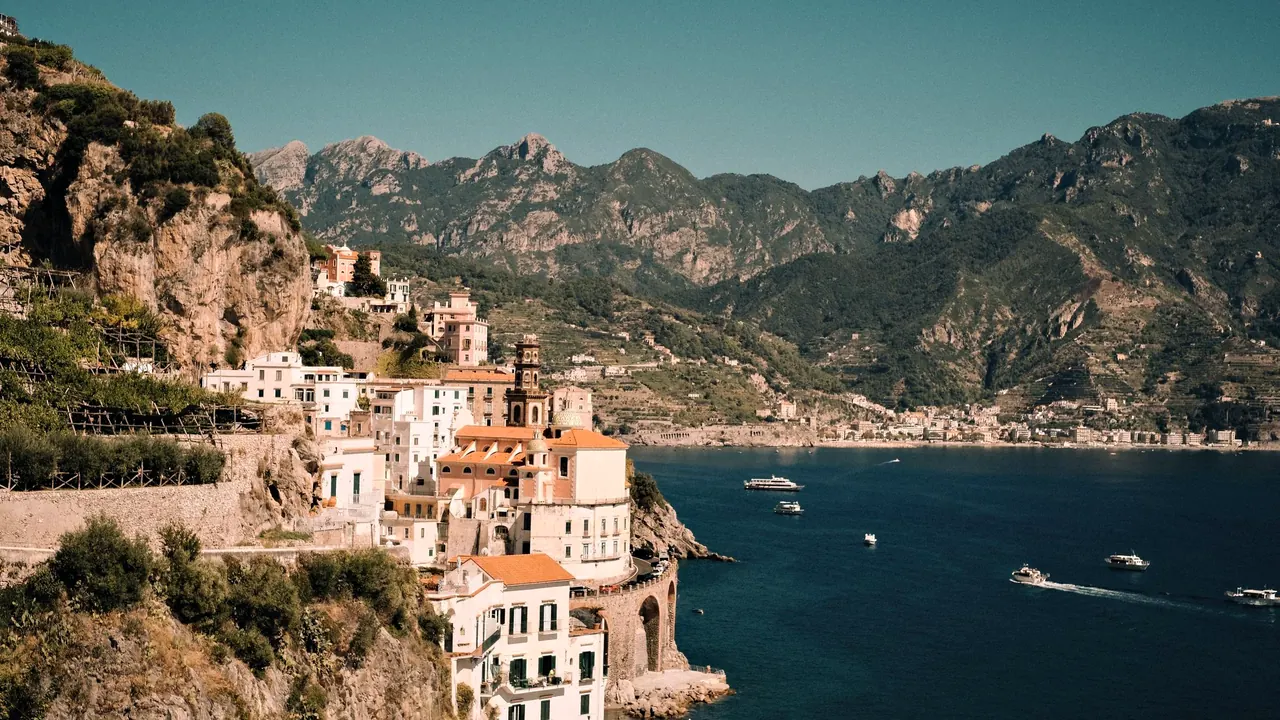
Photos: Amalfi Coast by Alina Chernii, Pexels License.
Amalfi Coast or Brač?
Our verdict in twelve categories, each scored against the same fixed benchmark cities, and the climate month by month, so you can choose for your trip.
Choose Amalfi Coast for
- shopping
- day trips
- food and drink
The Amalfi Coast is for travellers who want the scenery, the food and the history to carry the trip. Cliff walks like the Path of the Gods, Ravello's villas and summer concerts, Campanian cooking and the reach to Pompeii, Capri and Naples give it far more to do. The cost is high prices, steep stairways and one crowded road, so it suits couples and adults who don't mind paying for the view.
Choose Brač for
- prices
- families
- getting around
Brač is the easier and cheaper choice for a beach vacation. Zlatni Rat and the shallow bays of the north coast make swimming simple, apartments in the villages keep costs down, and children are well catered for on the quiet harbour fronts. The food, culture and day trips are thinner, but for a calm week by clear water with the family, or for windsurfing off Bol, it is the better fit.
Scoreboard
Twelve categories on one fixed scale from 0 to 100. The shaded stretch is the gap between the two.
Your match
Pick a travel style or drag the sliders, and both match scores follow your weighting.
Wins on shopping and day trips with your weighting.
Wins on prices and families with your weighting.
What matters to you?
Category by category
What the scores mean for a trip.
Beaches & swimming
On the Amalfi Coast you swim from small grey-pebble coves wedged into the cliffs at Positano, Amalfi and Atrani. Many are filled with hired sunbeds or reached by long stairways, and the best swimming is often from a hired boat. Maiori and Minori are the exceptions, with more room to spread out.
Brač makes beach days simpler. Zlatni Rat at Bol is a long spit of fine pebble with pine shade and very clear water. The north coast towns have shallow bays you can walk straight into, and Lovrečina near Postira is a rare sandy beach. The August sea is warm on both.
Food & drink
The Amalfi Coast has the richer and more varied food. There is scialatielli with clams, fish baked in lemon leaves, Cetara's cured anchovies and colatura, and Sfusato lemons in limoncello, cakes and granita. Places to eat run from family trattorias in Minori to terrace dining in the grand hotels of Ravello.
Brač's konobas do grilled fish, octopus under an iron lid, spit-roasted vitalac and walnut cake from Dol well, with good olive oil and red wine from above Bol. Fine dining is rare, though, and many kitchens close out of season. On both, the harbour-front menus are the weakest choice. A better meal is usually a short walk away, uphill from Amalfi or inland at Dol or Nerežišća.
Culture & sights
The Amalfi Coast has more history to visit. There is the striped Arab-Norman cathedral and the Cloister of Paradise from Amalfi's years as a maritime republic, and there are Ravello's Villa Rufolo and Villa Cimbrone. The UNESCO-listed landscape of pastel towns and lemon terraces is worth seeing in its own right.
Brač's heritage is quieter and built in stone: the cliff hermitage of Pustinja Blaca, the Illyrian walls of Škrip, the stonemasons' harbour of Pučišća and a Tintoretto in Bol's Dominican monastery. Neither has a major museum, but Brač's sights fill a few unhurried days rather than a whole trip.
Nightlife
Neither is a place to party, and on both the evening is mostly dinner and a drink by the water. The style differs. Positano's cocktail bars and the café tables on Amalfi's cathedral square suit couples out for a dressed-up aperitivo. In July and August, Bol has beach bars along the path to Zlatni Rat and a few open-air dance venues that run late.
For anything bigger, visitors to Amalfi go to Naples or Salerno, and visitors to Brač take the catamaran to Hvar town. Both go very quiet once summer ends.
Nature & outdoors
The Amalfi Coast has the grander walking. The Path of the Gods runs high above Positano from Agerola to Nocelle, old mule tracks link Ravello and Amalfi through the lemon terraces, and the Valle delle Ferriere climbs a shaded gorge with waterfalls. Offshore there are sea caves, the Grotta dello Smeraldo and snorkelling around Punta Campanella.
Brač's interior is a bare karst plateau of olive groves and dry-stone walls that rises to Vidova Gora at 778m, a steep climb from Bol. Its real strength is the reliable afternoon wind in the channel off Bol, which makes it the better choice for windsurfers and kitesurfers.
Day trips
From the Amalfi Coast, an exceptional range of places is within a day's reach: Pompeii and Herculaneum, Capri by ferry, the Greek temples at Paestum and the old centre of Naples. The roads are slow, so the boat is often the quickest way out.
On Brač, day trips centre on Split, where the town centre is built into Diocletian's Palace, with Trogir a little further on. A catamaran from Bol reaches Hvar, and a ferry from Sumartin crosses to Makarska. These are good days out but fewer and smaller, and they depend on a ferry timetable that thins out after summer.
Good for families
The Amalfi Coast is hard work with small children. The towns are vertical, with hundreds of steps, the coves are pebble, the main road has no pavement in long stretches and the summer buses are packed. Families manage best in the flatter towns of Maiori and Minori, and boat trips and the emerald grotto are the highlights.
Brač is far easier. Supetar, Sutivan and Postira have shallow, sheltered beaches, short promenades and apartments with kitchens, and children are welcome late into the evening on the harbour fronts. There is nothing built for children on either, and the north coast suits small swimmers better than Zlatni Rat, where the water deepens fairly quickly.
Getting around
On the Amalfi Coast everything depends on one narrow cliff road that jams in summer, with full buses and almost nowhere to park, so many visitors never hire a car. From spring to autumn the ferries between Positano, Amalfi, Minori, Maiori and Salerno are the easy option. Within the towns you climb stairs.
Brač is simpler once you are across. The roads are quiet and distances short, so a hired car or scooter covers the island well, though the road over the plateau to Bol is slow and the buses run too rarely to rely on. The real catch is the long ferry queue at Supetar on summer weekends.
Shopping & style
The Amalfi Coast has crafts worth buying. Positano's lanes sell loose linen clothing and sandals made to fit while you wait, Amalfi has handmade paper from its old mills, and Vietri sul Mare is known for painted majolica.
Brač offers much less: carved stone from the Pučišća workshops, olive oil, honey, lavender and wine, plus the souvenir stalls of Bol and Supetar. For anything more, visitors go to Split.
Affordability
In high season the Amalfi Coast is among the most expensive coasts in Europe. Sea-view rooms in Positano and Ravello, sunbeds, private boats and taxis on the coast road all add up. Staying in Atrani, Maiori or Agerola and getting around by bus and ferry helps, as does going in late September.
Brač is not cheap in July and August either, with hotels in Bol and waterfront meals close to Western European levels and car ferry fares on top. Even so, private apartments in the north coast villages, supermarket shopping and simple village konobas make it noticeably cheaper than Amalfi, and June and September bring costs down further.
Live music & performing arts
The Amalfi Coast has Ravello and its long link with Wagner. Its summer festival puts orchestras on a stage over the cliff in the gardens of Villa Rufolo, and a chamber series brings concerts to its halls and churches on many evenings. Elsewhere on the coast there are only church concerts and bands at feast-day processions.
Brač has no theatre or concert venue. There are summer concerts in the squares of Bol and Supetar, and klapa harmonies on festival evenings. For opera or theatre, you cross to Split for its summer festival.
Wellness & relaxation
Neither has thermal springs, and on both the spas belong to hotels. Amalfi's are the more lavish, set on the cliffs with seawater pools looking over the gulf. Ravello, Atrani, Praiano and Conca dei Marini make calm bases above the crowds, where gardens and long lunches set the pace.
On Brač the hotel spas in Bol and Supetar offer massages, saunas and pools. The rest comes from the quiet harbours of Milna, Povlja and Sumartin and the stone villages inland. On both, June and September are the restful months.
When should you go?
Pick your month. The climate figures are measured averages, not a forecast.
Amalfi Coast in July
Brač in July
Daytime high, °C
Rainfall in the month, mm
Where the figures come from
Amalfi Coast's temperatures are measured 65 km from the centre, at Grazzanise.
Amalfi Coast has no rain gauge within 25 km of the centre, so its rainfall comes from a gridded climate dataset read at the destination rather than from a gauge further away.
Brač's temperatures are measured 34 km from the centre, at Split / Marjan.
Brač has no rain gauge within 25 km of the centre, so its rainfall comes from a gridded climate dataset read at the destination rather than from a gauge further away.
Brač's sunshine is measured 34 km from the centre, at Split / Marjan.
Temperature and rainfall are climate normals, averaged over the years shown. Amalfi Coast: 1991-2020 normals, Grazzanise (64.7 km from centre). Brač: 1991-2020 (sunshine 1971-2000) normals, Split / Marjan (33.5 km from centre).
Around the main resort areas, the two have much the same summer. In July and August highs reach about 31°C, there is almost no rain and the sea is warm enough to swim from June to early October, about a degree warmer off Amalfi. Brač gets a little more sun all through the summer. At midday in midsummer it is too hot for the Amalfi stairways or the bare plateau on Brač, so walkers do better in May, or from late September into October.
The differences show at the end of the season. In September the Amalfi Coast still reaches about 28°C, while Brač has cooled to around 25°C, so Amalfi is the better choice for a late beach week. Rain returns to both from September and is heavier on the Amalfi Coast, which is the wetter of the two through winter at 143mm in November. Both winters are mild and damp, with Amalfi a couple of degrees warmer.
Which traveller are you?
On a culture and arts trip, the Amalfi Coast is the clear choice. Amalfi's cathedral and Ravello's villas are close by, Ravello's summer concerts fill the evenings, and Pompeii, Herculaneum, Paestum and the archaeological museum in Naples are all within a day's reach.
On a family trip with young children, Brač works better. Its north coast towns have shallow, sheltered beaches, flat promenades and apartments with kitchens. On the Amalfi Coast, steep stairways, pebble coves and a road with no pavement make every outing with a pushchair hard work.
For a trip on a tight budget, Brač makes the money go further. Private rooms in the north coast villages, supermarket shopping and grilled food at inland konobas keep costs sensible. The Amalfi Coast stays among Europe's most expensive coasts even away from Positano.
Before you go
| Measure | Amalfi Coast | Brač |
|---|---|---|
| Official language | Italian | Croatian |
| Currency | Euro (EUR) | Euro (EUR) |
| Sockets | CFL230 V, 50 Hz | CF230 V, 50 Hz |
| Driving side | Right | Right |
| Time zone | UTC+1, UTC+2 in summer | UTC+1, UTC+2 in summer |
| Emergency number | 112 | 112 |
| Main airport | Naples International Airport (NAP)131 non-stop destinations | Split Saint Jerome Airport (SPU)69 non-stop destinations |
| Public holidays this year | 13 days | 14 days |
By the numbers
| Measure | Amalfi Coast | Brač |
|---|---|---|
| Population | - | 14,434 |
| People per km² | - | 36 |
| Swim season, months above 21 °C | 5 months | 4 months |
Where else could you go?
Every comparison below shares a destination with this one, so you can follow Amalfi Coast or Brač somewhere new.
- Hvarvs Brač
- Caprivs Amalfi Coast
- Naplesvs Amalfi Coast
- Korčulavs Brač
- Pugliavs Amalfi Coast
- Pugliavs Brač