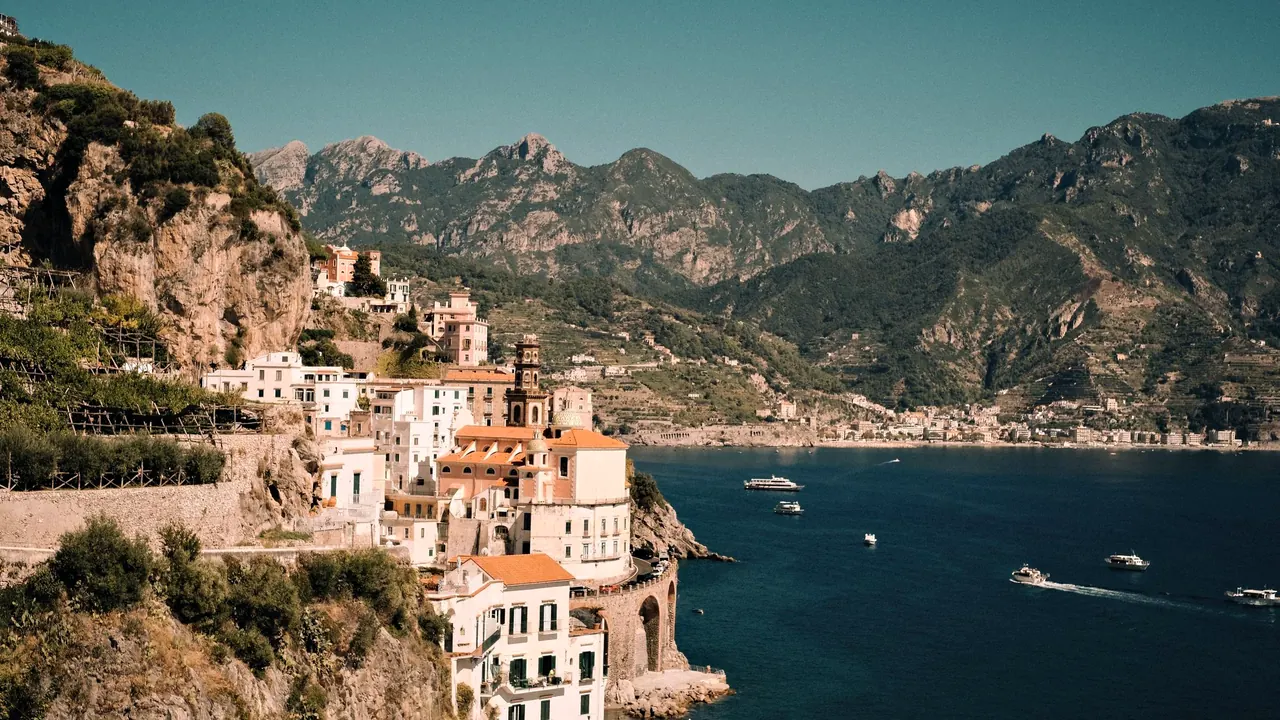
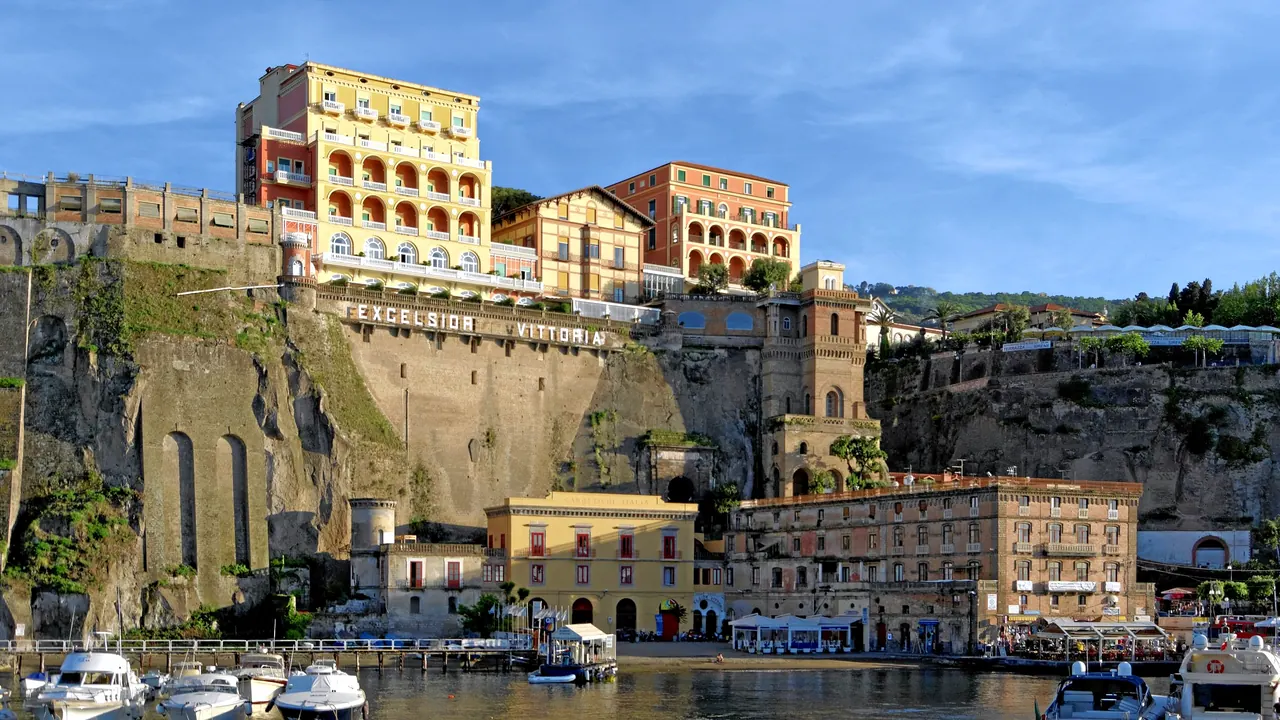
Photos: Amalfi Coast by Alina Chernii, Pexels License; Sorrento by Berthold Werner, CC BY-SA 3.0, cropped.
Amalfi Coast or Sorrento?
Our verdict in twelve categories, each scored against the same fixed benchmark cities, and the climate month by month, so you can choose for your trip.
Choose Amalfi Coast for
- culture and sights
- live music and the arts
- shopping
The Amalfi Coast suits a slower, more romantic trip built around the coastline itself. That means swimming from a boat below the cliffs, dinner on a terrace in Positano or Ravello, Amalfi's cathedral and the villa gardens high above it. It is best for couples who can afford it and don't mind stairs, crowded buses and a cliff road that jams in summer.
Choose Sorrento for
- getting around
- prices
- day trips
Sorrento makes more sense as a practical base for the whole region. From a flat, walkable town you can take the train to Pompeii and Naples, a ferry to Capri or a summer boat to Positano. Rooms and meals cost noticeably less, and families with pushchairs have an easier time. In return you give up some drama, because the town has few sights of its own and you swim from piers rather than coves.
Scoreboard
Twelve categories on one fixed scale from 0 to 100. The shaded stretch is the gap between the two.
Your match
Pick a travel style or drag the sliders, and both match scores follow your weighting.
Wins on culture and sights and live music and the arts with your weighting.
Wins on getting around and prices with your weighting.
What matters to you?
Category by category
What the scores mean for a trip.
Beaches & swimming
The Amalfi Coast has the better swimming. There is deep, clear water below the cliffs, with real pebble coves at Positano, Atrani and Marina di Praia and in the narrow fjord at Furore, and you can anchor a hired boat between Positano and Amalfi. Maiori and Minori add the one long stretch of sand with room to spread out.
In Sorrento most swimming is off the wooden piers at Marina Piccola and Marina Grande, or from the rocks at the Bagni della Regina Giovanna. The water is just as warm and clear, but for an actual beach you take a bus to Marina del Cantone or a boat over to the Amalfi side.
Food & drink
Both cook from the same Campanian larder of lemons, fish and hill dairies, but the Amalfi Coast has more local character. Look for Cetara's cured anchovies and colatura fish sauce, scialatielli with clams, fish baked in lemon leaves and the sfogliatella of Conca dei Marini. Meals range from family trattorias in Minori and Agerola to grand hotel terraces in Ravello.
Sorrento's own dish is gnocchi alla sorrentina, and good Neapolitan pizza is easy to find. The best meals are at Marina Grande, on the back lanes and in the fine-dining rooms of the hill villages, because around Piazza Tasso the tour-group menus take over.
Culture & sights
The Amalfi Coast has much more to see in its own right. There is Amalfi's striped cathedral with its Cloister of Paradise, a reminder of the old maritime republic. Up in Ravello are the villas and gardens of Rufolo and Cimbrone, and the whole UNESCO-listed coast, where Positano and Atrani are sights simply as places. Neither destination has a major museum.
Sorrento's old town is pleasant for a day or two, with its Roman street grid, the cloister of San Francesco and the Museo Correale's paintings and porcelain. Beyond the odd ravine of the Vallone dei Mulini, most of what draws people lies on day trips out of town.
Nightlife
Neither is a place for a big night out. Evenings on the Amalfi Coast mean a long terrace dinner, café tables in Amalfi's cathedral square and a couple of late cocktail bars in Positano. From November to March much of the coast shuts early.
Sorrento has a little more variety, though still quiet. There is the passeggiata on Corso Italia, plus wine bars, pubs aimed at British visitors and piano bars playing Neapolitan song. From either, a real night out means Naples and a room there for the night.
Nature & outdoors
Both sit on the same limestone ridge above the same sea, and from either the Path of the Gods is within reach. What differs is what lies on the doorstep. On the Amalfi Coast it is the cliffs themselves: old mule tracks between Amalfi and Ravello, the waterfall gorge of the Valle delle Ferriere, and boat trips to the Grotta dello Smeraldo and the snorkelling waters around Li Galli.
From Sorrento the walks head west to Punta Campanella and the protected bay of Ieranto, up into the beech woods of Monte Faito or to the crater rim of Vesuvius. Capri's grottoes are a short boat ride away.
Day trips
Sorrento is the better launch pad. The Circumvesuviana train reaches Pompeii in about half an hour and Naples in about an hour, so you can see Pompeii and Vesuvius on the same day. Capri is under an hour by ferry.
From the Amalfi Coast the same places are all reachable, but Pompeii takes over an hour on slow roads, so many trips depend on seasonal ferries. Its advantage lies to the east: Vietri sul Mare's ceramics, Salerno's medieval quarter and the Greek temples of Paestum are all nearer.
Good for families
Neither is easy with small children, but Sorrento is the gentler of the two. The centre is flat and largely pedestrian, so pushchairs work, and the train to Pompeii and the boat to Capri make simple outings. The catch is that swimming is off piers into deep water.
On the Amalfi Coast the towns are built on stairways, and long stretches of the road have no pavement. Families do best in Maiori or Minori, where the beaches are sandier and the seafront is level.
Getting around
Sorrento is far simpler to move around. The centre is small and flat, a lift goes down to the marinas, and a direct train runs to Pompeii and Naples, though it is crowded and often late. You don't need a car, although hotels up in the hills rely on shuttles or taxis.
The Amalfi Coast depends on one narrow cliff road that jams in summer, with packed buses and almost no parking, and every town means climbing. From spring to autumn the ferries between Positano, Amalfi and Maiori are the easy way to get about, and a base on the waterfront saves a lot of legwork.
Shopping & style
The Amalfi Coast has more worth browsing: Positano's lanes of loose linen and bright resort clothing, Amalfi's handmade paper and the majolica workshops of Vietri sul Mare, where you can buy anything from a single tile to a full dinner service.
Sorrento's lanes around Via San Cesareo lean heavily on lemon souvenirs, though its intarsia wood inlay and its coral and cameo jewellery are genuinely local. Both have sandal makers who will fit a pair while you wait.
Affordability
Of the two, the Amalfi Coast is the more expensive by a wide margin. In summer the costs come at you from every side: a balcony over the water in Positano or Ravello, lunch on a seafront terrace, a sunbed on a pebble cove, a boat for the day and a taxi along the cliff road. It costs less if you sleep in Maiori, Minori, Atrani or the hill villages of Agerola, eat away from the waterfront and travel by bus and ferry. Rates fall in May and October, and of those two, late September into early October is the better time for a beach stay, because the sea is still warm enough to swim.
Sorrento still charges resort prices in high season, but as a base it is the easier on your wallet. The train to Pompeii and Naples and the local buses cost very little, and a meal in a back-lane trattoria or pizzeria costs far less than one on a terrace over the bay. Hotel rates also drop sharply in spring and late autumn.
Live music & performing arts
Ravello gives the Amalfi Coast a real musical draw. Its long link with Wagner lives on in a summer festival, with orchestras on a stage built over the cliff at Villa Rufolo, a chamber series on many evenings and the auditorium below the town. Outside the season there is very little.
Sorrento has less: Neapolitan song and tarantella shows put on for visitors, and summer concerts in the cloister of San Francesco. For opera, both send you to the Teatro di San Carlo in Naples.
Wellness & relaxation
Neither has a bathing tradition of its own, and for both the nearest thermal springs are on Ischia, which is an easier ferry ride from Sorrento. In both places rest means a cliff-top hotel spa and a slower pace in spring and autumn.
The difference is in the setting. The Amalfi Coast has genuinely quiet bases in Ravello, Atrani, Praiano and Conca dei Marini, away from the beach crowds. In Sorrento the calm is in the old villa gardens and the hotels above the bay, because the centre itself is busy and noisy in summer.
When should you go?
Pick your month. The climate figures are measured averages, not a forecast.
Amalfi Coast in July
Sorrento in July
Daytime high, °C
Rainfall in the month, mm
Where the figures come from
Amalfi Coast's temperatures are measured 65 km from the centre, at Grazzanise.
Amalfi Coast has no rain gauge within 25 km of the centre, so its rainfall comes from a gridded climate dataset read at the destination rather than from a gauge further away.
Sorrento has no rain gauge within 25 km of the centre, so its rainfall comes from a gridded climate dataset read at the destination rather than from a gauge further away.
Sorrento's sunshine is measured 54 km from the centre, at Grazzanise.
Temperature and rainfall are climate normals, averaged over the years shown. Amalfi Coast: 1991-2020 normals, Grazzanise (64.7 km from centre). Sorrento: 2005-2025 (sunshine 1991-2020, rainfall 1991-2020) normals, Capri (17 km from centre).
Both look onto the same sea, so the swimming season is the same: warm enough from June, peaking at 26°C in August and still pleasant into early October. July and August are the hottest months and slightly hotter on the Amalfi side, where days around 31°C make the steep stairways and trails hard work by midday. Sorrento stays a degree or two cooler. Summers on both are dry and very sunny.
The rain comes back in September and builds through October to a wet November, when Sorrento gets around 150mm. Winter days stay near 13°C, which is mild and grey, fine for walking but not for swimming. On both, May, June and late September are the best compromise: warm enough to be out all day, with the sea reaching 23°C from June.
Which traveller are you?
On a culture and arts trip, the Amalfi Coast has more to see on the spot: Amalfi's Arab-Norman cathedral and cloister, Ravello's villa gardens and, in summer, festival concerts on a stage over the cliff. Sorrento's own sights fill a day or two at most.
On a tight budget, Sorrento lets you skip the extras that drain money on the Amalfi Coast. You can swim from the rocks at the Bagni della Regina Giovanna instead of hiring sunbeds, walk out to Punta Campanella and Ieranto for free, and take scheduled ferries to Capri rather than hiring a boat.
For a short city break, Sorrento works where the Amalfi Coast struggles. Its centre is compact and flat, and the old lanes and cliff-top terraces fill a couple of days. Pompeii or Capri add another day without needing a car or a slow cliff road.
Before you go
| Measure | Amalfi Coast | Sorrento |
|---|---|---|
| Official language | Italian | Italian |
| Currency | Euro (EUR) | Euro (EUR) |
| Sockets | CFL230 V, 50 Hz | CFL230 V, 50 Hz |
| Driving side | Right | Right |
| Time zone | UTC+1, UTC+2 in summer | UTC+1, UTC+2 in summer |
| Emergency number | 112 | 112 |
| Elevation | - | 50 m |
| Main airport | Naples International Airport (NAP)131 non-stop destinations | Naples International Airport (NAP)30 km from centre131 non-stop destinations |
| Public holidays this year | 13 days | 13 days |
By the numbers
| Measure | Amalfi Coast | Sorrento |
|---|---|---|
| Population | - | 15,407 |
| People per km² | - | 1,541 |
| Museums within 10 km | - | 6 |
| UNESCO World Heritage sites within 50 km | - | 5 |
| Swim season, months above 21 °C | 5 months | 5 months |
Where else could you go?
Every comparison below shares a destination with this one, so you can follow Amalfi Coast or Sorrento somewhere new.
- Positanovs Sorrento
- Caprivs Sorrento
- Amalfivs Sorrento
- Naplesvs Sorrento
- Caprivs Amalfi Coast
- Salernovs Sorrento