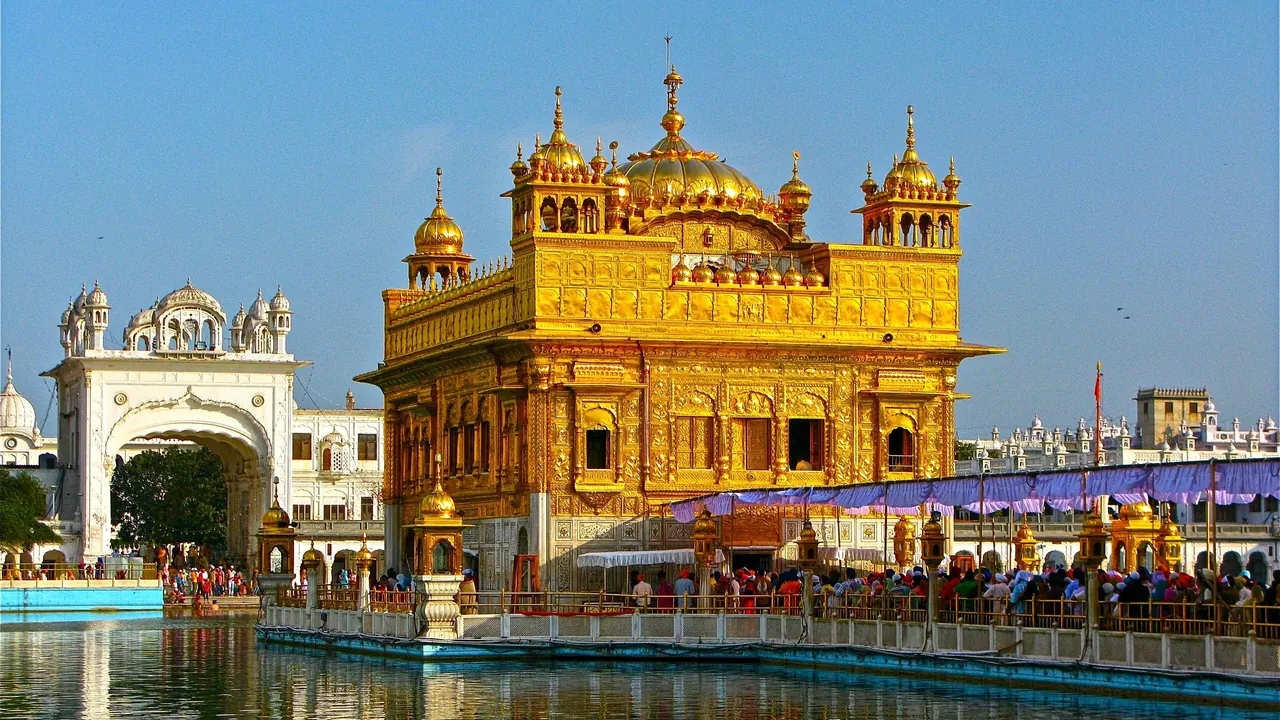
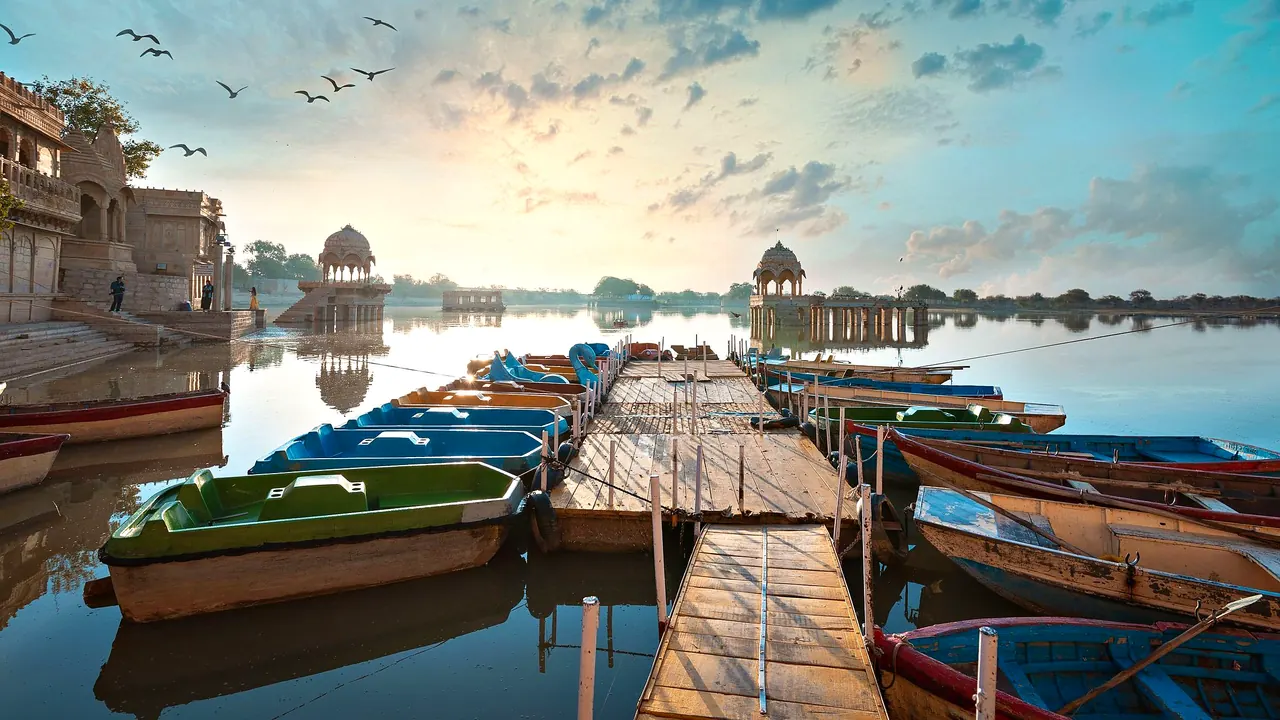
Photos: Amritsar by Ken Wieland, CC BY-SA 2.0, cropped; Jaisalmer by Prakash Yadav, Pexels License.
Amritsar or Jaisalmer?
Our verdict in twelve categories, each scored against the same fixed benchmark cities, and the climate month by month, so you can choose for your trip.
Choose Amritsar for
- food and drink
- day trips
- shopping
Amritsar is for the traveller who wants one great sacred place and a lot of good food. The Golden Temple, the langar and the dhabas of the old walled city make for a dense, absorbing stay, with Jallianwala Bagh, the Partition Museum and the Wagah border ceremony adding history. Its bazaars are also the better place to shop for textiles.
Choose Jaisalmer for
- nature and the outdoors
- getting around
- wellness
Pick Jaisalmer if the desert is what draws you. You get a lived-in sandstone fort, carved merchant havelis and the Thar dunes just outside town, with nights at a camp under a very dark sky and Manganiyar musicians by the fire. The eating is plainer than in Amritsar, and the town is remote, so it works best as one stop on a longer Rajasthan route.
Scoreboard
Twelve categories on one fixed scale from 0 to 100. The shaded stretch is the gap between the two.
Your match
Pick a travel style or drag the sliders, and both match scores follow your weighting.
Too close to call, 2 points apart
Wins on food and drink and day trips with your weighting.
Wins on nature and the outdoors and getting around with your weighting.
What matters to you?
Category by category
What the scores mean for a trip.
Beaches & swimming
Neither city has anywhere to swim. Amritsar sits on the inland plains of Punjab, and its only water is the Golden Temple's sacred pool, where pilgrims bathe as worship. In Jaisalmer, Gadisar Lake is for boating, not bathing. The real difference is the hotel pool: Jaisalmer's heritage hotels and resorts often have one, and in the hot months it earns its keep.
Food & drink
Amritsar is the city to travel to for food. Its own style of Punjabi cooking is famous: butter-laden kulcha with chole, batter-fried river fish, slow-cooked dal and lassi in steel tumblers, often from old dhabas near the temple that make one dish all morning. Eating dal and roti on the floor of the langar beside pilgrims is part of the visit.
Jaisalmer's desert cooking is worth trying, especially ker sangri and dal baati churma in a simple thali, or kachori from a morning stall. Many visitor restaurants, though, are rooftop places mixing a few local dishes with uneven pizza and pasta. Neither city does much fine dining.
Culture & sights
These two are evenly matched, but the experience is very different. Amritsar is about devotion and modern history. The Golden Temple is a working shrine you return to at dawn and after dark, and close by are Jallianwala Bagh and the Partition Museum's personal accounts of 1947.
Jaisalmer is about architecture. Its twelfth-century fort is still lived in, with Jain temples carved in astonishing detail, and below it stand the lace-like façades of Patwon ki Haveli and its neighbours. Both sets of sights are small. In Amritsar you go back to one place again and again, while in Jaisalmer you wander a whole golden townscape.
Nightlife
Neither is a place for a night out. Amritsar's evenings are a long dinner and then a walk round the illuminated temple pool, with only a few hotel bars in the newer districts. Jaisalmer offers a rooftop meal facing the floodlit fort, perhaps a beer, or a campfire show at a dune camp that ends soon after dinner. In both, the lanes go quiet early.
Nature & outdoors
Jaisalmer has the stronger draw outdoors, because the Thar Desert starts on its doorstep. An overnight camel trek through scrub and villages to sleep under the stars is the highlight, and the Desert National Park adds gazelles, raptors and the rare great Indian bustard. Still, there are no hills, rivers or forests.
Amritsar is surrounded by flat fields of wheat, rice and mustard, so walks happen in its city gardens. Its one real outing is the Harike wetland, about an hour and a half away, which is best in winter when the waterbirds arrive.
Day trips
Amritsar gives you more to do in a day. The Wagah border ceremony, about 30km away, is a loud and unforgettable afternoon, and Sikh pilgrimage towns such as Tarn Taran Sahib lie within an hour. Kapurthala's French-style palace and Moorish mosque are further, but still manageable in a day.
Jaisalmer's outings are short and pair well with a dune trip: the Jain temples at Lodurva and the abandoned stone villages of Kuldhara and Khaba. Beyond them, Pokaran and Tanot each take around two hours by road for a modest reward.
Good for families
Both suit a family with school-age children better than one with toddlers, and neither has anything built for children. Amritsar's draws are the excitement of the langar kitchens and the Wagah crowds. However, the old-city traffic, fierce summers and foggy winter mornings take some care.
Jaisalmer is more of an adventure. A fort that looks like a giant sandcastle, camel rides, jeep runs and a night in a tent camp tend to win children over. Getting there is a long journey, though, and it really only works in the cool months.
Getting around
Both are easy at the centre and awkward beyond it. In Amritsar, the temple, Jallianwala Bagh and the Partition Museum are linked by a pedestrianised heritage street. Anywhere else means rickshaws or ride-hailing cars through heavy traffic.
Jaisalmer is a smaller town, where the fort, havelis and lake are all within walking distance. The lanes are narrow and uneven and shared with motorbikes and cattle. In both places you need a hired car or an organised trip to get further out, whether that is Wagah or the dunes.
Shopping & style
Amritsar has the better bazaars. Hall Bazaar and Katra Jaimal Singh are dense with Punjabi suits, shawls, bright phulkari embroidery and stacks of juttis, and the food shops sell papad and warian to take home. The malls cover branded fashion.
Jaisalmer has plenty of crafts, such as mirror-work quilts, camel leather, silver and carved sandstone, sold in the fort lanes. However, much of the stock repeats from shop to shop and the sellers push hard. Expect to bargain in both cities.
Affordability
Both are very cheap, and the differences lie in the details. In Amritsar the biggest sight and the langar meals are free, and pilgrim rest houses take visitors too. In Jaisalmer, simple guesthouses with fort views cost little and camel trips can be haggled down. However, foreigners pay more at monuments there, and the palace hotels and luxury camps charge international rates.
Live music & performing arts
Music is what both cities offer, and neither has much else. Amritsar's music is devotional: gurbani kirtan sung to harmonium and tabla from before dawn until late, which anyone can hear sitting by the temple pool.
Jaisalmer's is folk music. Manganiyar and Langa singers with kamaicha and khartal play most evenings at camps and on rooftops, often alongside Kalbelia dancers, and the winter Desert Festival brings out more. The settings feel staged at times, but the musicians are the real thing.
Wellness & relaxation
Neither is a place for spas, which come down to a few hotel treatment rooms, and both towns are noisy in the lanes. The calm comes from very different places. In Amritsar, it is the cool marble round the temple pool at dawn or late at night, with hymns in the air. In Jaisalmer, it is a quiet haveli courtyard in the afternoon or a remote dune camp after dark.
When should you go?
Pick your month. The climate figures are measured averages, not a forecast.
Amritsar in July
Jaisalmer in July
Daytime high, °C
Rainfall in the month, mm
Where the figures come from
Jaisalmer has no rain gauge within 25 km of the centre, so its rainfall comes from a gridded climate dataset read at the city rather than from a gauge further away.
Temperature and rainfall are climate normals, averaged over the years shown. Amritsar: 1991-2020 normals, Amritsar (1.2 km from centre). Jaisalmer: 1993-2020 (rainfall 1991-2020) normals, Jaisalmer (1.9 km from centre).
Both are cool-season destinations, and neither is for swimming. Amritsar is at its best from October to March. November is pleasant for walking the old city, but December and January are cool, at around 17°C by day, and the mornings often bring dense fog. By May the city is baking at 40°C, and July and August are the wettest months, with about 190mm each.
Jaisalmer is much drier and runs warmer all year. Its winter days are mild and sunny, around 24°C in January, though desert nights get cold, so December to February suits it best. March already feels hot there while Amritsar is still comfortable. From April to June the desert is punishing, peaking at 43°C. The short monsoon brings most of its rain in August, and only the early mornings and evenings are good for being out.
Which traveller are you?
On a food and nightlife trip, Amritsar is the clear pick. Kulcha, fried fish and lassi in the old-city dhabas, plus a meal at the temple langar, beat Jaisalmer's rooftop menus. Evenings are quiet in both, but a lit-up temple walk rounds off dinner.
For an outdoors trip, go to Jaisalmer. The Thar Desert is right there, with sunset at the Sam or Khuri dunes, overnight camel treks and birding in the Desert National Park. Flat farmland around Amritsar offers little beyond the winter birds at Harike.
For a short city break, Amritsar works better. Its main sights sit close together around a pedestrian heritage street, and a few days cover the temple, the museums and Wagah. Jaisalmer takes a long train or road journey to reach, which suits a longer route.
Before you go
| Measure | Amritsar | Jaisalmer |
|---|---|---|
| Official language | Hindi, English | Hindi, English |
| Currency | Indian Rupee (INR) | Indian Rupee (INR) |
| Sockets | CM230 V, 50 Hz | CM230 V, 50 Hz |
| Driving side | Left | Left |
| Time zone | UTC+5:30 | UTC+5:30 |
| Emergency number | 108 or 112 | 108 or 112 |
| Elevation | 234 m | 225 m |
| Main airport | Sri Guru Ram Das Ji International Airport (ATQ)12 km from centre17 non-stop destinations | Jaisalmer Airport (JSA)6 km from centre5 non-stop destinations |
By the numbers
| Measure | Amritsar | Jaisalmer |
|---|---|---|
| City population | 1,159,227 | 65,471 |
| People per km² | 6,819 | 12,837 |
| Museums within 10 km | 3 | 2 |
| UNESCO World Heritage sites within 50 km | 1 | 1 |
Where else could you go?
Every comparison below shares a destination with this one, so you can follow Amritsar or Jaisalmer somewhere new.
- Jodhpurvs Jaisalmer
- Rishikeshvs Amritsar
- Lehvs Amritsar
- Udaipurvs Jaisalmer
- Delhivs Amritsar
- Jaipurvs Jaisalmer