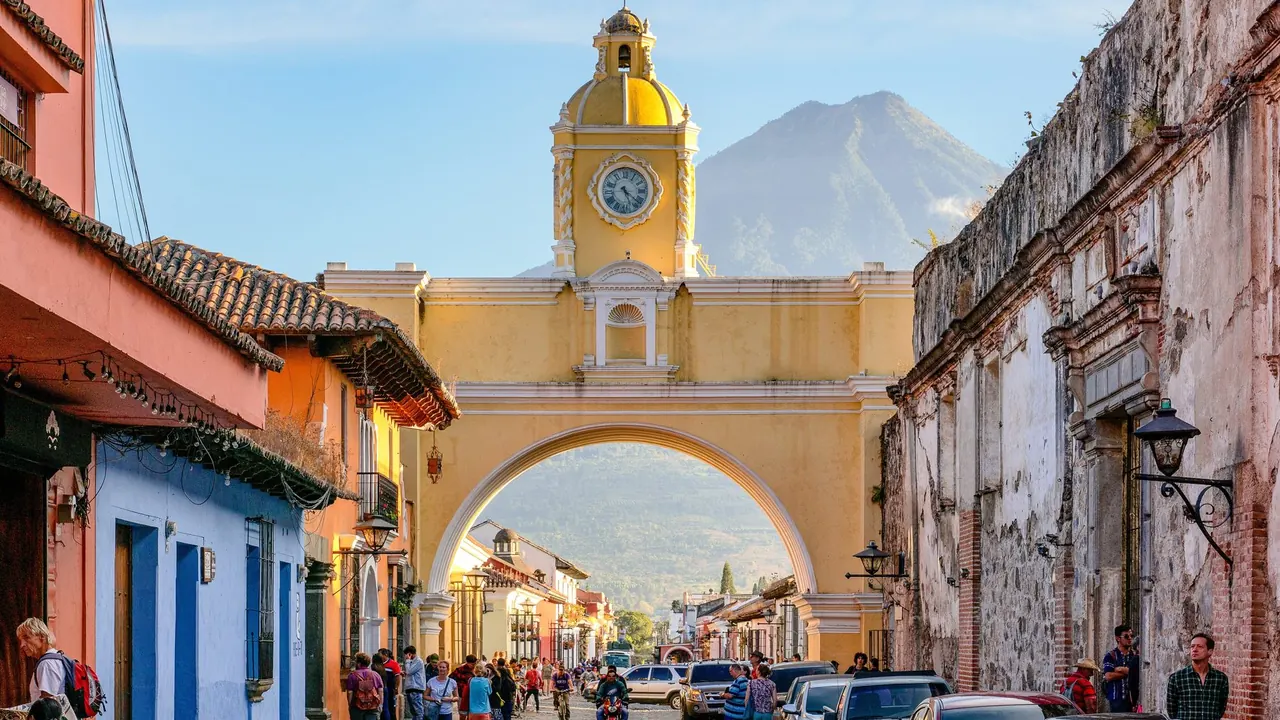
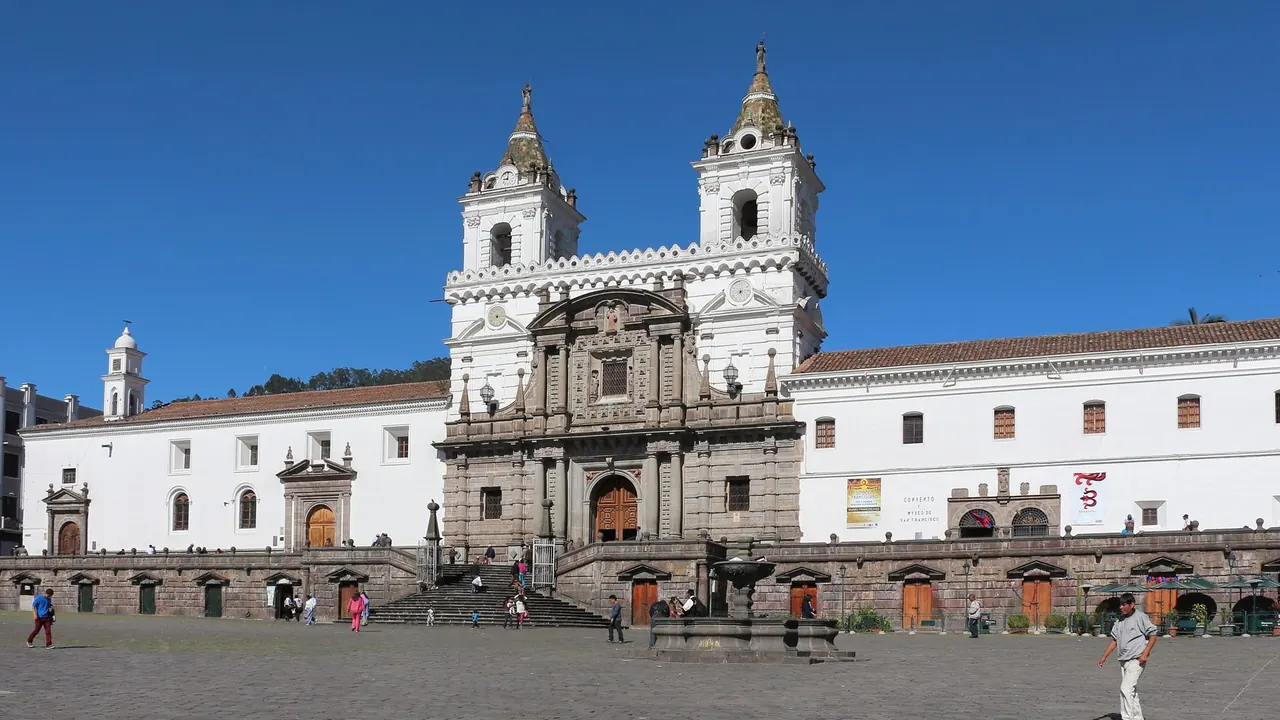
Photos: Antigua Guatemala by Chad Davis, CC BY-SA 2.0, cropped; Quito by Bernard Gagnon, CC BY-SA 3.0, cropped.
Antigua Guatemala or Quito?
Our verdict in twelve categories, each scored against the same fixed benchmark cities, and the climate month by month, so you can choose for your trip.
Choose Antigua Guatemala for
- getting around
- families
- shopping
Antigua suits a slower, smaller trip. Its colonial grid of ruined churches and cobbled streets can be walked end to end, the days are warm, and the altitude is gentle enough that nobody loses their first day to it. It is the easier choice with children or for a few unhurried days, and the overnight climb of Acatenango to watch Fuego erupt is an experience Quito has no match for.
Choose Quito for
- live music and the arts
- prices
- culture and sights
Travellers who want more depth should pick Quito. Its old town is larger and richer, with gilded churches and serious museums, it has a real theatre and folk ballet, and the mountains and cloud forest within reach are on a grander scale. Day-to-day costs are lower too, which helps on a long trip or one that goes on to the Galápagos, as long as you accept a sprawling city, cooler air and a couple of days to adjust to the altitude.
Scoreboard
Twelve categories on one fixed scale from 0 to 100. The shaded stretch is the gap between the two.
Your match
Pick a travel style or drag the sliders, and both match scores follow your weighting.
Wins on getting around and families with your weighting.
Wins on live music and the arts and prices with your weighting.
What matters to you?
Category by category
What the scores mean for a trip.
Beaches & swimming
Neither is a beach destination, and from either one swimming means a hotel pool. Antigua at least has a coast within a long morning's reach: the black volcanic sand at Monterrico is about two hours away, though the surf and currents make it better for an overnight stay than for a swim.
From Quito the Pacific is a long drive or a flight, so the sea becomes a separate leg of the trip, often the Galápagos. Closer to the city, the warm municipal pools in the valleys below make a pleasant alternative.
Food & drink
Quito has a little more to eat its way through. Mercado Central and Mercado Santa Clara serve locro de papa, hornado and almuerzo set lunches beside juice stalls selling unfamiliar Andean fruit, canelazo warms the cold evenings, and a small modern scene works with Andean produce.
Antigua's strength is narrower and comes from its slopes: coffee you can follow from farm to cup, chocolate tastings, and stews like pepián and jocón. Away from the market comedores, the restaurants around the central park are aimed at visitors, and the choice wears thin after a few days.
Culture & sights
Quito has the deeper heritage. Its old town is one of the largest intact colonial cores in the Americas, with La Compañía's gilded interior, the San Francisco monastery and the Quito school's carved altarpieces, and Casa del Alabado and the Capilla del Hombre add museums of real weight.
Antigua's appeal is the atmosphere of a capital abandoned after the 1773 earthquakes: roofless convents such as Capuchinas and Santa Clara, trees growing through broken vaults, and the yellow Santa Catalina arch. It suits slow wandering, but its museums are small and two or three days cover it.
Nightlife
Quito gives you more choice on a weekend. La Mariscal around Plaza Foch fills its salsa clubs and bars from Thursday to Saturday, and La Floresta offers quieter cocktail and craft-beer bars, though you take taxis between districts after dark.
Antigua's evenings fit into a few blocks near the arch: rooftop bars facing the volcanoes, mezcal bars behind colonial doorways and a couple of salsa spots full of language students. It is easy and walkable, but most of it closes well before the small hours.
Nature & outdoors
Quito has the wider range of country. The TelefériQo lifts you to about 4,000m for the climb to Rucu Pichincha, Cotopaxi's snow cone is two hours south, and to the west the Mindo cloud forest is among the richest birdwatching areas on earth.
Antigua's outdoors centres on three volcanoes, and one experience stands out: the overnight camp on Acatenango, facing Fuego as it throws lava into the night sky. Pacaya makes an easier half-day walk, while coffee-farm trails and Cerro de la Cruz lie just outside town.
Day trips
Both have a good spread of outings, but Antigua's best are close at hand: weaving villages like San Antonio Aguas Calientes are a tuk-tuk ride away, and Iximché is about ninety minutes out. Lake Atitlán and the Chichicastenango market are worth seeing but make long days, and many people stay over.
Quito's classic outing is Otavalo's Saturday market, paired with Cotacachi's leather shops, while the equator monument at Mitad del Mundo is under an hour away and Papallacta's hot springs lie over the Andes. Beyond those, most of its day trips head for mountains rather than towns.
Good for families
Antigua is the gentler place to bring children, mainly because it is small, calm and much lower. Chocolate-making workshops, coffee-farm visits, horse rides and the Pacaya walk keep school-age children busy, though cobbles defeat pushchairs and younger children may tire of cafés.
Quito has more set attractions, from straddling the equator line to the TelefériQo, the Yaku water museum and the lawns of Parque La Carolina. The catch is physical: the thin air can leave small children unwell for the first days, and the steep streets and heavy traffic shorten the day.
Getting around
Antigua is far simpler to get around. The centre is a grid of about a dozen blocks each way, the volcanoes keep you oriented, and tuk-tuks fill the gaps, though the rough cobbles call for sturdy shoes.
Quito runs some 40km along its valley, so you rely on the metro, crowded bus corridors where pickpockets work, and cheap taxis or ride-hailing at night. Its old town is walkable, but steep, and at that altitude the climbs leave newcomers breathless.
Shopping & style
Both are craft towns rather than fashion destinations, and the difference lies in what you bring home. Antigua's craft market and the shops near the arch sell handwoven huipiles from highland villages, jade carving and ceramics, along with local coffee and chocolate, and the courtyard boutiques offer finer versions of the same.
Quito's specialities are Panama hats of toquilla straw, alpaca textiles, tagua-nut carvings and bean-to-bar chocolate, gathered in the La Mariscal artisan market. Serious buyers there save themselves for Otavalo, while in Antigua close inspection and bargaining matter more.
Affordability
Quito is the cheaper of the two for everyday travel. Set lunches, market juices, metro rides and cross-town taxis cost very little, and boutique hotels in old colonial houses are good value; only international hotels in the north, guided excursions and the Galápagos push costs up.
Antigua costs more than Guatemala's reputation suggests, because its restored-house hotels and central park restaurants charge close to Western rates. Careful travellers still manage well on hostels, comedor lunches and chicken buses.
Live music & performing arts
Quito gives you a real evening out. The nineteenth-century Teatro Nacional Sucre stages opera, dance and the national symphony, and the folk ballet companies perform Andean music and dance in full costume, with baroque concerts in old-town churches now and then.
In Antigua, music mostly happens in passing: marimba in the central park, salsa nights in bars and the odd concert in a ruined cloister. Its great spectacle is Holy Week, with brass bands and sawdust carpets, which is a matter of faith rather than the stage.
Wellness & relaxation
The two are about even for rest, but they offer it in different places. In Antigua it comes from the town itself: quiet evenings, garden courtyards with fountains, yoga studios, spa treatments using coffee and cacao, and the occasional Maya temazcal, though church bells can come early.
In Quito, relaxation means leaving town. Papallacta's steaming thermal pools in the misty páramo are the high point, and the valley pools at El Tingo are closer, while the city itself is noisy and the altitude makes the first days more tiring than restful.
When should you go?
Pick your month. The climate figures are measured averages, not a forecast.
Antigua Guatemala in July
Quito in July
Daytime high, °C
Rainfall in the month, mm
Where the figures come from
Antigua Guatemala has no rain gauge within 25 km of the centre, so its rainfall comes from a gridded climate dataset read at the city rather than from a gauge further away.
Quito's station stands 208 m above the city centre, so the centre is likely a little warmer than the figures say.
Temperature and rainfall are climate normals, averaged over the years shown. Antigua Guatemala: 1998-2020 (rainfall 1991-2020) normals, Guatemala Aeropuertola Aurora (23.5 km from centre). Quito: 1961-1990 normals, Izobamba-Santa Catalina (16.8 km from centre).
Antigua is warm all year, with afternoons of about 23°C to 27°C, so walking the streets is comfortable in any month. Rain decides when to go. From November to April it is dry, and from December to March almost no rain falls, which brings clear volcano views and the best hiking. From May to October heavy afternoon storms set in, peaking at nearly 300mm in June, and cloud often hides the peaks.
Quito stays cool, at about 18°C by day all year, so pack a layer whatever the month. Its calendar runs almost the other way round from Antigua's. June to August is the dry, sunniest stretch, with July down to about 32mm, while February to May is the wettest, peaking in April. The two cities are therefore at their best at opposite times of year, Antigua in the northern winter and Quito in midsummer.
Which traveller are you?
For a short city break, Antigua is the easier pick. Everything sits within a fifteen-minute walk on a compact grid, the ruins and the arch can be seen in two or three days, and there is no altitude to slow your first morning.
On a culture and arts trip, Quito goes further. It has a larger and better-preserved colonial centre, gold-leafed La Compañía, museums of pre-Columbian art and Guayasamín's paintings, and evenings at the Teatro Nacional Sucre or the folk ballet, which Antigua cannot offer.
On a trip on a tight budget, Quito gives you more for little. Antigua's free pleasures are its streets and the walk up Cerro de la Cruz, but the volcano climbs need paid guides. From Quito, hike Pichincha from the TelefériQo, bus to Otavalo or soak at El Tingo.
Before you go
| Measure | Antigua Guatemala | Quito |
|---|---|---|
| Official language | Spanish | Spanish, Shuar, Northern Quichua |
| Currency | Quetzal (GTQ) | US Dollar (USD) |
| Sockets | AB120 V, 60 Hz | AB120 V, 60 Hz |
| Driving side | Right | Right |
| Time zone | UTC-6 | UTC-5 |
| Emergency number | Police 110/120, ambulance 128, fire 123 | 911 |
| Elevation | 1,582 m | 2,850 m |
| Main airport | La Aurora International Airport (GUA)22 km from centre19 non-stop destinations | Mariscal Sucre International Airport (UIO)20 km from centre22 non-stop destinations |
| Public holidays this year | 13 days | 11 days |
By the numbers
| Measure | Antigua Guatemala | Quito |
|---|---|---|
| City population | 59,091 | 1,763,275 |
| People per km² | - | 4,735 |
| Museums within 10 km | 2 | 16 |
| UNESCO World Heritage sites within 50 km | 1 | 2 |
Where else could you go?
Every comparison below shares a destination with this one, so you can follow Antigua Guatemala or Quito somewhere new.