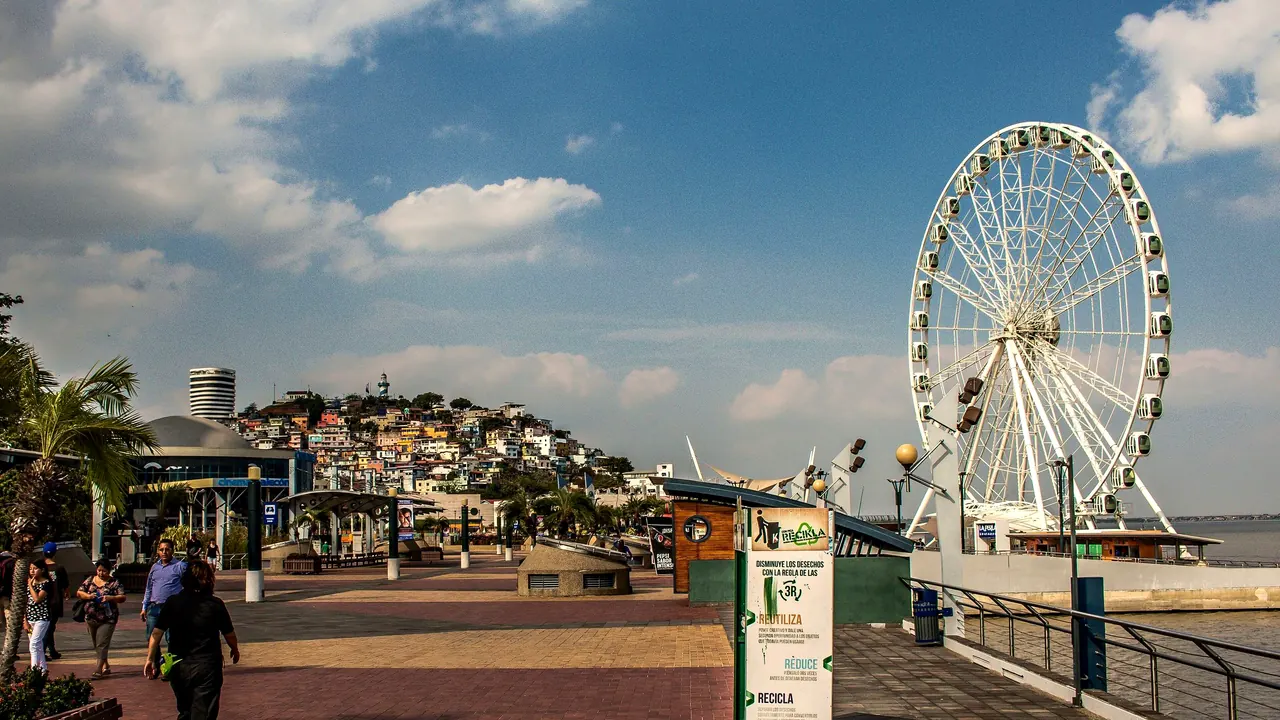
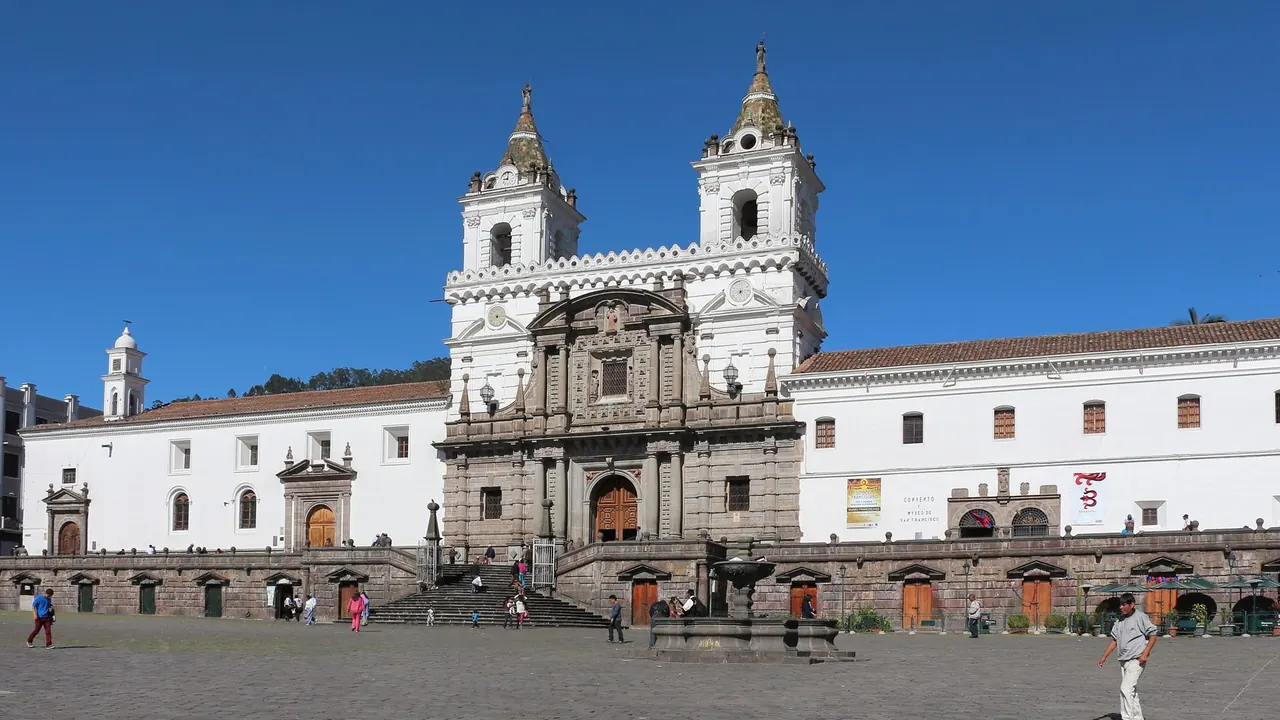
Photos: Guayaquil by Paulakindsvater, CC BY-SA 4.0, cropped; Quito by Bernard Gagnon, CC BY-SA 3.0, cropped.
Guayaquil or Quito?
Our verdict in twelve categories, each scored against the same fixed benchmark cities, and the climate month by month, so you can choose for your trip.
Choose Guayaquil for
- beaches
- food and drink
- families
Guayaquil suits travellers who are passing through on the way to the coast or the Galápagos and want to eat well on the way. Ecuador's coastal cooking is at its best here, from encebollado at breakfast to whole mangrove crabs cracked with a mallet. The Pacific beaches are a drive away rather than a flight. A day or two on the Malecón and in Las Peñas covers the sights, and the city works best as a hot, lively stopover.
Choose Quito for
- culture and sights
- nature and the outdoors
- day trips
Quito is the better choice for a longer stay, and for anyone who cares about history or mountains. Its colonial centre is one of the great old towns of the Americas, Pichincha and Cotopaxi are within easy reach, and Mindo's cloud forest and Otavalo's market both make good days out. The thermal pools at Papallacta give you somewhere to rest as well. You need a couple of slow days to get used to the altitude, but there is far more to do.
Scoreboard
Twelve categories on one fixed scale from 0 to 100. The shaded stretch is the gap between the two.
Your match
Pick a travel style or drag the sliders, and both match scores follow your weighting.
Wins on beaches and food and drink with your weighting.
Wins on culture and sights and nature and the outdoors with your weighting.
What matters to you?
Category by category
What the scores mean for a trip.
Beaches & swimming
Neither city is a beach destination, but Guayaquil at least lies within driving distance of the Pacific. The grey sand at Playas is about an hour and a half away, and Salinas and the surf villages are two hours or more. It is a long day out, but you can do it there and back.
Quito sits in an Andean valley, and the coast is a full day's drive or a flight away. Swimming there means a hotel pool or the warm municipal pools in the valleys below the city. Anyone who wants sand will plan the coast as a separate part of the trip.
Food & drink
Guayaquil has the edge, because this is where coastal Ecuadorian cooking is at its best. Expect shrimp ceviche, coconut encocados and bolón for breakfast, along with crab houses where tables of locals crack mangrove crabs with wooden mallets. The smarter, more creative cooking is found in Urdesa and Samborondón.
Quito's highland food is heavier and built on potatoes, corn and pork: locro soup, hornado and sugared empanadas de viento, followed by hot canelazo on a cold evening. The Mercado Central food courts are the place to try it. Quito also makes it easier to taste Ecuadorian coffee and cacao, which Guayaquil, with its thin café culture, does not.
Culture & sights
This is the biggest gap between the two cities. Quito's historic centre was one of the first places inscribed as a World Heritage site, and it is a large, largely intact colonial grid. Within it are the gold-leaf interior of La Compañía, the San Francisco monastery and its plaza, and climbable towers at the Basílica del Voto Nacional. Casa del Alabado and the Capilla del Hombre add serious art.
Most of colonial Guayaquil was lost in fires, above all in 1896, so its sights line up along the river instead. You can walk the Malecón, climb the 444 steps of Las Peñas, see the iguanas in Parque Seminario and spend an hour at the MAAC museum. It is a pleasant day, but there is not much more.
Nightlife
The two cities are about level for a night out, but they feel quite different. Guayaquil's scene is spread across the city: small terrace bars on the hill in Las Peñas, pubs on Urdesa's avenue, and polished clubs across the river in Samborondón, where the crowd dances to reggaeton and salsa. It is mostly a local scene and is most fun if you go with people who live there.
Quito's nightlife is concentrated around Plaza Foch in La Mariscal, with salsa clubs and backpacker bars. Quieter craft-beer and cocktail spots are spread through La Floresta, and La Ronda is good for an early canelazo. In both cities you take taxis between areas after dark.
Nature & outdoors
Quito has much the better outdoors. The TelefériQo lifts you to about 4,000m for the hike up Rucu Pichincha, Cotopaxi's snow cone is about two hours south, and the road west drops into Mindo's cloud forest, where you can see dozens of hummingbird species, ride zip-lines and walk to waterfalls.
Guayaquil's nature is lowland and on a smaller scale. Cerro Blanco has dry forest with howler monkeys and macaws, the footbridge to Isla Santay leads to mangrove boardwalks, and boats from Puerto El Morro go out to see dolphins. The birdlife is good, but there are no mountains nearby, and the wet-season heat cuts walks short.
Day trips
Guayaquil is more of a gateway than a base. The Santa Elena peninsula, with its ancient Amantes de Sumpa burial, and the cacao haciendas inland make decent outings. The places most visitors want to see, Cuenca, Montañita and the Galápagos, all need at least a night away.
Quito has a stronger choice of days out. Otavalo's Saturday market, combined with Cotacachi's leather shops and the weaving villages around Peguche, is a classic. The equator monument is under an hour away, and Mindo or the hot springs at Papallacta each fill a satisfying day.
Good for families
Neither city is ideal with children, and Guayaquil is slightly easier. Feeding the iguanas in Parque Seminario, the riverside playgrounds and the climb to the Las Peñas lighthouse are simple pleasures. The Parque Histórico mixes native animals with old wooden houses, and the malls give relief from the humid heat.
Quito has good outings too: straddling the equator line, the cable car, the Yaku water museum and the pedal boats in Parque La Carolina. The problem is the altitude, which can make small children unwell for the first few days, and the steep old town makes things harder still.
Getting around
Quito is easier to get around. A metro line runs the length of its long, narrow valley, and the colonial centre is best explored on foot, although the steep streets and thin air leave newcomers breathless. Taxis and ride-hailing fill the gaps cheaply.
In Guayaquil, the flat riverside core of the Malecón, downtown and Las Peñas is walkable in the heat, but beyond it the city sprawls. The Metrovía buses are not designed with visitors in mind, so app taxis do most of the work.
Shopping & style
Both cities sell much the same Ecuadorian crafts: toquilla straw hats, tagua carvings, textiles and local chocolate. Both also have malls that hold little for visitors. The difference is where the better crafts are found. Guayaquil's downtown artisans' market is useful, and the Bahía street market is worth a look as a scene.
Quito's galleries in the old town and La Floresta sell better-made pieces. Otavalo, the country's great craft market, is an easy day trip from Quito, whereas serious buyers in Guayaquil have to wait for Cuenca or Montecristi.
Affordability
Both are cheap cities for eating set lunches, riding buses and taking taxis, and Quito goes slightly further. Its guesthouses and small hotels in old colonial houses are good value, while Guayaquil's beds lean towards business hotels priced for corporate travellers. The costs that add up in Quito are guided volcano trips and any Galápagos trip booked from there. In Guayaquil, the main free attractions, the Malecón and the steps of Las Peñas, help keep a visit cheap.
Live music & performing arts
Guayaquil has no opera season and nothing to match Quito's grand old theatre. Its stage rests on the Teatro Centro de Arte, the Teatro Sánchez Aguilar in Samborondón and the city's symphony orchestra. What it does have is the pasillo. Julio Jaramillo, the ballad's best-known voice, was born here, his museum stands in Las Peñas, and a few bars still play the music live.
Quito gives you a little more for an evening out. The nineteenth-century Teatro Nacional Sucre on Plaza del Teatro stages opera, concerts and dance, and Andean folk ballet companies perform there in full costume. Old-town churches hold occasional baroque and choral concerts, and small venues in La Floresta and La Mariscal have live Andean, Latin and rock bands.
Wellness & relaxation
Quito is clearly the better choice if you want to rest. The thermal pools at Papallacta, set among misty páramo hills, are about an hour and a half away, and the simple public pools at El Tingo are closer still, even if the city itself is congested and the altitude is tiring at first.
Guayaquil has no bathing tradition, and with its heat, noise and traffic it offers little beyond hotel spas. The calmest time is early evening in the gardens along the Malecón, when the breeze comes off the river.
When should you go?
Pick your month. The climate figures are measured averages, not a forecast.
Guayaquil in July
Quito in July
Daytime high, °C
Rainfall in the month, mm
Where the figures come from
Quito's station stands 208 m above the city centre, so the centre is likely a little warmer than the figures say.
Temperature and rainfall are climate normals, averaged over the years shown. Guayaquil: 1991-2020 (rainfall 1981-2010) normals, Guayaquil / Simon Bolivar (4.5 km from centre). Quito: 1961-1990 (rainfall 1981-2010) normals, Izobamba-Santa Catalina (16.8 km from centre).
Guayaquil is hot all year, with highs of around 30°C every month, so the weather to plan around is the rain. From January to April it is wet and sticky, with as much as 362mm in March, and long walks become hard going. That is also when the sea off the nearby coast is warmest, at about 27°C, so a beach trip means accepting the humidity. From June to November the city is almost dry and easier for walking, but the water is cooler and the skies are often grey.
Quito stays at about 18°C by day all year, which is pleasant for walking the steep old town in any month. The rain comes in two seasons, from February to May and again from October to December. June to August is the dry spell, with around 20mm a month, and it is also the sunniest time of year, which makes it the best season for the volcano hikes. If you are combining the two cities, the middle of the year gives you Quito at its clearest and Guayaquil at its driest.
Which traveller are you?
On a beach and sun trip, Guayaquil is the closer starting point. Playas is about an hour and a half by road, and Salinas and Montañita are a few hours away, while Quito sits high in the Andes with no coast anywhere nearby.
For a culture and arts trip, Quito is far stronger. Its huge colonial centre, the gilded La Compañía, the Quito school altarpieces and museums such as Casa del Alabado could fill several days, and Guayaquil's riverside sights take only one or two.
On an outdoors trip, Quito wins easily. You can hike Rucu Pichincha from the cable car, walk on Cotopaxi's glacier or go birdwatching in Mindo's cloud forest. Guayaquil has mangrove boat trips and dry-forest trails, but the landscape is flat and humid.
Before you go
| Measure | Guayaquil | Quito |
|---|---|---|
| Official language | Spanish, Shuar, Northern Quichua | Spanish, Shuar, Northern Quichua |
| Currency | US Dollar (USD) | US Dollar (USD) |
| Sockets | AB120 V, 60 Hz | AB120 V, 60 Hz |
| Driving side | Right | Right |
| Time zone | UTC-5 | UTC-5 |
| Emergency number | 911 | 911 |
| Elevation | 4 m | 2,850 m |
| Main airport | José Joaquín de Olmedo International Airport (GYE)4 km from centre16 non-stop destinations | Mariscal Sucre International Airport (UIO)20 km from centre23 non-stop destinations |
| Public holidays this year | 11 days | 11 days |
By the numbers
| Measure | Guayaquil | Quito |
|---|---|---|
| City population | 2,650,288 | 1,763,275 |
| People per km² | 7,476 | 4,735 |
| Museums within 10 km | 6 | 16 |
| UNESCO World Heritage sites within 50 km | 0 | 2 |
| Swim season, months above 21 °C | 12 months | - |
Where else could you go?
Every comparison below shares a destination with this one, so you can follow Guayaquil or Quito somewhere new.
- Cuenca, Ecuadorvs Guayaquil
- Cuenca, Ecuadorvs Quito
- Calivs Quito
- Bogotavs Quito
- Calivs Guayaquil
- Bogotavs Guayaquil