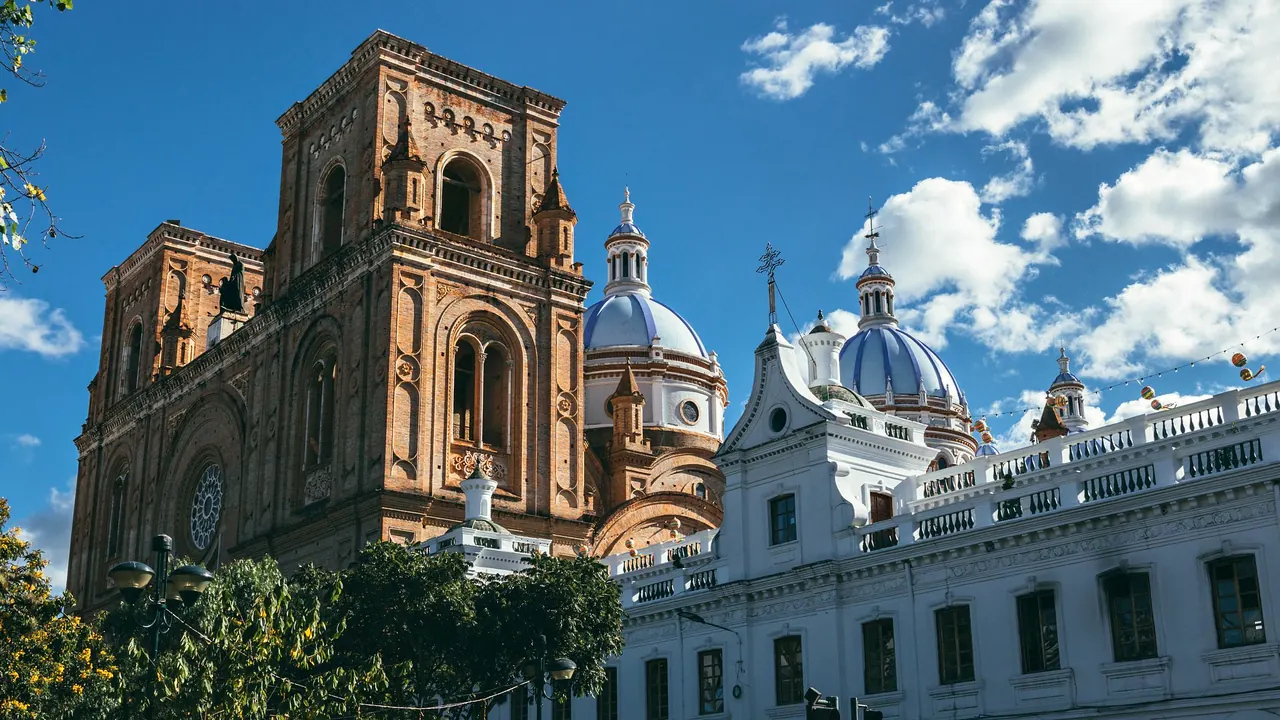
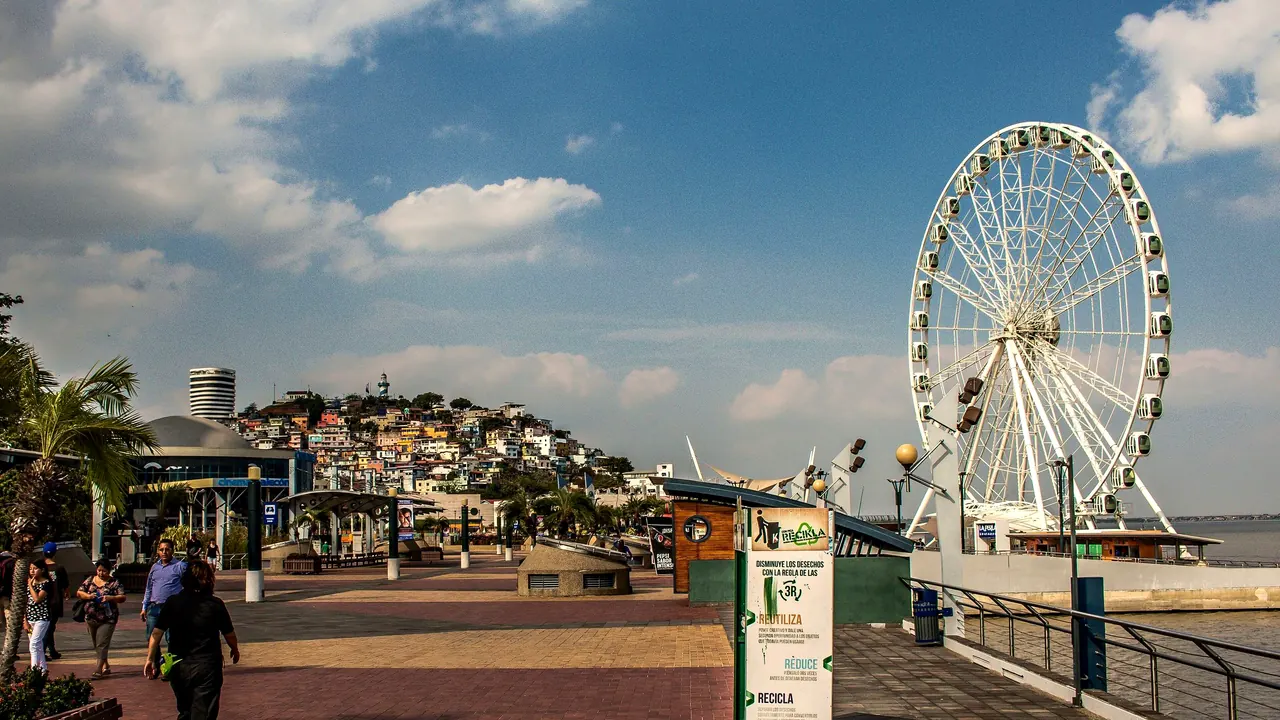
Photos: Cuenca, Ecuador by Charly Chacon, Pexels License; Guayaquil by Paulakindsvater, CC BY-SA 4.0, cropped.
Cuenca, Ecuador or Guayaquil?
Our verdict in twelve categories, each scored against the same fixed benchmark cities, and the climate month by month, so you can choose for your trip.
Choose Cuenca, Ecuador for
- wellness
- culture and sights
- getting around
Cuenca suits travellers who want a city to walk and linger in. The colonial centre, with its blue-domed cathedral and riverside escarpment, can be covered on foot. The wild páramo of Cajas starts less than an hour away, and the hot springs at Baños are on the edge of town. Days are cool and the pace is slow, and it costs very little. If you want a few calm days of sightseeing, hiking and good sleep, this is the better choice.
Choose Guayaquil for
- beaches
- food and drink
- nightlife
Guayaquil is for people who travel to eat. Its coastal cooking is the best in Ecuador: encebollado for breakfast, ceviche at lunch and mallet-cracked crab at long tables. Nights go on later and louder, and the city is the natural stopover on the way to the Galápagos or the surf coast. Expect heat, a sprawling city and taxis between neighbourhoods, and treat it as a lively stop of a day or two rather than a long stay.
Scoreboard
Twelve categories on one fixed scale from 0 to 100. The shaded stretch is the gap between the two.
Your match
Pick a travel style or drag the sliders, and both match scores follow your weighting.
Wins on wellness and culture and sights with your weighting.
Wins on beaches and food and drink with your weighting.
What matters to you?
Category by category
What the scores mean for a trip.
Beaches & swimming
Neither city is for a beach trip, but Guayaquil gets you to the sea far more easily. Playas is about an hour and a half by road, and Salinas and the surf villages around Montañita are two hours or more. You can do a long day out, though staying on the coast makes more sense.
From Cuenca the Pacific lies on the far side of the Andes, too far for a day trip. The nearest you get to swimming is a hotel pool or the warm pools at Baños.
Food & drink
Guayaquil eats better and with more variety. Its coastal cooking runs from a morning encebollado or bolón to shrimp ceviche, coconut encocados and the ritual of cracking mangrove crabs with a mallet. Urdesa and Samborondón add modern Ecuadorian cooking built on local cacao and fruit.
Cuenca's highland food is honest and filling but narrower. Hornado is carved in the Mercado 10 de Agosto, roast cuy is a weekend trip out to Ricaurte, and a hot canelazo warms the cold evenings. There is little fine dining to explore.
Culture & sights
Cuenca is the heritage city of the two by a wide margin. Its World Heritage grid of whitewashed colonial streets is crowned by the blue-tiled domes of the New Cathedral on Parque Calderón. Pumapungo pairs ethnographic collections with Inca terraces running down to the river, and the Conceptas convent museum fills out two or three good days.
Guayaquil's colonial wooden town burned, above all in 1896, so its sights gather along the river. There is the Malecón, the painted houses and lighthouse steps of Las Peñas, the MAAC's pre-Columbian collections and the marble tombs of the Cementerio General.
Nightlife
Guayaquil has more going on after dark. Locals go out late from Thursday to Saturday, with hillside bars in Las Peñas, pubs in Urdesa and big reggaeton and salsa clubs across the river in Samborondón. The catch is that the areas are spread out, so you need taxis and some care about street crime.
Cuenca's evenings centre on the small bars and craft-beer places of Calle Larga, which fill up with students and expats at weekends. The cool air sends most people home early, so it suits a quiet drink rather than a big night out.
Nature & outdoors
Cuenca has the more dramatic landscape. Cajas National Park starts less than an hour west, a windswept páramo of granite ridges and more than two hundred glacial lakes rising past 4,000m, with trails of every length. Closer in, four rivers give the city green banks for walking and cycling.
Guayaquil's nature is flat, hot and wet. There are dry-forest trails with howler monkeys at Cerro Blanco, boardwalks through the mangroves on Isla Santay, and boat trips from Puerto El Morro to see dolphins and frigatebirds. It is rewarding for birdwatchers, but hard going in the humid rainy months.
Day trips
Cuenca makes the better base. Ingapirca, Ecuador's largest Inca site, is about two hours north. A loop through the eastern valleys takes in Gualaceo's market, the silver filigree of Chordeleg and the straw-hat weavers of Sígsig.
Guayaquil works more as a gateway than a base. Within a day you can reach the Santa Elena peninsula, with its ancient embrace burial at the Amantes de Sumpa museum, or a cacao hacienda. The places most visitors want, the Galápagos, Montañita and indeed Cuenca, call for an overnight stay.
Good for families
Both cities have only a short list of things for children, and the difference is in how the days feel. Cuenca is calm and easy-paced. Bioparque Amaru has condors and spectacled bears, and the Baños pools are a treat, though the altitude tires small children at first and cobbles make pushchairs hard work.
Guayaquil offers simple pleasures: feeding the iguanas in Parque Seminario, the playgrounds and riverboats on the Malecón, and the native animals at Parque Histórico. The humid heat and the taxi rides between places are what wear families down.
Getting around
Cuenca is much easier to get around. Nearly everything a visitor wants lies within the compact old grid and along the river below it, so you walk most of the time and take the tram or a cheap taxi for longer hops. The altitude does make the river steps feel steep.
Guayaquil's riverside core is flat and walkable, but the heat drains you. Beyond it the city spreads into wide avenues, so Urdesa, Samborondón and the bus terminal mean an app-booked taxi. The crowded Metrovía is not built for visitors.
Shopping & style
For crafts, Cuenca has the edge, because the toquilla straw hat sold abroad as the Panama hat is finished and blocked in its own workshops. You can buy every grade here, along with local ceramics, embroidery and Chordeleg silver close by. Guayaquil's downtown artisans' market sells hats too, and its regional chocolate and big Samborondón malls cover what Cuenca lacks. Neither city has a fashion or boutique street.
Affordability
Both are cheap if you eat locally, but Cuenca goes further, mainly because of where you sleep. Guesthouses and restored colonial hotels in its old centre cost little, and its market lunches are among the cheapest good meals anywhere.
Guayaquil's comedores, ceviche and free riverside sights are just as kind to the wallet. Its hotels, however, lean towards business properties priced for corporate travellers, and that pushes up the cost of a stay.
Live music & performing arts
The two are about level, with small local scenes rather than big stages. Cuenca's symphony orchestra plays often, and frequently for free, in old churches and theatres. Its standout event is the Christmas Eve procession of the Pase del Niño Viajero.
Guayaquil offers more touring acts at the Teatro Sánchez Aguilar and stadium pop concerts. Its own musical voice is the pasillo, remembered at the Julio Jaramillo museum in Las Peñas and still played live in some bars.
Wellness & relaxation
Cuenca is far better for rest. The hot springs at Baños, a short ride away, have public pools, steam rooms and mud treatments that locals have used for generations. The city's unhurried pace and cool, quiet nights also make for good sleep.
Guayaquil is hot, humid and loud and has no bathing tradition, so wellness means a massage at a hotel spa. People in Guayaquil looking for rest usually head up to valleys like Cuenca's.
When should you go?
Pick your month. The climate figures are measured averages, not a forecast.
Cuenca, Ecuador in July
Guayaquil in July
Daytime high, °C
Rainfall in the month, mm
Where the figures come from
Cuenca, Ecuador has no weather station within reach, so its figures come from a gridded climate model rather than a measured record, and read a broad area rather than the city itself.
Temperature and rainfall are climate normals, averaged over the years shown. Cuenca, Ecuador: 2001-2020 normals, NASA POWER reanalysis grid, no weather station within 90 km. Guayaquil: 1991-2020 (rainfall 1981-2010) normals, Guayaquil / Simon Bolivar (4.5 km from centre).
The two cities feel very different through the year. Cuenca's mountain climate stays spring-like all year, with afternoons around 18°C in every month. That is good for walking the streets but never warm enough for swimming. Its wettest stretch runs from February to April, and the drier months from July to September are the best time for clear walks in Cajas.
Guayaquil is hot all year, with highs near 31°C, and its seasons depend on rain. From January to April heavy downpours arrive, up to 362mm in March, and the humidity makes walking hard. This is also when the sea on the nearby coast is warmest, at about 27°C. From June to November almost no rain falls and the heat is a little easier to bear, but the coastal water cools and skies are often grey.
Which traveller are you?
On a culture and arts trip, choose Cuenca. Its whole historic centre is a World Heritage Site of churches and balconied streets, and Pumapungo shows the excavated Inca city of Tomebamba. Guayaquil lost its colonial town to fire, and its sights take only a day.
For a food and nightlife trip, Guayaquil wins. Its coastal kitchen of ceviche, encocados and crab houses has far more range than Cuenca's market pork and soups. Its nights, from Las Peñas terraces to Samborondón clubs, also run much later than Cuenca's quiet bars.
On a relaxing and wellness trip, Cuenca is the clear choice. It has thermal pools and mud treatments at Baños, slow evening walks along the Tomebamba and cool, quiet nights. Guayaquil is hot, loud and full of traffic, and offers little beyond business-hotel spas.
Before you go
| Measure | Cuenca, Ecuador | Guayaquil |
|---|---|---|
| Official language | Spanish, Shuar, Northern Quichua | Spanish, Shuar, Northern Quichua |
| Currency | US Dollar (USD) | US Dollar (USD) |
| Sockets | AB120 V, 60 Hz | AB120 V, 60 Hz |
| Driving side | Right | Right |
| Time zone | UTC-5 | UTC-5 |
| Emergency number | 911 | 911 |
| Elevation | 2,550 m | 4 m |
| Main airport | Mariscal Lamar Airport (CUE)2 km from centre3 non-stop destinations | José Joaquín de Olmedo International Airport (GYE)4 km from centre16 non-stop destinations |
| Public holidays this year | 11 days | 11 days |
By the numbers
| Measure | Cuenca, Ecuador | Guayaquil |
|---|---|---|
| City population | 361,524 | 2,650,288 |
| People per km² | 5,121 | 7,476 |
| Museums within 10 km | 4 | 6 |
| UNESCO World Heritage sites within 50 km | 2 | 0 |
| Swim season, months above 21 °C | - | 12 months |
Where else could you go?
Every comparison below shares a destination with this one, so you can follow Cuenca, Ecuador or Guayaquil somewhere new.
- Quitovs Guayaquil
- Quitovs Cuenca, Ecuador
- Calivs Guayaquil
- Salentovs Cuenca, Ecuador
- Bogotavs Guayaquil
- Limavs Guayaquil