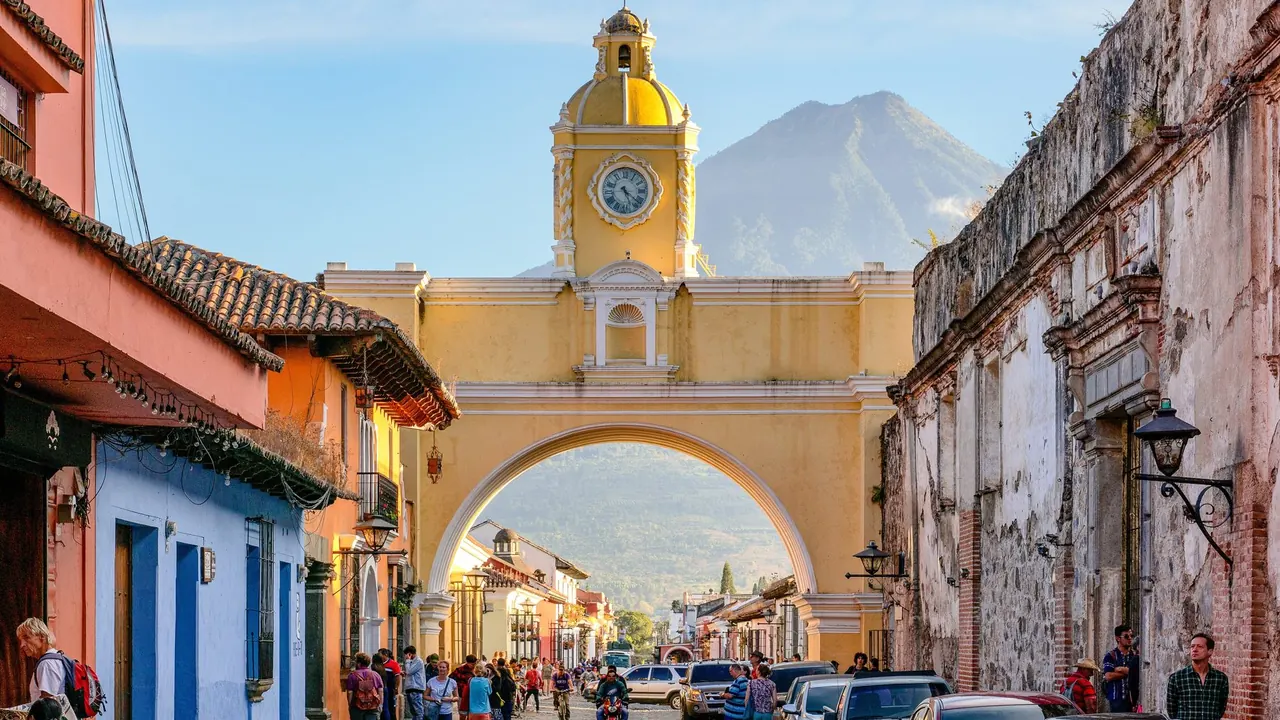
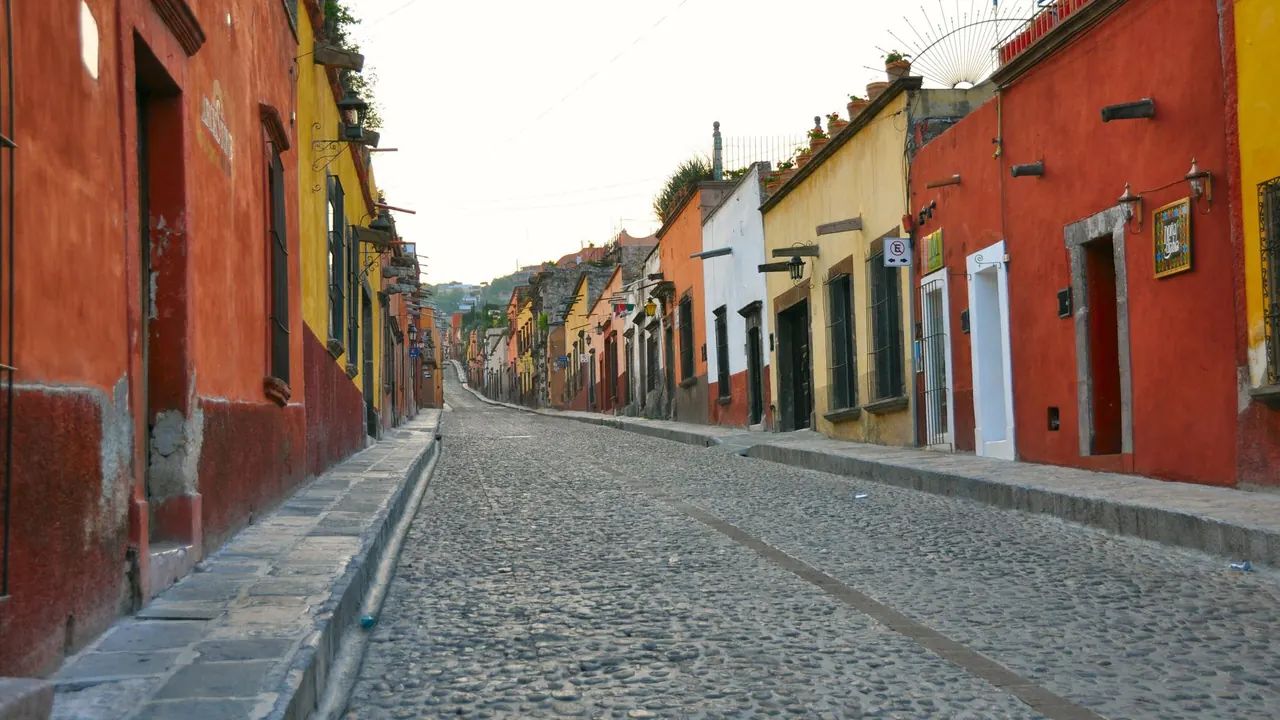
Photos: Antigua Guatemala by Chad Davis, CC BY-SA 2.0, cropped; San Miguel de Allende by Russ Bowling, CC BY 2.0, cropped.
Antigua Guatemala or San Miguel de Allende?
Our verdict in twelve categories, each scored against the same fixed benchmark cities, and the climate month by month, so you can choose for your trip.
Choose Antigua Guatemala for
- nature and the outdoors
- prices
- getting around
Antigua Guatemala suits travellers who want the outdoors close at hand and a town that is easy on the feet and the wallet. Volcanoes rise on three sides, the overnight climb of Acatenango to watch Fuego erupt is the trip many people come for, and the ruined colonial churches give the flat, compact grid a strong sense of history. Evenings are quiet, and the food runs out of variety after a few days.
Choose San Miguel de Allende for
- wellness
- day trips
- live music and the arts
San Miguel de Allende is the better choice for a slower, more comfortable stay built around eating well, hot springs and excursions. Its restaurants are more polished and its craft and design shops are stronger. Guanajuato, Querétaro and Atotonilco are all within easy reach, and the town has more live music and a theatre. The trade-offs are higher costs, steep streets and countryside that offers gentle walks rather than real adventure.
Scoreboard
Twelve categories on one fixed scale from 0 to 100. The shaded stretch is the gap between the two.
Your match
Pick a travel style or drag the sliders, and both match scores follow your weighting.
Too close to call, 1 point apart
Wins on nature and the outdoors and prices with your weighting.
Wins on wellness and day trips with your weighting.
What matters to you?
Category by category
What the scores mean for a trip.
Beaches & swimming
Neither town is a beach destination, and both sit high in the mountains. Antigua at least has the Pacific within reach. Monterrico is about two hours away by shuttle, with warm water and black volcanic sand, though the heavy surf and strong currents make it better for an overnight stay than for swimming.
San Miguel is many hours from either coast. Its swimming is the warm spring-fed pools in the valley, which are for soaking rather than swimming lengths.
Food & drink
San Miguel is the better place to eat. Its courtyard and rooftop restaurants rework Bajío ingredients such as nopal, mesquite and local cheeses, and local high-desert wines and plenty of mezcal bars add to the choice. The Mercado Ignacio Ramírez and the Sunday tianguis cover the cheaper end.
Antigua's strengths are narrower: coffee grown on the surrounding volcanoes, chocolate tastings, and stews such as pepián and jocón eaten at market comedores. Beyond those, the restaurants on the central park can be ordinary, and the choice wears thin sooner than San Miguel's.
Culture & sights
Both are UNESCO-listed colonial towns of cobbled streets that can be seen in two or three days. Antigua has a little more depth. The earthquakes of 1773 left it full of roofless churches and convents, so walking Capuchinas, San Francisco and Santa Clara, with trees growing through broken vaults, is a lesson in history that San Miguel cannot match.
San Miguel's centre is intact rather than ruined. Its main sights are the pink spires of the Parroquia, the art schools around Bellas Artes and the house where Allende was born.
Nightlife
Neither town has a club scene, and both are at their busiest at weekends, when visitors arrive from the capital. In Antigua, evenings centre on a few blocks by the arch, with mezcal and craft-beer bars and salsa nights full of language students and backpackers, and most places close early.
San Miguel's nights feel older and more settled. A rooftop drink as the Parroquia lights up leads on to cantinas, and on Fridays and Saturdays a few dance bars stay open into the early hours.
Nature & outdoors
This is the biggest gap between the two towns. Antigua is ringed by volcanoes and offers real adventure: the easy half day on Pacaya, the overnight climb to a camp near 3,500m on Acatenango facing an erupting Fuego, and trails through coffee farms and cloud forest.
San Miguel's landscape is the dry scrub and cactus of the Bajío. The canyon trails of El Charco del Ingenio, horse riding on the ranches and dawn balloon flights make pleasant mornings out, but there is nothing to match a volcano summit.
Day trips
San Miguel is the better base for excursions. Guanajuato's painted ravine and Querétaro's aqueduct are each about an hour away, the murals of Atotonilco are closer still, and further out are Dolores Hidalgo, Bernal and the wine country.
From Antigua, the easy outings are the weaving villages in the valley and the museums of Guatemala City. The big sights, Lake Atitlán and the Chichicastenango market, each take two and a half hours or more each way, and many travellers stay the night.
Good for families
Neither town is built for children, and cobbles make pushchairs hard work in both. Antigua has a slight edge for school-age children, with hands-on activities such as chocolate workshops, coffee-farm visits and the Pacaya walk, as well as ruins with courtyards to explore.
San Miguel's steep streets are harder going. On the other hand, its evening Jardín, with balloon sellers and local families, and its fiesta fireworks and spring pools give older children plenty to enjoy.
Getting around
Antigua is the easier town to get around. Its flat grid of about a dozen blocks each way can be crossed in a quarter of an hour, tuk-tuks cover short trips, and shuttles run to the airport and the lake, so nobody needs a car.
San Miguel's centre is compact too, but the streets are steep and the altitude of about 1,900m makes every climb harder. It has no airport of its own, and the smaller day-trip destinations need a driver or a hire car.
Shopping & style
Both towns are about crafts, not fashion, but San Miguel offers more. Its stepped artisans' market sells tin lanterns, blown glass and silver, its design shops carry furniture, talavera and rugs from across Mexico, and a former textile mill is now full of studios and antique dealers.
Antigua's best buys are handwoven huipiles and textiles from the highland villages, along with jade, coffee and chocolate. Quality varies at the market stalls, so look closely and bargain.
Affordability
Antigua is the cheaper of the two, even though it is the most expensive place in Guatemala. Hostels are plentiful, comedor lunches and chicken buses cost little, and the ruined churches charge only small entry fees. The guided volcano hikes are the main extra cost.
San Miguel's boutique hotels and restaurants on the Jardín charge prices aimed at foreign residents, and rooms cost most at weekends and during festivals. Its sights are mostly free, though, and street food and cantinas stay cheap.
Live music & performing arts
San Miguel has the livelier music scene. The nineteenth-century Teatro Ángela Peralta stages concerts and dance, and the chamber music and jazz festivals are well established. There is also mariachi on the Jardín every evening and live son or guitar in many bars.
Antigua offers marimba in the park, a few salsa nights and the occasional concert in a ruined cloister. Holy Week is the great spectacle in both towns, but Antigua has no programme of performances to plan a trip around.
Wellness & relaxation
San Miguel is the more restful choice, mostly because of the hot mineral springs towards Atotonilco. Open-air pools and domed grottoes fed by naturally hot water are only fifteen minutes away. The dry, mild weather and the town's many spas and yoga classes add to its slow pace.
Antigua can be calm as well, especially in its garden-courtyard hotels with volcano views, and some spas use local coffee and cacao in their treatments. It has no hot springs, though, and saints'-day fireworks can wake you early.
When should you go?
Pick your month. The climate figures are measured averages, not a forecast.
Antigua Guatemala in July
San Miguel de Allende in July
Daytime high, °C
Rainfall in the month, mm
Where the figures come from
Antigua Guatemala has no rain gauge within 25 km of the centre, so its rainfall comes from a gridded climate dataset read at the city rather than from a gauge further away.
San Miguel de Allende's temperatures are measured 54 km from the centre, at Guanajuato, Gto..
San Miguel de Allende has no rain gauge within 25 km of the centre, so its rainfall comes from a gridded climate dataset read at the city rather than from a gauge further away.
Temperature and rainfall are climate normals, averaged over the years shown. Antigua Guatemala: 1998-2020 (rainfall 1991-2020) normals, Guatemala Aeropuertola Aurora (23.5 km from centre). San Miguel de Allende: 1991-2020 normals, Guanajuato, Gto. (53.7 km from centre).
Antigua stays mild all year, with daytime highs between 23°C and 27°C, so the choice comes down to rain. November to April is dry, with clear mornings for volcano views and the Acatenango climb. The rains start in May, and from June to October afternoon storms are the rule. June is the wettest month at close to 300mm, and cloud often hides the peaks.
San Miguel's dry season is longer, running from October to May, but heat cuts into the end of it. April and May reach about 32°C, which makes the steep streets hard work at midday, so November to February is the most comfortable time for walking. The summer rains from June to September are lighter than Antigua's, at around 130mm in the wettest month, and there is still plenty of sunshine between the showers. The two towns are both dry and pleasant at the same time from November to March.
Which traveller are you?
On an outdoors trip, Antigua is the obvious base. One week can take in a warm-up walk to get used to the altitude, a guided night high on a volcano and a day on the bike trails in the hills. San Miguel's dry countryside fills a morning at most.
For a relaxing and wellness trip, San Miguel makes doing very little easy: a weekday soak in natural hot pools, a massage or a morning yoga class, then a long lunch. Antigua is calm too, but its days tend to start early for the volcanoes.
On a trip with a tight budget, Antigua makes money go further. Chuchitos and tamales from street stalls make cheap meals, and the flat grid needs nothing more than the odd tuk-tuk. In San Miguel, staying away from the centre helps, but outings beyond the bus routes mean paying a driver.
Before you go
| Measure | Antigua Guatemala | San Miguel de Allende |
|---|---|---|
| Official language | Spanish | Spanish, Nahuatl, Yucatec Maya |
| Currency | Quetzal (GTQ) | Mexican Peso (MXN) |
| Sockets | AB120 V, 60 Hz | AB127 V, 60 Hz |
| Driving side | Right | Right |
| Time zone | UTC-6 | UTC-6 |
| Emergency number | Police 110/120, ambulance 128, fire 123 | 911 |
| Elevation | 1,582 m | 1,900 m |
| Main airport | La Aurora International Airport (GUA)22 km from centre19 non-stop destinations | Guanajuato International Airport (BJX)77 km from centre22 non-stop destinations |
| Public holidays this year | 13 days | 9 days |
By the numbers
| Measure | Antigua Guatemala | San Miguel de Allende |
|---|---|---|
| City population | 59,091 | 69,811 |
| Museums within 10 km | 2 | 2 |
| UNESCO World Heritage sites within 50 km | 1 | 2 |
Where else could you go?
Every comparison below shares a destination with this one, so you can follow Antigua Guatemala or San Miguel de Allende somewhere new.