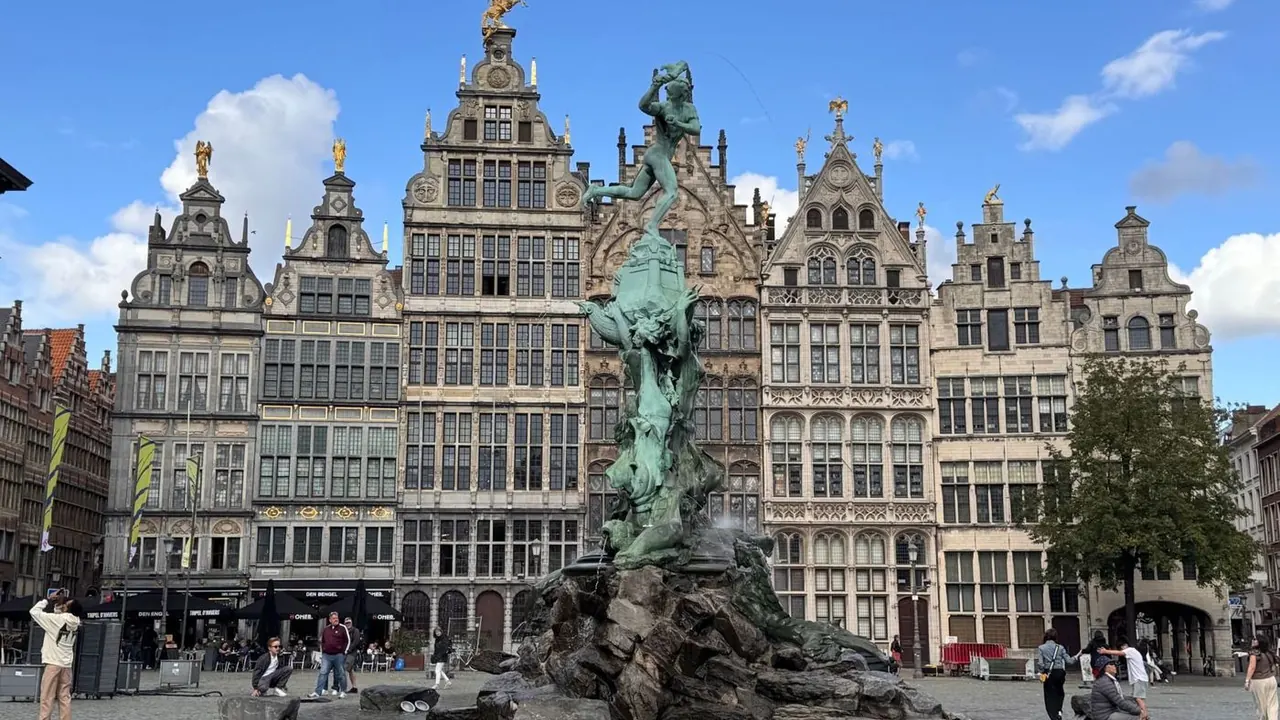
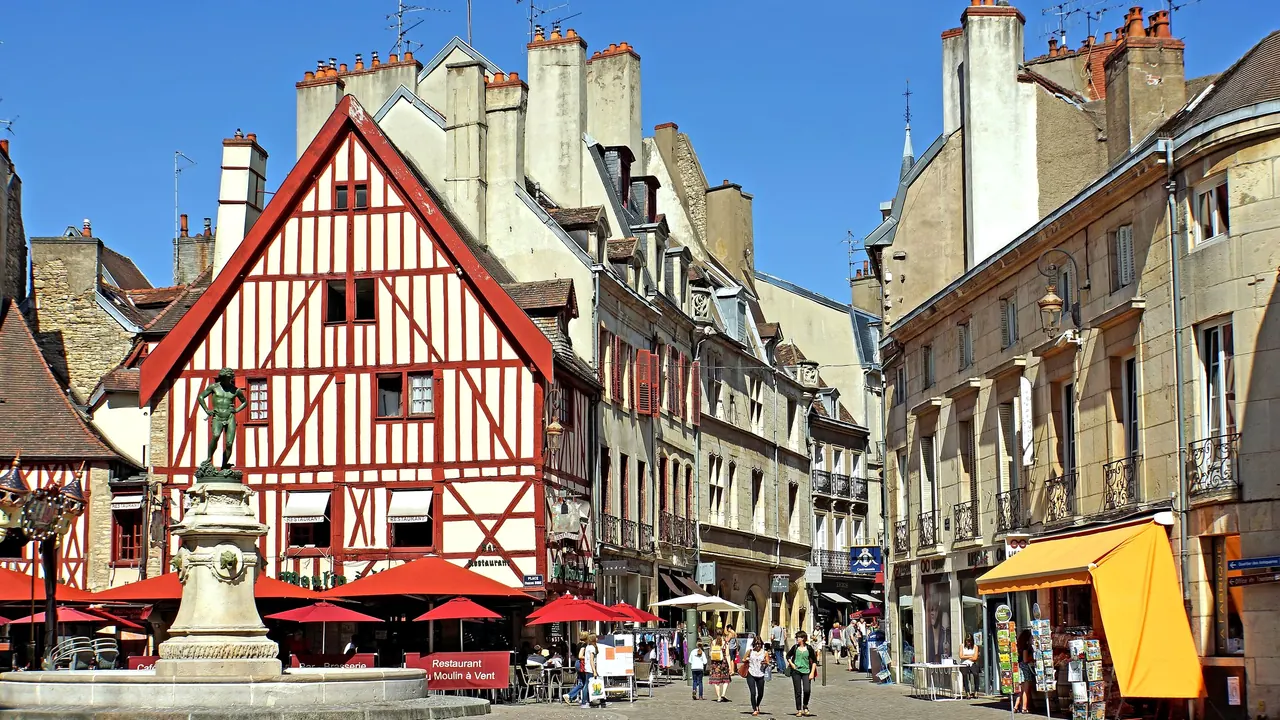
Photos: Antwerp by Norbert Jakab, Pexels License; Dijon by Dennis G. Jarvis, CC BY-SA 2.0, cropped.
Antwerp or Dijon?
Our verdict in twelve categories, each scored against the same fixed benchmark cities, and the climate month by month, so you can choose for your trip.
Choose Antwerp for
- shopping
- nightlife
- families
Antwerp is the better pick for a city vacation with more going on in the galleries, the shops and after dark. It has Rubens altarpieces and the Plantin-Moretus printing house, designer boutiques shaped by its fashion academy, and clubs in old dock warehouses. Its trains put Ghent, Bruges and Rotterdam within a day's reach. It is also the easier of the two with children, with the zoo right beside Central Station.
Choose Dijon for
- nature and the outdoors
- prices
- food and drink
Choose Dijon if the trip is built around the table and the countryside. The Burgundy wine villages begin at the edge of town, Les Halles feeds the city on market days, and the combes and canal towpaths give walkers and cyclists more room than the flat land around Antwerp. It is also the cheaper of the two and the slower in pace, though its evenings end earlier.
Scoreboard
Twelve categories on one fixed scale from 0 to 100. The shaded stretch is the gap between the two.
Your match
Pick a travel style or drag the sliders, and both match scores follow your weighting.
Wins on shopping and nightlife with your weighting.
Wins on nature and the outdoors and prices with your weighting.
What matters to you?
Category by category
What the scores mean for a trip.
Beaches & swimming
Neither city works for a beach vacation, but they fall short in different ways. Antwerp has the sand of Sint-Annastrand on the tidal Scheldt, which is not for swimming, and the cold North Sea at Knokke or Blankenberge is less than two hours away by train.
Dijon is several hours from any coast. It does have Lac Kir on its western edge, with a supervised bathing area in summer. That makes an actual outdoor swim simpler than in Antwerp, where it means a pool or a recreation lake on the outskirts.
Food & drink
Dijon has the edge for anyone who travels to eat. Classic Burgundian dishes, Époisses and Bresse poultry at Les Halles, and village wines served by the glass because the vineyards start at the city's edge make it a destination in its own right. The range stays narrowly French and regional, though.
Antwerp's food is heartier and built around beer: stoofvlees, mussels with frites, a bolleke of amber ale and long Trappist lists in the brown cafés. Its modern kitchens in Het Zuid and Het Eilandje add variety, but the tourist menus around the Grote Markt are best avoided.
Culture & sights
Antwerp has more to see. There are Rubens altarpieces in the cathedral, his house and studio, the UNESCO-listed Plantin-Moretus printing house and a major fine-arts collection. Central Station, the Art Nouveau streets of Zurenborg and the museums of fashion and emigration add to them.
Dijon's sights cluster around the Palace of the Dukes of Burgundy. The highlights are the carved ducal tombs, the gargoyles and lucky owl of Notre-Dame, and Sluter's Well of Moses at Champmol. It is a handsome medieval and Renaissance townscape, but narrower in scope.
Nightlife
Antwerp is the place to stay out late. Its bars have no fixed closing time, house and techno play in warehouses near the docks, and it has one of the best-known gay scenes in the Low Countries, so weekends run long into the night.
In Dijon a night out means wine bars, beer on Rue Berbisey and a late dinner, with only a handful of clubs. Outside term time the streets are quiet by midnight.
Nature & outdoors
Dijon is better for getting outdoors. The wooded combes just west of town have trails, climbing cliffs and views over the roofs. The Burgundy Canal towpath and the vineyard route to Beaune make for easy cycling, and the granite hills and lakes of the Morvan are within reach.
Antwerp's surroundings are flat and dominated by the port. The Kalmthoutse Heide heathland and rides along the dykes in the Scheldt polders are pleasant, but they make a break from the city rather than a reason to come.
Day trips
Both cities make strong bases, but Antwerp's railway reaches more places. Ghent, Brussels, Leuven and Mechelen are each under an hour away, and Bruges takes a little longer. Across the border you can reach Rotterdam, Delft and the Kinderdijk windmills, all without a car.
Dijon's day trips are about wine and abbeys: the Route des Grands Crus to Beaune, Fontenay Abbey, Semur-en-Auxois and Vézelay. Beaune and Besançon are easy by train, but most of the wine villages need a car, a bike or a tour.
Good for families
Antwerp works better with children. The zoo beside Central Station, the trams, the MAS rooftop, the Steen and the walk through the tunnel under the Scheldt fill the days easily, and cafés welcome children. You will want indoor plans for grey weather.
Dijon is small, safe and largely pedestrianised. It has a planetarium at the Jardin de l'Arquebuse and summer paddling at Lac Kir, but its tastings and fine-art museums are aimed at adults.
Getting around
You can manage both without a car. The difference is size. Antwerp's sights lie within a half-hour walk, trams and the premetro reach Het Eilandje and Zurenborg, and cycle lanes cover much of the rest. Central Station has fast trains to Brussels and the Netherlands.
Dijon's centre is smaller still, a few minutes on foot from the station to the palace. Two tram lines serve the edges of town and the TGV runs to Paris. The catch is the wine country, where villages away from the railway need a car, a bike or a tour.
Shopping & style
Antwerp is a real shopping city. It has avant-garde Belgian fashion in the Nationalestraat and Het Zuid, chain stores on the Meir, the diamond quarter, and antiques and interiors shops on the Kloosterstraat. Dijon has nothing on that scale.
Dijon's best buys are things to eat and drink: mustard, pain d'épices, cassis, cheese from Les Halles and Burgundy from the cellars. Fashion is limited to a department store and some chains along Rue de la Liberté.
Affordability
Dijon costs less. Hotel rooms are moderately priced, bistro set lunches are a cheap way to eat well and wine by the glass is inexpensive. Cellar tastings and good bottles can quickly eat into those savings, though.
Antwerp follows Belgian prices, which make sit-down dinners in particular more expensive. Frites, a beer in a café, lunch menus and a centre you can walk all help, but the city suits a mid-range budget.
Live music & performing arts
Antwerp has more on stage. Opera Ballet Vlaanderen performs at the opera house on the Frankrijklei, the Antwerp Symphony Orchestra plays in the Queen Elisabeth Hall, deSingel puts on contemporary dance and AMUZ is devoted to early music. Much of the theatre is in Dutch, though.
The Opéra de Dijon divides its season between the Grand Théâtre and the Auditorium, known for its acoustics. The city also has a national drama centre and a venue for touring bands. Its season follows the academic year and thins out in summer.
Wellness & relaxation
For a proper sauna day, Antwerp is the place. Flanders has a solid sauna culture, and large complexes with pools, steam rooms and gardens lie in the suburbs and the countryside, though you mostly need a car to reach them. In town there are hotel and day spas, and a quiet afternoon in Rivierenhof or a brown café does the rest.
Dijon's spa offer is thin: a few hotels in town and in the wine villages, some with grape-based treatments. Its strength is pace rather than facilities. Long lunches, quiet squares and slow afternoons among the vines make the stay itself restful.
When should you go?
Pick your month. The climate figures are measured averages, not a forecast.
Antwerp in July
Dijon in July
Daytime high, °C
Rainfall in the month, mm
Where the figures come from
Antwerp has no rain gauge within 25 km of the centre, so its rainfall comes from a gridded climate dataset read at the city rather than from a gauge further away.
Antwerp's sunshine is measured 47 km from the centre, at Uccle.
Temperature and rainfall are climate normals, averaged over the years shown. Antwerp: 1991-2020 normals, Antwerpen / Deurne (5.2 km from centre). Dijon: 1991-2020 normals, Dijon (7 km from centre).
Neither city is a beach destination, so the question is when the streets and the countryside are pleasant. Dijon warms up sooner and further. It is noticeably milder from March, reaches about 27°C in July against Antwerp's 23°C, and gets clearly more sunshine through spring and summer. That suits cycling the wine route and an afternoon swim at Lac Kir. Antwerp's summer is gentler and comfortable for long walks, though July and August are among its wetter months.
The rain falls at different times. Dijon's wettest spells come in May and again in October and November, while Antwerp gets steadily wetter towards winter and peaks at about 83mm in December, which is also its darkest month. Both are cold and grey in midwinter. For either city the best window runs from late May to September, and September is a good month for walking in both.
Which traveller are you?
For a shopping trip, Antwerp is the clear choice. Fashion is its specialism, led by independent Belgian designers rather than global brands. Dijon's shopping is mostly things to eat and drink, which make good gifts but not a whole trip.
On a family trip with children, choose Antwerp. Its zoo and riverside sights lie close to the centre and need no planning, and children are welcome in cafés. Dijon is calm and safe, but its days are built for adults.
For an outdoors trip, Dijon is the better base. Walkers, climbers and cyclists reach wooded country a short ride from the centre, gentle rather than dramatic. Antwerp's flat, built-up surroundings offer pleasant bike rides but little more to plan a trip around.
Before you go
| Measure | Antwerp | Dijon |
|---|---|---|
| Official language | French, German, Dutch | French |
| Currency | Euro (EUR) | Euro (EUR) |
| Sockets | CE230 V, 50 Hz | CE230 V, 50 Hz |
| Driving side | Right | Right |
| Time zone | UTC+1, UTC+2 in summer | UTC+1, UTC+2 in summer |
| Emergency number | 112 | 112 |
| Elevation | 7 m | 220 m |
| Main airport | Brussels Airport (BRU)36 km from centre191 non-stop destinations | Lyon Saint-Exupéry Airport (LYS)178 km from centre141 non-stop destinations |
| Public holidays this year | 14 days | 11 days |
By the numbers
| Measure | Antwerp | Dijon |
|---|---|---|
| City population | 529,247 | 161,830 |
| People per km² | 2,542 | 3,890 |
| Museums within 10 km | 38 | 8 |
| UNESCO World Heritage sites within 50 km | 9 | 1 |
Where else could you go?
Every comparison below shares a destination with this one, so you can follow Antwerp or Dijon somewhere new.