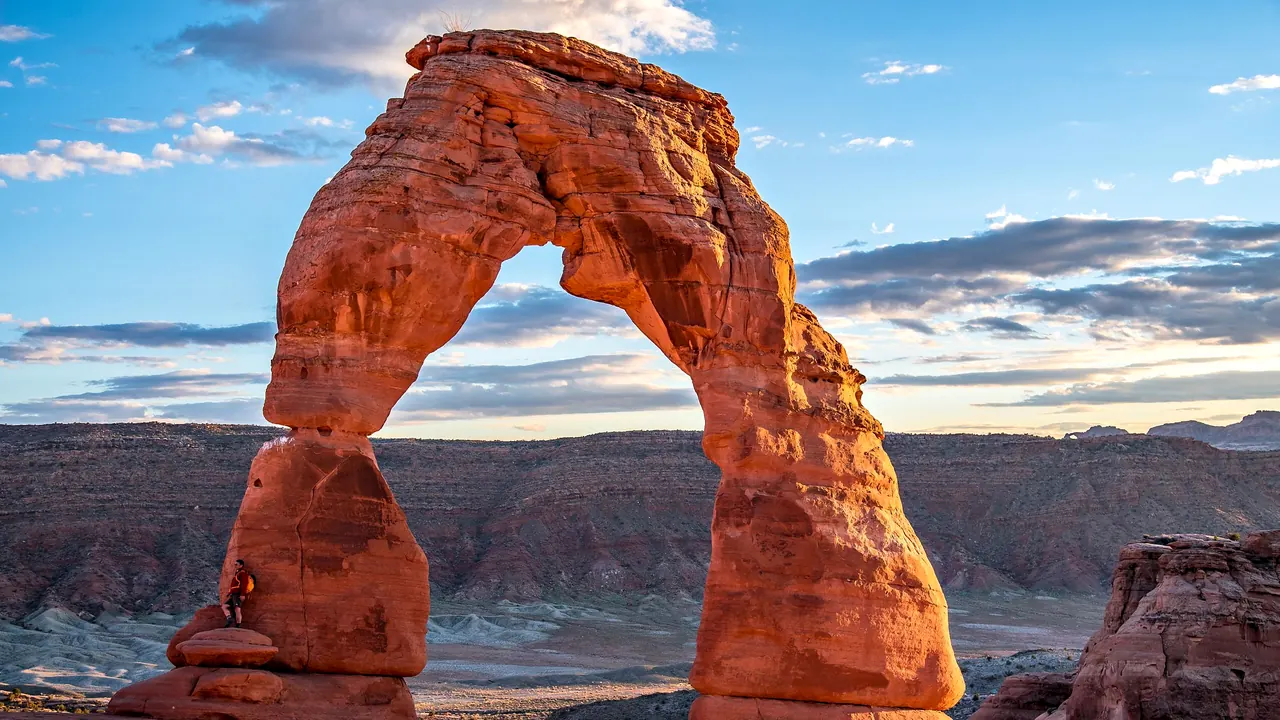
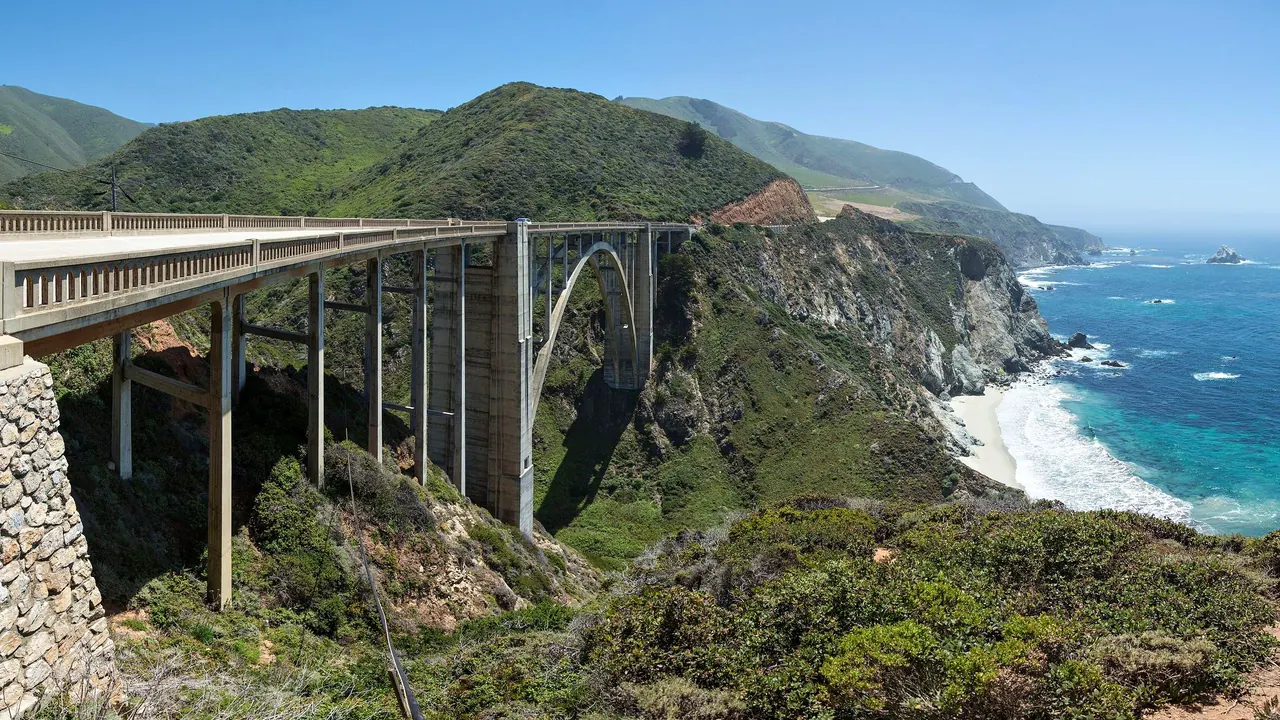
Photos: Arches by Jan Tang, Pexels License; Big Sur by Diliff, CC BY-SA 3.0, cropped.
Arches or Big Sur?
Our verdict in twelve categories, each scored against the same fixed benchmark cities, and the climate month by month, so you can choose for your trip.
Choose Arches for
- prices
- getting around
- shopping
Arches suits the active traveller who wants the desert at full strength: sunrise hikes to stone arches, slickrock biking, rafting on the Colorado and Canyonlands within easy reach. Moab makes a compact, practical base five minutes from the park gate. It is also the easier trip to run, with simple driving and campgrounds that keep costs in check, although there is little to do beyond the landscape.
Choose Big Sur for
- wellness
- day trips
- beaches
For a slower and more indulgent trip, Big Sur is the better pick. Its cliff-top lodges, ocean-facing spas and the hot-spring baths at Esalen make it a place to unwind rather than push yourself. Carmel, Monterey and Hearst Castle give you proper outings at either end. The cost is high, the single coast road is slow and easily cut, and the sea is for looking at, not for swimming.
Scoreboard
Twelve categories on one fixed scale from 0 to 100. The shaded stretch is the gap between the two.
Your match
Pick a travel style or drag the sliders, and both match scores follow your weighting.
Too close to call, 2 points apart
Wins on prices and getting around with your weighting.
Wins on wellness and day trips with your weighting.
What matters to you?
Category by category
What the scores mean for a trip.
Beaches & swimming
Neither is a place to swim, but Big Sur at least has beaches worth visiting: Pfeiffer Beach with its rock arch and purple-streaked sand, the coves at Garrapata and the sandy stretch by Plaskett Creek. The water is cold and the surf heavy, so these are places to walk and sit in a jacket.
Arches has no shoreline at all. The Colorado is cold and fast and people go on it by raft, so on a hot afternoon the realistic swim is a motel pool. Big Sur's visitors who want to swim end up in a lodge pool too.
Food & drink
In both places you get a small, practical choice rather than a food scene, but the settings differ. Moab puts brewpubs, taco and burger places, green-chile Southwestern cooking and breakfast diners along one street you can walk, although Utah's liquor rules make a glass of wine with dinner less simple. Big Sur's places are spread out along the highway: a respected bakery and a couple of cliff-top dinner rooms cooking with Central Coast produce and wine. They are costlier and far apart, so keen eaters head to Carmel or Monterey.
Culture & sights
Neither has much built heritage, and what each offers comes from a very different era. Around Arches the history is ancient: petroglyph panels at Courthouse Wash, beside Wolfe Ranch and along Potash Road, plus dinosaur trackways and Moab's small museum of local history.
Big Sur's story belongs to the 20th century. There is the 1932 Bixby Bridge, the Point Sur Lightstation, which you can see on guided walks, and the Henry Miller Memorial Library, which recalls the writers and Beat-era artists the coast drew. In both places these fill the gaps between walks rather than whole days.
Nightlife
Evenings end early in both, but Moab at least has a small town where climbers and mountain bikers meet in a few brewpubs within walking distance of each other. Big Sur has only lodge bars and a roadside tavern, and the dark, winding highway keeps people where they are after dinner. In both, the real event of the night is a sky full of stars.
Nature & outdoors
Both are among America's great landscapes, and Arches has the edge for the sheer range of what you can do there. Beyond the park's arches, fins and balanced rocks, Island in the Sky and Dead Horse Point are close by and the La Sal Mountains add alpine trails. You can ride slickrock, raft the Colorado, go canyoneering or climb at Fisher Towers.
Big Sur's scenery is of another kind: mountains dropping straight into the Pacific, redwood canyons, waterfalls and the roadless Ventana Wilderness. For wildlife there are condors, sea otters, passing grey whales and the elephant seals at Piedras Blancas. It suits walkers and wildlife watchers more than people who come for adventure sports.
Day trips
Big Sur is far better placed for outings. At the northern end are Carmel's cottages and mission, Monterey's Cannery Row, old adobe quarter and aquarium, and the Carmel Valley wineries. Hearst Castle and Cambria lie to the south, though the winding road means most people pick one end.
From Moab, almost everything within reach is more wilderness. Green River's museum of river exploration is about an hour away and Bluff's rock art and Ancestral Puebloan ruins take nearly two. Mesa Verde and Monument Valley really need an overnight stay.
Good for families
Both suit families who hike and camp rather than those who need attractions, and both have unfenced drops at viewpoints. Arches gives children a little more to do. In the park there are the sandy slot to Sand Dune Arch and the Junior Ranger booklet. Close by are dinosaur tracks in the canyons near Moab and gentle float trips on the Colorado. The summer heat, though, is punishing.
Big Sur's draws are paddling in the creek at the redwood campgrounds and watching elephant seals and sea otters. On the other hand, the twisting road brings car sickness and the sea is unsafe for play. In its favour, the Monterey aquarium is close enough for a day out.
Getting around
You need a car for both, but Arches is much simpler. Moab is five minutes from the park gate, the scenic road through the park is only about 30km long and Canyonlands is under an hour away. The main nuisance is trailhead car parks filling by mid-morning, and a paved bike path links the town and the park.
Big Sur depends entirely on Highway 1, a slow two-lane road of hairpins and photo stops, with few petrol stations and patchy phone signal. After wet winters, landslides can close sections and force detours of several hours inland, and there is nowhere you can walk between places.
Shopping & style
Moab's Main Street is a modest place to shop, but it still gives you more than Big Sur. Bike shops and outfitters sell serious gear, rock and fossil shops sell geodes, and galleries sell Southwestern photography and Native American jewellery and pottery.
Big Sur has only a scattering of roadside gift shops, a couple of galleries and some general stores, so visitors who want to browse drive up to Carmel.
Affordability
Arches is the cheaper trip by some way, though not a cheap one. Moab's motels and condos charge gateway-town prices in spring and autumn, and you need a car. Free hiking, a modest park fee and campgrounds on public land keep the basic costs down, and guided tours are the big extra.
Big Sur is one of the most expensive places to stay in the country. The lodges charge luxury rates, even plain cabins cost as much as a good city hotel, and food and petrol cost more because everything is trucked in along one road. Campgrounds help if you book months ahead, and otherwise people sleep in Monterey or San Simeon and drive in.
Live music & performing arts
At Arches the one real event is the Moab Music Festival at the end of summer, which puts on chamber concerts in unusual places, among them a sandstone grotto reached by boat.
Big Sur has the Henry Miller Memorial Library instead, with outdoor concerts, readings and film screenings in the warmer months. Monterey's jazz festival and Carmel's Bach festival are an hour or more up the road. Apart from these, neither place has a regular stage.
Wellness & relaxation
This is where Big Sur pulls well ahead. Esalen's stone baths, fed by hot springs on a ledge above the surf, are open through its workshops and stays. The cliff-top resorts add ocean-facing spas, yoga and soaking tubs, so the whole coast is set up for slow stays, though they cost a lot and need booking well ahead.
Around Arches there are no hot springs, only a few massage studios and the odd resort by the river, and the days start early and run hot. The rest it offers costs nothing: an evening on a quiet campsite as the light fades on the red cliffs and the stars come out.
When should you go?
Pick your month. The climate figures are measured averages, not a forecast.
Arches in July
Big Sur in July
Daytime high, °C
Rainfall in the month, mm
Where the figures come from
Arches has no rain gauge within 25 km of the centre, so its rainfall comes from a gridded climate dataset read at the destination rather than from a gauge further away.
Big Sur's temperatures are measured 42 km from the centre, at Monterey / Pacific Grove Acres.
Big Sur has no rain gauge within 25 km of the centre, so its rainfall comes from a gridded climate dataset read at the destination rather than from a gauge further away.
Temperature and rainfall are climate normals, averaged over the years shown. Arches: 2006-2020 (rainfall 1991-2020) normals, Moab / Crescent Junction (19.4 km from centre). Big Sur: 1991-2020 normals, Monterey / Pacific Grove Acres (41.9 km from centre).
Arches is at its best in spring and autumn. April, May, September and October bring comfortable walking weather. July reaches about 35°C, which pushes any hike into the early morning, and in midwinter daytime highs sit near freezing, so it is quiet and sometimes snowy. Rain is light in every month, so the weather question here is temperature rather than wet days.
Big Sur is mild all year, with highs of around 20°C, but its rain comes mainly in winter and peaks at about 205mm in December, when storms can also close the road. From May to September it is almost dry, and autumn gives the clearest days on the coast. The sea never rises above about 15°C, so swimming is not realistic in any month.
Which traveller are you?
On an outdoors trip, choose Arches if you want a different activity each day, all within a short drive of one base. Big Sur suits walkers who are happy to give a whole day to one trail and to the coast's wildlife.
For a relaxing and wellness trip, Big Sur is the clear choice. The whole coast is made for slowing down, and you can plan a few days there as a proper retreat. Arches gives you rest only in quiet evenings after demanding days.
On a tight budget, go to Arches. Most of what you come for costs little, and only guided outings push the bill up. Big Sur strains a small budget at every turn unless you camp and plan well ahead.
Before you go
| Measure | Arches | Big Sur |
|---|---|---|
| Currency | US Dollar (USD) | US Dollar (USD) |
| Sockets | AB120 V, 60 Hz | AB120 V, 60 Hz |
| Driving side | Right | Right |
| Time zone | UTC-7, UTC-6 in summer | UTC-8, UTC-7 in summer |
| Emergency number | 911 | 911 |
| Main airport | Canyonlands Regional Airport (CNY)2 non-stop destinations | Monterey Regional Airport (MRY)11 non-stop destinations |
| Public holidays this year | 12 days | 13 days |
By the numbers
| Measure | Arches | Big Sur |
|---|---|---|
| Swim season, months above 21 °C | - | None |
Where else could you go?
Every comparison below shares a destination with this one, so you can follow Arches or Big Sur somewhere new.
- Canyonlandsvs Arches
- Carmel-by-the-Seavs Big Sur
- Montereyvs Big Sur
- Napa Valleyvs Big Sur
- Bryce Canyonvs Arches
- Yosemitevs Big Sur