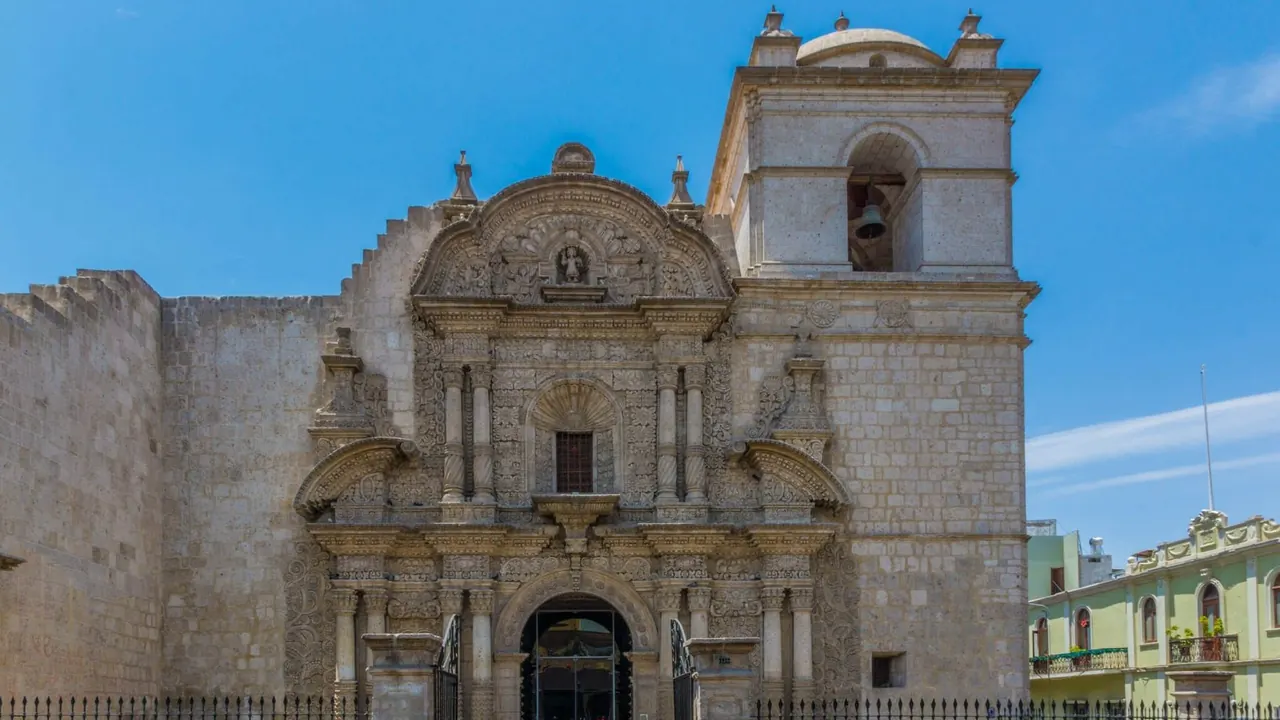
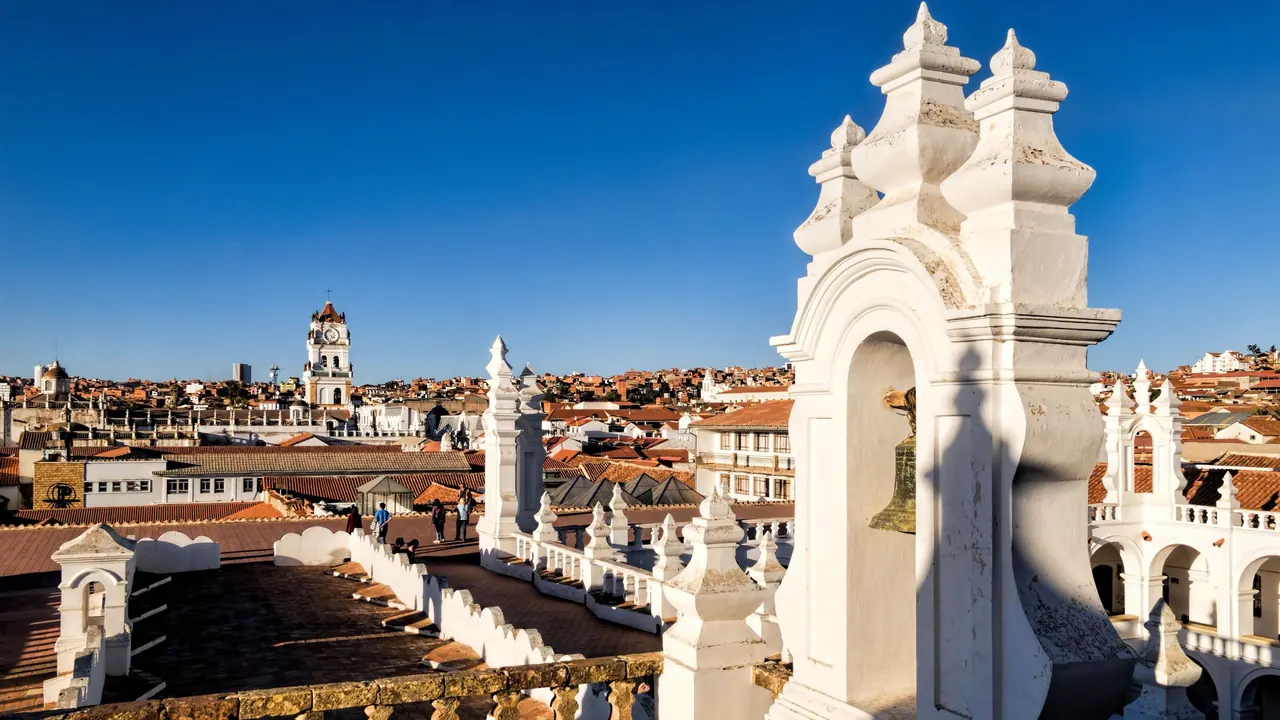
Photos: Arequipa by DocSlyper, CC BY-SA 2.0, cropped; Sucre by Dan Lundberg, CC BY-SA 2.0, cropped.
Arequipa or Sucre?
Our verdict in twelve categories, each scored against the same fixed benchmark cities, and the climate month by month, so you can choose for your trip.
Choose Arequipa for
- food and drink
- nature and the outdoors
- shopping
Arequipa is the stronger pick for travellers who want big landscapes and serious eating. Colca Canyon, the condors and three volcanoes put real adventure within reach of the city, and the picanterias give it one of the best regional kitchens in Peru. It also has the better alpaca shopping and a livelier weekend night out, so it rewards a trip with energy.
Choose Sucre for
- getting around
- prices
- families
Sucre suits a slower, cheaper stay. Its whitewashed centre is easy to walk, the living costs are among the lowest on the continent, and the mild days and shaded courtyards make it a natural place to stop for a week or two, take language lessons or recover from the altiplano. Its excursions, from Tarabuco's Sunday market to treks in the Cordillera de los Frailes, are gentler and more about villages and weaving than summits.
Scoreboard
Twelve categories on one fixed scale from 0 to 100. The shaded stretch is the gap between the two.
Your match
Pick a travel style or drag the sliders, and both match scores follow your weighting.
Wins on food and drink and nature and the outdoors with your weighting.
Wins on getting around and prices with your weighting.
What matters to you?
Category by category
What the scores mean for a trip.
Beaches & swimming
Neither city is a place for the sea. Sucre lies deep in landlocked Bolivia with nothing but pools, while Arequipa at least has a Pacific coast about two hours away at Mollendo and Mejia.
Those beaches are wide and sandy but the Humboldt Current keeps the water cold and the surf rough, so for either city a swim means the hotel pool.
Food & drink
Arequipa eats far better. Its picanterias, some with wood-fired clay stoves, serve rocoto relleno, river-shrimp chowder and Sunday adobo with chicha de guinapo, and the San Camilo market shows off the Andean produce behind it. Modern Peruvian restaurants around the plaza add another layer.
Sucre's food is honest and cheerful but narrower: morning salteñas, spicy local chorizos and set lunches upstairs in the Mercado Central. Its real speciality is chocolate from the old makers on the main square, and beyond that the choice thins out quickly.
Culture & sights
Both are UNESCO-listed colonial centres worth two or three days, and they are evenly matched. The difference is in stone and story. Arequipa is built of pale volcanic sillar carved in an Andean mestizo baroque, and its showpieces are the walled town of Santa Catalina and the frozen Inca girl Juanita.
Sucre is whitewashed and quieter, and its weight is political and indigenous: the Casa de la Libertad where Bolivia declared independence, the Jalq'a and Tarabuco weaving in the Museo de Arte Indígena, and a quarry wall of dinosaur footprints just outside town.
Nightlife
Neither is a party city, but Arequipa has a little more going on. Calle San Francisco gathers pisco bars, craft beer pubs and a few clubs, and weekend nights can run late to salsa and reggaeton.
Sucre's night out is smaller and student-driven, a handful of traveller bars and a couple of clubs near the square on Fridays and Saturdays, and many visitors settle for a singani after dinner.
Nature & outdoors
Arequipa has the more dramatic outdoors. Snow-capped El Misti and Chachani can be climbed with a guide, and Colca Canyon, reached across vicuña country on the high puna, offers condors at Cruz del Condor and multi-day descents to the canyon floor.
Sucre's countryside is quieter and more human in scale. The Cordillera de los Frailes has old stone paths to the striped Maragua crater and Jalq'a villages, with nights in community lodges, while Siete Cascadas makes an easy half day. It is rewarding walking rather than high mountain adventure.
Day trips
The two are level here, and in both cases the best excursions are really overnight trips. Arequipa's short outings are rural: the Sabandia mill, country restaurants in Characato and the thermal pools at Yura, with Colca better done with a night away.
Sucre has one classic day out that Arequipa lacks, the Sunday market at Tarabuco with its Yampara textiles, plus the odd Castillo de La Glorieta. Potosí, like Puno from Arequipa, is better as the next stop.
Good for families
Both are calm, welcoming places with little built for children. Sucre has the edge for younger ones thanks to the Parque Cretácico, where life-size dinosaurs stand beside a cliff of real footprints, though its higher altitude can tire small children at first.
Arequipa sits lower and is easier on the body in town, and older children enjoy Santa Catalina's coloured lanes and the frozen mummy, but its big excursions mean pre-dawn starts and roads above 4,800m.
Getting around
Sucre is the easier city to get around. Nearly everything lies on a tidy grid a few blocks from the Plaza 25 de Mayo, taxis are plentiful, and a tourist bus runs out to the dinosaur park, though the climb to the Recoleta is steep.
Arequipa's centre is also compact and mostly flat, but traffic is heavy and pavements narrow near the plaza, and the buses and colectivos are hard to read, so taxis or ride-hailing apps do the work beyond Yanahuara.
Shopping & style
Arequipa is the better place to shop, because it is the home of Peru's alpaca industry. Mill outlets sell baby alpaca and vicuña knitwear of reliable quality, and Fundo El Fierro gathers artisans under one colonial roof.
Sucre's buys are woven rather than knitted: the dark, imaginative Jalq'a textiles and bright Tarabuco geometrics in fair-trade shops, plus a box of local chocolate. Neither has fashion or luxury streets.
Affordability
Both are cheap, but Sucre goes further. Market lunches, taxis and colonial guesthouses cost very little, and even its boutique hotels are modest, which makes a long stay easy.
Arequipa is still good value for comfort, but Colca tours and guided volcano climbs are real expenses, and the restaurants around the plaza charge more than the rest of town.
Live music & performing arts
Neither city has much of a stage, and the offer is similar in kind: folk bands and dancers in weekend peñas, with occasional symphony concerts. Arequipa's Teatro Municipal and university centres carry the formal programme, and its mid-August founding anniversary fills the streets.
Sucre's highlight is the elegant nineteenth-century Teatro Gran Mariscal, and its folkloric dinner shows cover dances from across Bolivia, devil masks included.
Wellness & relaxation
Arequipa has slightly more for a restful stay, mainly because of the volcanic springs at Yura and the open-air hot pools near Chivay after a day at Colca.
Sucre has no bathing tradition at all. What it offers is pace: mild weather, shaded courtyards and the Recoleta arcade at sunset, which make it a common place to rest after the harsher altiplano.
When should you go?
Pick your month. The climate figures are measured averages, not a forecast.
Arequipa in July
Sucre in July
Daytime high, °C
Rainfall in the month, mm
Where the figures come from
Arequipa's station stands 203 m above the city centre, so the centre is likely a little warmer than the figures say.
Temperature and rainfall are climate normals, averaged over the years shown. Arequipa: 1991-2020 normals, Arequipa (9.2 km from centre). Sucre: 1991-2020 normals, Sucre (5.4 km from centre).
Both cities have spring-like days all year, with daytime highs that barely move from about 20°C to 23°C, so heat is never a problem for walking the streets. The real difference is rain. Arequipa is close to desert dry from April to December, and even its wettest month, February, brings only about 36mm, so almost any time works and the clearest skies for Colca and the volcanoes fall from May to November.
Sucre has a proper rainy season. From December to March it is wet, with around 125mm in January, which turns the valleys green but makes rough country roads and treks harder. May to August is its dry spell, and the shoulders of April and September are still good. If you want both cities on one route, the southern winter months suit them equally well. Neither has a beach season worth planning around.
Which traveller are you?
For an outdoors trip, Arequipa is the clear choice. Colca Canyon with its condors and treks to oasis villages, guided climbs on El Misti or Chachani, and rafting in the Chili gorge give far more scope than Sucre's walking country.
On a trip on a tight budget, Sucre stretches money furthest. Market lunches, salteñas, taxis and colonial guesthouses cost very little, and the compact, walkable centre means few transport costs, which is why language students stay for weeks.
For a food and nightlife trip, Arequipa wins. Long lunches in noisy picanterias, Sunday adobo and the San Camilo market beat Sucre's modest scene, and the bars of Calle San Francisco keep a weekend evening going later.
Before you go
| Measure | Arequipa | Sucre |
|---|---|---|
| Official language | Spanish, Aymara, Quechua | Spanish, Aymara, Quechua, Guarani |
| Currency | Sol (PEN) | Boliviano (BOB) |
| Sockets | ABC220 V, 60 Hz | AC50 Hz |
| Driving side | Right | Right |
| Time zone | UTC-5 | UTC-4 |
| Emergency number | 111 or 911 | 911 |
| Elevation | 2,335 m | 2,810 m |
| Main airport | Rodríguez Ballón International Airport (AQP)7 km from centre2 non-stop destinations | Alcantarí International Airport (SRE)25 km from centre3 non-stop destinations |
| Public holidays this year | 17 days | 12 days |
By the numbers
| Measure | Arequipa | Sucre |
|---|---|---|
| City population | 1,008,290 | 360,544 |
| People per km² | 1,551 | 204 |
| Museums within 10 km | 3 | 4 |
| UNESCO World Heritage sites within 50 km | 1 | 1 |
Where else could you go?
Every comparison below shares a destination with this one, so you can follow Arequipa or Sucre somewhere new.